Blog posts

Welcome from the Graduate Students’ Union (GSU)

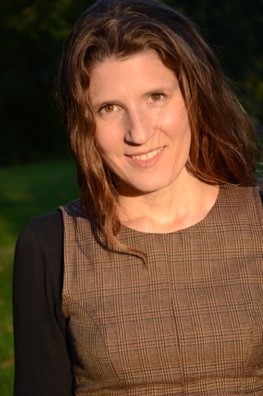
by Ute Thiermann, GSU President 2018/19

I am delighted to welcome you to Imperial College! Let me introduce you to the Graduate Students’ Union (GSU). We are the representative body defending your interests as a post-graduate student in major decisions taken by the College. Beyond that, we work towards building a thriving post-graduate community that spans faculties and where students effectively communicate in an interdisciplinary way. Our committee is comprised by motivated post-graduate students like yourself, who have been appointed in university-wide elections and volunteer to make your experience at Imperial as fulfilling and enjoyable as possible.

So, what are we up to for this coming year 2018/19? We are going to focus on three major areas of action:

  • Continue improving post-graduate well-being by increasing the quality of supervision and by creating strategies to tackle common mental health challenges in higher education.
  • Develop the GSU to become central to the post-graduate community by improving the two-way flow of information, between the GSU and you.
  • Organise exciting events around the topics of well-being, interdisciplinary research, and entrepreneurship.

As the GSU president, I would like to emphasise that Imperial College London is relying on its post-graduate students to maintain its position as a front-runner in world-class research and teaching. For us, the GSU, to be successful we need to receive as much of your input as possible. We want to work with you, for you!

Finally, I hope that you have a fantastic time here at Imperial and take advantage of the richness of opportunities that awaits you. If ever you have questions or ideas to share with us, please do not hesitate to get in touch with us and we are looking forward to seeing you at our events!

Ute Thiermann, GSU President 2018/19
gsu.president@imperial.ac.uk

CEP Ultimate Team Building Experience

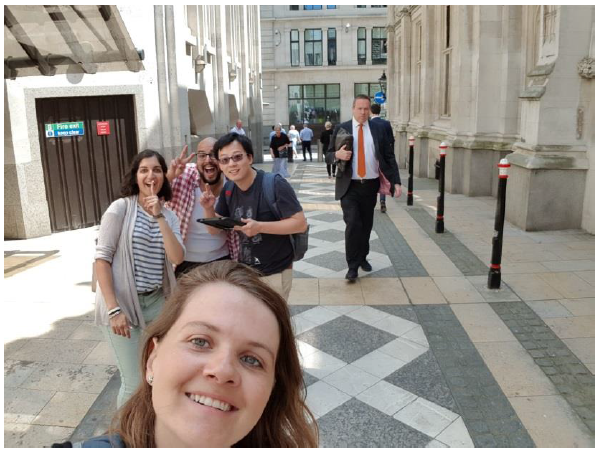
In search of an activity to build bonds and healthy competition between the PhD cohort at the CEP, we found the Ultimate Team Building Experience as the best option. It offered a novel way to explore the City of London helping our first year students to get a taste of what this city has to offer whilst getting to know their peers in an unconventional way. Following up the activity with a lunch discussion helped the students to get familiarized with other research topics and get a sense of the wide variety of topics our department holds. We would definitely recommend this activity to other departments and would love to turn this into an every-year activity.

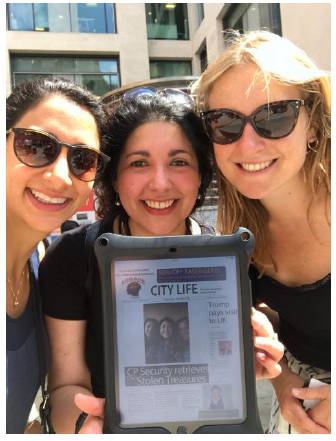
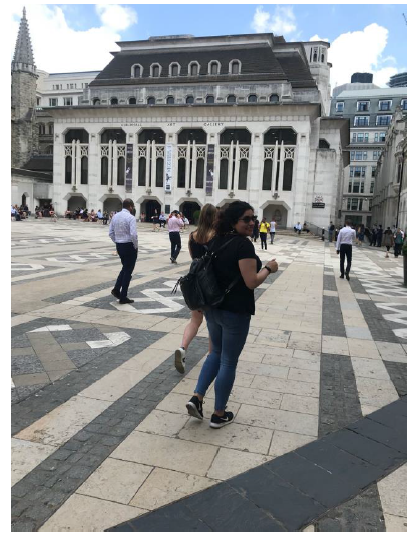
Our day started at 9:00am at the Escape Entertainment offices (ldn.escape-entertainment.com) where we were split into four teams of four people. This were chosen in a way that would promote teams with members of different research areas. We were given instructions on the outdoor game and a tablet with GPS and the riddles to solve, in increasing difficulty levels. We had the good fortune of having the perfect weather for the activity, and we managed to visit iconic places such as Saint Paul’s Cathedral, The Royal Exchange, and the Guildhall art gallery. Even, one of our groups got a taste of the international jet-set scene and spotted Angelina Jolie!… he couldn’t help himself and bragged about it for a week! The entire activity culminated with a lunch the day after where we had time to talk about how this activity had helped bringing a sense of community and to share the different research topics everyone is involved in.

Overall the activity was a big success. Everyone enjoyed it and said that got more out of it than they expected. As part of the discussion during lunch, some ideas on how to improve came up, such as:

  • Attendance rates could improve. Although at the end we had close to 20 participants,these were the ones that are normally very much involved in departmental activities. In future editions, a bigger effort could be done to promote the event in a way that appeals to those less interested.
  • The activity had to be split in two days mainly because of other research commitments. In the future, supervisors could be more flexible and even encourage their entire teams to take part.

Finally, we would like to thank the Graduate School for providing sponsorship for this event via the Research Community Fund.

Strengthening links among Brazilian academics at Imperial

by Lorena Fernanda dos Santos de Souza, PhD student in the Department of Chemical Engineering

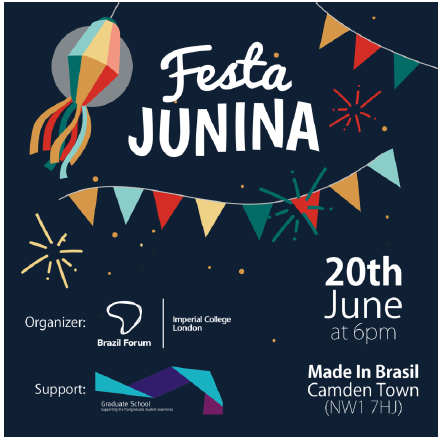
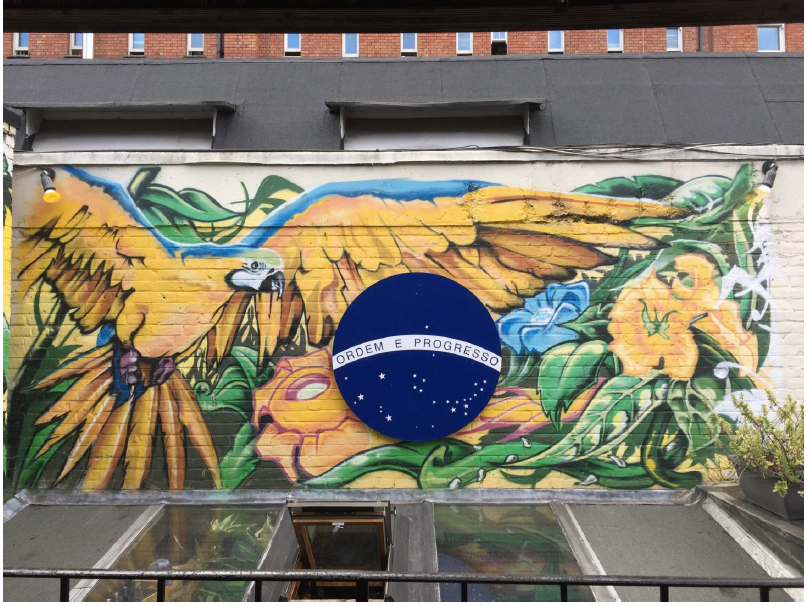
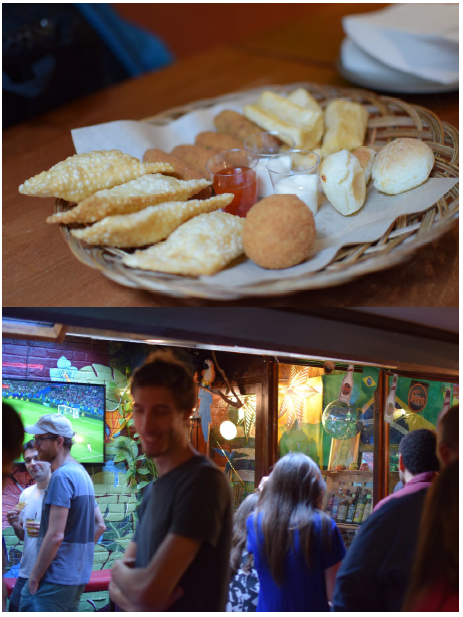
We are the Student Committee of the Imperial College Brazil Forum, and on June 20th (Wednesday) we organized a happy hour to promote the Brazilian culture and foster networking among Brazilian students and international members of the Forum. In a ‘Festa Junina’ themed event, we gathered 26 people in a cross-department get together in the authentic Brazilian restaurant ‘Made in Brasil’, in Camden Town. In Brazil, June is the month to commemorate St John’s day with a “Festa Junina”, the second most important popular celebration in the Brazilian culture.

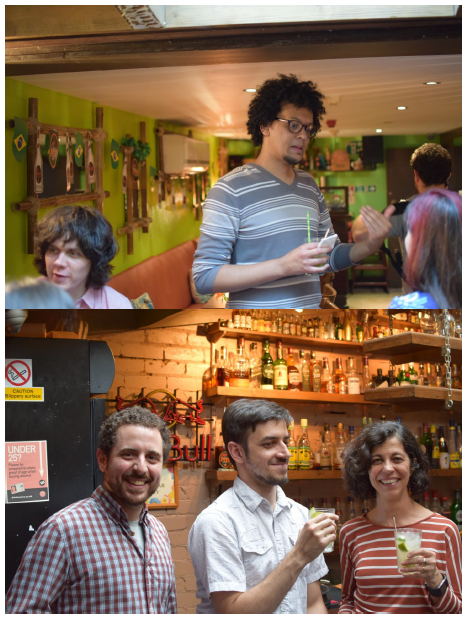
Apart from celebrating our culture, the main aim of this happy hour was to strengthen the links among Brazilian research students and research students involved or interested in Brazilian issues. Despite being based in the same departments, and sometimes even in the same floor, many Brazilian students/staff do not know each other. New opportunities for collaborations could come, but due to poor networking, it does not happen. This Graduate School-funded event gave new students and postdocs the chance to meet each other and interact with senior members of the Forum. The president of the IC Brazil Forum, Dr Vania Braga, took part in the happy hour, which was particularly important to present initiatives of the Forum to potential new members, and to share our experiences at Imperial.

The feedback we received from those who came along was extremely positive. The participants mainly appreciated the opportunity to meet and network in a friendly environment with Brazilians students/staff and researchers interested in Brazilian issues. They also suggested to have more get-togethers similar to this one, for example every 2/3 months. We believe the event provided the first step to create a more integrated community at Imperial and, hopefully, collaboration among different areas in order to develop interdisciplinary researches. And for that, we are extremely satisfied. We are grateful to the Graduate School for providing funding to the ‘Festa Junina’. If you are interested on any tips on how to organize an event to integrate students/staff, feel free to contact us (l.dos-santos-de-souza14@imperial.ac.uk).


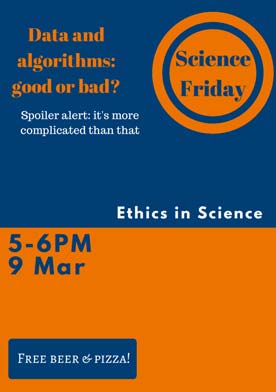
Data and Algorithms: Good or bad? Spoiler alert: It’s more complicated than that!

By Victor Pedrosa, PhD student representative

Few things are more effective in motivating PhD students and researchers to take a break from their ‘Nobel Prize-winning’ research than pizza, drinks and the promise of an interesting
talk.

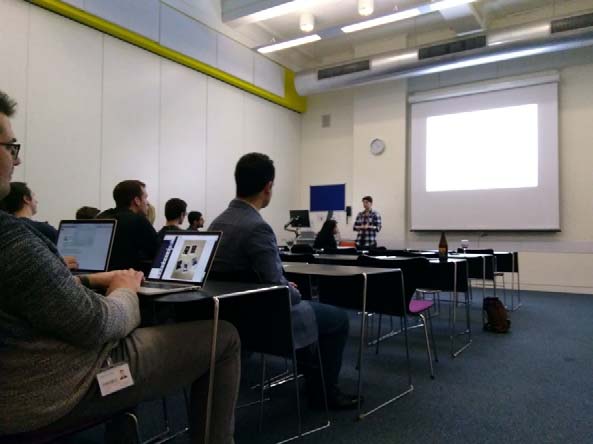
The Bioengineering PhD student representatives organised a talk on data ethics on Friday 9th of March. The topic was widely popular and the event was well-attended. There were some lively discussions over pizza and drinks in room 301.C at the Royal School of Mines Building.

Is data science intrinsically ethically good?

People mingled before the start of the talk, to get the food distraction out of the way, then Dr. Stefania Garasto started her talk titled “Data and algorithms: good or bad? Spoiler
alert: It is more complicated than that.”

She posed the question on whether data science is intrinsically ethically good and her presentation went on to show that algorithms are not ethically neutral because the values
and biases of their designers are reflected in the code. For example, Google shows high-paying job ads preferentially to men and ads with the word “arrest” are more likely to
appear when searching black-sounding names.

There are ethical concerns for current data practices. These practices beg such questions as: Do people have real control over their data? How can bias in the data be corrected? Who is responsible for the ethical failure of an algorithm? And these questions are hard to answer.

Stef presented the controversy over a Facebook case study wherein Facebook manipulated its users’ emotions without their knowledge by influencing their news feeds.
Many in the audience had not heard of this case and no one supported the ethics of this practice.

Stef went on to discuss how ethical data practices might be ensured. One is by law, for example, the GDPR principles. However, people pointed out that this could be restrictive
in data mining and that it might not cover everything, and it would at least be valid for everyone. Another option is to develop a sort of data code of conduct. Yet it was also
argued that this would be hard to enforce and this may vary from one organization to another.

Discussion continued with more pizza and drinks, and people shared with one another whether they were on social media or not and what their privacy settings were.

This event provided a good opportunity for the research students to get to know one another. There was good feedback from both students and other researcher guests about how the talk was a
good reminder to be vigilant about exercising control over our data.

We want to thank the Graduate School for funding this event and helping Bioengineering become a friendly research community.

CSM Summer Social, Research Community Fund

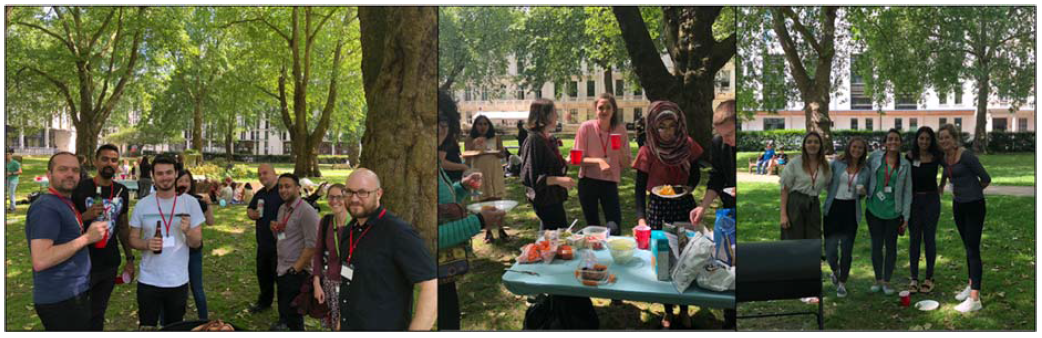
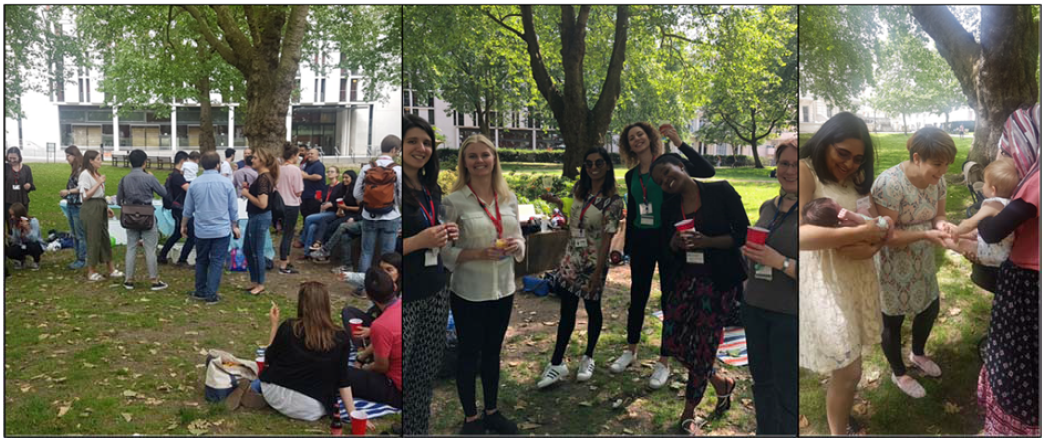
The CSM Summer Social BBQ that took place on the Friday 8th of June in Prince’s Garden was a real success. About 70 persons came along that afternoon, from 12.30 pm to late at night. The aim of this informal lunch was to give a chance for the PhD students to catch up with their peers, discuss some of their research projects with more expert persons, or even to find career advices.

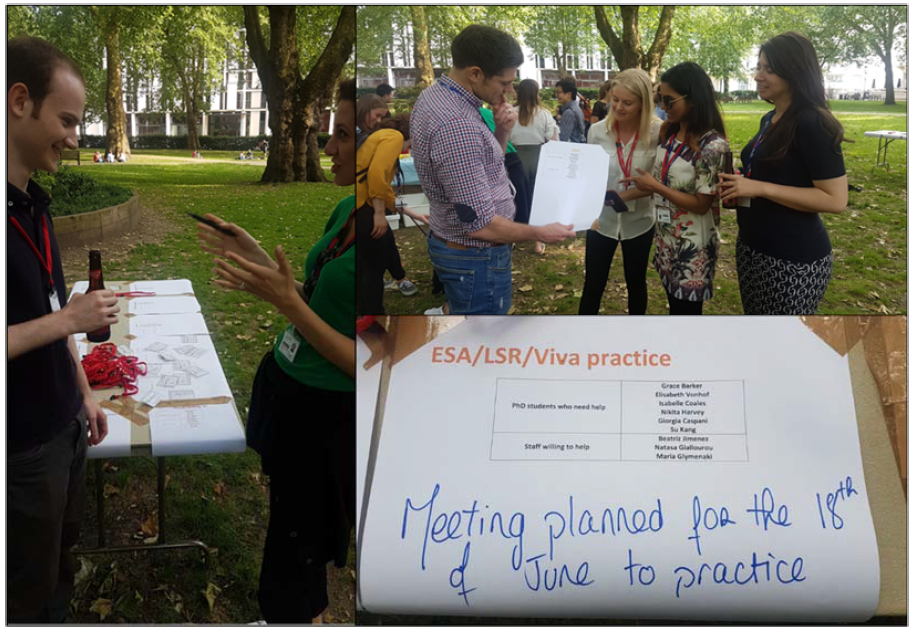
To facilitate the discussion, each PhD students had to chose three subjects that he felt like he needed help with. On the other hand, each staff had chosen three subjects in which they could give advices to PhD students. In the following pictures we can see some examples such as a last‐year PhD student (Peter Bradshaw) receiving advices from a post‐doc (Natasa Giallourou) about how to write efficiently a thesis, or also the Dr Jon Swann, reader in Microbiomics and Human Development, talking about NMR with a part of his team. Some boards were also made available, per subjects, so PhD students could find more easily the staff who could help them for the subjects they chose to talk about (1st year PhD students were happy to find some peers with whom they have been able to practice their Early Stage Review later in the month).

PhD students were particularly lucky to have experts in LCMS and NMR who came that day to share their knowledge. Our division is such a large group, gathering about 160 persons from different
campus. The LCMS MRC‐NIHR Phenome Centre (NPC) team came from Hammersmith Hospital to socialise with the PhD students, which are mostly based on South Kensington campus. Their CCO Matt Lewis was actively engaging himself, by taking care of the BBQ with Dr Antonis Myridakis to fed everyone.

The great weather made the day even more enjoyable, and it pushes more people to join us along the day. It was also a great opportunity for the NMR NPC team to come with their new borns and present to everyone the new generation of scientists!

Infectious Diseases and Immunity “The Bench and Beyond” Career Talks and Summer Party!

By Grace Birch and Kristin Krohn Huse, PhD students in Infectious Diseases and Immunity

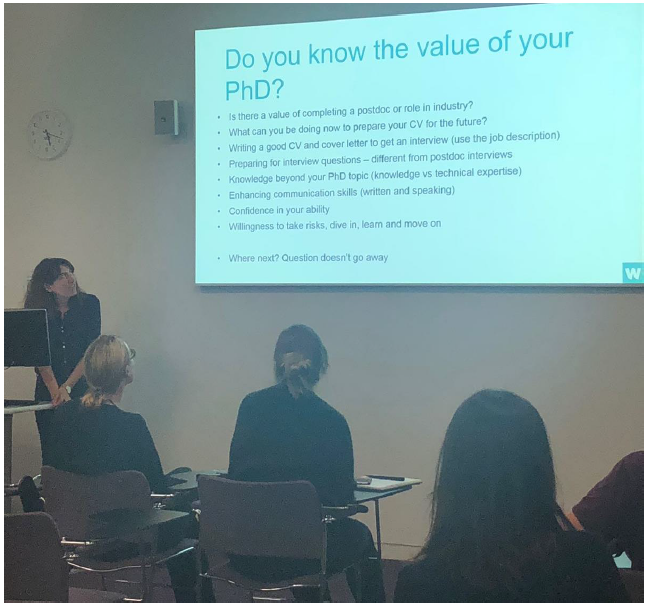
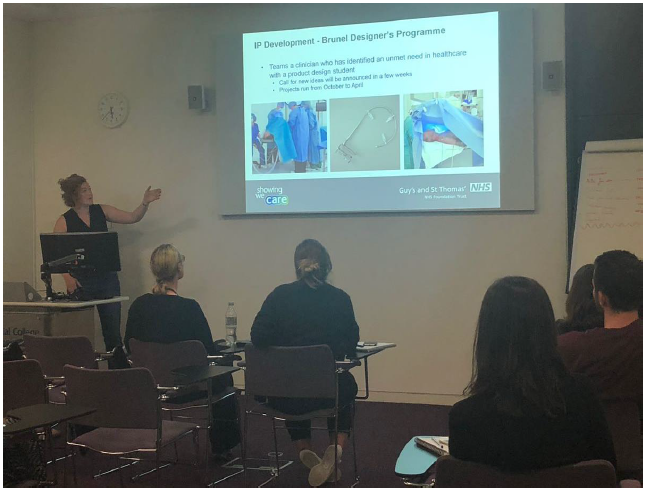
On Thursday June 28th, the postgraduate representatives for the Section of Infectious Diseases and Immunity hosted a series of talks on careers entitled “The Bench and Beyond” followed by a summer party for the entire section, to celebrate the arrival of summer and provide a more laidback opportunity to network between research groups.

After identifying a lack of speakers in careers outside of traditional bench science at other career sessions, speakers with connections to the section from a wide variety of careers were invited to attend. Some of the speakers had previously completed their PhDs or Post Docs in the section of Infectious Diseases and Immunity or currently work within the section. The talks were well attended, including not just students from our own section but also some from outside the department as we decided to advertise the talks to all Department of Medicine postgraduate students. Feedback from students was very positive, and one of the speakers even remarked that they had learned something!

Talks were kicked off by Dr Mick Jones, Reader in Molecular Medicine and the current section cohort leader for IDI, who highlighted how sometimes a research career doesn’t always go to plan but works out in the end. Following that, Dr Katherine Fox described her work as a Policy Officer at the Academy of Medical Sciences, and the challenges of consulting on science policies in the current post-Brexit environment. Dr Zoe Seager explained her role as the Vaccines Programme Officer at the Wellcome Trust and emphasised the importance of embracing and making opportunities for yourself. Dr Debra Smith then took us on the journey of how her career brought her to work as Senior IP and Commercial Research Manager at Guy’s and St Thomas’ NHS Trust. Finally, Dr Stephanie Ascough, who did her PhD in the section and has now returned by way of The Gambia and Pirbright, wrapped up the talks by stressing how it is essential to choose a job which allows you to maintain and pursue your own personal goals and values.

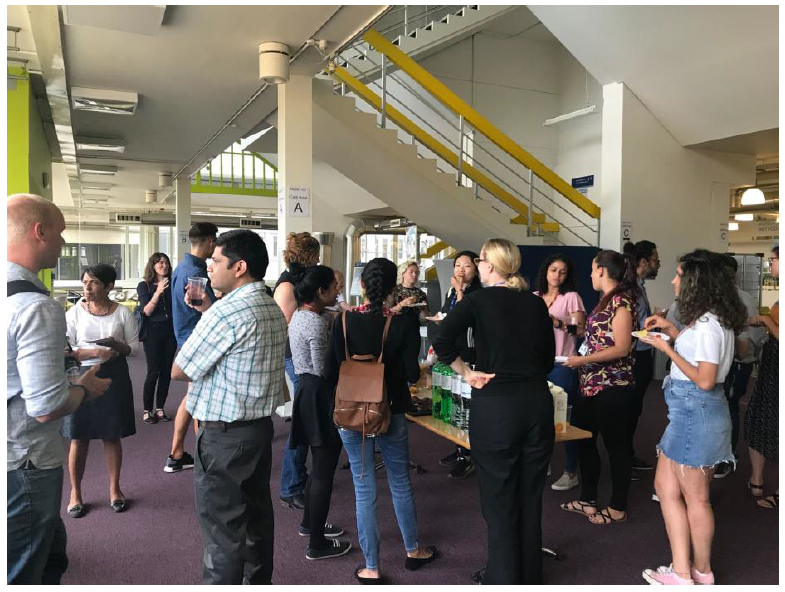
Following the talks, the entire section of Infectious Diseases and Immunity was invited for drinks and nibbles provided by the Graduate School Research Community Fund. Everyone always appreciates a chance to chat away from the lab coats and computers, especially as it had been nearly seven months since the last time we had an opportunity to come together like this.

We think the event was incredibly successful, and thank the Graduate School for their support. Hopefully section events such as this will continue to be held in the future!

Interdepartmental Laser Tag


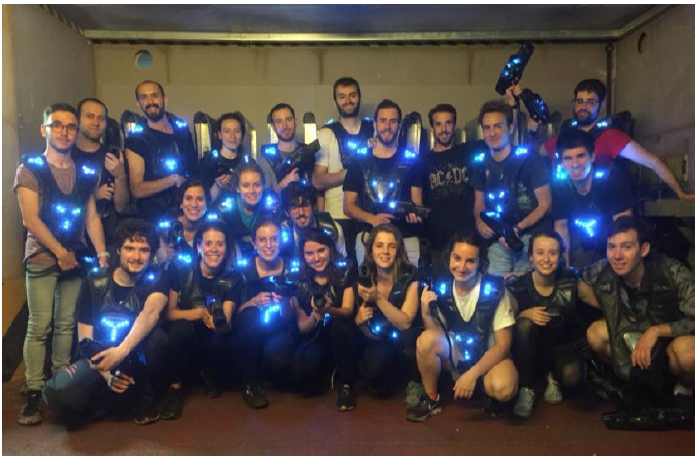
The first Laser Tag event to connect PhD students from different departments, took place at the brand-new facility “Bunker 51” on Saturday 23rd of June. The aim of this initiative was to mix students with various research interests, to develop our research communities within Imperial and foster collaborations inter-departments.

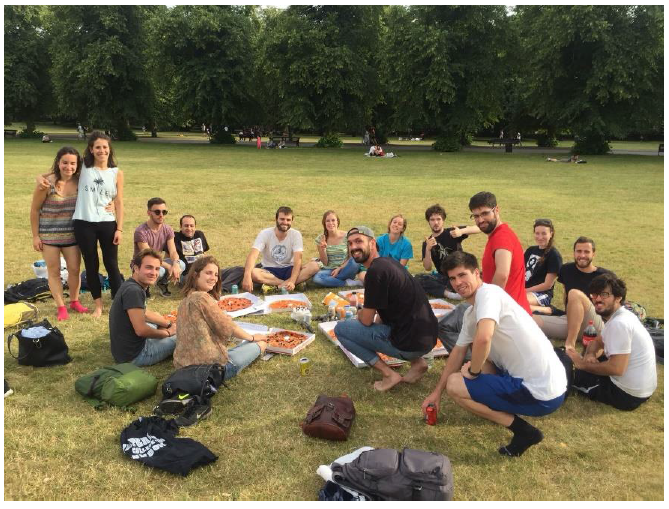
This Laser Tag event, was an icebreaking way of encouraging PhD attendants to work together in a series of mini games played with guns which fired infrared beams. After the team building event, a picnic hangout with pizzas and drinks in Greenwich Park offered a more relaxed ambiance for students to get to know more about each other and their projects.

The whole day was a great success, with a high turnout of 22 PhDs from departments such as: Electrical and Electronic Engineering, Bioengineering, Chemistry, Civil Engineering or Medicine.

Everyone had an amazing time, and were very grateful to meet other students and share their PhD experiences so far. They also liked the idea of building teamwork and social skills with new people in such a fun way. All of them were looking forward for the next interdepartmental activity.

Cross-CDT Trip 2019 & World Cup Dinner

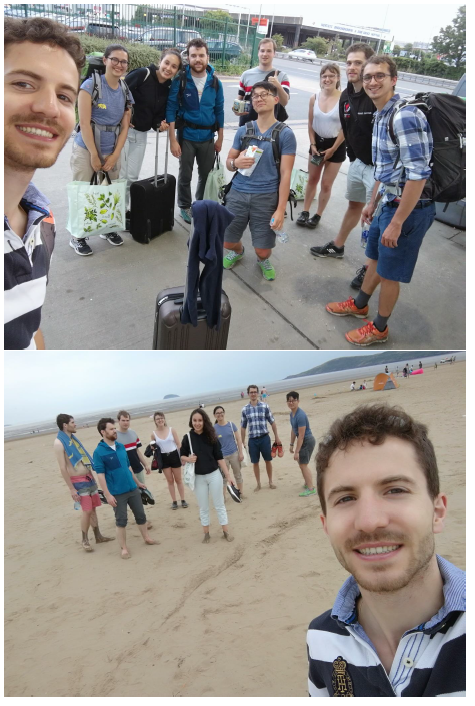
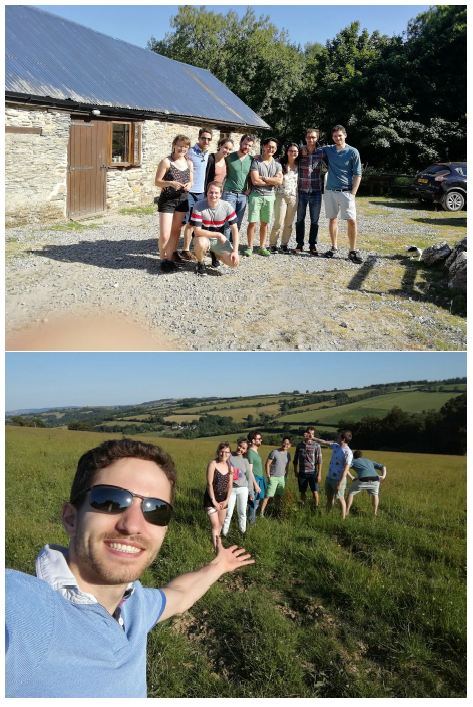
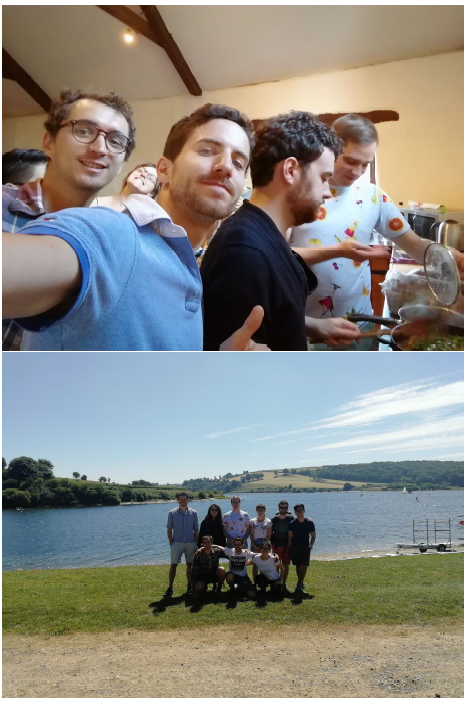
On 29th of June 9 CDT PhD students from 2 different CDTs left London for a 3 days trip to the countryside to explore West England.

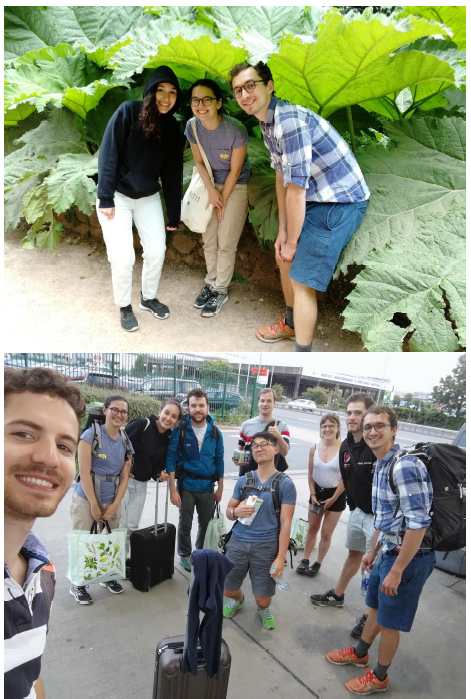
On Friday morning all of us met at Heathrow airport at the Sixt car rental shop. After everyone arrived and after we got our cars we drove towards Bristol and then turned further left to reach a town called Tauton. There we bought some groceries and continued our journey to finally reached our end destination with was a small farm located between Taunton and Exeter.

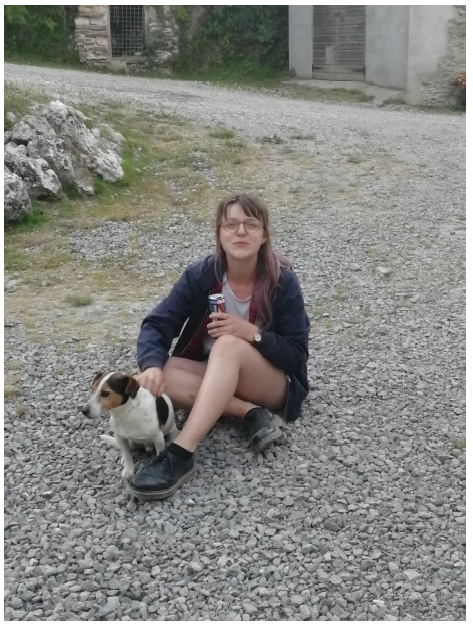
Immediately the AirBnB owner welcomed us with her lively 3 dogs Bisket, Douglas and Holly. After playing a bit with the dogs which we decided to go for a walk and discover the area of where we would stay the next 3 days. One speciality about this place was that it was so far from any other bigger city or town that there was no internet and mobile connection at all. Everyone felt it as a relieve not being connected to the rest of the world which made us enjoy the beautiful nature even more.

When we returned to the house we prepared dinner where the more talented chefs amongst us prepared a delicious pasta for us. We spoke a lot played some card games and at night we enjoyed watching the full moon and the stars.

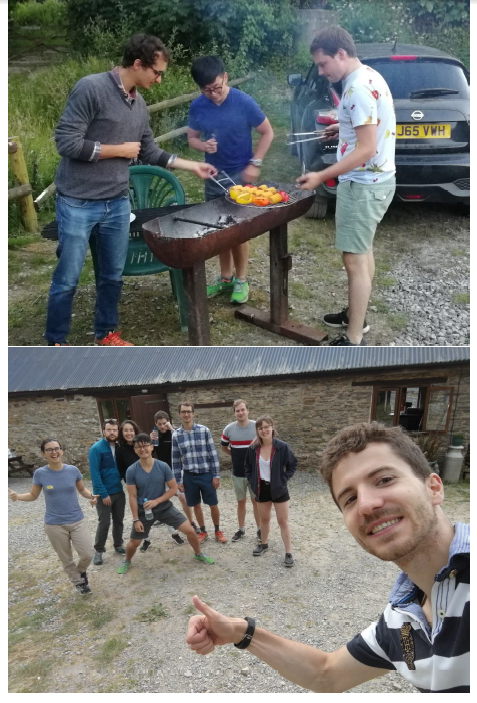
On Saturday the highlight of the day was that we took our cars to go to Wimbleball Lake. There we enjoyed the warm summer weather and borrowed some rowing boats to explore the lake. Furthermore, we managed to borrow a football and a tennis ball and played around with them on the grass. In the evening we prepared a BBQ and traditional Shakshuka which one of our friends knew very well how to cook it. We ended the second evening listening to music, playing some board and card games and exchanging other funny stories about our lives.

On Sunday we left the dorm quite early straight after breakfast to drive to a nearby castle called “Dunster Castle”. Although it started raining a bit we found joy in discovering and exploring a medieval town with its watermill, church, a beautiful garden and also the tiny houses and narrow streets. After that we continued with our cars to go to the coastal region in the north to a small city called “Weston-Super Mare”. There we enjoyed the sandy beach and also the mud which was left over due to the ebb of the sea.Finally, we enjoyed a last lunch together after returning back to London.

Here we also want to take the opportunity to thank the Graduate School for their financial support for this really joyful Cross-CDT Trip.

Here some impressions from our Journey

Cross-CDT World-Cup Dinner

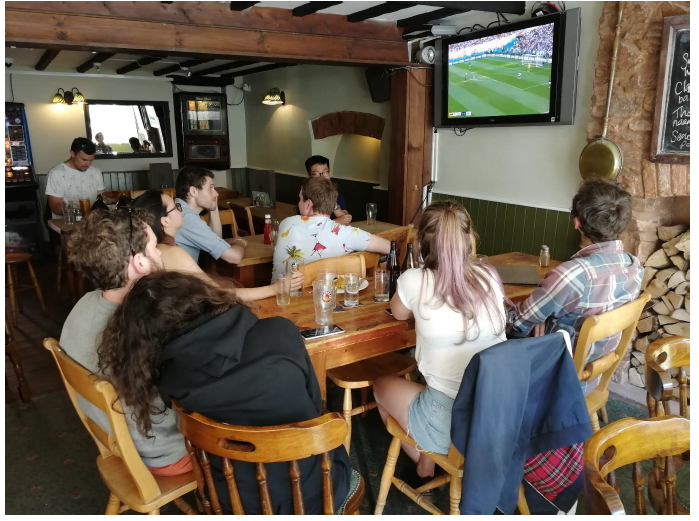
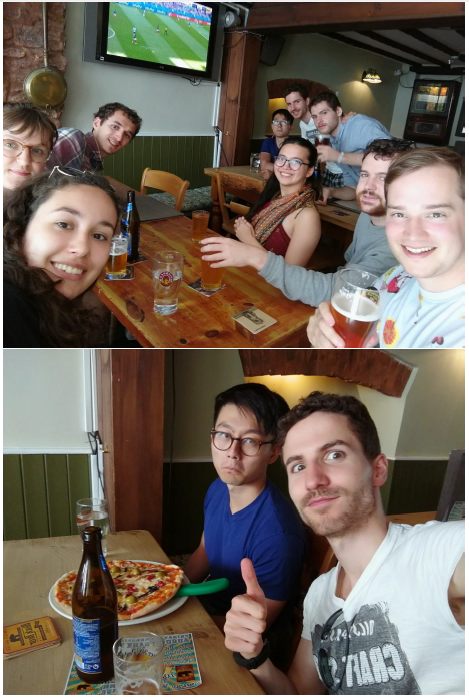
To celebrate the end of the term and to also exchange our football knowledge 10 CDT-PhD students from 2 different CDTs met up at a bar to watch the game Argentina against France.

It has been a quite long time that some of us have seen each other and therefore this reunion was very enjoyable by also hearing about the lives of our former MRes colleagues. The world-cup game of the day was France against Argentina. After discussing our bets on who is more likely to win the game and who we thought would score first the game started. While watching we enjoyed our dinner at the bar which was also very delicious, and which made the whole reunion experience even more enjoyable. The football-game was very exciting because throughout the match both teams were showing their best and most creative moves and strategic brilliance. Finally France ended up winning against Argentina 4:3. Since most of us were supporting France we were very relieved about this outcome and discussed the game in more detail also after the referee finished the game.

Here we also want to take the opportunity to thank the Graduate School for their financial support for this very nice reunion at the Cross-CDT World-Cup Dinner.


Workshop on Advanced Topics in Complex Networks

A large amount of the research carried out at Imperial College is highly interdisciplinary in nature. The field of Network science is no exception to this. “Network scientists” study the behaviour of complex interconnected systems which are often represented mathematically by graphs or complex networks. Examples of these systems include: social networks, transportation networks, such as the London Underground, and even the vast network of neurons in our own brains. The disadvantage of working in such a multidisciplinary field is that individuals performing similar research can often become scattered across different departments in the college without any idea that others working on similar issues exist! Imperial College’s Networks Networking group was created as a way of bringing together those working on graph theory, complex networks and related subjects in different departments.

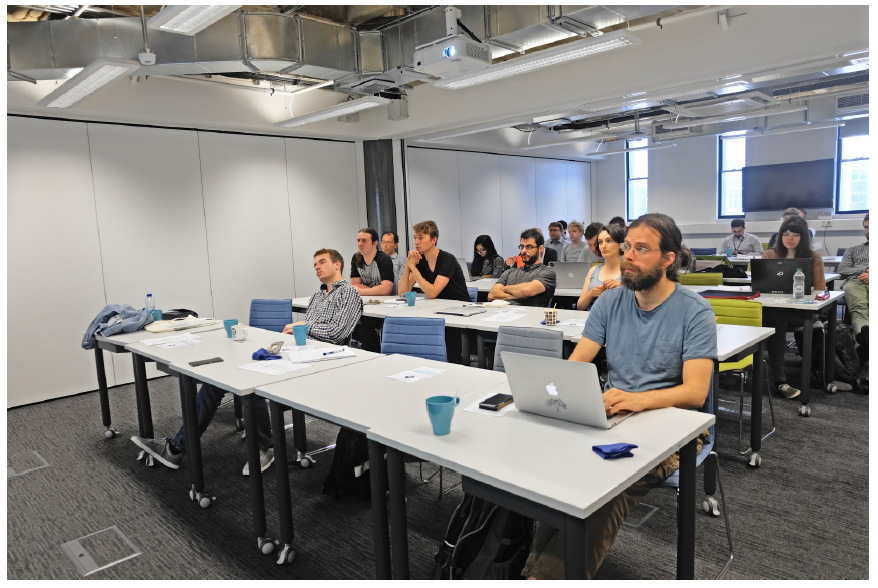
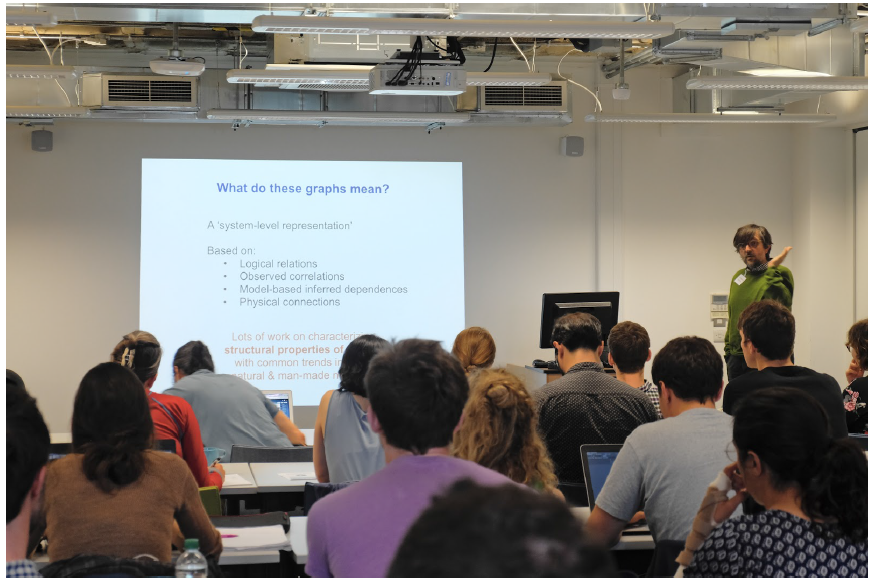
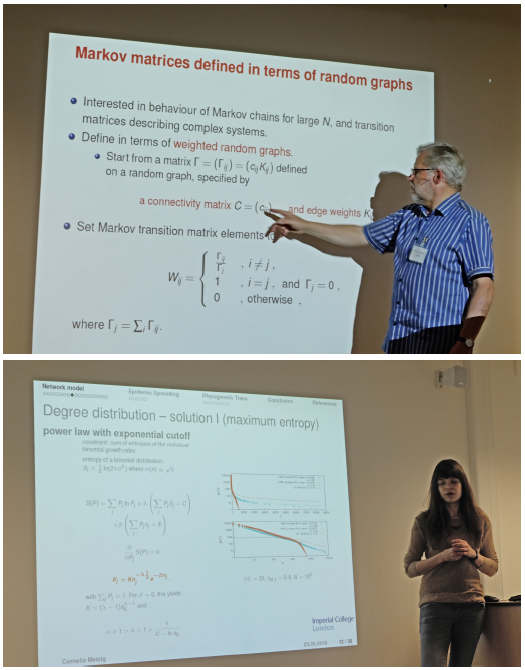
On Wednesday the 23rd of May Imperial College’s Networks Networking group held a workshop entitled Advanced Topics in Complex Networks which was funded and supported by Imperial College Graduate School’s research community fund . The aim of the event was twofold. Firstly, it was an opportunity for PhD students and early career researchers to gain some insight into the “state of the art” mathematical tools being employed by researchers in the area. Secondly, it was to provide a networking opportunity for those in the field. The event was attended by roughly 3040 PhD students and postdoctoral researchers from Imperial College working on a variety of topics. Attendees came from a range of departments including Ecology (Silwood park campus), Physics, Mathematics and even Economics meaning that the event was truly interdisciplinary.

Imperial College’s mathematics department who are both active researchers in the field of graphs and complex networks. Professor Barahona spoke about “highdimensional
data, graph embeddings and multiscale community detection” while Dr Colijn gave a talk entitled “Comparing tree with new metrics and features: applications in evolution and infectious
disease.” Both talks explored ideas that related to the analysis of large graph data sets and also gave insight into how techniques from machine learning are beginning to creep into
network science as well. The talks were followed by a break for lunch which provided an opportunity for the attendees to network with researchers and discuss any questions raised
in more detail.

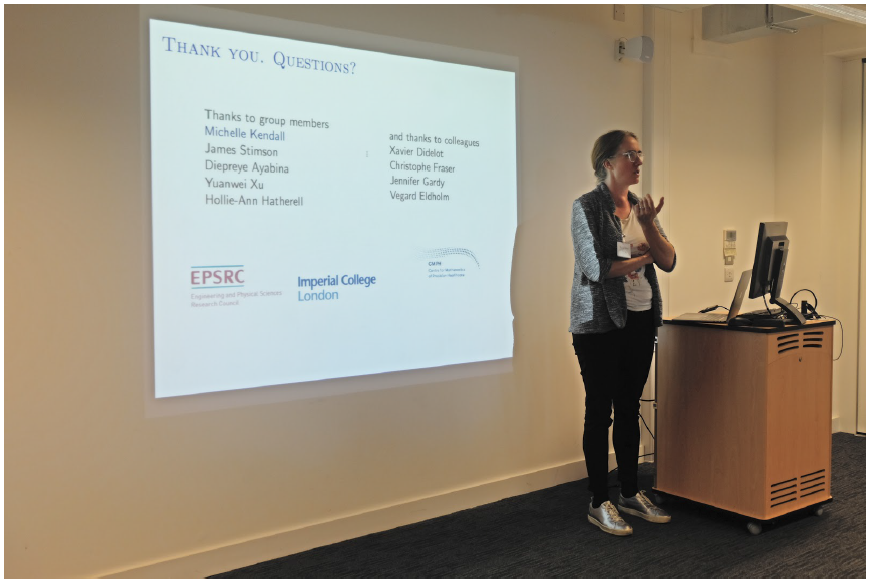
The first talk of the afternoon was given by Professor Reimer Kühn, a Professor in mathematics at King’s College London. His talk entitled “Spectra of Random Stochastic
Matrices and Relaxation in Complex Networks” gave details of the mathematical machinery which can employed of study graph spectra. This is an important topic in applied network
science where researchers are often interested in dynamical processes unfolding on graphs. These may include: the spread of disease, models of opinion formation or perhaps the
synchronization of stations in power grids. The final talk of the day was from Dr Cornelia Metzig, a postdoctoral researcher at Imperial College who gave a talk concerning her recent
research on dynamic network models. This provided an opportunity to learn about the type of questions that practicing researchers in network science are trying to answer.

In future the Networks Networking group intends to organise more events for the benefit of researchers at Imperial working in network science and graph theory. These meeting will
allow individuals working in the area to keep up to date with the latest research and potentially to foster collaboration.

NHLI Careers Panel

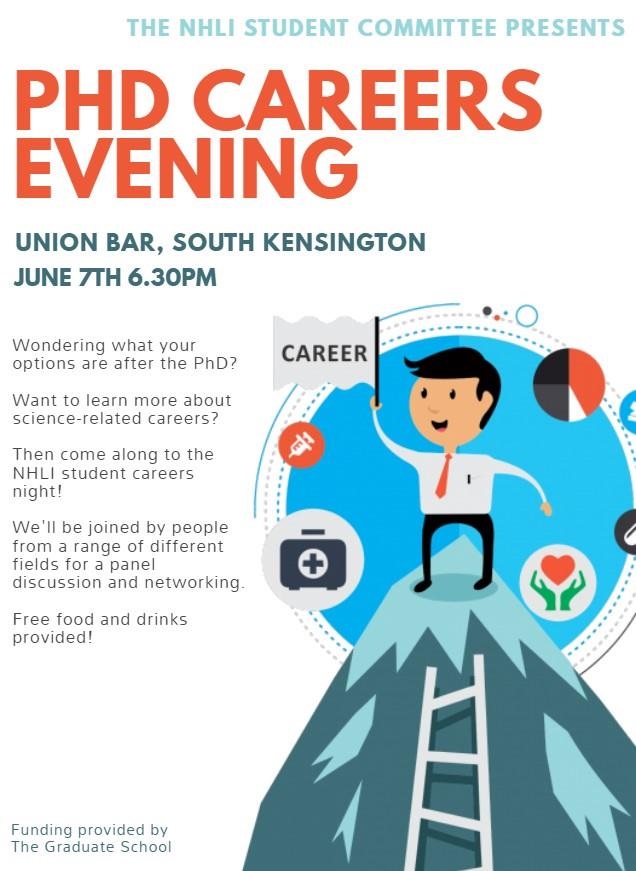
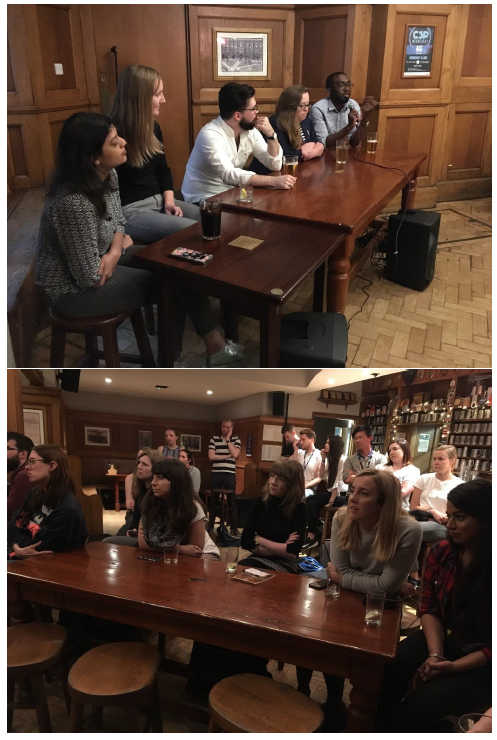
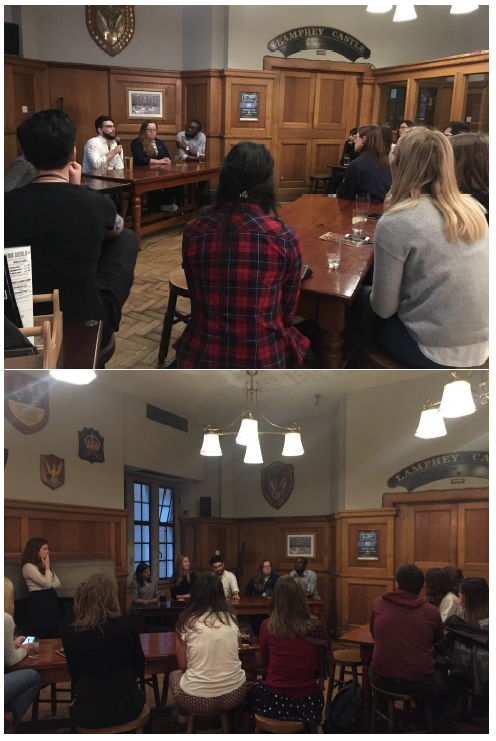
The National Heart and Lung Institute Postgraduate committee organised a PhD careers panel on the 7th June with great success. The event, which was held at the union bar in South Kensington, was extremely well attended. Students travelled from all the Imperial campuses, which is often a challenge to achieve. Our five panellists were all working in non-academic areas such as industry, medical writing and scientific consulting. Students asked questions about interviews, their day to day life at work and why they chose their career paths.

After the panel session, students had the opportunity to chat one on one with the panellists and ask more specific questions. The atmosphere during the Q&A and networking was made even better with drinks and buffet which were provided thanks to the Research Community fund.

The feedback received by the students and those involved was overwhelmingly positive. Students commented on how it was a great chance to learn about career possibilities outside of the university setting.

We as a committee believe that events like these are an essential part of the PhD experience and for career development in the department. We are therefore grateful to the graduate school for providing funding without which nights like these wouldn’t be possible.