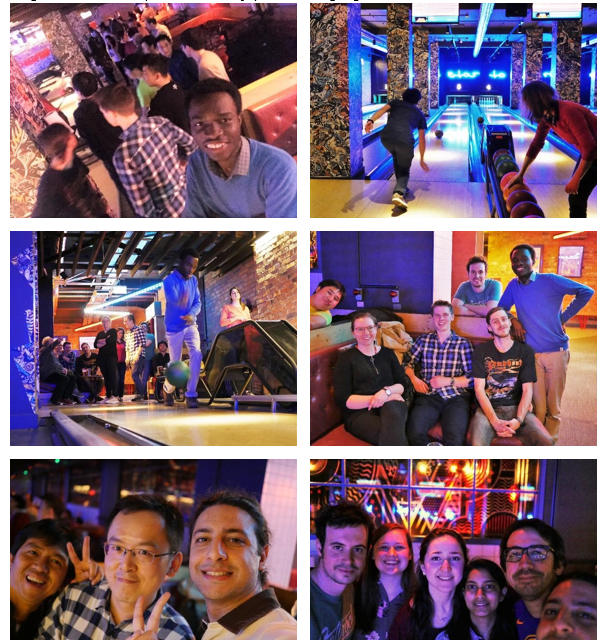
On the 29th of March 2019 we made our way to the nearby bowling place in Bayswater for a Geotechnics Section-bowling night. After a nice group walk through Hyde Park we all gathered at the bowling alley at 18:00. Thanks to the great turnout of 26 people, we took over five of the lanes and played two hours of bowling – some more competitively than others. A few people tried bowling for the first time in their life and ended up getting one strike after the other, so there were many great celebration dances to be seen. While waiting for our next turn and cheering our teammates on, there was a large selection of burgers and other finger foods for everyone to enjoy.
Since bowling in London is quite expensive, this event would not have taken place at all without the support from the Graduate School’s Research Community Fund. We are therefore very grateful that we got the chance to spend such an enjoyable evening together as a Section.
by Nora Schmit & Constanze Ciavarella, PhD students in the School of Public Health
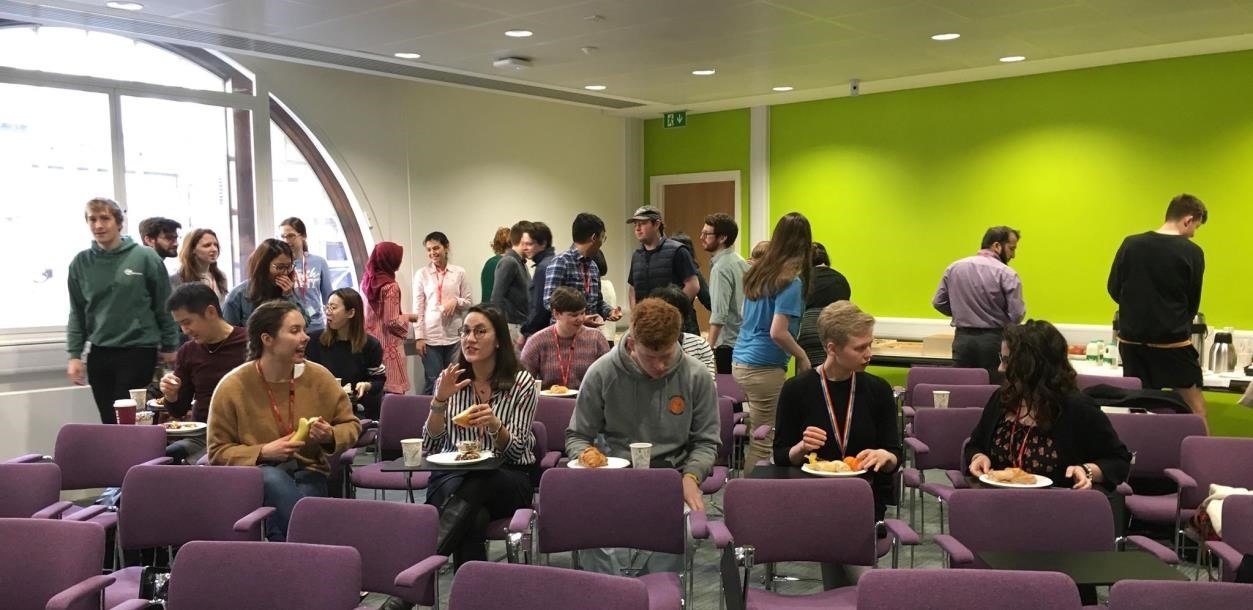
The first School of Public Health breakfast club took place in the morning of Tuesday 26th March 2019 at St Mary’s campus. The student reps organised this initiative to bring together PhD students from 5 departments spread across St Mary’s, Charing Cross and White City campuses, to share their experiences around the theme “Making the most of your PhD” while enjoying a delicious breakfast buffet.
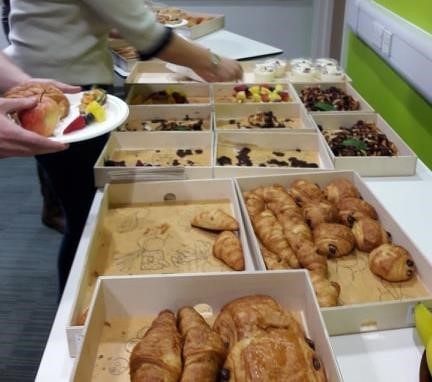
The event had a high turnout, with over 50 students from all stages of the PhD gathering in room G64. It started at 10am with tea, coffee and various breakfast options from Le Pain Quotidien, including waffles, pastries, baguettes and fruit. After everyone had taken a seat, 3 students from the Department of Infectious Disease Epidemiology gave short talks on extracurricular activities they had pursued during their PhD.
First, final-year PhD student Tom talked about the insights he gained during an internship at the Parliamentary Office of Science and Technology. He also gave practical tips for students wanting to apply to the internship scheme and on managing the practical aspect of taking time out of the PhD. Andria, a second-year student, then presented an overview of her short-term work assisting the Ebola outbreak response team at the World Health Organization. She gave some details on the current Ebola epidemic and the tasks she had to complete during this position interspersed with beautiful pictures of Geneva. Finally, Nora shared her experience of the Global Fellows Programme at Tokyo Tech University organised by the Graduate School, which she had attended during the first year of her PhD. She highlighted her happy memories of the trip and encouraged participants interested in developing teamwork and communication skills to apply. All speakers agreed on the benefits of taking up these varied opportunities and expanding their experience beyond their research project, particularly with regards to skills and careers development, but also highlighted the difficulties they encountered in reconciling the activity with their PhD.
After the talks, everyone had the chance to ask questions or talk to the speakers in person. People helped themselves to more food and some stayed to mingle with the other students until 11.30am. Participants additionally had the opportunity to vote on future social activities to be organised by the PhD reps, with paintball, karaoke and a museum late visit coming out as favourites.
The first breakfast club was a great success and received positive feedback throughout; everyone was impressed by the food and participants said they appreciated the opportunity to get to know other students and getting inspiration and practical information to make the most of their PhD.
We would like to thank the Graduate School for funding this event and hope to organise more activities in the future to improve the postgraduate research community in the School of Public Health.
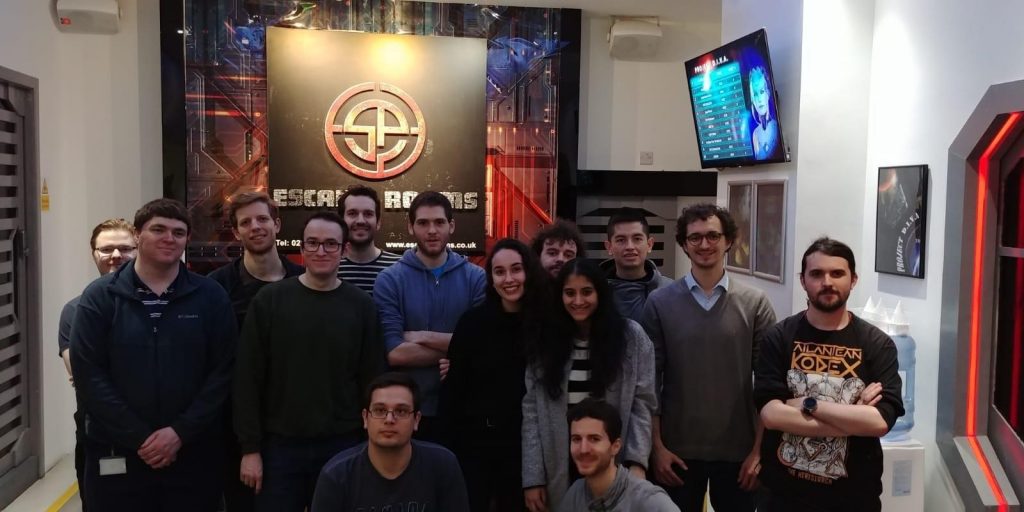
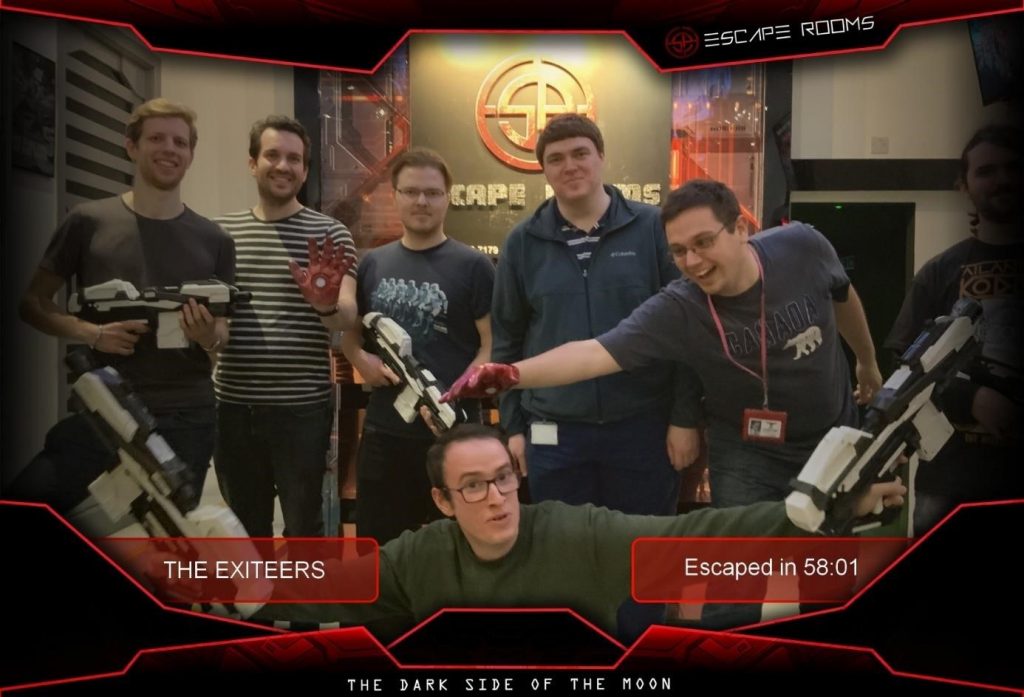
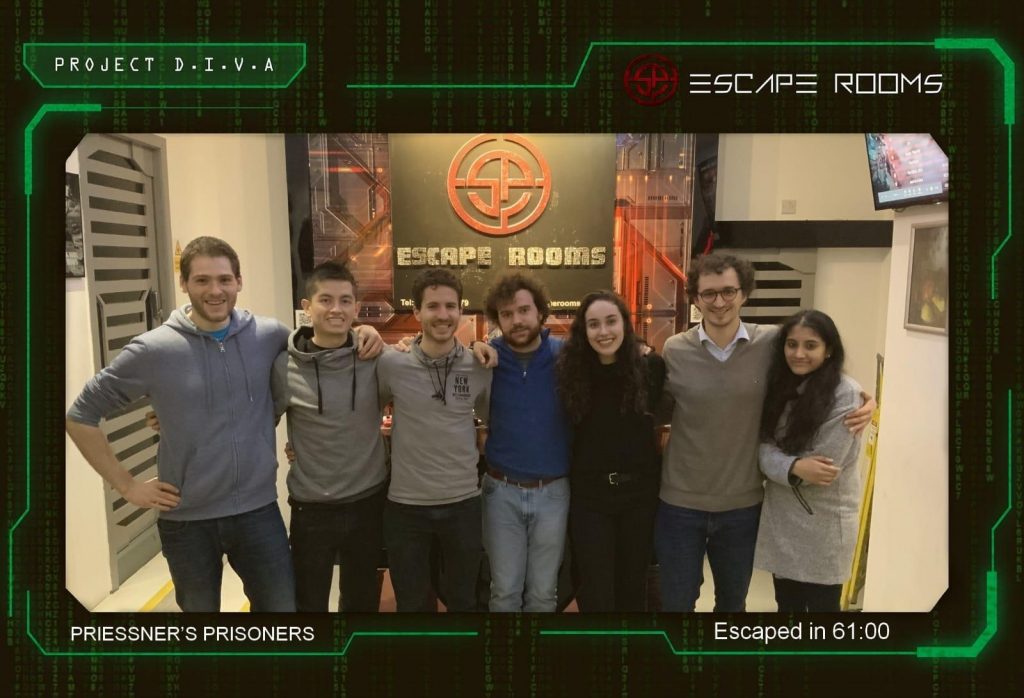
On Wednesday 13th of February 2019, the second event in the Cross-CDT series took place – a total of 14 PhD students from different 3 different CDTs gathered to face the tasks that needed to be solved. The students divided in to two teams and were required to work together to solve different puzzles in order to beat the clock (and each other), to escape and unlock their respective ‘rooms’. As this was the second of the scheduled activities, many of the students were already acquainted and were able to jump to the tasks at hand instantly.
The theme of the first room was “Project D.I.V.A” and the second, “Dark side of the moon”. Both adventures had their own unique set of fun challenges, questions and tasks which needed to be solved and which put our team work and skills of inquiry to the test. It was a welcome distraction from our PhD work and a reminder that from time to time, we also need to enjoy ourselves.
After an initial struggle both teams managed to escape their respective rooms – rooms. It was great to receive the “Mission accomplished” announcement!
Following the escape room activity, the students who still had some energy left, decided to go to the pub to reward their hard work. This gave the group the opportunity to chat and share experiences.
Overall it was a great event and we are all looking forward to the next!
We would like to extend our thanks to the Graduate School for financially supporting this cohort building activity.
Britain is at the forefront of energy system transformation. In 2018, 53% of electricity consumed came from low-carbon generators, up from 25% in 2009. As a result, carbon intensity halved from nearly 500 to 217 gCO2/MWh (Electric Insights). However, as an island with limited interconnection to its neighbours, the stakes are particularly high to achieve further reductions down to 100 gco2/MWh by 2030 (Fifth Carbon Budget).
At the same time, me and fellow PhD students miss the exchange amongst us as well as with other academic, industry and policy experts on energy system transformation. What is missing is a closeknit energy system community that can easily discuss transformation pathways. Although individually, research, business and policy-making in energy, is world-leading, the community is siloed. In addition, there is no forum within Imperial where students working in this field can easily exchange information and discuss.
The missing link is a platform that offers a direct (!) communication channel between students and experts of all sectors and brings them together to openly discuss ongoing work. That’s why I set up PowerSwarm.
Power Swarm is an open, free network of energy system transformation experts across academia, industry and policy. It is not a single event, but rather has two key components:
E-mail list: Every Power Swarmer can write to this list to advertise jobs, papers, conferences, etc., and ask questions related to energy system transformation. The purpose is to leverage swarm intelligence for better information exchange and more efficient problem-solving. When I e-mailed the group about recent reports on the amount of storage required in future energy system scenarios, I received more than 15 reports I hadn’t been aware of. That’s my PhD literature review sorted!
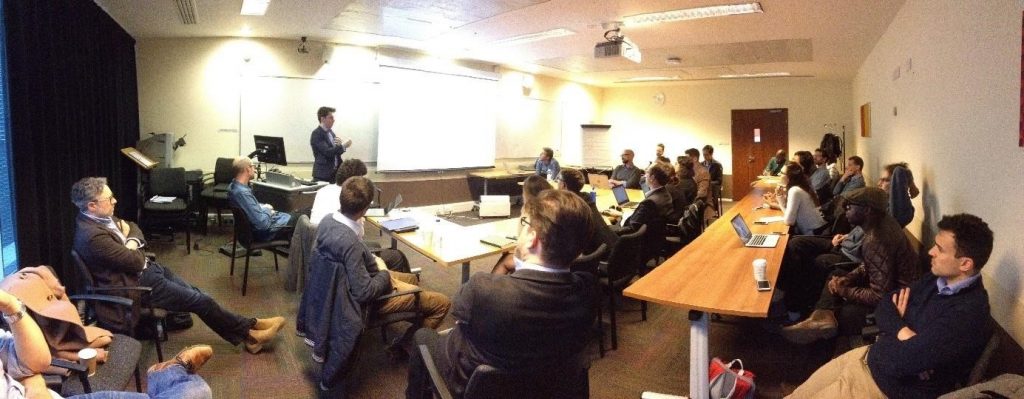
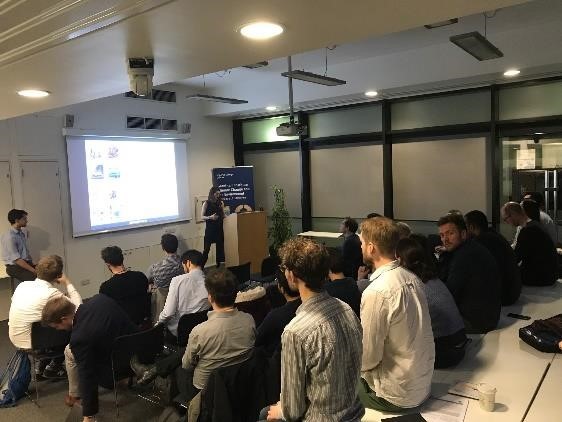
Workshops: For a different topic each month, academic, industry and policy experts speak about their ongoing work in this area. Two hours with five presentations of ten minutes ensure a concise format that allows for real, content-based, cross-sectoral discussions. No need for shiny result slides, rather a discussion of current roadblocks. The workshops take place from 5-7pm and are usually attended by 20-30 people working in the particular field. Past meetings were on ‘Modelling Renewables’, ‘Value of Storage’, ‘Energy Trading’ and ‘Hydrogen’. My roadblock was how to quantify the value of energy storage and the advice from experts of Pivot Power, Aurora, RenewablesUK, and others came in very handy.
Last week’s workshop (21st February) was already our fourth one and focussed on the future role of ‘Hydrogen’ in the UK. 20 to 30 attendees (MScs, PhDs, researchers, NGOs, industry), discussed with speakers from academia (Imperial, UCL), consulting (Element Energy, E4Tech), industry (ITM Power) and policy (BEIS) about the current roadblocks to decarbonising energy, transport, heat and industry with hydrogen. The event was followed by drinks at Eastside where students could network with professionals and continue the discussion.
Power Swarm thereby supports Imperial’s research network and fosters exchange of research insights on energy across departments, connects Imperial’s research community to the wider academic and (most importantly) industry and policy community working on energy, and establishes a forum for students to network among each other, with the Imperial community, and with industry and policy experts.
Power Swarm has already more than 200 members in the energy sector. If you think you could benefit from the network, join!
We would like to extend our thanks to the Graduate School for supporting this Research Community Fund activity.
The first Power Swarm workshop on Modelling Renewables on 18th October 2018.The fourth Power Swarm workshop on Hydrogen on 21st February 2019.
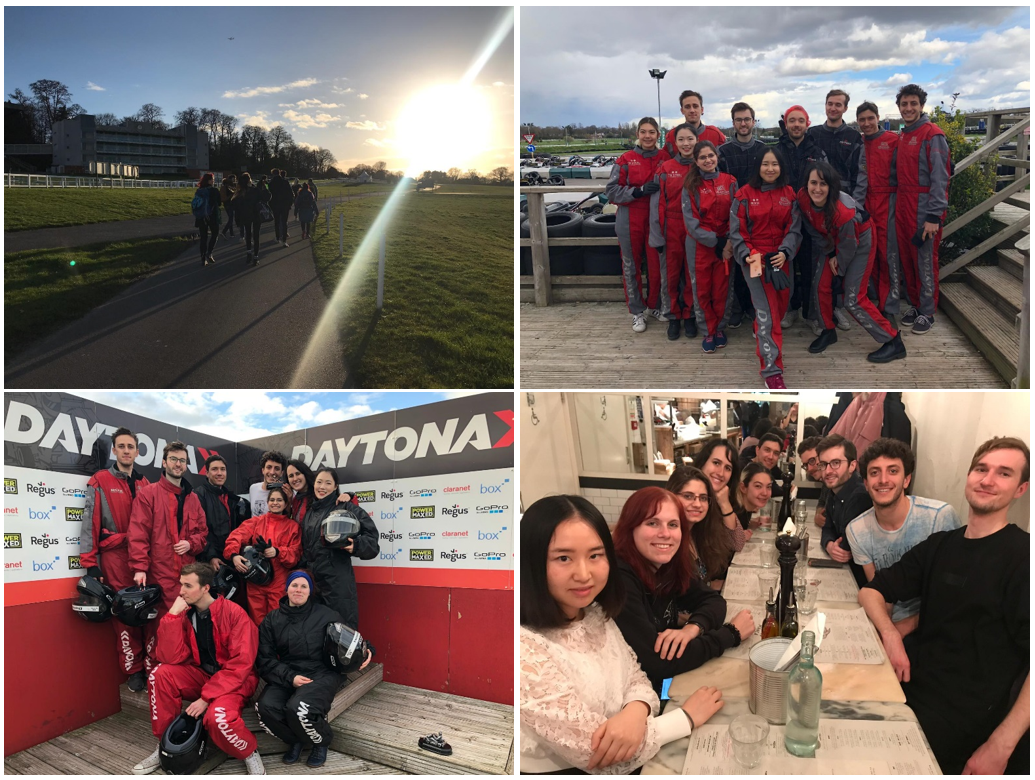
On Sunday the 17th of March 2019, the first-year PhD students from the Bioengineering Department enjoyed an active day out which started with a go-karting race in Sandown Park and culminated in a joyful social over dinner at Franco Manca in Earl’s Court. The students, who organised the outing on the WhatsApp group they created at the beginning of the year, sought to reinforce the professional ties and personal bonds they developed since the first social at the beginning of February. The event was made possible thanks to funding obtained through the Imperial College London Graduate School from the Research Community Fund, for which the students are very grateful.
The day out started at 1 P.M. when the students met at the South Kensington Campus to catch a minibus ride they’d booked, and headed out for Sandown Park. The bus quickly filled with a variety of overlapping conversations with topics ranging from technical comparisons of experimental methodologies to the importance of engaging as Teaching Assistants for one’s own self-development. Such conversations promote collaboration: as an example, a professional connection between two students which emerged in the previous social event resulted in one’s participation in the other’s lab work as a pilot subject – allowing them to further tune their experimental design through discussion other peers. As one student put it: “It’s also nice to connect with people who I might be able to collaborate with – providing opportunities for similar connections to occur is essential and may result in fruitful collaborations and exchanges of perspectives of the challenges PhD students face daily”.
As the minibus approached the venue, those that had been go-karting before shared their accounts of previous experiences. The weather gave some signs of worsening before clearing up, fortunately – the track was just made humid enough to make the spin-outs funnier to recount on the minibus on the way back. The student engaged in the race showing their competitive spirits and very much enjoyed the challenge of handling the karts in damp conditions. The event ended with pizzata – Italian for a pizza get together – in Franco Manca at Earl’s Court, where the room filled with friendly conversation.
Indeed, aside from the aspect of providing an opportunity to develop professional relationships for direct scientific collaboration, a very important aspect of social interaction is to web a support network made of personal relationships between the students. This network enables students to manage any work-related anxiety, stress or loneliness by having a go-to person in a similar professional situation to them. The event was designed to facilitate a combination of the tension-releasing adrenaline-inducing sporting activity and the relaxed and informal follow-on dinner and was a great success! Everyone thoroughly enjoyed the day out, as one student’s reaction reveals: “We all had a fantastic time, relaxing, having fun and forgetting about work for a few hours! Very much looking forward to seeing my colleagues again for another event in a few weeks’ time!”