Month: February 2019

Theory Group Student Seminars: Sharing Our PhD ‘Wisdom’

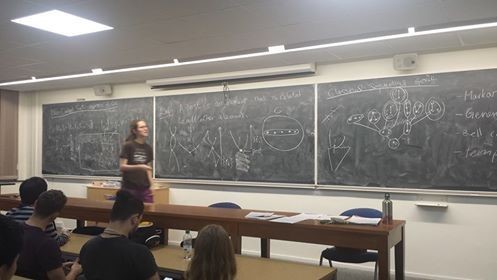
One of the most important skills of any physicist, second only to the ability to do research itself, is to communicate both the results and the methods of that research to a variety of audiences: students, peers, senior researchers, and to a lesser extent, the general public. All of these groups require their own unique approach, and it is to the first two that the student seminars in the theoretical physics department at Imperial are aimed. The speakers are PhD students, the audience consists of PhD and MSc students in comparable proportions. This is a pedagogical experience for all involved, albeit in different ways.

Firstly, the speaker. Choosing a subject for a talk is a nontrivial task in itself. The choice might be, roughly, between the day to day research of the speaker, maybe an upcoming paper, and a broader, less directly related topic, with which the speaker had to familiarise themselves in order to perform their research, not having learnt about it in class. Sometimes, these are useful tools; sometimes, these are topics which are interesting in and of themselves. Whichever subject is chosen, having to talk about this to an audience is an excellent self check – have I truly understood what I am talking about? What is the broader picture here, what is the forest behind the trees and leaves of equations? A variety of wise human have said, in more or less these words, that one has not truly understood that which one cannot explain to a computer, or an undergraduate. Since both of these would take considerable amounts of time, postgraduate students will have to suffice.

Giving a talk is a skill which is valuable both to future academics as well as those who go on to work in what is known with varying degrees of derision as “real life”. How to be engaging, how to be clear, how to estimate the level of knowledge of the audience, adapt the talk if that estimate proves to be inadequate. Choosing suitable visualization tools: the chalk vs. the powerpoint!

Secondly, the audience. It is a rough awakening to go to a talk for the first time. However complicated a lecture seemed to be, the knowledge the professor assumed you to have was always knowledge that you knew you should hypothetically have. It is an art in itself to not be discouraged and stop listening the second one does not understand something. A good speaker will usually try to give you “the gist of it”, and it is possible to understand a number of things without understanding anywhere near all the detail. It is an excellent opportunity for MSc students to be given the chance to listen to a talk that is less complicated than a full fledged conference talk, but still more complicated than any seminar talk they would have previously come across.

The other PhD students might learn some of the actual material which is being presented, as well as give some valuable feedback (“no, you may not assume everybody knows what diffeomorphism invariance is”, “no, don’t print black on a red background on your slides”) .

Finally, it is a well known fact that students are being underpaid and hence underfed, and therefore free pizza provides a most useful tool to lure the starving students in, as well as feed them. Bon appetit!

We would like to extend our thanks to the Graduate School’s Research Community Fund for sponsoring this event.
‘Breaking the Ice’ – Hammersmith Campus Postgraduate Social!

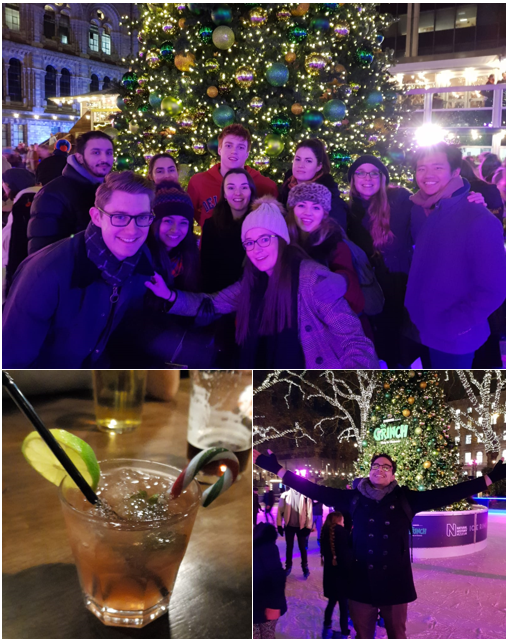
Postgraduate students based at the Imperial Hammersmith Hospital campus took to the ice for a PG student social at the Natural History Museum on Wednesday the 19th of December. This social brought together research students from the departments of Medicine, Surgery & Cancer and the NHLI in a festive skating session followed by drinks at ħ bar, allowing PG students on the campus to mingle across different departments and disciplines.

The event was a great success, bringing together research students from across departments and institutes based at the Hammersmith hospital campus, as well as other research staff that were interested in getting involved with the event (including clinical and postdoctoral fellows). The Graduate School’s Research Community Fund, paid for twenty tickets for PGR students to go ice skating at the NHM (which sold out within 12 hours of the email being sent out) and a free drink at ħ bar, where PG students shared a festive drink as a way to send off the end of term before college closes.

This event was organised by campus-based PhD student representatives (Emily Heathward, with assistance from Hannah Maude and Berta Font Cunill), who’d like to improve the postgraduate research community in the Faculty of Medicine at the Hammersmith Campus, and serves as an introductory event, with high hopes for more to follow.

Thank you to the Graduate School for enabling this event to take place!

Mech Eng – Robotics Forum PhD Connect

by Eloise Matheson, PhD student in the Department of Mechanical Engineering

The first PhD networking event for robotics related researchers was held on Thursday 15th November 2018. Sponsored by the Imperial College Graduate School Research Community Fund and the supported by the Imperial College Robotics Forum (Network of Robotics), this event was aimed to connect PhD researchers across the college that face similar technical and research challenges! Robotics in general is a very multi-disciplinary topic, and with over 28 robotics labs spread across departments and faculties, this event was a great chance to bring people together. Over 50 people from 15 different labs registered for the event, with a turnout of around 40. It was a fantastic success, and the outputs of the afternoon have included ad hoc visits to other’s labs, the plan to form a mailing list between PhD/EngD researchers, future smaller social meetings and the hope to run the event annually.

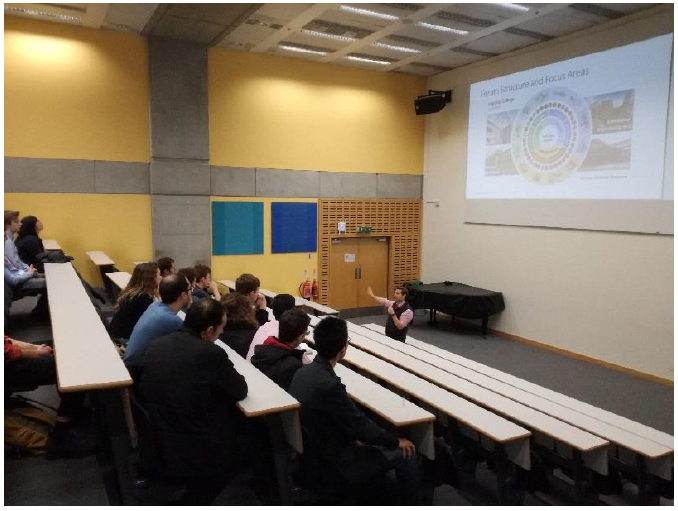
The afternoon started with a short presentation by Prof. Ferdinando Rodriguez y Baena, the Speaker for the Robotics Forum, who highlighted the importance of creating links between our labs at all levels – including between PhDs and other researchers.

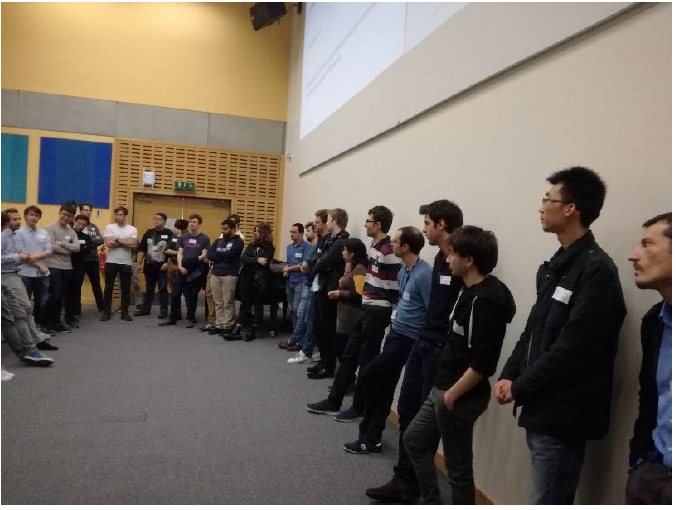
Keen to meet the other researchers in the audience, we then had a few minutes to introduce ourselves to someone we didn’t know – and following that, to introduce our new partner in a round circle to the rest of the group.

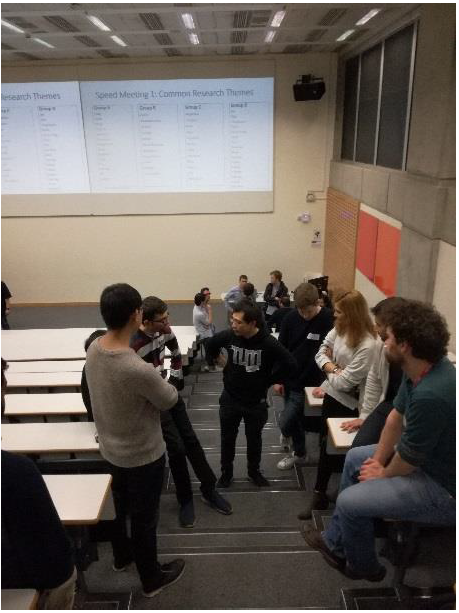
The group introduction helped break the ice, so that we could begin the main activity of the afternoon – intense speed meeting! We broke into pre-allocated smaller groups over three sessions each of 20 minutes, meaning that targeted discussions could take place. The first session grouped people from different labs together, and the topic encouraged them to talk about best practises from their labs. The second grouped people of similar research topics together – specifically covering Modelling and Simulation, Control, Mechanical Design, and Sensing and Electronics. The third and final group split us according to a more social demographic – with Post-Docs and later stage PhDs in one group, early PhDs in another, middle PhDs in the third and finally all the robotics female researchers together, so that they could discuss issues and exchange ideas pertinent to their experience.

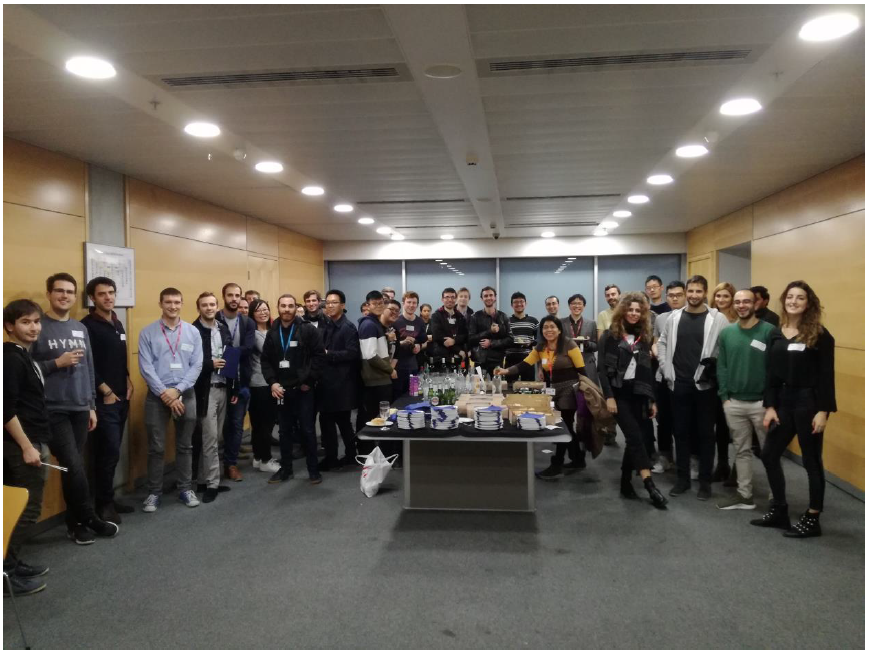
To conclude a fantastic afternoon, we finished the event with food and drinks and a social networking opportunity. Thanks again to the Graduate School for enabling this event!