Month: May 2018

Global Fellows Programme “Innovation to Eradicate Poverty”, a rich educational and cultural experience in Japan!

By Vasiliki Kioupi, PhD student in the Centre for Environmental Policy

Doing my research on Transformative Education for a Sustainable Society I always thought about visiting Japan. Not only because the Global Action Plan on Education for Sustainable Development (ESD) was launched during the UNESCO World Conference in Aichi-Nagoya in 2014 but also because during the decade for ESD (2005-2014), which was initially proposed by the government of Japan to UNESCO, I was a classroom teacher actively engaged in Environmental Education Projects with my students in Greece.

When I saw the opportunity for the Global Fellows Programme themed “Innovation to Eradicate Poverty” advertised by the Imperial College Graduate School in collaboration with Tokyo Institute of Technology, I was intrigued to apply. I strongly believe that Poverty Eradication, currently Sustainable Development Goal (SDG) #1 in the United Nations’ 2030 Agenda, is a global challenge clearly linked with how the society, the economy and the environment function and in order to arrive to a thorough solution, access to quality education is the key. The better part of this Programme was that I could also apply for a research visit to a Tokyo Tech lab, provided a Professor had agreed to act as a supervisor during my stay.

The Global Fellows Programme took place in Hachi-oji, a quiet suburb of Tokyo, from March 5 to 9 2018 and the venue was the Inter-University Seminar House, an all-inclusive facility on top of a hill. During the first-day of activities we attended lectures on the theme, did ice-breaker presentations and formed teams of four, comprised of both Imperial College and Tokyo Tech PhD students using effective team development and team work techniques. Following, we participated in team building activities to boost mutual understanding and effective communication and collaboration, before we started to work on our project to tackle poverty. During the activities we became familiar with each other and we developed strong bonds mainly because of our common interest to empower people through education. So our team was named EduPower! We were an international and interdisciplinary team of two Indonesians Mira and Albert (a Materials and a Computer Scientist), Ashley, a Scottish Bioscientist and myself, a Greek Social scientist, with diverse and valuable skills to contribute to our project. We had the most productive time working on our idea, a platform for collaboration in the education sector and we took pride on the poster we prepared and presented.

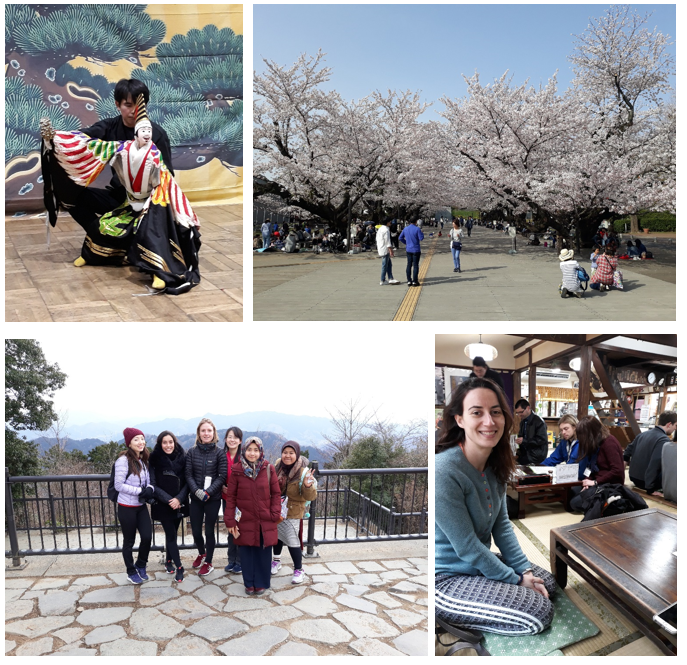
The seminar provided opportunities for cultural experiences as well, such as the Japanese puppet performance and the student lead outing to Takao Mountain. The Programme culminated with an amazing farewell event at the Ishikawadai area of Tokyo Tech O-okayama campus, featuring amazing talks, delicious sushi and traditional Japanese drinks, followed by karaoke at a nearby club. I was also able to witness the sakura (cherry blossom), one of the most spectacular sights Japan can offer to the visitor.

I highly encourage all students who are interested in enhancing their research and also creating memorable experiences to apply to similar opportunities provided by the Graduate school. The benefits to my personal development, network expansion and team-working skills were immense. The possibility of a research visit is also an invaluable experience for all PhD students to widen their perspectives. To read more about my research visit in Professor Abe’s lab please follow the link to my personal website.
My Three Minute Thesis

By Hannah Maude, 2nd Year PhD Student, Department of Medicine.
hannah.maude12@imperial.ac.uk

I was absolutely thrilled to recently be awarded third place in the Graduate School Three Minute Thesis (3MT) Competition. Not only because it was completely unexpected, but because the standard of the competition was insanely high (classic Imperial?!). Every single contestant gave an excellent talk.

If you aren’t familiar with the concept of a three-minute thesis, I can tell you it means exactly that: describe your three-year PhD in three minutes. Sounds a challenge, right? I confess that my favourite bad habit is signing up to anything outside my comfort zone; bad because it means experiencing all the nerves and potential failure, but good because overcoming the challenge means learning new skills, feeling proud of my achievements, and ultimately having a great time.

What’s involved?

The first brief was quite general, “nominees will present their current research in one slide and three minutes”, so I did what I do best and carried out some research. YouTube revealed that 3MT equals general overview of your research topic: background, clarity, content, confidence, enthusiasm and simplicity were just a few of the recommended qualities. People approach this in different ways, some choose to speak ad-lib, while others—including myself—write a speech and learn it word for word.

What did your speech cover?

My speech covered the background and concepts behind my research, in a nutshell that risk of Type 2 Diabetes can be inherited, and that I spend my days researching exactly how DNA mutations increase your risk of disease. See the published speech: https://hanmaude.wixsite.com/keepcalmreadscience/my-3-minute-thesis


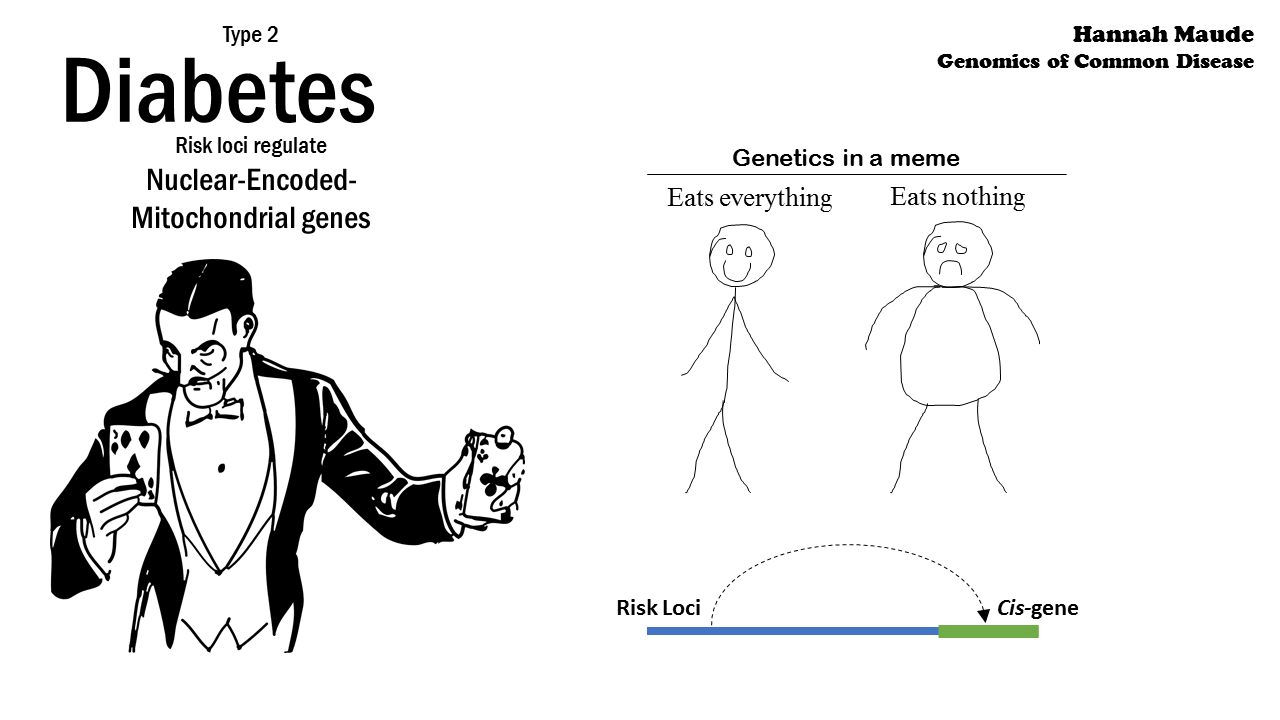
The 3MT slide, with quotes below. “This meme, which recently appeared on my Facebook, represents how some people can live healthily, yet still develop obesity and Diabetes. This bad luck has an explanation: it’s in your DNA”. “The DNA you inherit is like a game of cards; we have no control over whether we are dealt a ‘healthy’ or an ‘unhealthy’ genetic hand.” “Mutations at ‘risk loci’ disrupt ‘instructions’ and change the activity of nearby genes.”

How was the experience?

Honestly, the idea of standing up at the front of a lecture theatre and reciting a speech word for word within a strict time limit is pretty daunting. Once on stage however, I really enjoyed myself. I was able to be fully enthusiastic about my work and explain it to an audience who were genuinely curious. I also loved listening to all the other fascinating 3MT’s – who knew the concept of mixing two liquids could be so interesting?!

What did you learn?

The aim of a 3MT is to help a lay audience understand what you are researching. Not only is this super fun (and my Mum finally understands what I do) but taking a step back to think about your research in very basic terms, is totally underrated. I learnt to overcome my nerves, to be disciplined within a time limit, and how to communicate my research.

Take home message?

I would recommend the 3MT competition to all graduate students. It’s one of my biggest achievements this year and was so much fun. If you’re not one for presenting, I would absolutely recommend watching. It’s an inspiring event with engaging talks and you get a real feel for the huge variety of PhD projects going on at Imperial.

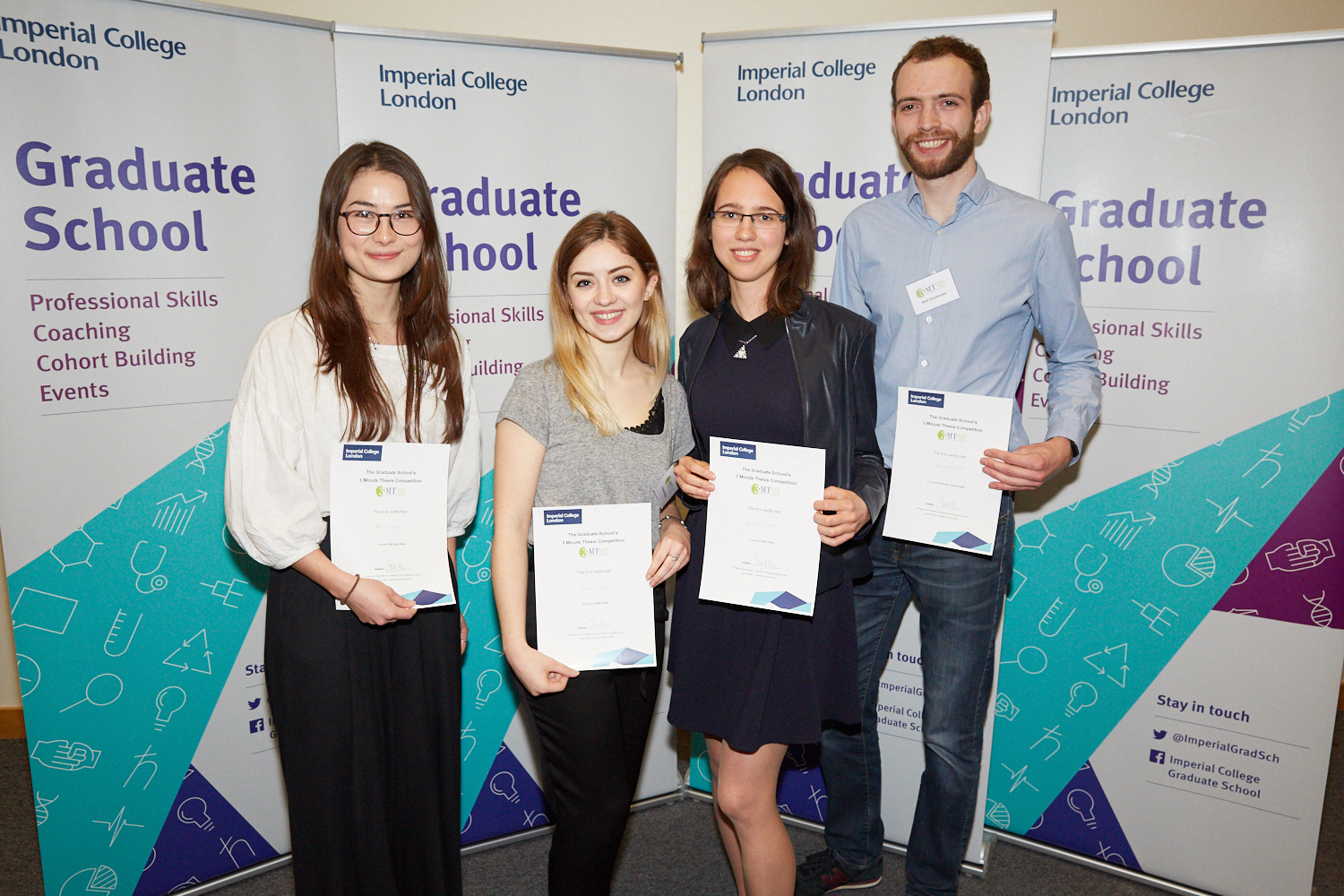
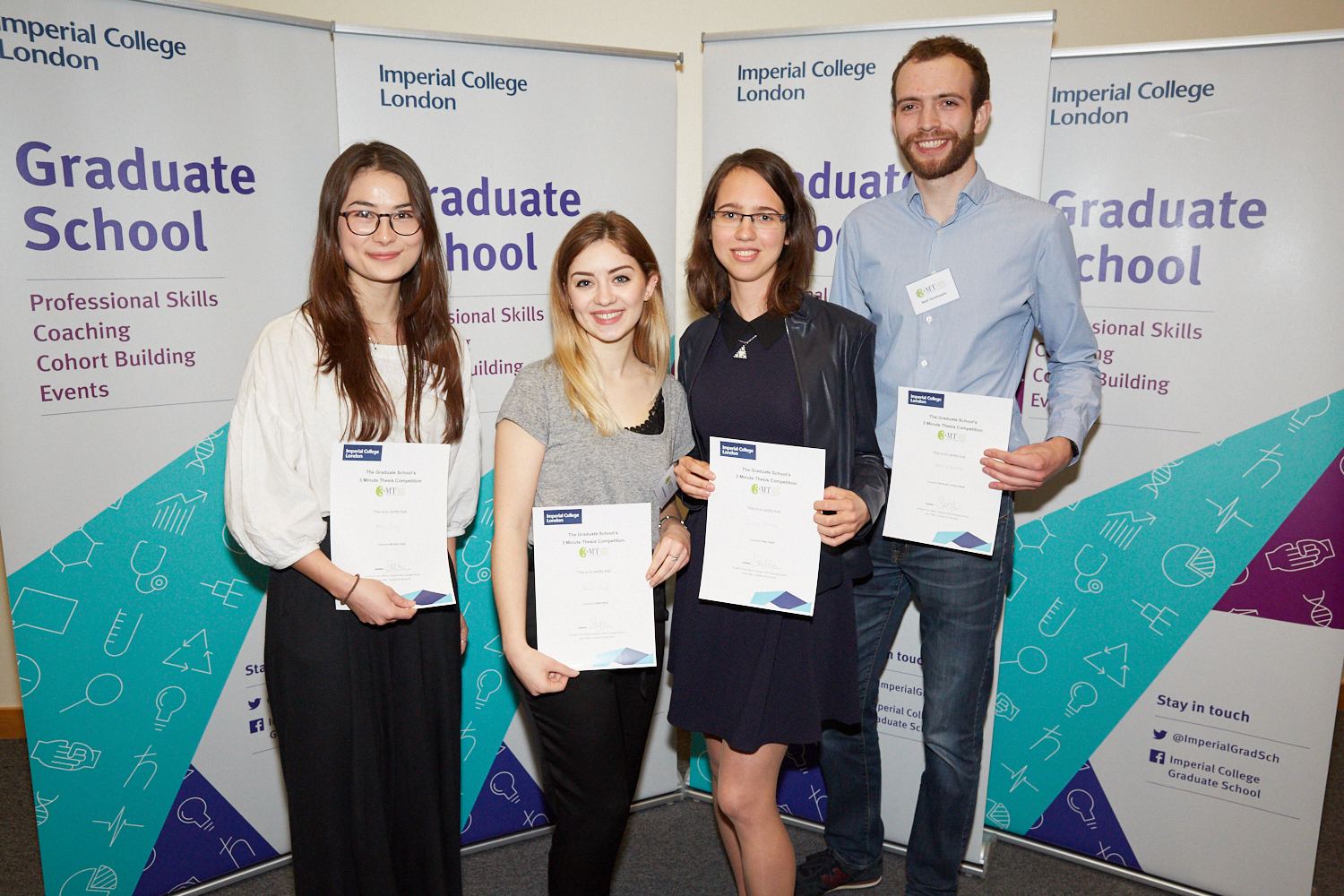
Maria Lucey (2nd place), me (3rd place), Paulina Rowinska (1st place) and Matt Douthwaite (People’s choice).

180 Seconds

by Paulina Rowinska, PhD student in the Department of Mathematics.

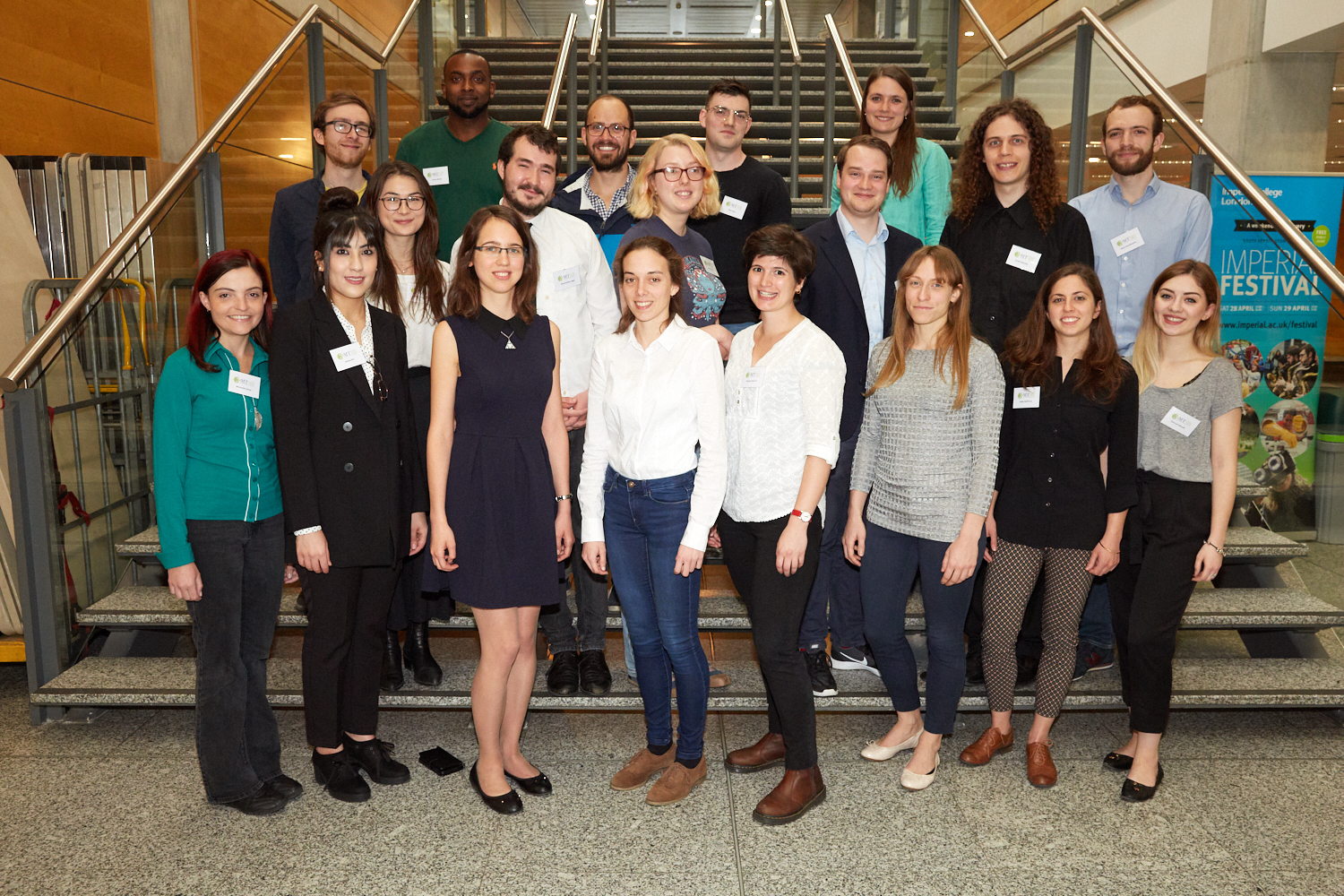
Years of research squeezed into three minutes? That was the task I and eighteen other participants of Imperial College Three Minute Thesis competition had to face on Tuesday 24th April 2018.

The rules are very simple. Contestants get exactly three minutes to describe their research to a general audience, using only one static slide. Sounds easy, but trust me, it’s extremely difficult. How do you introduce your narrow topic, explain what your research involves and persuade the audience that they should care in the first place?

All nineteen of us managed to do that. I learned a lot about a variety of research areas, from planting forests in Brazil, to optimal mixing of coffee and milk, to gravitational waves. I was impressed by the amount of information other contestant were able to convey in such a short time.

Because my last name starts with “R” and the order of presentations was alphabetical, I had to wait for what felt like AGES for my turn. These were very stressful hours! However, as soon as I stepped on the stage, I felt much better, especially since the audience was lively and reacting very positively to my words.

Our host, Professor Tom Welton, the dean of the Faculty of Natural Sciences, made the event truly entertaining. His jokes, smiles and charismatic personality let us, the contestants, forget about the challenge ahead of us.

Finally the panel of judges consisting of Dr Helal Ahmed, Dr Amy Seakins and Simon Schöller picked their favourite talks. The third place went to Hannah Maude from the Department of Medicine for her talk ‘Genomics of Common Disease’ that explored the link between the genes and diabetes. The second place was awarded to Maria Lucey from the same department. During her presentation ‘Food for Thought: Inhibiting Appetite with Prokineticin’ she explained how our appetites works. And the first prize… to me, for my talk ‘Winds of Change’! I used my three minutes to describe how I’m applying mathematics to help investments in renewable energy sources. The audience also voted for their favourite presentation, which turned out to be ‘Wearable Integrated Circuits for Sweat Analysis’ by Matt Douthwaite from the Department of Electrical and Electronic Engineering, who made us feel a bit better about our stress sweat 😉

I signed up for this contest spontaneously and I’m truly happy I did it! During this fun event I got a chance to hear about the research of fellow PhD students as well as practice giving talks, which is the key to get over the fear of public speaking.

Make sure that in 2019 you sign up yourself and get your own three minutes of fame. Good luck!

The 2018 Three Minute Thesis Contestants
The winners! L-R: 2nd place, 3rd place, 1st place and People’s Choice winner