Much research has moved online during COVID-19, but that hasn’t stopped Lindsay and her co-researchers
World Mental Health Day is an opportunity to reflect on what needs to change, but also to celebrate the people who are working to make sure positive change happens. Like Dr Lindsay Dewa, IGHI Research Fellow and mental health expert.
We caught up with Lindsay to find out about her mental health research, her path into academia, and why she’s excited about what the future might hold. (more…)
IGHI is home to a team of staff who are skilled and passionate about their roles. Our talented people are the reason we’re able to tackle some of the most pressing global health challenges through cutting-edge innovation.
At IGHI’s NIHR Imperial Patient Safety Translational Research Centre, I lead research projects relating to the role that patients and carers can play in making sure medicines are used safely.
“No test is better than a bad test,” said Matt Hancock.
While we may tire of hearing slogans, the principle here is important.
Coronavirus antibody tests have been hailed as a game-changer for the pandemic and a way forward as we traverse these uncertain times. Antibodies are Y-shaped immune molecules produced by the body in response to an infection. They latch onto the offender – such as coronavirus – in a bid to thwart it. Your body keeps a record of the encounter, so that if it comes across the same pathogen in the future, it can quickly make more antibodies and launch an effective attack.
This is the basis for hedging bets on antibody testing for coronavirus. The idea is that the tests will flag people who have already had the infection and therefore might have protection from getting it again. And so these individuals could potentially be afforded greater flexibility than those vulnerable to the disease.
But it’s not that simple.
Despite being known for under a year, this is arguably one of the most studied viruses ever. Yet it’s still new, and there are many unknowns. Crucially, we don’t yet know whether having antibodies can prevent future infection. Or, even if they do, how long this immunity lasts – a month, a year, many years? These are all questions we must answer before a potentially dangerous over-reliance is placed on these tests.
With so many caveats, why are researchers at Imperial leading a major study of community antibody testing? While the tests’ power to indicate immunity is – as yet – far from clear, they have important uses beyond this. Rather than focussing on individuals, looking at widespread patterns at the population level could help to monitor the evolution of the epidemic, which will have important implications for easing of restrictions such as social distancing.
Antibodies vs antigens
Currently the most accurate way to look for antibodies is to perform a lab test called an ELISA, on a sample of blood. Antibodies are very selective about what they stick to – specific molecules called ‘antigens’ (in this case, bits of the coronavirus). In an ELISA, a blood sample is mixed with coronavirus antigens that are ‘glued’ onto a test surface. If antibodies are present in the sample, they stick to the antigens and this binding leads to a detectable signal, most commonly in the form of a colour change.
These lab-based tests are accurate and can tell us the exact amount of antibody in a sample, but they’re complicated to perform, and require expensive, specialised labs. This means it’s not feasible to roll out this kind of antibody testing at a national scale, when labs are already overburdened. That’s why Imperial’s REACT study is looking at the possibility of using home testing kits instead.
“The big advantage is that the home testing kits are really cheap to produce, easy to distribute and store at room temperature, and they completely bypass the lab,” says Barney Flower, Clinical Research Fellow at Imperial and member of the REACT study team. “The beauty is that you get participants to do the leg work and carry out the tests themselves, so it’s less of a capacity issue when resources are stretched.”
These home tests, called Lateral Flow Tests (LFTs), work in a similar way to ELISA, but everything is crammed into a small testing stick, which participants place a drop of blood onto. If antibodies are present, a signal will show up in a window on the testing stick, usually a coloured line.
The antibody testing kits display coloured lines depending on the result
A flooded market
By May of this year, already more than 200 of these LFTs had reached the market. However, there was no guarantee of their accuracy.
“The tests have been validated for use in laboratories, but in general their performance has been tested in small numbers of individuals, often fewer than 50 patients,” Barney says. “And these were usually individuals who were in hospital with COVID-19, so quite sick, and therefore more likely to have a strong immune response to the virus, producing lots of antibodies.”
This presents an issue, given that many people who have been infected with the coronavirus don’t have symptoms, and most don’t end up in hospital. So it’s critical to ensure that these tests work in this key group. And it’s also important to make sure that the tests perform well when they’re carried out by individuals themselves, not a trained technician – which is usually how they’re scrutinised in formal validation tests.
Antibody test results: true or false?
There are two main criteria that researchers use to assess how well an antibody test works. Its sensitivity is how well it picks up people who have been infected. If a test is 95% sensitive, for example, then out of 100 individuals who have had COVID-19, five will be wrongly identified as having not been previously infected (false negatives). Specificity, on the other hand, concerns the test’s ability to correctly identify those who were not infected. So if a test’s 99% specific, out of 100 people who haven’t had COVID-19, one will be wrongly identified as having been infected (a false positive).
In the UK, our regulator of medicines and medical devices (the MHRA), set out guidelines which stated that antibody tests need to be at least 98% sensitive to be able to guide decision-making in the clinic.
“The tests we’ve been looking at have been far below that,” Barney says. “So they’re no good at the individual level. But if we can find a test that’s really specific, we can make adjustments in our calculations and get a fairly accurate picture of the proportion of people who have antibodies at the population level.”
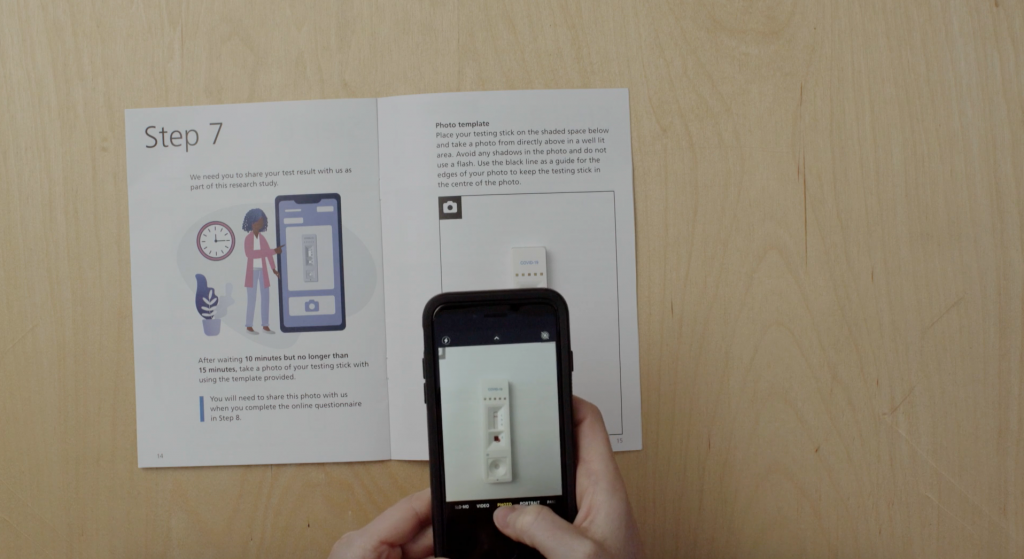
Study participants are asked to read the result of their test and submit a photograph so that researchers can review their interpretation
A testing conveyor belt
For the REACT programme, a team led by Professor Graham Cooke has been assessing a number of different commercially available tests, including the Wondfo test that the UK Government stockpiled early on in the epidemic. In the first phase, researchers carried out a small-scale study to test accuracy and usability (how well people can perform the test by themselves) on a group of around 270 healthy people, all NHS staff. Importantly, they’d all had a previous diagnosis of COVID-19 confirmed by a nose swab, but none of them had been hospitalised from the disease.
“The first test we tried out was throwing out negative results in four out of five participants – in a group who’d all had confirmed infection,” Barney says.
As well as testing the positive cases’ blood with the antibody kits, the researchers also performed an accurate lab ELISA to check if antibodies were detectable on the best test available. They found antibodies were present in more than 95% of cases.
They also tested the antibody kits on a batch of 500 blood samples taken from 2019 or earlier, i.e. preceding the pandemic and therefore COVID-19-free.
Together, this process is allowing the researchers to determine the tests’ sensitivity and specificity with a high degree of confidence.
“We’ve now developed a system where we can continually bring in new tests as they emerge, evaluate them on our bank of ‘known positive’ and ‘known negative’ samples, and if they look good we can test them in the clinic in more of a real-life scenario,” Barney says. “It’s like a lateral flow test conveyor belt.”
It’s how you use it
Another vital aspect of this work has been determining how usable these tests are by members of the public. Even if they perform well in controlled environments, they’re no good for use en masse if people can’t do them at home. A huge effort has been underway at Imperial, led by Prof Helen Ward, to involve and engage the public in this part of the project. Thousands of volunteers to date have given their time, offering valuable insight that’s not possible to gauge through lab testing alone.
While all of the LFTs work in the same way – placing a drop of blood onto a testing stick – there have been a number of issues with usability that this public involvement exercise has flagged up.
“This has been so important to highlight real issues with the tests,” Barney says. “One of the major things has been getting enough blood from the finger-prick, and successfully dropping this on the right part of the testing strip.”
At the start of the study, participants were provided with a plastic pipette to collect their blood after pricking their finger, which was then used to transfer a droplet of their blood onto the stick. But this soon proved a fiddly procedure, and now individuals are asked to place a drop of blood directly onto the test.
“We also found that health professionals tended to dive straight in and pay less attention to the instruction manual, and were therefore more likely to get it wrong!” Barney recounts. “Clear, simple instructions are so important!”
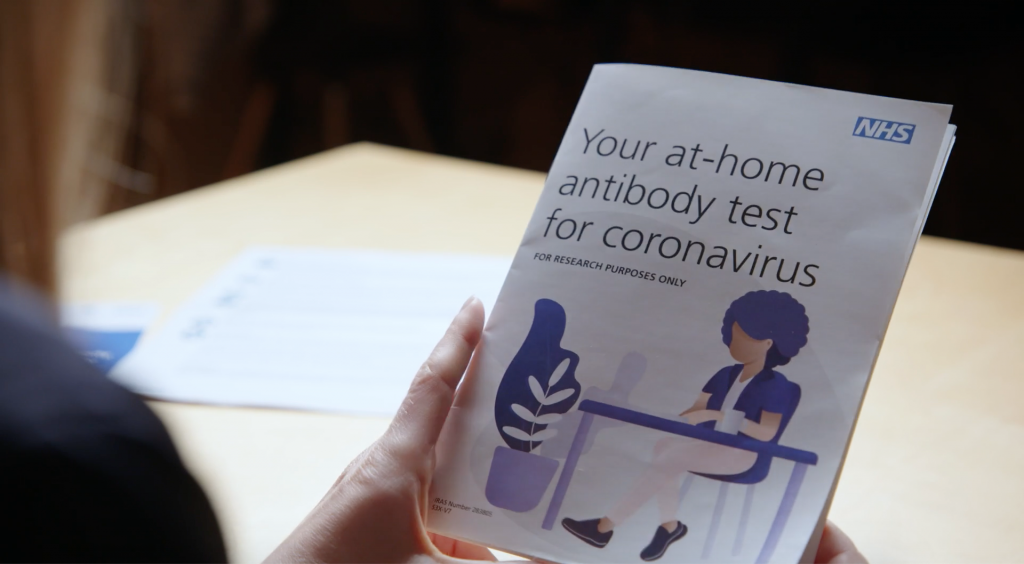
The leaflet to guide people through the at-home antibody test was developed with the public
Blood, spit, spots
While this research continues, the REACT team has narrowed down their hunt for the best home LFT. After analysing 11 different LFTs in the lab, they found the best tests could correctly identify individuals with coronavirus antibodies over 80% of the time, while also correctly ruling out those who don’t in more than 98% of tested individuals.
Based on these findings, the team selected and rolled out a finger-prick test to more than 100,000 people across England, who tested themselves at home in June and July. Covering all 315 local authorities to ensure a nationally-representative sample, this major study found that just under 6% of the population had antibodies to coronavirus and had therefore likely already had COVID-19. It also revealed that the virus hadn’t spread evenly across the country, disproportionally affecting key workers and Black, Asian and minority ethnic individuals.
Watch the video below for the study highlights:
Today we announced our findings of the world’s largest study on home coronavirus antibody testing. @imperialcollege researchers show that around 3.4 million people in England may have already had #COVID19, but that it hasn’t spread evenly across the country.
The team is continuing further testing of LFTs on a group of 5,000 key workers to gather more data. This particular piece of work is also investigating whether other methods could also be used for antibody testing, such as saliva samples or drops of blood dried on paper.
While this research can’t tell us anything about possible immunity levels, its offering is a greater understanding of how the epidemic is progressing, and who is at greatest risk from the infection.
“What this can help us understand is how many people have been exposed to the virus,” Barney says.
“Comparing these numbers to deaths and numbers admitted to hospital, in different populations and different parts of the country, will help plan for future outbreaks.
“However, it’s still important to say that we don’t know what these antibodies mean for individuals yet. Do they offer protection? And if so, for how long? The future of mass antibody testing rests on what we can learn from research like this.”
IGHI is home to a team of staff who are skilled and passionate about their roles. Our talented people are the reason we’re able to tackle some of the most pressing global health challenges through cutting-edge innovation.
According to the Department for Transport, between June 2017-18, 1,770 people lost their lives due to a road traffic collision in Great Britain.
But this isn’t an issue that only affects developed countries. It’s a global problem with many low-and-middle-income countries having even higher numbers of victims. Road traffic incidents can result in the loss of loved ones for families and friends, and for those who do survive, they can mean sustaining life-changing injuries and trauma. These impacts stretch beyond the individual, affecting economies and put pressure on health systems.
His healthcare innovation, Third Eye Intelligence, an artificial intelligence (AI) driven platform that predicts a patient’s risk of organ failure impressed the competition judges. Sam’s pitch earnt him the top prize of £10,000. But behind every start-up, there is a journey full of twists and turns.
Digital technology has been poised to transform the way that healthcare is delivered. Yet uptake and implementation has been slow; in the UK alone for example, almost a quarter of hospitals still use paper rather than electronic records.
But when COVID-19 hit, health systems were forced to rapidly adapt and use technology to deliver care remotely, where face to face appointments were no longer possible. While it’s impossible to predict when the COVID crisis will be over, will remote care become the ‘new normal’ post-pandemic? And if digital-first health technologies are here to stay, what are the implications for patients?
Newly launched IGHI research, supported by Imperial’s COVID-19 Response Fund, will explore these important questions. We caught up with project lead, IGHI Research Fellow Dr Ana Luisa Neves, to find out more about the work and what it hopes to achieve.
What are digital-first health technologies?
“These are all means in which the patient’s first point of contact is through a digital channel, rather than face-to-face. For example, phone and video consultations, online services, and mobile apps.”
Why are you interested in these?
“Our idea is that digital technology can help tackle challenges that we had before COVID hit. Like making care more accessible and affordable, and reaching groups of people who may not be confident going to a doctor or nurse.
“Right now we’re in the middle of a massive real-life experiment, which has pushed this closer to reality. We will resume normality at some stage, however it may look. But what can we take from this experience so that we can continue using these models in a better way?”
What are you hoping to find out about these technologies?
“We want to understand the patient experience. In principle these technologies should improve accessibility, but that may not turn out to be true – or at least not true for everyone. So we’ll explore the potential barriers to healthcare access, whether some individuals or groups are somehow excluded from these technologies.
“We also want to look at patients’ attitudes and perceptions. In what circumstances do they want to use digital technologies? How do patients want these to move forward? When do they think that digital tech may work better than more traditional models of care, and how can we create conditions for that to happen?”
And how are you going to answer those questions?
“This work sits within a broader program of work that’s also looking at GPs’ views of these technologies. That’s using a global survey and focus groups, involving 18 countries. We’ll be replicating this method but looking at patients’ perspectives instead.
“We want to make sure we get nationally-representative samples from countries and information about demographics, as well as ‘digital literacy’. Part of digital literacy covers technical aspects, such as Internet access, but also individuals’ ability and experience using digital tools.”
Do you have any assumptions about what you might find?
“I expect we’ll find that certain groups feel excluded. Evidence has shown that elderly individuals, for example, or those with lower digital literacy are less likely to use these technologies. We want to understand what we can do to make it easier for them.”
How will you apply your findings to healthcare settings?
“We’re hoping to bring together the findings from both GPs and patients, and then consider how we can make these technologies better for the future. We’ll then develop a framework for recommendations, a ‘toolkit’ that healthcare professionals can use to support decision-making. For example, when triaging patients, the framework could help doctors identify when digital technologies may be useful and appropriate. This could help doctors decide whether to offer digital solutions as part of patient care, post-COVID-19.”
Grappling with a novel virus that reared its ugly head barely six months ago, the world is facing many uncertainties. The SARS-CoV-2 virus is proving unpredictable and the pandemic is fast-moving. But one thing we do know is that older people bear the brunt of the impacts of COVID-19. The elderly are disproportionately affected, with those over 65 accounting for some 80% of hospitalisations due to the disease. And one in five over-80s with COVID-19 will need to go to hospital, compared with one in 100 individuals under 30. (more…)
I started my research on wearable sensors when I was appointed as a researcher in a UK Trade & Investment (now Innovate UK) funded project, while I was working on my PhD on a completely different topic.
When I first started working on sensor research, the concept of wireless sensor networks had just been introduced. I was one of the first few researchers who started the development of body-worn sensors for healthcare and wellbeing applications. Being one of the pioneers in this emerging field, I have developed a number of novel sensing platforms, and some have been widely used in the research community.
In wearable sensing research, we often have to start from scratch. We build our own sensing hardware, compose the embedded software, design the networking infrastructure, and develop the data analysis algorithms, as well as conducting the clinical validation studies. Basically, we have to start from generating the new ideas, turning the ideas into working prototypes, and then carry out the studies to evaluate the technologies’ potential benefits to patients. Although it is very challenging, I have learnt and gained invaluable experience in multi-disciplinary research. Apart from addressing healthcare challenges in the UK, our work has been extended to address some global health challenges.
Currently, I am leading a Bill & Melinda Gates Foundation funded project with a team of researchers from the UK and US to develop wearable and AI technologies to enable accurate assessment of dietary intake. The project aims to develop the technology to support large-scale nutritional studies, in particular assessing family nutritional intakes in low- and middle-income countries.
We plan to deploy and trial our technologies in rural and urban households in African countries. It is a very ambitious and challenging project, but at the same time,
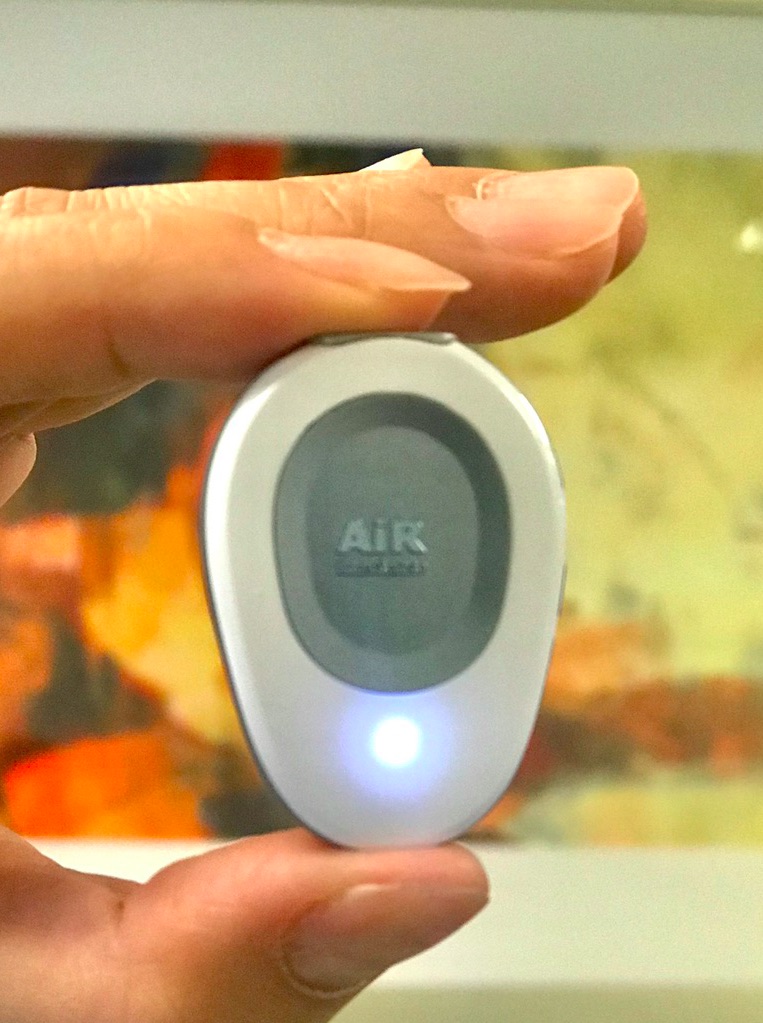
One of the sensors Dr Lo has been working with
it has given us an opportunity to develop technologies which could potentially transform the field of dietary intake analysis.
While tackling the challenges in conducting field studies in Africa, my research group is also working closely with a research partner in Thailand. This project is deploying and testing our low-cost wearable sensors for fall preventions in local hospitals and residential care homes. Apart from healthcare applications, I have also explored the applications of sensing technologies for elite sport training and other applications.
With the advances in 5G mobile networks and Internet of Things (IoT) technologies, we anticipated that sensors will be widely used in supporting the digital transformation of our society. In particular with the current COVID-19 crisis, pervasive and low-cost sensing technologies could help alleviate the pressure on our healthcare services while providing quality care remotely.
As I started my research in this new field at its infancy, it has been a very exciting journey. It has given me opportunities to investigate novel technologies to tackle major healthcare challenges. The most rewarding part of my work is seeing our technologies being deployed and used to help patients.
 By
By 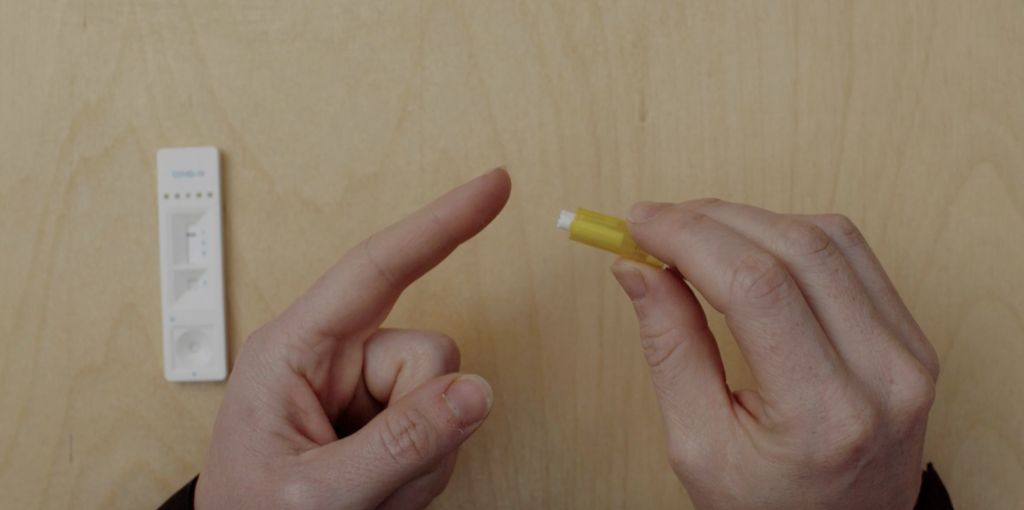


 It’s been almost a month since Imperial PhD student Sam Tukra won IGHI’s

 By
By