Blog posts
 Being admitted to hospital can be a distressing for anyone.
Working together to improve global patient safety
 In 2015, the United Nations (UN) established the ambitious Sustainable Development Goals (SDGs) to achieve a better and more sustainable future globally by 2030. This includes the UN’s target to achieve universal health coverage (UHC) and give one billion more people quality healthcare.
IGHI people: Meet Roberto Fernandez Crespo, Analytics Fellow, Big Data and Analytical Unit
 IGHI is home to a team of staff who are skilled and passionate about their roles. Our talented people are the reason we’re able to tackle some of the most pressing global health challenges through cutting-edge innovation.
Could robots transform treatment for cardiovascular disease?
 Cardiovascular diseases (CVDs) have a significant impact on populations around the world. Affecting the heart and blood vessels, they are responsible for more deaths across the globe than any other cause.
Could a robotic scrub nurse be assisting our surgical procedures in the future?
 Assistive robotic devices (ARD), machines controlled by a person to help carry out a task, are increasingly being explored for their potential to help deliver healthcare.
In 2019, the UK government launched a five-year research programme dedicated to making autonomous systems (such as robots to support older people at home) safe for public use. The appetite for advancing healthcare with robotics is driven by the multiple benefits these devices can offer, including freeing up healthcare staff for other tasks and minimising human error.
What’s it like to…work in mental health research?
 By Dr Lindsay Dewa, Advanced Research Fellow, NIHR Imperial Patient Safety Translational Research Centre, IGHI
I have been aware of mental health from an early age. I just didn’t know it was called that at the time! I remember feeling deeply about things and wanting to make sure everyone was okay if they looked sad or down. It was then only natural that I leaned towards getting a degree in psychology – the science of the mind and behaviour. I then completed my MSc in research methods and forensic psychology. This naturally led me to embarking on a PhD studying sleep and mental health in prison populations. I couldn’t wait to get started!
Calidiscope: Modernising the treatment and detection of pressure sores

Almost three months ago, the Institute of Global Health Innovation held the final of their 9th annual Health Innovation Prize, a competition searching for the next generation of innovators in health.
Harnessing technology to tackle undernutrition

Almost half of all deaths in children under the age of five are linked to undernutrition. Most of these occur in the developing world. There is therefore an urgent need to address this pressing issue which costs the lives of millions of children every year. And as detailed below, the answer is not as simple as providing more food.
In a new Gut review, led by IGHI lecturer Dr Alex Thompson, scientists explore the role that technology could play in improving understanding, management and prevention of this complex condition, with a focus on low- and middle-income countries.
We caught up with Dr Thompson to find out more. (more…)
Climate change is undermining people’s mental health – it’s time for action

I have spent the last 18 months encouraging effective international responses to COVID-19. I have learned that the coordinated and connected responses needed for responses to global threats are not easily achieved in today’s world. Yet unless nations can find ways to agree on the challenge, combine their responses and work willingly in synergy, success will be elusive.
Building the habit of working together is even more important when tackling climate change and its consequences. This particularly applies when exploring how changing climates affect people’s mental wellbeing.
There is indeed mounting evidence that climate change is affecting people’s minds as well as their bodies. The number who end their lives during extreme weather and climate events is on the increase. Following a climate-driven disaster, cases of psychological trauma can exceed those of physical injury by 40 to 1.
Yet the potent psychological effects of climate change are largely absent from the public and policy discourse. They need to be made tangible and accessible. This is even more important given the expected increase in the extent and severity of extreme weather all over the world.
The issue needs attention now because it has the potential to undermine the lives of millions of people. It needs professional bodies, universities, local authorities, governments and international organisations to act together now. If effective action is delayed, the scale of the challenge will increase sharply, as will the cost of action.
The Climate Cares team from Imperial’s Institute of Global Health Innovation and Grantham Institute has laid bare some of these issues in a major new review, released last week. The review sets out best how to support people whose mental wellbeing is undermined by changing climate. The proposed actions will enable them to live their lives to the full, enjoying good mental health. There is a clear appreciation of who needs to act, and how they should do so. Actions should be implemented with a view to their being adapted to local context and reviewed regularly.
Implementation can be challenging as those most at risk of climate-related mental ill-health often have limited power and agency and are hard to reach. Those who are at risk should be incorporated into any response. As health and social care systems adapt to their specific needs, they will make an even more important contribution to fair, healthy and happier futures for all.
Professor David Nabarro is co-director of the Institute of Global Health Innovation and WHO Special Envoy on COVID-19.
Download the report, ‘The impact of climate change on mental health and emotional wellbeing: current evidence and implications for policy and practice’, by clicking this link.
IGHI people: Meet Professor Ferdinando Rodriguez y Baena, Co-Director, Hamlyn Centre
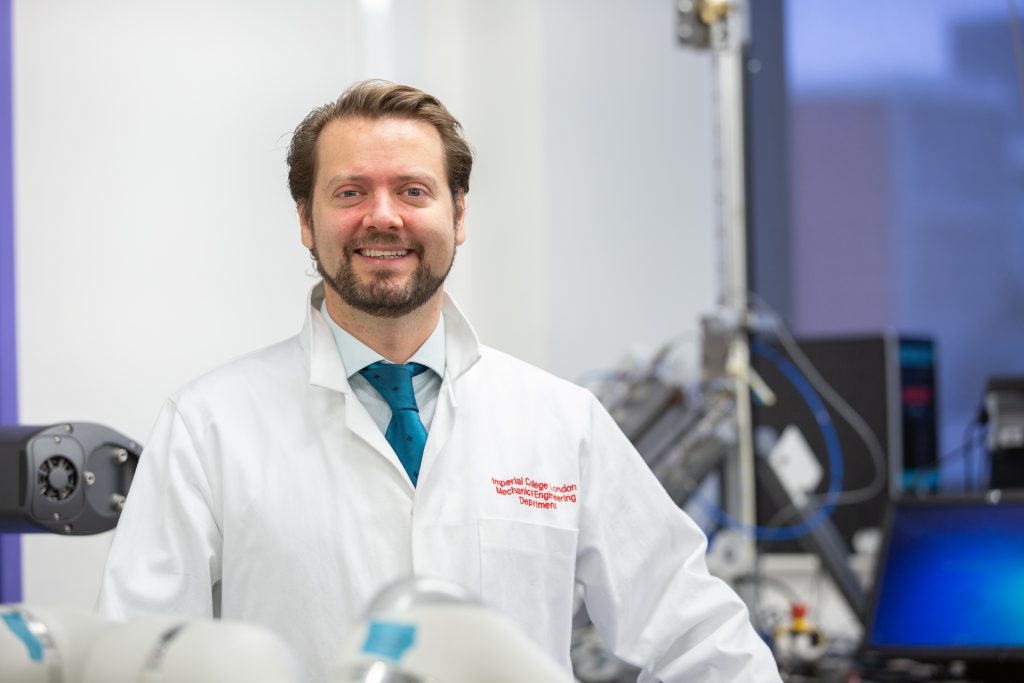 IGHI is home to a team of staff who are skilled and passionate about their roles. Our talented people are the reason we’re able to tackle some of the most pressing global health challenges through cutting-edge innovation.
We’re giving you the chance to get to know our staff a little better and learn about what motivates them in their roles, who inspires them and what they like to get up to outside of IGHI.
Meet Ferdinando Rodriguez y Baena, co-director of IGHI’s Hamlyn Centre and Professor of Medical Robotics. Find out more about Ferdinando’s passion for engineering and medicine and his love for food!
What does your role involve?
As the engineering co-director of the Hamlyn Centre, I work with Professor Ara Darzi to deliver the strategy we have set out, keep our finances in check, and look for new ways to expand our remit, reach and impact.
What attracted you to the role?
The opportunity to influence a research field that is close to my heart. I was also attracted by the chance to build tighter links between engineering and medicine, which I think are key to understanding what is needed to translate research successfully and achieve clinical impact.
How would your colleagues describe you in three words?
Caring, funny, and with integrity.
What’s your biggest achievement to date – personal or professional?
The impossible question… remaining sane while juggling family life and career in a working couple household!
Who inspires you?
Amazing people that no one knows about.
If you had a superpower, what would it be?
Definitely teletransportation!
What’s your guilty pleasure?
Definitely food! Mrs and I are definitely foodies. Was it not for my discipline and self-control, I would most definitely be rolling into work!