By IGHI guest blogger, Chris Bird, PG student from the MSC in Health Policy at the Centre for Health Policy and Project Manager in the System Engagement Programme at the National Institute for Health and Care Excellence (NICE)
At a recent conference I was lucky to listen to a guest lecture by Dr Kevin Fong. Kevin has a long standing interest in human space exploration and space medicine and has worked with NASA’s Human Adaptation and Countermeasures Office at the Johnson Space Centre in Houston. He’s travelled the world to meet medical innovators and has produced interesting documentaries for television showing the extreme scenarios in which healthcare and technology can be applied to further human survival.
Innovating through battlefield medicine
Listening to Kevin inspired me to go away and discover more about how innovations in battlefield medicine have gone on to benefit wider society.
Such are the advances in emergency medicine on the battlefield in recent years that many soldiers who previously would have succumbed to their injuries are now often going on to be so-called ‘unexpected survivors’ as found by the National Audit Office’s assessment into the quality of treatment on military operations. In many cases they survive with complex and highly specialised needs.
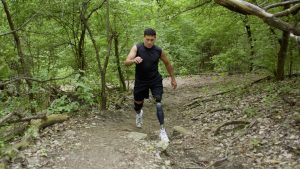
One of the most common injuries resulting from recent military engagements in Iraq and Afghanistan has been limb loss. Many soldiers have become multiple amputees as a result of maiming from improvised explosive devices. In the past such survivors would have been constrained by their physical condition and the limits of technology available to give them some form of mobility.
Engineering meets medicine
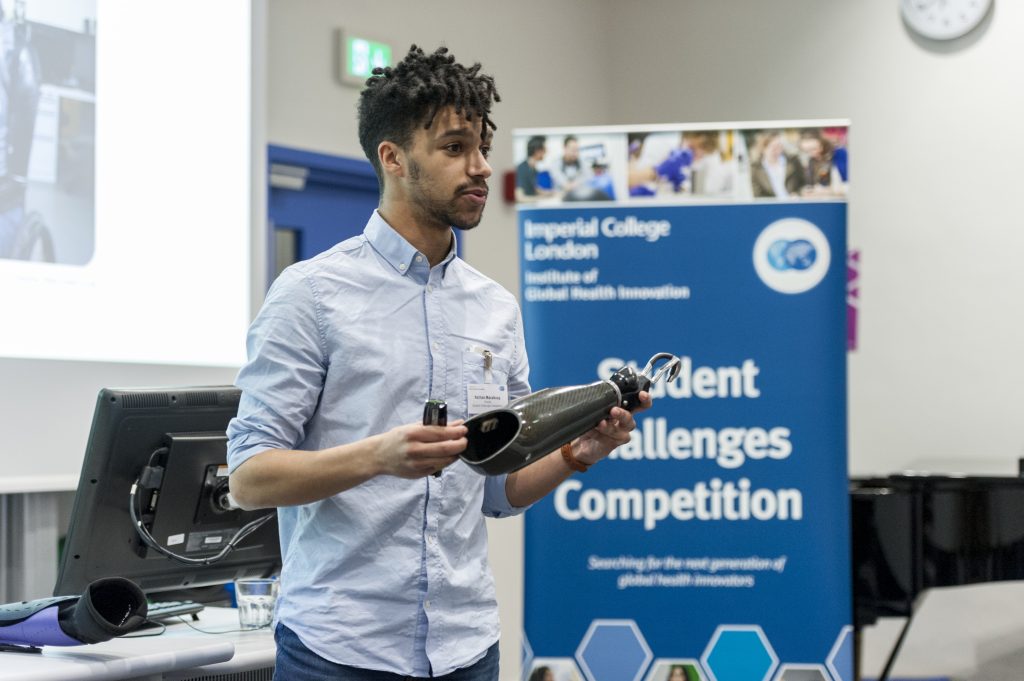
Today, advances in prosthetic limb replacements mean that science fiction has become science fact. Devices that 20 years ago were only the stuff of science fiction movies are now benefiting veterans in real life today. Specialist providers of prosthetics and orthotics such as the Hanger Clinic in the US are at the forefront of efforts to meld the best practices of engineering, science and healthcare to devise prosthetic solutions that empower their patients.
Recent innovations to prosthetics include gyrostabilisers to provide better balance and support. These devices known as microprocessor-controlled prosthetic knees (MPKs) have an in-built battery powered computer which senses the mode and level of activity the user is undertaking and adjusts swing and stance and the vacuum that grips the user’s residual limb to match this activity. People using an MPK have reported improved individual mobility and independence and greater freedom to undertake activities. Prince Harry’s Invictus Games have served to highlight the incredible achievements that these veterans, supported by advanced prosthetics such as MPKs can realise as a result of these advances in emergency medicine, technology, physical and mental rehabilitation.
So how do we get those innovations out to people in wider society, but living with similar disabilities who might benefit from their application?
Specialised commissioning
In the UK National Health Service (NHS), its specialised commissioning team are now overseeing the provision of MPK devices to restore quality of life to around 500 people per year. Resource stewardship in an era of stretched finances requires policy makers to ensure that money in new innovations is invested wisely. For these new treatments, complex decisions have to be made about which ones represent the best value taxpayers and clinical effectiveness for patients. NHS England has found the MPKs to be a cost-effective innovation for the NHS’s specialised services given the range of improvements that can deliver to a patient’s overall health and wellbeing.
NHS England’s Specialised Commissioning through Evaluation (CtE) Programme (with a budget of £25m) is testing an approach to evaluating further potentially promising specialised treatments, for which there is currently insufficient evidence to supporting routine commissioning (funding) within the NHS.
For each CtE scheme, new data is collected within a formal evaluation programme, undertaken with the National Institute for Health and Care Excellence (NICE), potentially leading to the development of a new or revised national clinical commissioning policy for future access.
Amongst promising new innovations currently at the CtE’s data-gathering stage is the Second Sight Argus II Retinal Prosthesis – ‘bionic eyes’ to tackle inherited blindness where an implant in the patient’s retina is linked to a camera mounted on a pair of glasses. This camera sends wireless signals direct to the nerves which control sight and are then ‘decoded’ by the brain as flashes of light.
Boldly going….
It’s often the case that science fiction forecasts what the next technological innovation will be. Looking at the latest offerings in cinema – from the artificially intelligent synthetic beings of Ridley Scott’s Alien and Blade Runner franchises to the advanced medical diagnostics and regenerative medicine of Star Trek, the future of medicine looks an exciting place to be.
At the recent Expo, NHS Medical Director Sir Bruce Keogh noted exciting new evidence that artificial intelligence will have the capability to read x-rays within four years. It continues to be the role of health service policy makers today to ensure the conditions are in place for these innovations to be tested and if found to meet value and outcomes thresholds, realised for the benefit all those whose lives may be enhanced by them in our healthcare systems.
Follow Chris Bird on Twitter – @TheChrisBirdy
Read Advancing patient outcomes through technological innovation – from science fiction to science fact in full
 Standing in the Royal Society on the 16th of April waiting for the participants to arrive was both surreal and exciting. Surreal because of the rapid journey our wonderful team had taken to make the programme happen – this had become a reality so quickly. Exciting because I couldn’t wait to get started – this programme is important for the system and for me something I am hugely committed to.
 My name is Katy Pickles and I’m currently part of the Young Persons Advisory Group (YPAG) for Imperial College London’s social media, other technologies and mental health research, which is focused on how young people might use social media whilst suffering with a mental health issue. Having used social media whilst in treatment for mental illness, I have found myself curious about the results of research such as this. I have been receiving information and helping shape the project for just over a month now and look forward to the next few months whilst I follow the progress that is made.
 By John Norton