How do you remember your health appointments? Do you set a reminder on your phone, or wait for a health care provider to send a text? When invited for cancer screening do you book right away, or ignore it or forget as it makes you anxious, or as you have too much else going on?
These are some of the questions Dr Gaby Judah, a psychologist working on behaviour change at the Patient Safety Translational Research Centre at the Institute of Global Health Innovation, considers in her research to encourage people to attend their NHS cancer screening appointments.
Earlier in the pandemic, around 5% of Northwest Londoners were considered clinically extremely vulnerable and advised to ‘shield’. Although the shielding programme has ended, with the vaccination programme helping to lower people’s risk of becoming seriously ill, many are still avoiding social contact to continue to protect themselves, particularly as new variants continue to circulate.
Although all legal restrictions have ended in the UK, protective measures such as face mask wearing are still considered important to help curb the spread of COVID-19 and protect vulnerable groups. Charities have urged the population to continue to perform these behaviours to keep those at risk safe, while also allowing them to reconnect with society.
Through our Master’s in Healthcare and Design, we aim to enable creative thinkers and change-makers to drive forward innovative, human-centred approaches to healthcare service delivery. If you want to lead innovation in healthcare systems, services and spaces, this is the course for you. To find out what it’s like to study with us, we caught up with Jeremy Chui, one of our alumni, who was awarded a distinction for this programme. Read on to explore some of the design projects that he worked on during his studies.
During our final year at Imperial College London, the three of us – Akhilesh, Jeannine and Hansa – came together with the vision to reduce healthcare inequity. Akhilesh was born and raised in London and is of Sri Lankan heritage. Hansa was born in India where she remained well into her teenage years and then immigrated to the UK with her family to finish high school, and has been in the UK for nearly a decade. Jeannine was born and brought up in Pakistan, where she is currently based, and spent four years at Imperial in the UK. So we have always known we wanted to break startup norms by starting off a business in a low-income country and then expanding that to the UK. We were born global. (more…)
The Imperial Breast Unit is an internationally renowned breast research centre and one of the largest breast units in the UK. The unit receives 150 new patients per week and around 400 to 450 new breast cancer cases are diagnosed each year. According to the National Cancer Patient Experience Survey (2011/2012), nine out of ten of the lowest-rated cancer patient experiences are at large London NHS Trusts.
Mr Daniel Leff, consultant breast surgeon at Imperial College Healthcare NHS Trust and programme lead for IGHI’s MSc Healthcare and Design, worked with postgraduate students from a range of healthcare and design backgrounds on the course using human-centred design to improve the patient experience at the Imperial Breast Unit. Read on as Mr Leff takes us through this innovative journey of redesign.
“In the MSc Healthcare and Design course, the education team introduces a healthcare design challenge to students. For this project, we embedded students in the breast unit to discover the potential challenges there with respect to patient experience. It was interesting that after the field trips our students identified a few major challenges.”
Challenges with the current design of the Imperial Breast Unit
“The waiting room experience was found to be poor. Every patient was lined up, facing each other, so that everybody could see each other. This created an anxious and stressful environment in the waiting room.
“The one-way patient flow also contributed to negative emotions among patients. Patients exited the counselling areas through the waiting room, which was the same route for them to enter the counselling areas. For those who received bad news, their facial expressions could be visibly distressed, and that made the waiting room experience more stressful for other patients. Worst still is that patients receiving bad news or a cancer diagnosis could feel very uncomfortable and self-conscious.”
What has been done so far?
“Students provided the course team with their very detailed patient feedback and qualitative research findings. They presented their findings to the external examiners, the Imperial charity, unit managers, and other key unit staff and brainstormed solutions.
“Working with the course team including leaders in design innovation at the Royal College of Art (Prof Ashley Hall and Anna Wojdecka), we then worked to further mature the initial ideas and then pitched the final design brief to the Imperial charity, and they decided to fund the final re-design.
“Based on the students’ findings, several changes have been implemented so far and there and there is more to come.”
Lucie’s Room
“They created ‘Lucie’s room’ which is a quiet place for patients behind the waiting room. Rather than going back through the waiting room, patients can exit the unit through a separate route via Lucie’s room, which provides a calming place for patients to process the information they received in their consultation and counselling sessions. There is a small kitchenette with a fridge and coffee making facilities in Lucie’s room for both the patients and staff to talk in a more relaxed, less clinical and more domestic and calming surrounding.
“The table in Lucie’s room is designed to split into two sections whereby two different conversations can be happening simultaneously. When Lucie’s room is used for meetings, the staff can connect the two pieces of the table, and everyone can sit around it, much like a boardroom configuration. The ideas behind Lucie’s room are therefore multifactorial, including escape route for patients with high expressed emotions, quiet calm space for nursing-patient discussions and modular design flexibility to facilitate staff multidisciplinary team meetings.”
New patient exit route through Lucie’s room
Dynamic art installation
“A prismatic dynamic art installation has been designed for the waiting room’s window. The idea behind the installation is that this acts as a distractor to alleviate anxiety. When the light hits the glass prisms, different ‘rainbows’ form on the waiting room. There is good evidence that positive distraction alleviates anxiety. Students also redesigned how patients are seated and where to put the reception desk to provide more space in the unit.”
Prismatic dynamic art installation for the waiting room at Imperial Breast Unit.
Hopes for a better patient experience
“The project team has almost finished the redesign. After its completion, researchers will follow up on this project and collect data to see if our work improves the unit environment and patient experience.”
A decade ago, Imperial medical student John Chetwood darted from his Varsity hockey match to try his hand at another competition, with a different prize at stake. It was the inaugural IGHI Health Innovation Prize, giving UK university students the opportunity to win cash towards their global health idea.
John was one of five finalists to face our panel of judges at the Dragon’s Den-style final, and took home the top prize of £2,000 towards his new diagnostic tool for an aggressive type of bile duct cancer.
As we launch this year’s event, a decade after it all began as the ‘Student Challenges Competition’, we caught up with some of our winners to find out their journeys since taking home the prize. If you want the chance to win £10,000 towards your global health idea, click here to find out more and apply now.
Spreading SMILE across the world
Kitty and Abellona, 2017 winners
“Our innovation, the SMILE (SMart-last mILE) vaccine cooling system, is the only last-mile solution that reduces human error and vaccination spoilage. It’s patented, low-tech (freeze-free) and fail-proof. SMILE can last for three to six days without power while monitoring and displaying the remaining cool-life of temperature-sensitive products, like vaccines.
“We have made a tremendous amount of progress since we won the IGHI competition. SMILE has been iterated, lab tested and field-proven. We conducted a successful field trial in remote villages in Madagascar at the end of 2019. We are entering the manufacturing and commercialisation stage. We are also working on an upgrade for a second version with extended features.
“SMILE’s help is not limited to developing countries. It will also help in biomedical research and cold-chain applications in the developed world. We are looking for trial partners in the UK and are keen to work with institutions to improve their work efficiency with SMILE.
“Winning IGHI has helped with running our IDEABATIC platform and helped raise awareness of the last-mile cold-chain challenges. After winning the competition, we won funding from the Expo 2020 Dubai, Royal Academy of Engineering and InnovateUK which also helped in this journey. We were also selected as finalists for the MIT-Solve global challenges.
“We encourage everyone who has a passion to solve important issues to take part. Make sure you tell people the story behind the innovation and share your passion with them. Good luck!”
Getting smart with parasitic worms
Laura and Kai, 2019 winners
Capta is a smart, low-cost tool to accurately and rapidly diagnose parasitic worm infections, which are responsible for soil-
Laura and Kai
transmitted helminth infections and diseases such as schistosomiasis. Compared to current labour-intensive testing, their handheld microscope uses machine learning and automatic imaging to analyse samples. The device also records data to provide real-time statistics on global disease burden. Team Capta hope that their tool will allow for faster diagnosis of these infections, and help target treatment to areas that need it the most.
“Winning the IGHI student challenge competition provided a huge opportunity for Capta. Shortly after the competition we expanded our team and used the funding to prototype the diagnostic tool. This was crucial to demonstrate to future partners and investors that we do have the capability and expertise to develop this tool. We have recently won a grant that will support our data collection in sub-Saharan Africa, and are excited to make progress following a break throughout lockdown.
“We couldn’t recommend the IGHI competition highly enough – it is a friendly pitching competition that provides a fantastic opportunity to network and meet fellow health-tech start-ups.”
Third Eye Intelligence: Buying time for people with organ failure
Sam Tukra, 2020 winner
Third Eye Intelligence is an artificial intelligence-driven platform that brings together a vast array of patient data to predicts their risk of organ failure, acting as an early warning system for doctors working in intensive care.
The platform design
“Ever since we won the Health Innovation Prize our development speed increased significantly. Following the award, we were able to hire bright engineers from Imperial College who were hungry to grow and implement their machine learning skills in a real clinical problem case. To wit, we completed our prototype of our early warning system for organ failure software to a presentable state. Using this new developed system we were able to present to 2 hospital partners whom we will be collaborating with for a clinical trial of our system in an intensive care unit.
“Currently, we are in the process of raising our seed round to fund this multi-centre trial to continue our development for market entry with product v1. Hence, the initial winnings from the health innovation prize really helped us to accelerate our growth not only from the technology development perspective but also from the commercial perspective. Additionally, the network effects from the pitching event, lead to attracting bright minds that joined our team and helped us grow Third Eye organically.
“My advice to student innovators would be, that Imperial is full of resources to accelerate their commercial journey that goes beyond R&D. Hence, just go out there and utilise all resources at your disposal, this includes competitions, events and more importantly people, that share your mission and can join your team to help you grow and reach the next stage.”
Could you be the next Health Innovation Prize winner?
Our annual student competition is open for applications, open to students at any UK university. Click here to find out more and apply for your chance to win £10,000 towards your global health idea.
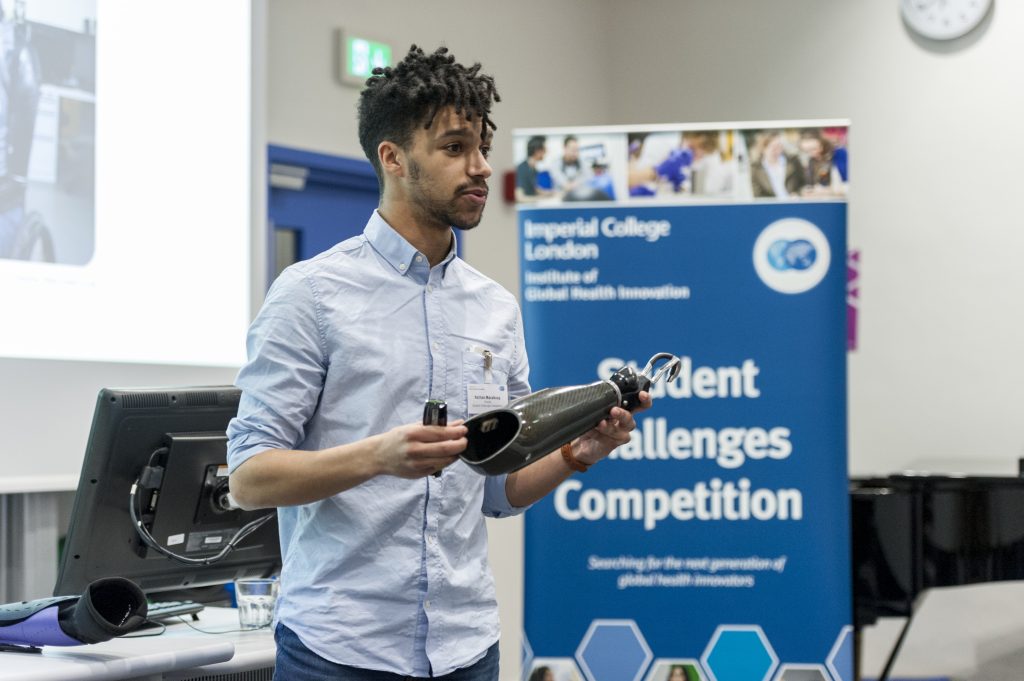
Former winner Nate Macabuag presenting his project to the 2018 judging panel.
Cardiovascular diseases (CVDs) have a significant impact on populations around the world. Affecting the heart and blood vessels, they are responsible for more deaths across the globe than any other cause.
Assistive robotic devices (ARD), machines controlled by a person to help carry out a task, are increasingly being explored for their potential to help deliver healthcare.
In 2019, the UK government launched a five-year research programme dedicated to making autonomous systems (such as robots to support older people at home) safe for public use. The appetite for advancing healthcare with robotics is driven by the multiple benefits these devices can offer, including freeing up healthcare staff for other tasks and minimising human error.
Almost three months ago, the Institute of Global Health Innovation held the final of their 9th annual Health Innovation Prize, a competition searching for the next generation of innovators in health.


 Being admitted to hospital can be a distressing for anyone.
 Cardiovascular diseases (CVDs) have a significant impact on populations around the world. Affecting the heart and blood vessels, they are responsible for more deaths across the globe than any other cause.
 Assistive robotic devices (ARD), machines controlled by a person to help carry out a task, are increasingly being explored for their potential to help deliver healthcare.