Author: Nikita Rathod

The state of mental health in the UK: Where are we going wrong?

By Erin Hallett, Head of Alumni Relations, Imperial College Business School  

Today is World Mental Health Day.

Every year on 10 October healthcare professionals, advocates, patients and other stakeholders come together to raise awareness of global mental health issues and encourage efforts in support of mental health. The World Federation for Mental Health has set this year’s theme as mental health inthe workplace.  

(more…)

Advancing patient outcomes through technological innovation – from science fiction to science fact

By IGHI guest blogger, Chris Bird, PG student from the MSC in Health Policy at the Centre for Health Policy and Project Manager in the System Engagement Programme at the National Institute for Health and Care Excellence (NICE)

At a recent conference I was lucky to listen to a guest lecture by Dr Kevin Fong. Kevin has a long standing interest in human space exploration and space medicine and has worked with NASA’s Human Adaptation and Countermeasures Office at the Johnson Space Centre in Houston. He’s travelled the world to meet medical innovators and has produced interesting documentaries for television showing the extreme scenarios in which healthcare and technology can be applied to further human survival.

Innovating through battlefield medicine

Listening to Kevin inspired me to go away and discover more about how innovations in battlefield medicine have gone on to benefit wider society.

Such are the advances in emergency medicine on the battlefield in recent years that many soldiers who previously would have succumbed to their injuries are now often going on to be so-called ‘unexpected survivors’ as found by the National Audit Office’s assessment into the quality of treatment on military operations. In many cases they survive with complex and highly specialised needs.

One of the most common injuries resulting from recent military engagements in Iraq and Afghanistan has been limb loss. Many soldiers have become multiple amputees as a result of maiming from improvised explosive devices. In the past such survivors would have been constrained by their physical condition and the limits of technology available to give them some form of mobility.

Engineering meets medicine

Today, advances in prosthetic limb replacements mean that science fiction has become science fact. Devices that 20 years ago were only the stuff of science fiction movies are now benefiting veterans in real life today. Specialist providers of prosthetics and orthotics such as the Hanger Clinic in the US are at the forefront of efforts to meld the best practices of engineering, science and healthcare to devise prosthetic solutions that empower their patients.

Recent innovations to prosthetics include gyrostabilisers to provide better balance and support. These devices known as microprocessor-controlled prosthetic knees (MPKs) have an in-built battery powered computer which senses the mode and level of activity the user is undertaking and adjusts swing and stance and the vacuum that grips the user’s residual limb to match this activity. People using an MPK have reported improved individual mobility and independence and greater freedom to undertake activities. Prince Harry’s Invictus Games have served to highlight the incredible achievements that these veterans, supported by advanced prosthetics such as MPKs can realise as a result of these advances in emergency medicine, technology, physical and mental rehabilitation.

So how do we get those innovations out to people in wider society, but living with similar disabilities who might benefit from their application?

Specialised commissioning

In the UK National Health Service (NHS), its specialised commissioning team are now overseeing the provision of MPK devices to restore quality of life to around 500 people per year. Resource stewardship in an era of stretched finances requires policy makers to ensure that money in new innovations is invested wisely. For these new treatments, complex decisions have to be made about which ones represent the best value taxpayers and clinical effectiveness for patients. NHS England has found the MPKs to be a cost-effective innovation for the NHS’s specialised services given the range of improvements that can deliver to a patient’s overall health and wellbeing.

NHS England’s Specialised Commissioning through Evaluation (CtE) Programme (with a budget of £25m) is testing an approach to evaluating further potentially promising specialised treatments, for which there is currently insufficient evidence to supporting routine commissioning (funding) within the NHS.

For each CtE scheme, new data is collected within a formal evaluation programme, undertaken with the National Institute for Health and Care Excellence (NICE), potentially leading to the development of a new or revised national clinical commissioning policy for future access.

Amongst promising new innovations currently at the CtE’s data-gathering stage is the Second Sight Argus II Retinal Prosthesis – ‘bionic eyes’ to tackle inherited blindness where an implant in the patient’s retina is linked to a camera mounted on a pair of glasses. This camera sends wireless signals direct to the nerves which control sight and are then ‘decoded’ by the brain as flashes of light.

Boldly going….

It’s often the case that science fiction forecasts what the next technological innovation will be. Looking at the latest offerings in cinema – from the artificially intelligent synthetic beings of Ridley Scott’s Alien and Blade Runner franchises to the advanced medical diagnostics and regenerative medicine of Star Trek, the future of medicine looks an exciting place to be.

At the recent Expo, NHS Medical Director Sir Bruce Keogh noted exciting new evidence that artificial intelligence will have the capability to read x-rays within four years. It continues to be the role of health service policy makers today to ensure the conditions are in place for these innovations to be tested and if found to meet value and outcomes thresholds, realised for the benefit all those whose lives may be enhanced by them in our healthcare systems.

Follow Chris Bird on Twitter – @TheChrisBirdy

An insider’s view of patient and public involvement

By John Norton

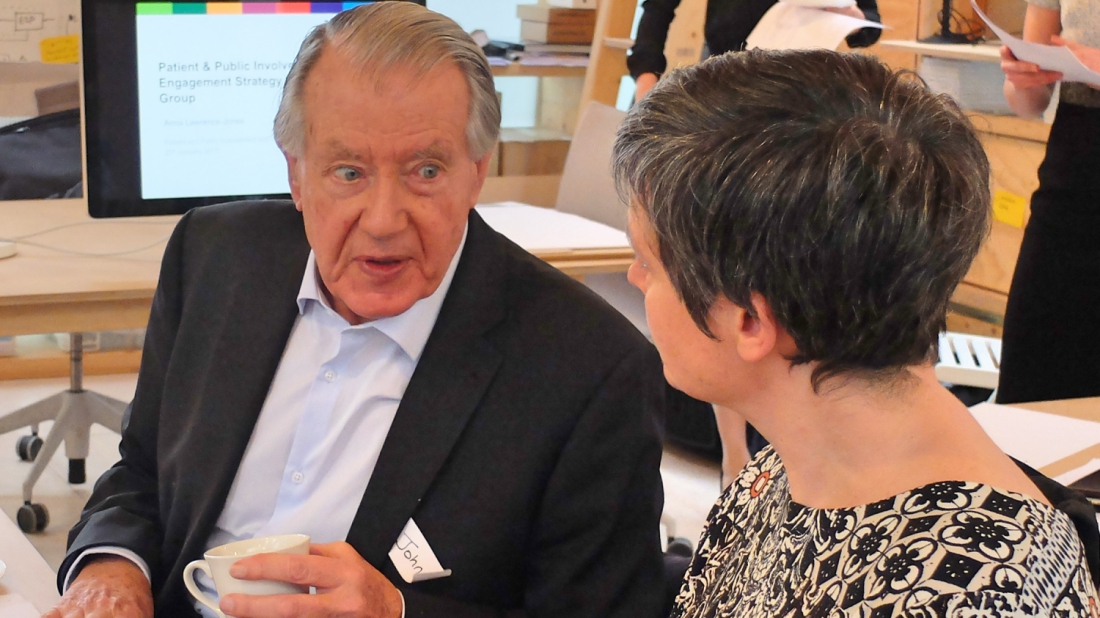
I am delighted to have been appointed one of the first 11 patient, carer and public members (lay partners) of the new Research Partners Group (RPG) of the Patient Safety Translational Research Centre (PSTRC).

What a mouthful of terms!  But, essentially, the RPG is one of the new structures the PSTRC have put in place to help ensure appropriate involvement of patients, carers, and members of the public across its research projects. The RPG will be the first point of call for researchers and will scrutinise the patient and public involvement plans in research projects and act as a link to other lay partners. The “P” is very important, as I strongly believe that patients and the public should be equal “partners” in research and care. (more…)

Peer-delivered mental health interventions – a pragmatic solution to scaling-up access to mental healthcare?

By Dr Kike Olajide, Wellcome Global Health Clinical Research Fellow, Centre for Psychiatry, Imperial College London.

MHAW17 BadgeGlobally, the number of people with depression and anxiety is on the rise – up from 416 million in 1990 to 615 million in 2013. The World Health Organisation estimates that mental illness is now the leading cause of disability worldwide, accounting for over 15% of years lost due to disability (YLD). In addition to disability, common mental illnesses such as depression can lead to suicide. If you are aged 15 to 29 and living in Europe, the thing most likely to kill you, is you – suicide is the leading cause of death in this age group.
(more…)

Mums step up to make vaccines work at all ages – even before their babies are born!

By Dr Beth Holder and Professor Beate Kampmann Paediatrics, Centre for International Child Health, Imperial College London

The great success of vaccination during pregnancy

MatImmsPregnancy. For millions of women and their partners, discovering that they are expecting a baby is a very exciting time. However, it can also be a quite stressful time; suddenly there are lots of things to think about. There’s the fun stuff – wondering whether you are having a boy or a girl, thinking about baby names and buying first items of tiny baby clothes. Then there’s the more serious stuff- thinking about a birth plan, and suddenly having to attend several doctor and hospital appointments. One other thing for expectant parents to think about is whether they get vaccinated against specific infections whilst pregnant – this is called maternal immunisation.

This week, we celebrate European Immunisation week with the slogan of “Vaccines work- at all ages”. Pregnant women are a group that might not be on everyone’s radar for vaccinations, which we usually associate with children, right? However, maternal immunisation is a really clever way of enhancing what mother nature already does anyway: passing protective antibody from the mum to her unborn baby across the placenta. Therefore, giving certain vaccines in pregnancy will boost protective antibody in both mum and baby, therefore not only protecting the mothers from the infection, but their child in their first weeks of life.

Maternal immunisation has been a huge success story – initially in countries in the world where a lot of babies used to die from tetanus infection – and now also in Europe. The two most widely used vaccines in pregnant women in Europe protect against influenza (flu) and pertussis (whooping cough). The whooping cough vaccine was introduced in several countries following large-scale outbreaks of the disease. Whooping cough is extremely serious in young infants, and in the UK alone it caused the deaths of 27 babies between 2012 and 2015. The response by public health authorities was decisive; vaccinating mums could help protect these vulnerable children. Following the rollout of maternal pertussis vaccination, large studies have shown that it is safe, and extremely effective at preventing whooping cough in young infants.

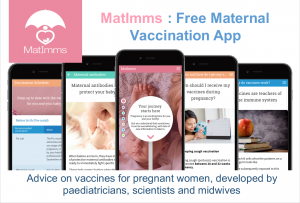
But we still have some way to go. Studies in the UK show that despite overall maternal vaccination coverage continuing to rise, it’s still only reaching an average of 60% of the women who should have it. As part of our research at Imperial College London, funded by the NIHR Imperial BRC, we have held detailed interviews with pregnant women to seek their opinions on maternal immunisation and to find out why some chose to decline vaccination whilst pregnant. Their views were diverse, but one key thing we realised that we as researchers could address, was their desire for more information. As a result, we designed an app to fill this need- MatImms.

Developed by a team of scientists, clinicians and midwives, the MatImms app provides reliable information to expectant parents. It includes information about the immune system and how vaccines work, written in a clear and understandable way. It also provides detailed information on the current vaccines available to pregnant women, including how and when women can receive these vaccines. Finally, the app has a personalisable vaccination calendar, based on the woman’s due date, which provides reminders. Currently focused on the UK setting, we hope in the future to extend the app to include country-specific information to cover the rest of Europe.

In line with this year’s motto for European Immunisation week, we know that vaccines in pregnancy work and many mums are already stepping up to help protect their unborn babies from life-threatening infections; now we want to make sure that our research helps and supports as many mums as possible in this decision.

The MatImms app is freely available for iPhones and Android in iTunes and Google Play.

Combining diverse expertise – Imperial College Network of Excellence in Malaria

By Dr Aubrey Cunnington, Clinical Senior Lecturer in Paediatric Infectious Diseases and Dr Jake BaumReader in Parasite Cell Biology, Faculty of Natural SciencesDepartment of Life Sciences, Imperial College London 

WHO/S. Hollyman

World Malaria Day is a good time to reflect on successes in the fight against malaria and the enormous challenges that still lie ahead. Malaria is a mosquito-transmitted parasitic disease, which causes illness ranging from severe flu-like symptoms to coma and death. Those at greatest risk are small children and pregnant women. It is an ancient enemy of mankind, and has exerted a powerful influence on our evolution. Malaria is a cunning foe, the parasites stay one step ahead of our immune systems allowing repeated infections to occur and they have a great capacity to develop resistance to antimalarial drugs.

(more…)

Malaria in 2017 – “It is too soon to be complacent”

By Professor Kathryn MaitlandProfessor of Tropical Paediatric Infectious Diseases, Director of Centre for African Research and Engagement, Imperial College London 

MosquitoApproximately 1200 African children are estimated to die from malaria every day, accounting for the vast majority of the global deaths from this disease. Over the past decade there has been an unprecedented increase in funding for malaria-control activities and vaccine development – the two major tools in ‘Roll back Malaria’ prevention and elimination programme. This has resulted in major scaling-up in the distribution of bed nets treated with long-lasting insecticides and public-private funding for late phase multi-site trials of the most promising anti-malaria vaccine candidate developed to date (RTS,S).

(more…)

SMILE – a smart vaccine cooling system for the last-mile journey in developing countries

By Kitty Liao and Abellona U of Ideabatic, IGHI’s 2017 Student Challenges Competition winners

IdeabaticEach year, there are two to three million children who die of a vaccine-preventable disease and there are 19.4 million who are unable to receive basic immunisation. One of the main reasons behind these figures is that the carrier boxes currently used to carry vaccines during the last miles of the delivery journey are incapable of sustaining the vaccines at the required temperature range for the entire duration of the journey. This is an urgent global health issue and Ideabatic is developing a solution called SMILE— a smart last-mile cooling and delivery system to address these problems. We presented Ideabatic at the IGHI’s Student Challenges Competition in March this year and won the first prize.

(more…)