Tag: Events

Global Fellows Programme “Innovation to Eradicate Poverty”, a rich educational and cultural experience in Japan!

By Vasiliki Kioupi, PhD student in the Centre for Environmental Policy

Doing my research on Transformative Education for a Sustainable Society I always thought about visiting Japan. Not only because the Global Action Plan on Education for Sustainable Development (ESD) was launched during the UNESCO World Conference in Aichi-Nagoya in 2014 but also because during the decade for ESD (2005-2014), which was initially proposed by the government of Japan to UNESCO, I was a classroom teacher actively engaged in Environmental Education Projects with my students in Greece.

When I saw the opportunity for the Global Fellows Programme themed “Innovation to Eradicate Poverty” advertised by the Imperial College Graduate School in collaboration with Tokyo Institute of Technology, I was intrigued to apply. I strongly believe that Poverty Eradication, currently Sustainable Development Goal (SDG) #1 in the United Nations’ 2030 Agenda, is a global challenge clearly linked with how the society, the economy and the environment function and in order to arrive to a thorough solution, access to quality education is the key. The better part of this Programme was that I could also apply for a research visit to a Tokyo Tech lab, provided a Professor had agreed to act as a supervisor during my stay.

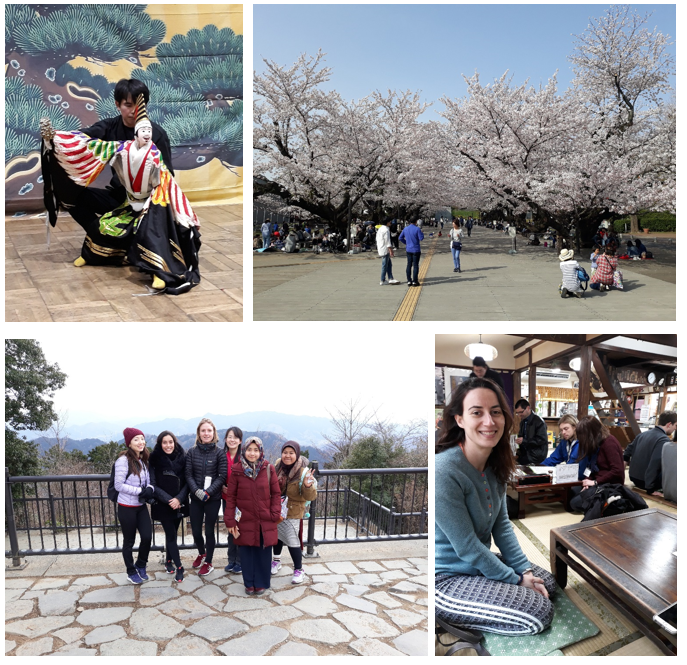
The Global Fellows Programme took place in Hachi-oji, a quiet suburb of Tokyo, from March 5 to 9 2018 and the venue was the Inter-University Seminar House, an all-inclusive facility on top of a hill. During the first-day of activities we attended lectures on the theme, did ice-breaker presentations and formed teams of four, comprised of both Imperial College and Tokyo Tech PhD students using effective team development and team work techniques. Following, we participated in team building activities to boost mutual understanding and effective communication and collaboration, before we started to work on our project to tackle poverty. During the activities we became familiar with each other and we developed strong bonds mainly because of our common interest to empower people through education. So our team was named EduPower! We were an international and interdisciplinary team of two Indonesians Mira and Albert (a Materials and a Computer Scientist), Ashley, a Scottish Bioscientist and myself, a Greek Social scientist, with diverse and valuable skills to contribute to our project. We had the most productive time working on our idea, a platform for collaboration in the education sector and we took pride on the poster we prepared and presented.

The seminar provided opportunities for cultural experiences as well, such as the Japanese puppet performance and the student lead outing to Takao Mountain. The Programme culminated with an amazing farewell event at the Ishikawadai area of Tokyo Tech O-okayama campus, featuring amazing talks, delicious sushi and traditional Japanese drinks, followed by karaoke at a nearby club. I was also able to witness the sakura (cherry blossom), one of the most spectacular sights Japan can offer to the visitor.

I highly encourage all students who are interested in enhancing their research and also creating memorable experiences to apply to similar opportunities provided by the Graduate school. The benefits to my personal development, network expansion and team-working skills were immense. The possibility of a research visit is also an invaluable experience for all PhD students to widen their perspectives. To read more about my research visit in Professor Abe’s lab please follow the link to my personal website.
My Three Minute Thesis

By Hannah Maude, 2nd Year PhD Student, Department of Medicine.
hannah.maude12@imperial.ac.uk

I was absolutely thrilled to recently be awarded third place in the Graduate School Three Minute Thesis (3MT) Competition. Not only because it was completely unexpected, but because the standard of the competition was insanely high (classic Imperial?!). Every single contestant gave an excellent talk.

If you aren’t familiar with the concept of a three-minute thesis, I can tell you it means exactly that: describe your three-year PhD in three minutes. Sounds a challenge, right? I confess that my favourite bad habit is signing up to anything outside my comfort zone; bad because it means experiencing all the nerves and potential failure, but good because overcoming the challenge means learning new skills, feeling proud of my achievements, and ultimately having a great time.

What’s involved?

The first brief was quite general, “nominees will present their current research in one slide and three minutes”, so I did what I do best and carried out some research. YouTube revealed that 3MT equals general overview of your research topic: background, clarity, content, confidence, enthusiasm and simplicity were just a few of the recommended qualities. People approach this in different ways, some choose to speak ad-lib, while others—including myself—write a speech and learn it word for word.

What did your speech cover?

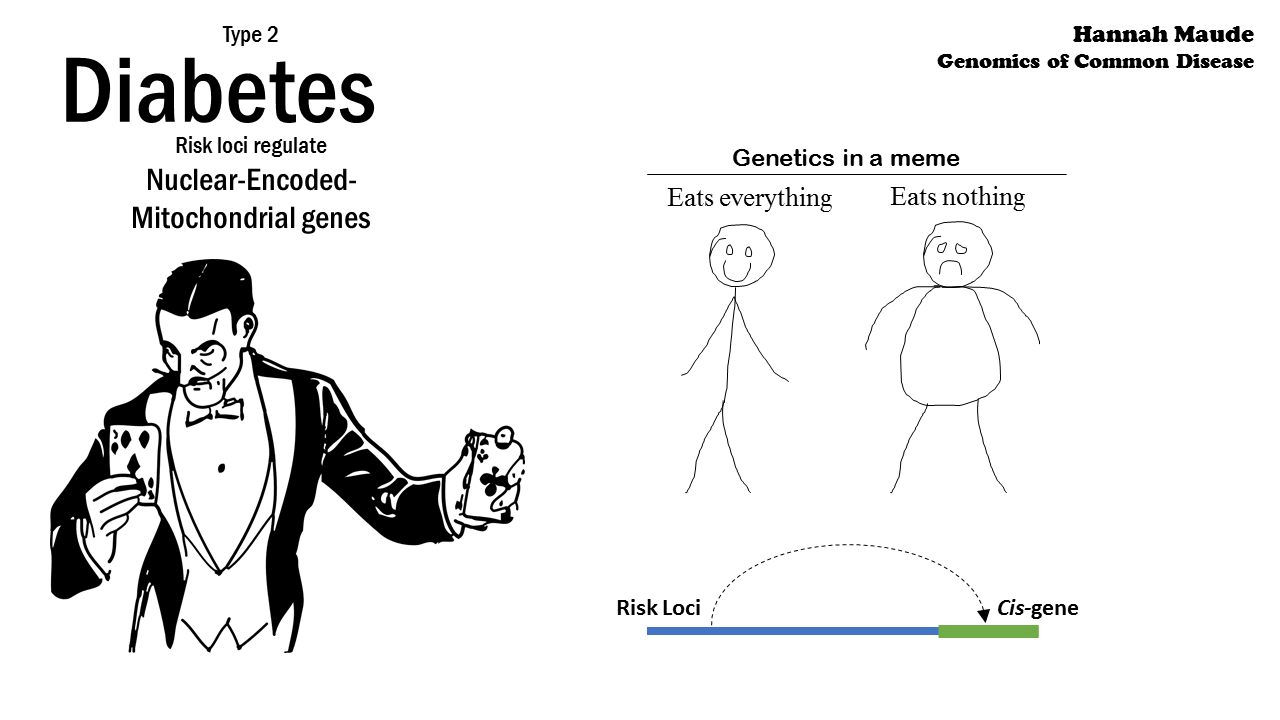
My speech covered the background and concepts behind my research, in a nutshell that risk of Type 2 Diabetes can be inherited, and that I spend my days researching exactly how DNA mutations increase your risk of disease. See the published speech: https://hanmaude.wixsite.com/keepcalmreadscience/my-3-minute-thesis


The 3MT slide, with quotes below. “This meme, which recently appeared on my Facebook, represents how some people can live healthily, yet still develop obesity and Diabetes. This bad luck has an explanation: it’s in your DNA”. “The DNA you inherit is like a game of cards; we have no control over whether we are dealt a ‘healthy’ or an ‘unhealthy’ genetic hand.” “Mutations at ‘risk loci’ disrupt ‘instructions’ and change the activity of nearby genes.”

How was the experience?

Honestly, the idea of standing up at the front of a lecture theatre and reciting a speech word for word within a strict time limit is pretty daunting. Once on stage however, I really enjoyed myself. I was able to be fully enthusiastic about my work and explain it to an audience who were genuinely curious. I also loved listening to all the other fascinating 3MT’s – who knew the concept of mixing two liquids could be so interesting?!

What did you learn?

The aim of a 3MT is to help a lay audience understand what you are researching. Not only is this super fun (and my Mum finally understands what I do) but taking a step back to think about your research in very basic terms, is totally underrated. I learnt to overcome my nerves, to be disciplined within a time limit, and how to communicate my research.

Take home message?

I would recommend the 3MT competition to all graduate students. It’s one of my biggest achievements this year and was so much fun. If you’re not one for presenting, I would absolutely recommend watching. It’s an inspiring event with engaging talks and you get a real feel for the huge variety of PhD projects going on at Imperial.

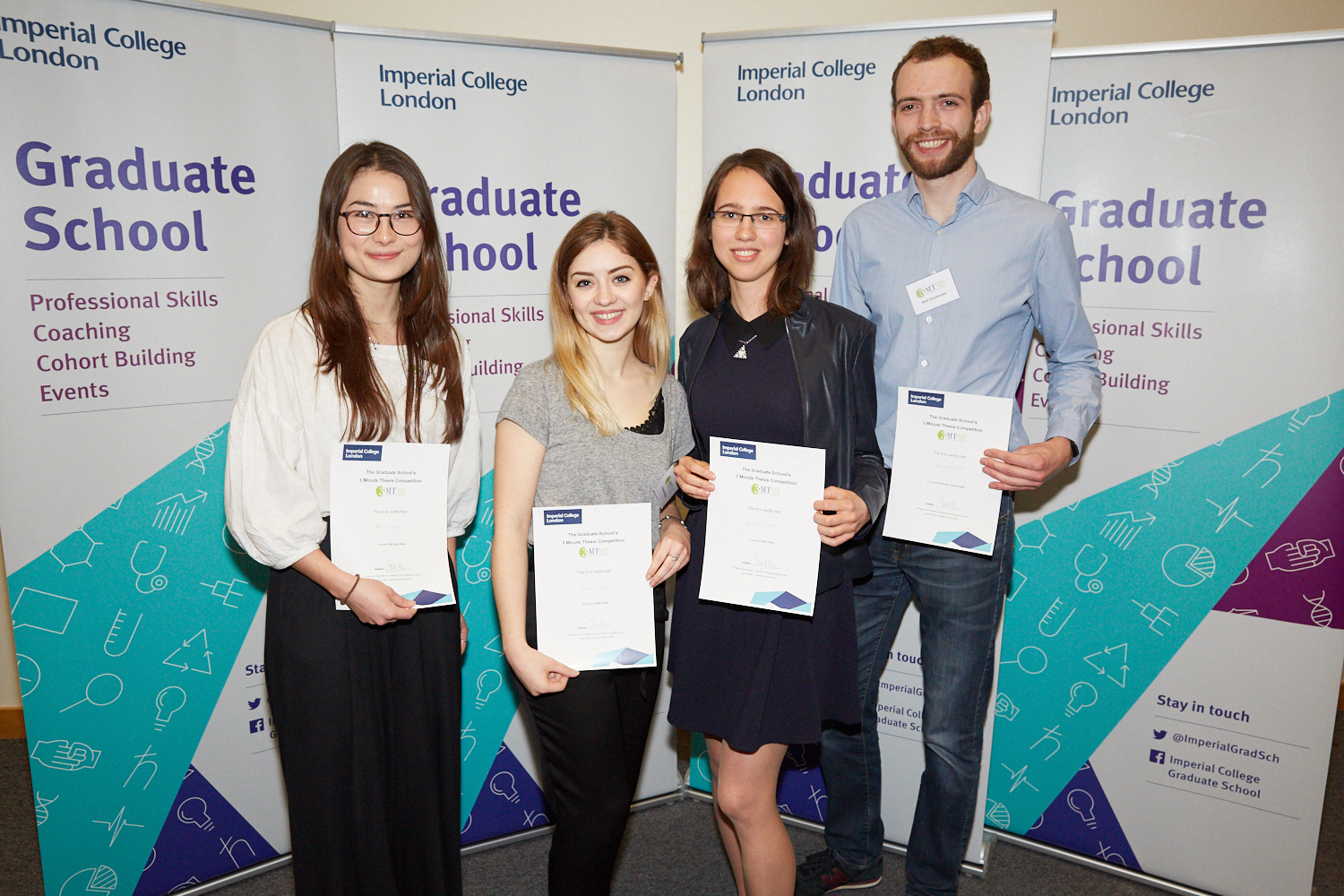
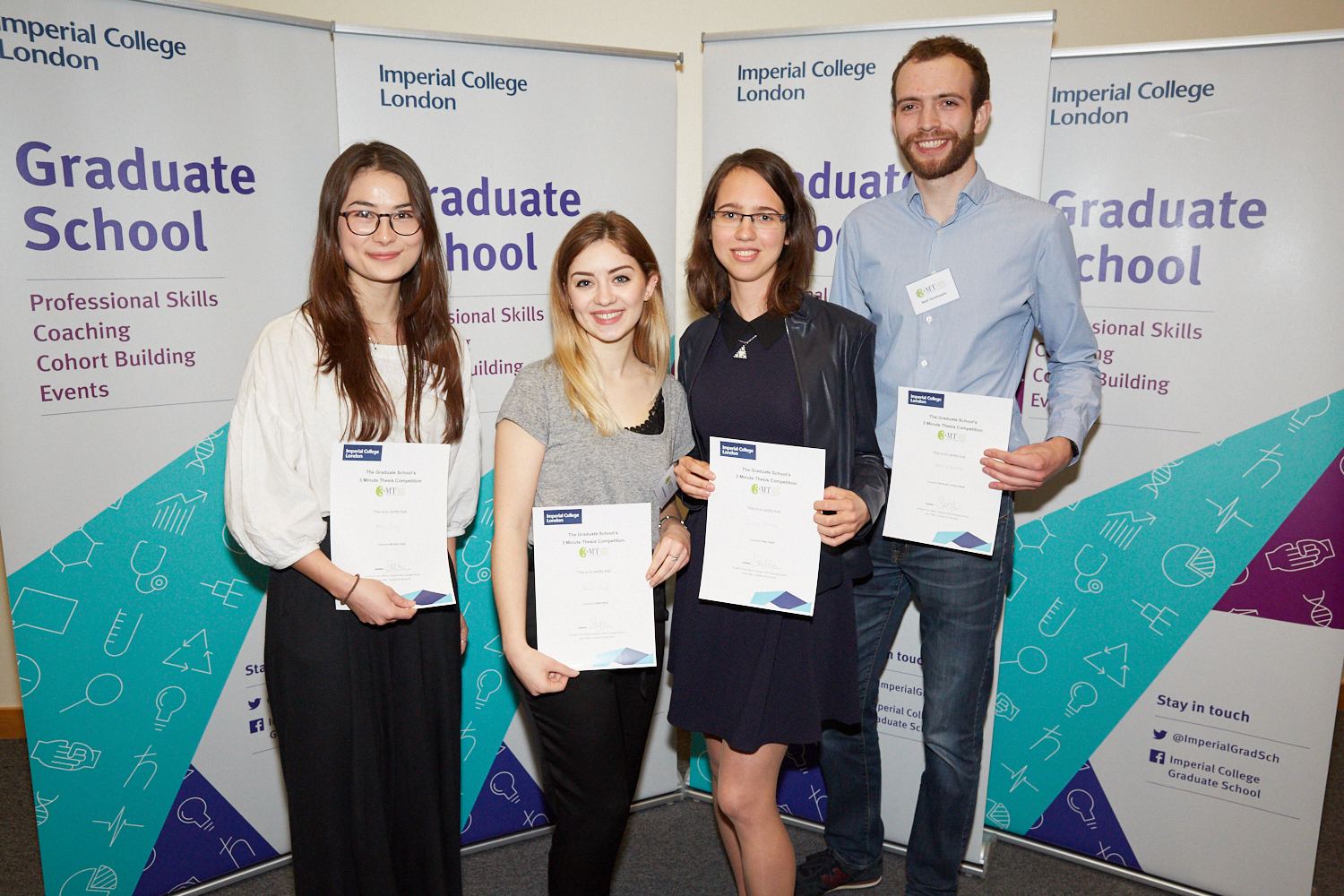
Maria Lucey (2nd place), me (3rd place), Paulina Rowinska (1st place) and Matt Douthwaite (People’s choice).

180 Seconds

by Paulina Rowinska, PhD student in the Department of Mathematics.

Years of research squeezed into three minutes? That was the task I and eighteen other participants of Imperial College Three Minute Thesis competition had to face on Tuesday 24th April 2018.

The rules are very simple. Contestants get exactly three minutes to describe their research to a general audience, using only one static slide. Sounds easy, but trust me, it’s extremely difficult. How do you introduce your narrow topic, explain what your research involves and persuade the audience that they should care in the first place?

All nineteen of us managed to do that. I learned a lot about a variety of research areas, from planting forests in Brazil, to optimal mixing of coffee and milk, to gravitational waves. I was impressed by the amount of information other contestant were able to convey in such a short time.

Because my last name starts with “R” and the order of presentations was alphabetical, I had to wait for what felt like AGES for my turn. These were very stressful hours! However, as soon as I stepped on the stage, I felt much better, especially since the audience was lively and reacting very positively to my words.

Our host, Professor Tom Welton, the dean of the Faculty of Natural Sciences, made the event truly entertaining. His jokes, smiles and charismatic personality let us, the contestants, forget about the challenge ahead of us.

Finally the panel of judges consisting of Dr Helal Ahmed, Dr Amy Seakins and Simon Schöller picked their favourite talks. The third place went to Hannah Maude from the Department of Medicine for her talk ‘Genomics of Common Disease’ that explored the link between the genes and diabetes. The second place was awarded to Maria Lucey from the same department. During her presentation ‘Food for Thought: Inhibiting Appetite with Prokineticin’ she explained how our appetites works. And the first prize… to me, for my talk ‘Winds of Change’! I used my three minutes to describe how I’m applying mathematics to help investments in renewable energy sources. The audience also voted for their favourite presentation, which turned out to be ‘Wearable Integrated Circuits for Sweat Analysis’ by Matt Douthwaite from the Department of Electrical and Electronic Engineering, who made us feel a bit better about our stress sweat 😉

I signed up for this contest spontaneously and I’m truly happy I did it! During this fun event I got a chance to hear about the research of fellow PhD students as well as practice giving talks, which is the key to get over the fear of public speaking.

Make sure that in 2019 you sign up yourself and get your own three minutes of fame. Good luck!

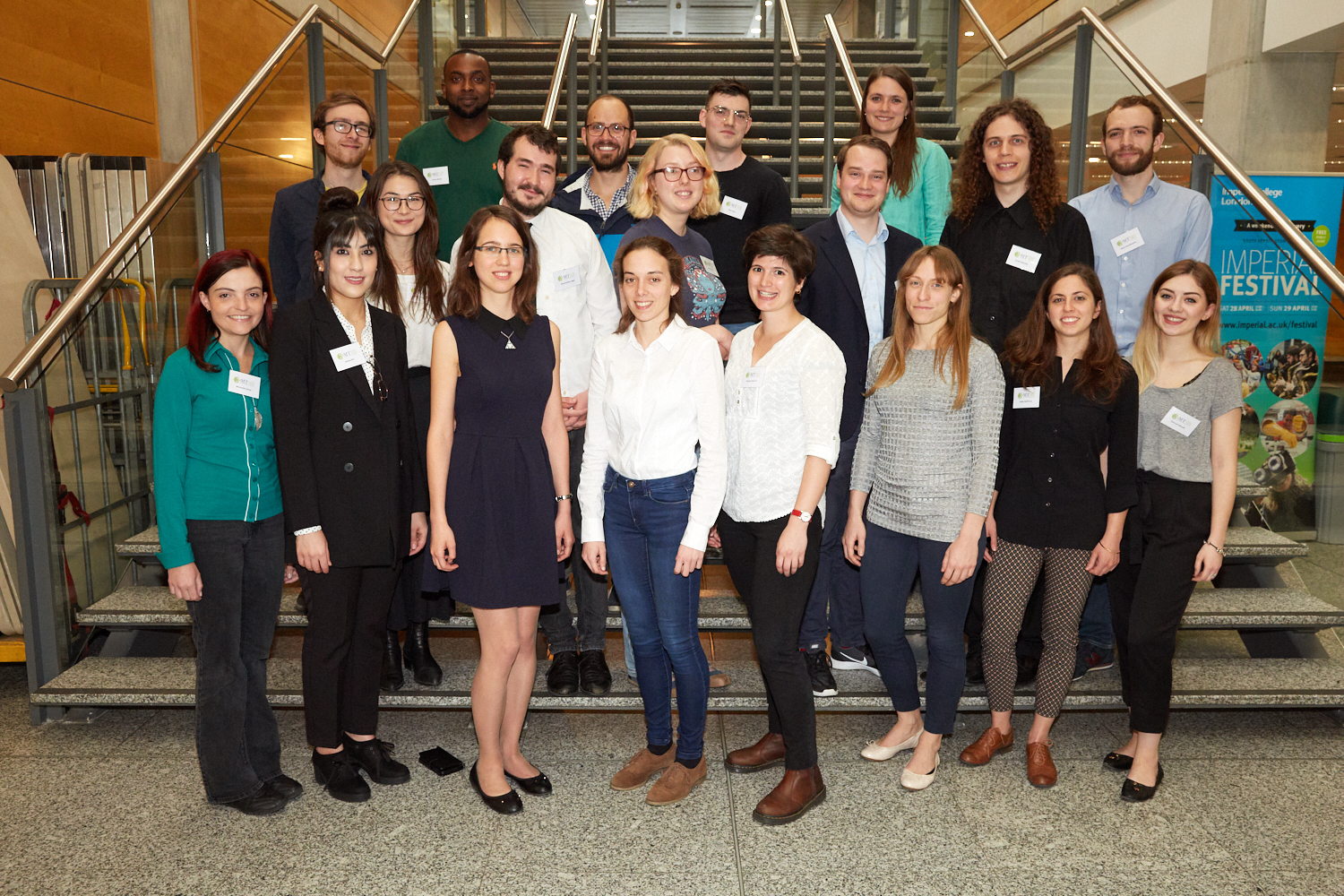
The 2018 Three Minute Thesis Contestants
The winners! L-R: 2nd place, 3rd place, 1st place and People’s Choice winner

NHLI Quiz Night

by Katerina Lawlor, Sara Samari, Helena Lund-Palau and Kate Strong, PhD students in the National Heart and Lung Institute.

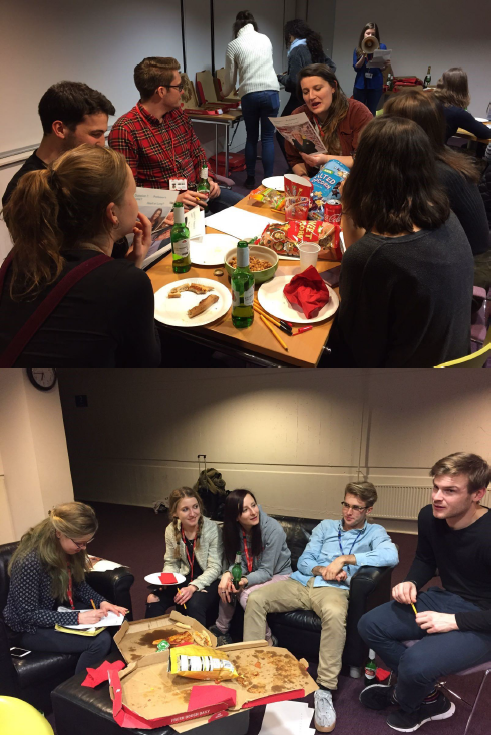
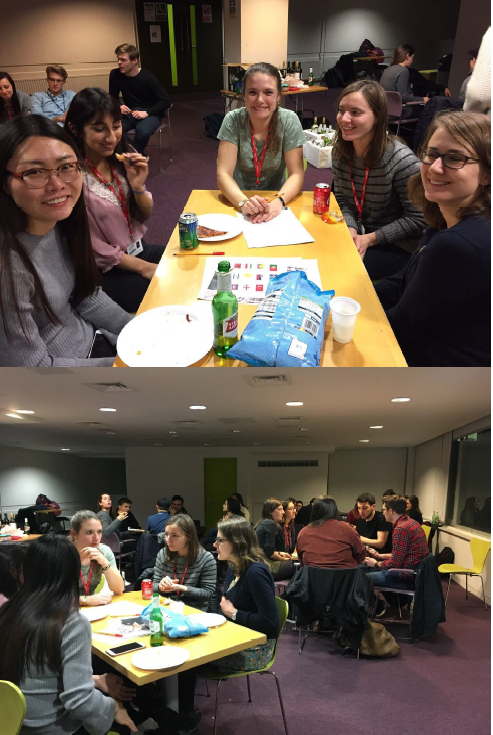
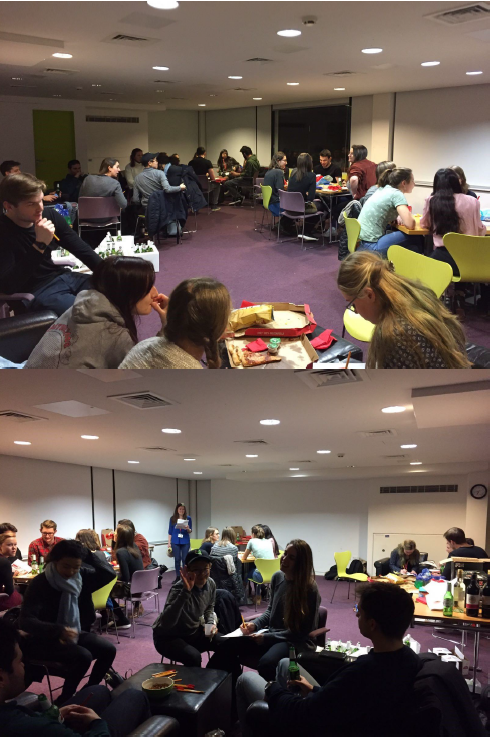
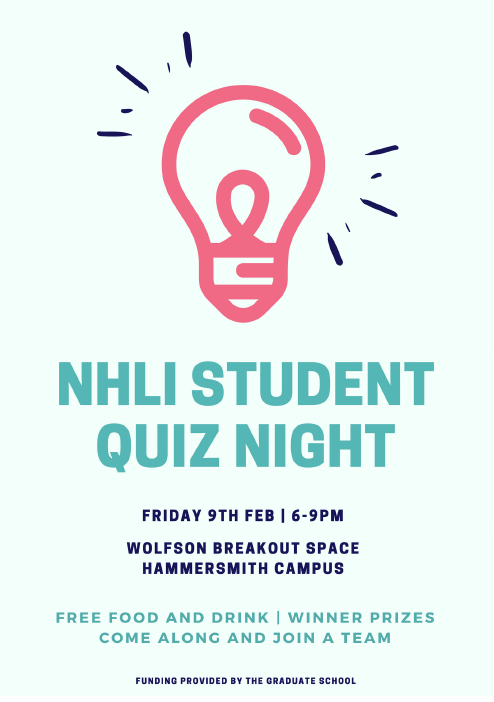
The National Heart and Lung Institute Postgraduate committee successfully put on a student quiz night on Friday 9th February. The event took place at the Hammersmith Campus, which was a welcome change from South Kensington for the many students based there. The evening was well attended and everyone enjoyed the drinks and pizza which were provided thanks to the Research Community Fund. Rounds included ‘Name the Professor’, as well as Imperial College and London trivia. The competition was fierce, but in the end Team #Covfefe were victorious and went home with the winner’s prize.

Overall, we received very positive feedback from all those who came along with many commenting that they appreciated the opportunity to meet students from other sections. We believe that events like these help us achieve our goal as a committee to improve the experience of PhD students in the department. We are therefore always grateful to the Graduate School for providing funding to make these nights possible and helping us to attract more students with the promise of free food and drink!

Inter-group Bowling Event 2018

by Adrian Brown, Clinical Medicine PhD student.

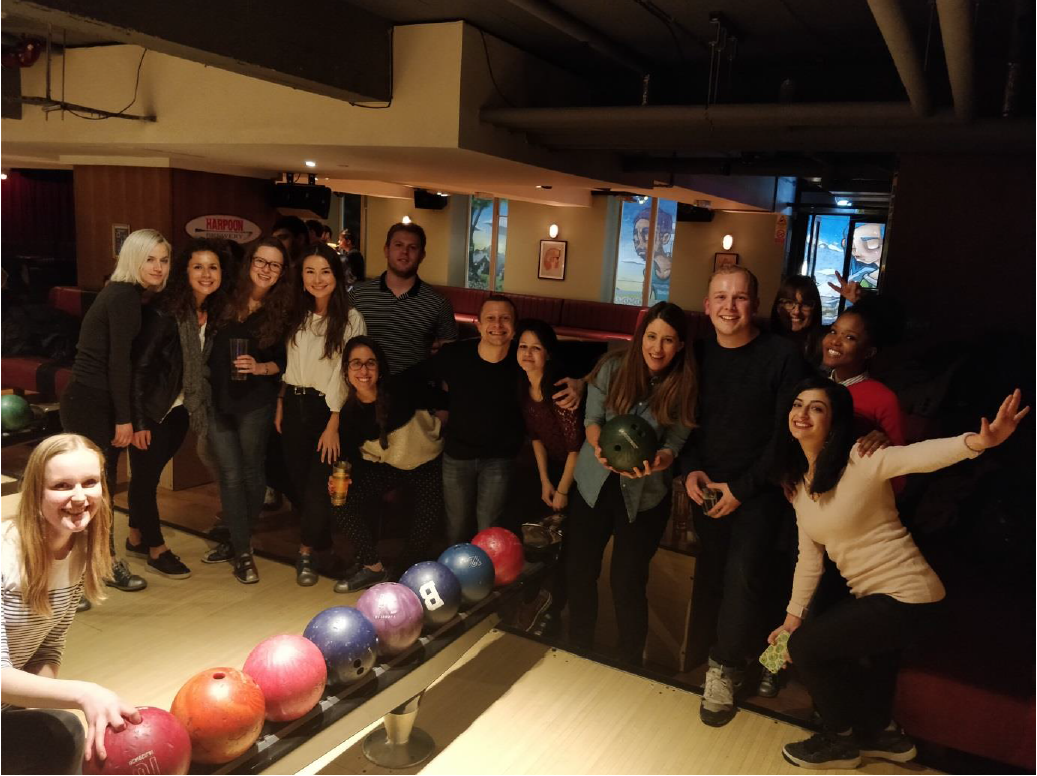
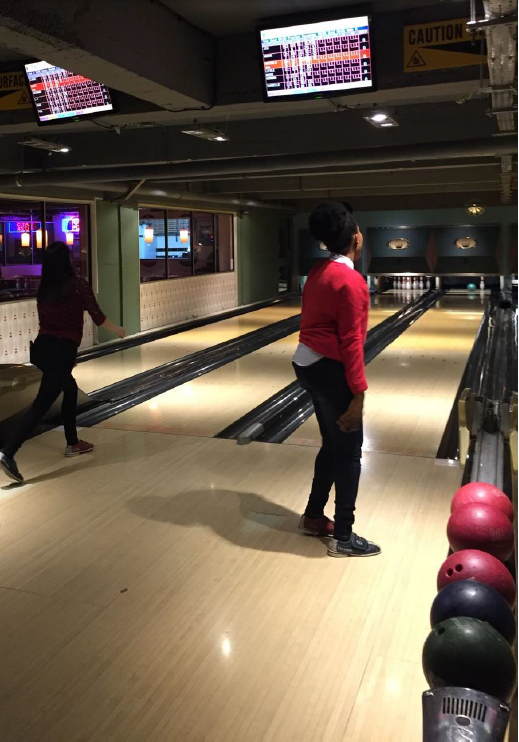
We originally decided to organise a social event to try and help our fellow colleagues beat the January blues! Once we had a spare moment, and to stop the students going on a New Year’s strike, we decided to organise an after-work bowling event. We invited students from Investigative Medicine and the Division of Brain Sciences to attend the inter-group networking event on Friday 12th January 2018. We were very fortunate and extremely grateful as this event was funded by the Graduate School. Attendees were randomly divided into teams across the three bowling alleys hired and participated in some friendly competition to find the top scoring team and player. We also shared some delicious pizza and drinks. After one game, the teams were reshuffled and play resumed. While the bowling skills among the group varied Jamie was the bowling champion among the group!

Aygul Dagbasi, a 1st year PhD student in Investigative Medicine particularly enjoyed the event commenting “I had a great time at my first PhD social event! It was a fantastic way to get to know people from the lab in a more informal setting”. Katerina Petropoulou, a final year PhD student also added “I haven’t bowled in years but the event was the most fun I’ve had at a social event during my PhD”.

Thank you again to the Graduate School for funding the event. As you can see from the photographs, everyone had a lot of fun and we look forward to the next event!


Theoretical Physics Student Research Seminars, Winter Term, Oct – Dec 2017

by Scott Melville

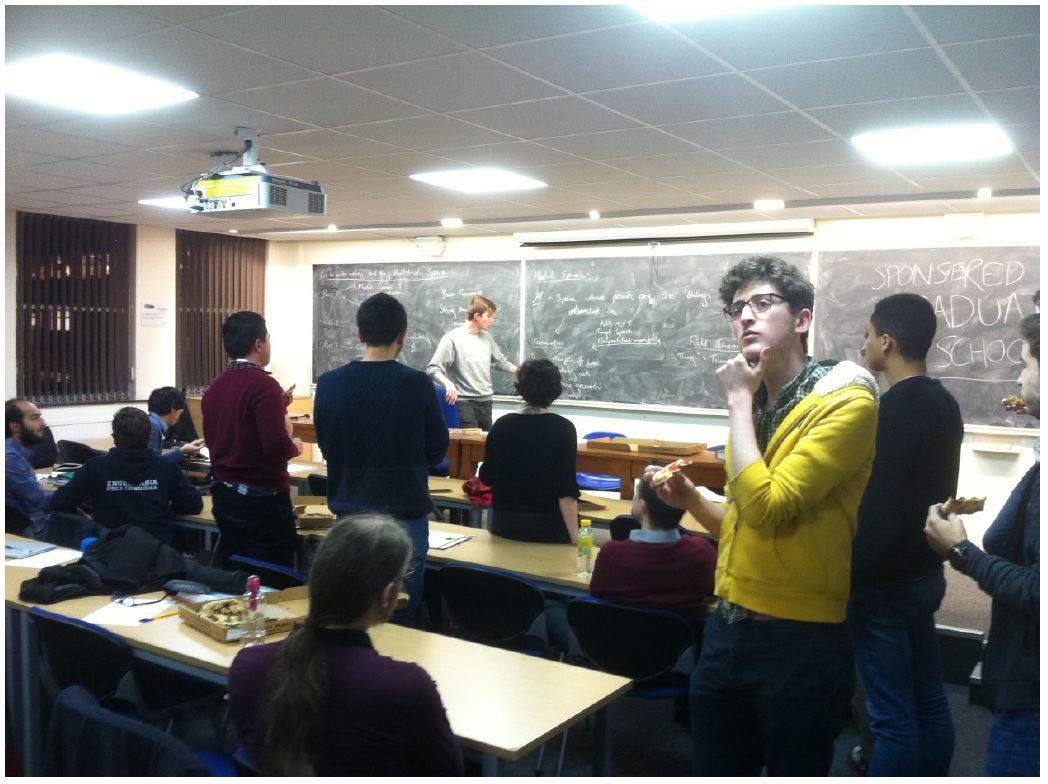
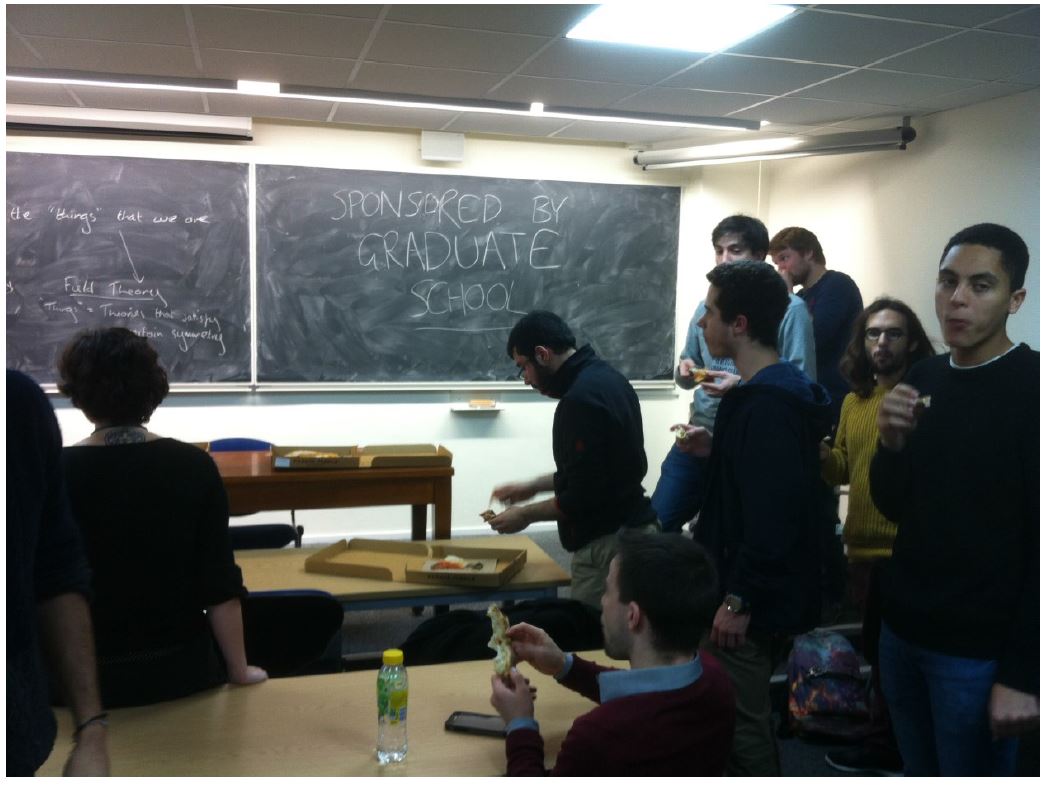
The Theoretical Physics cohort are a reclusive bunch. But nothing brings them out of their shells better than the promise of knowledge (and pizza). Thanks to the generous support of the Graduate School, this term saw the Theoretical Physics PhD students come together each week for a heart-warming exchange of ideas and discussion of how their research is progressing, bringing together not only the graduate students, but also a great number of Master’s students and postdocs to share in the fun.

The seminars took place every Thursday from 17.00-18.00 in Huxley 503. On average, 16 PhD students, 15 Masters students and 2 postdocs attended.

One particularly successful session was a Master’s students Q&A, in which the current undergraduate students could chat informally with the PhD students about their favourite physics, and what it was like doing a PhD. This really helped solidify a sense of community among the cohort.

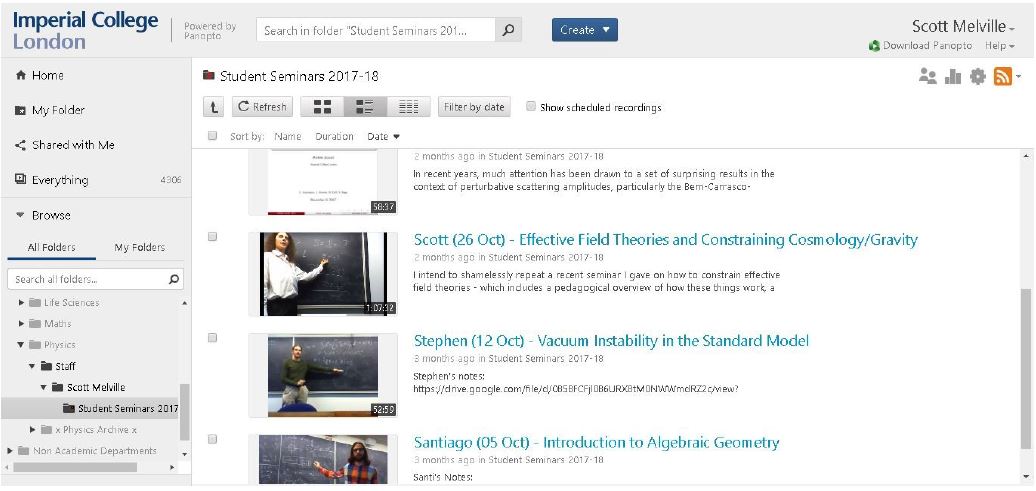
The event was given visibility through posters in the department and a weekly email. The presentations were recorded, and made available online through a dedicated folder on Imperial’s Panopto system. This not only allows participants to relive the heady joy of the event, but also serves as a useful tool for the speakers to review their own performance and think critically about how they can improve.

The invaluable support of the Graduate School was acknowledged both on the posters advertising the event, and at the beginning of each seminar.

Overall, the seminars succeeded in bringing together the cohort and establishing lasting links both with each other and with the wider physics community at Imperial. We look forward to continuing the Student Seminar series long into the future.

Meet the Scientist – Open Days at the Division of Brain Science

By Luigi Montibeller

The laboratories of Brain Division of Imperial College London (ICL) opened its doors on the 23rd and 25th of October to display it’s state-of-the-art technology, experiments and research through interactive talks and guided tours run by its researchers, specializing in the field of neurodegenerative diseases.

More than 100 people including patients, relatives and members of the public attended the event. The tour and presentations gave attendees the opportunity to talk to leading researchers and medical professionals, exploring the latest research, tackling conditions like Parkinson’s disease, Alzheimer’s disease and brain injury.

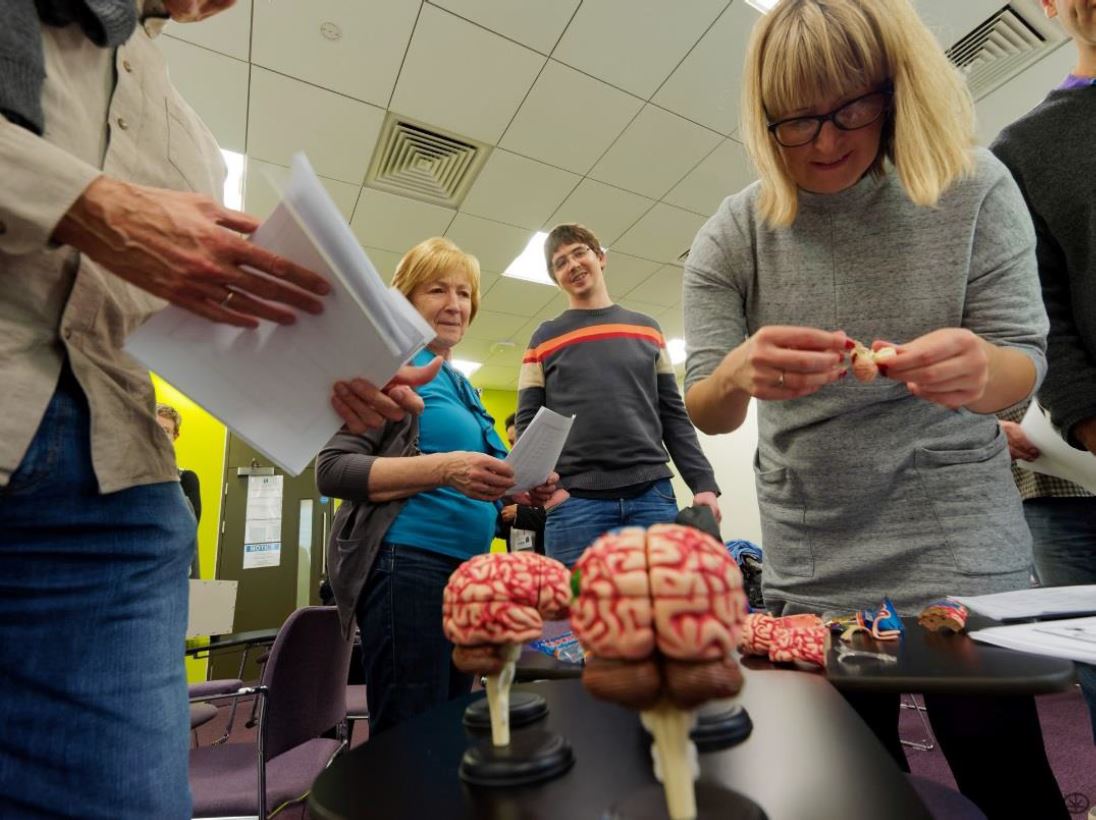
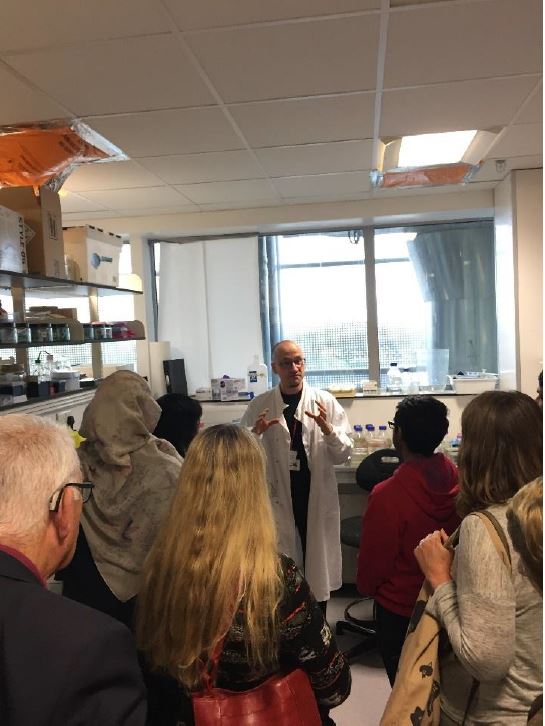
A presentation about each specific neurological disorder was given followed by a visit through the labs and the Brain bank. For example, visitors witnessed the dissection of a human brain by Dr. Steve Gentleman, highlighting brain function and it’s impairment in such diseases.

With additional ‘hands-on’ demonstrations, the participants had the unique opportunity to participate in experiments that researchers conducted inside the labs. These included learning about cell culture, immunohistochemistry and microscopy.

The event received great feedback from attendees. With comments like “Very well organized. Complicated research presented in plain English. Very enthusiastic stuff. Thank you all”, “Super day: excellent, translated well for lay man’s language”.

Cross-CDT Fair – Pain Relief for Scientific Computing

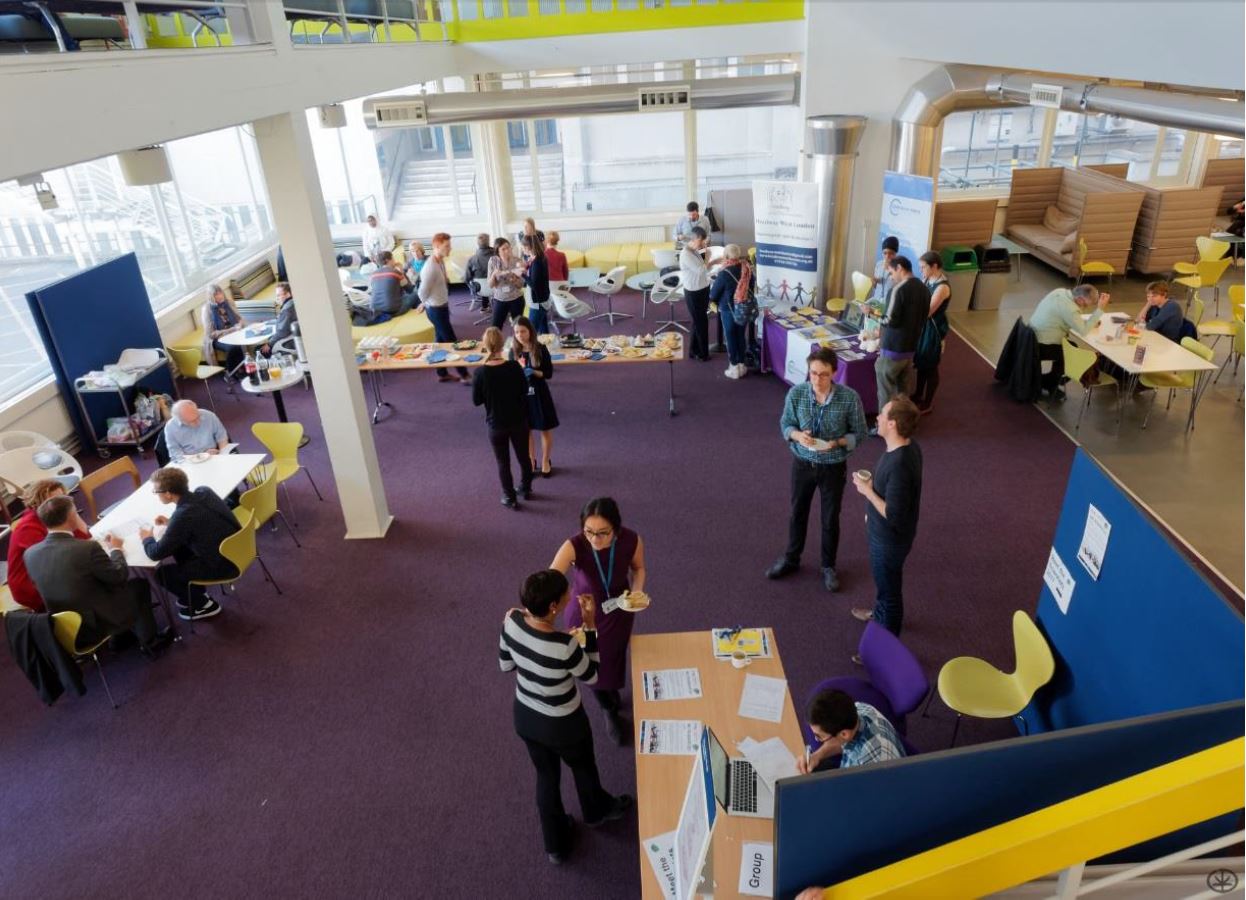
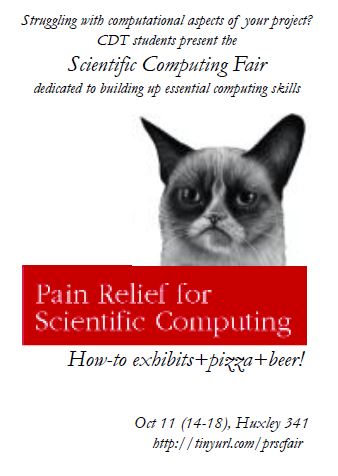
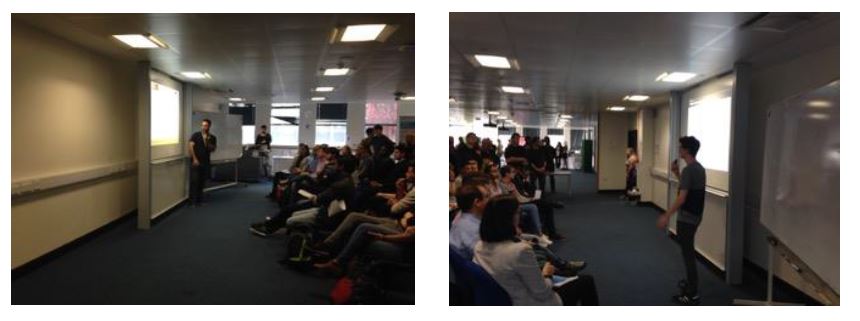
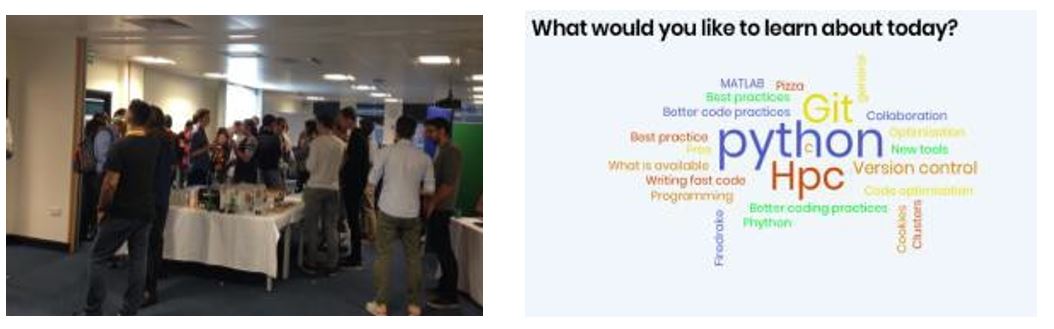
Did you ever wonder what most of PhD students at the College have in common? They need to compute to finish their degree. The task can be as simple as a quick data analysis or as complex as creating a new software package. Did you also know that most of the students arrive with a minimal background in computing? A lot of them find themselves in a “sink or swim” situation. After experiencing this ourselves, we decided that we don’t want others to suffer the same fate and make the same mistakes. To bring the issue into the spotlight, we decided to organise a Fair that featured exhibits dedicated to essential computing skills that every student should know before they attempt to “swim”.  

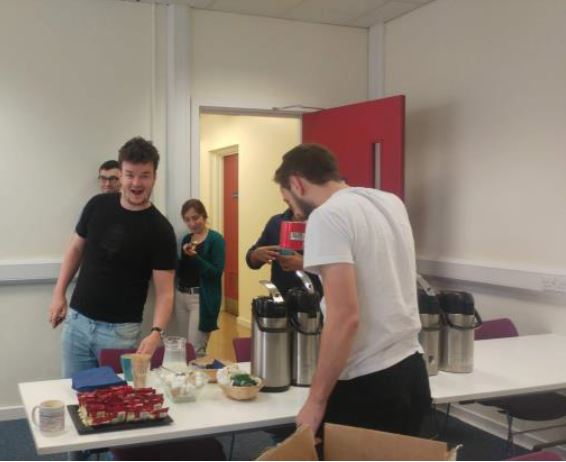
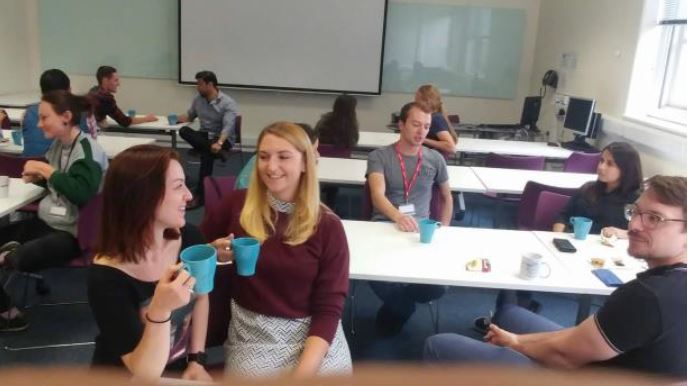
The Fair happened on October 11th, 2017 and it was a success. We had at least 60 visitors – after that we lost count. We invited CDT cohorts as well as PhD students across the College to come, network and pick up useful tips. The event started on a high note, almost everyone showed up right when the door opened. The visitors dispersed around the exhibits and listened to what we had to say. The ones that needed a bit of help with getting enthusiastic got cookies coffee or tea. We had an incredibly busy three hours at the exhibits as well as giving short talks.

After picking up useful computing tips and hints, the audience had a chance to visit a poster session at the Fair. We invited open source software projects from the College to present to the students. Many of these packages can be applied to various types of projects. Who knows, maybe we encouraged future collaborations.

The pizza and beer arrived just in time, one could not keep this pace much longer. The networking part that followed went very smoothly.

With the Fair out of the way, we intend to continue our effort to educate the cohorts via the Scientific Computing Support Network. There is a good chance that we’ll organise the Fair again. Note to self – keep it simple and order more pizza.

Many thanks to the Graduate School, Platform for Research in Simulation Methods and the Research Computing Service for funding and many thanks to everyone who contributed to the poster session.

Thomas Bendall, MPE
Eduardo Ramos Fernandez, TSM Matthew Garrod, MPE
Thomas Gibson, MPE Michael Haigh, MPE
Hemant Khatri, Math Department Smitha Maretvadakethope, Fluids Josephine Park, MPE
Sergio Perez, Fluids Matthew Taylor, HiPEDS
The Computational Methods Hub

ESE Stress Less Campaign: a resounding success, valuable for all

Abstract
On Thursday 22nd June 2017, Earth Science and Engineering Graduate Society (Grad Soc) begun their Stress Less campaign, made possible by funding received from the Graduate School’s Research Community Fund. A recent Grad Soc survey had highlighted the number of PhD students within the department who felt that work-related stresses had a significant impact on their daily lives. This campaign aimed to foster discussion about such issues and provide activities that introduced coping techniques.

PhD “stress less” lunch
A sandwich lunch was set out informally on picnic blankets and was very well attended, drawing more than 30 PhD students, and providing an opportunity for all to voice concerns relating to any aspect of PhD life. One of the most positive aspects was the number of students present who had not previously attended any Grad Soc event. On the whole the mood was positive but concerns as to finance, demonstrating pay, the tidiness of the department and general organisational issues affecting welfare of students were raised. These issues have now been brought to the attention of staff and the head of department. Lunch also gave time for newer students to integrate into the departmental “social scene”, contributing to a peer support network.

Mindfulness
The mindfulness session though short was enjoyed by attendees. It also gave the opportunity to raise awareness of the regular mindfulness sessions run by the college.

Yoga
Maria provided an excellent introduction to yoga for stress relief. Attendees had varying degrees of experience from complete beginners to experienced yogis. Talking afterwards to those who went, the class was enjoyed and a few people are now considering taking Maria’s regular class at Ethos. A follow up email will go out to students providing details of this.

PhD Coffee
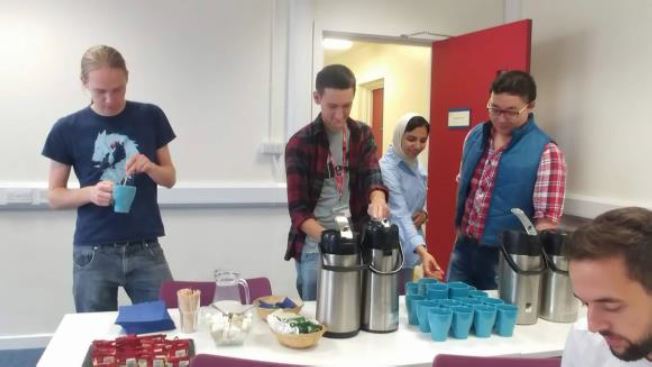
PhD coffee was well attended by around 25 students. Materials for known activities to reduce stress were provided, such as mindfulness adult colouring. It was hoped that by introducing students to these activities some might implement them into their routine as a way to provide stress relief. A comments box was also provided for students to anonymously voice any concerns they were currently having relating to their PhD. Comments were then processed by Grad Soc and referred to the head of department. As we have no common space for PhD students within the department, coffee enabled students a rare chance to talk freely of their concerns.

Massages
All of the massage sessions on the day were booked out, 18 students receiving a 10 minute hand and forearm or neck and shoulder massage each. The feedback from this was extremely positive!

The success of the day is also now to be published in the Departmental Newsletter raising awareness of student welfare and mental health.

Continuation of the Campaign
Within the department, Grad Soc have continued the Stress Less Campaign on a monthly basis by providing an afternoon PhD-only coffee session. During the summer months this has been extremely well attended and enjoyed. As a PhD-only event it provides a safe, friendly environment to voice concerns. We are all realising that stress and difficulties with work-life balance affect many people and there is a more open attitude to discussing this with peers among the PhD Students.

A word of Thanks
Grad Soc would very much like to thank the Graduate School for the funding they provided; without it this campaign would not have happened. Through the discussions facilitated by the Stress Less series, we have seen evidence of the classic statement “a problem shared is a problem halved”. It is refreshing to have a more open attitude to discussing problems that affect so many people, and we hope the mental health of the PhD students will improve as a result of this.

Environmental and Sustainability Mixer

by Daniel Hdidouan, PhD student in the Centre for Environmental Policy

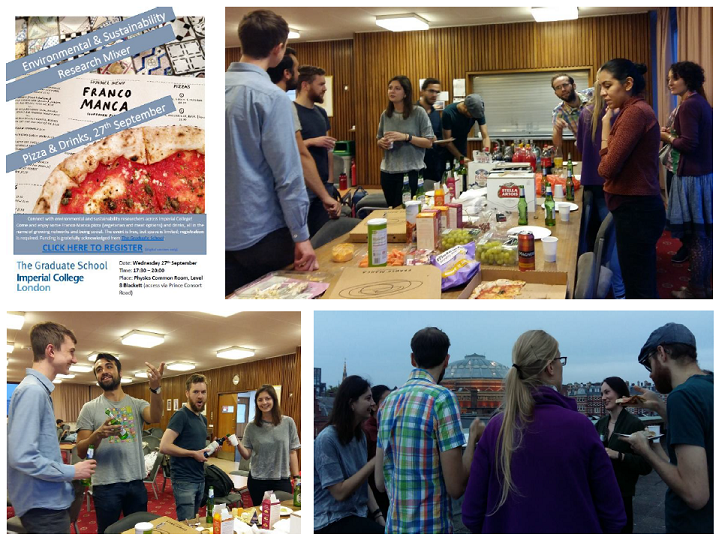
The second annual Environmental and Sustainability Mixer took place on Wednesday 27th of September. The mixer is a cross-departmental initiative, the aim of which is to encourage the postgraduate research student community working in environmental and sustainability research to get to know each other. It was a fantastic event which saw high turnout for the social; students enjoyed pizzas and drinks in the Physics common room on Level 8 of the Blackett Building.

Purpose

The event was devised because students in the past have found it difficult to find informal events for research students to build cross-departmental and cross-College relationships. As such, the event was funded by the Graduate School’s Research Community Fund.

From previous experience shared by the alumni, a College-wide neutral platform (i.e. funded by the Graduate School) with students from other departments was needed to facilitate interaction and foster collaboration at an earlier stage in our careers. A lot of work is done in the environment and sustainability at Imperial but often people don’t realise the wealth of the network until it’s too late.

Numbers

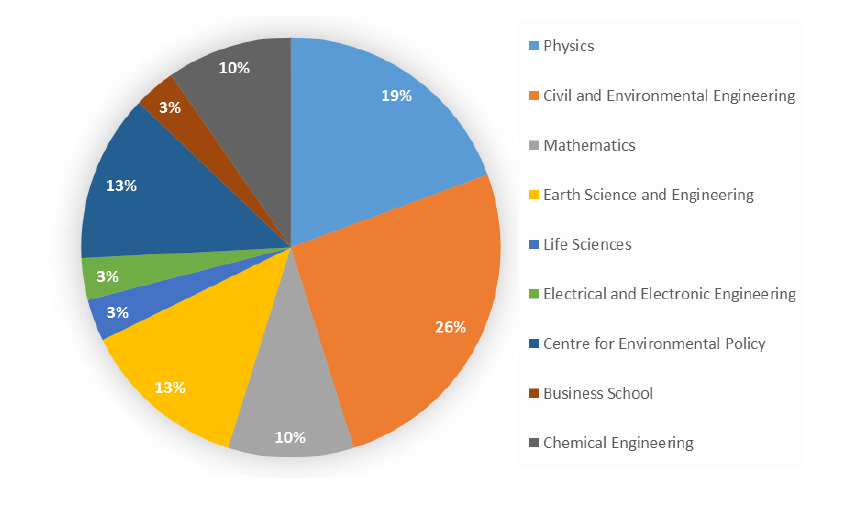
With over 45 registered attendees, and a turnout of 71% (32) we were able to welcome in the new academic year with some familiar and fresh faces to Imperial’s environmental and sustainability research area. The mixer was designed to encourage Imperial’s environmental and sustainability research community to get to know each other and increase awareness of the breadth of research undertaken in this field across all of Imperial’s departments. A total of 9 departments were represented across Imperial’s four faculties, including: the Centre for Environmental Policy, Physics, Mathematics, Business School, Earth Science and Engineering, Public School of Health, and Civil and Environmental Engineering.

Pie chart showing break down of registered attendees’ departments

Outcomes

This cohort building exercise introduced attendees to other departments, topics of research and new friends. We are in contact and are aiming to meet up again in the next few weeks. There is also an initiative to formalise an environmental and sustainability network here at imperial that was further floated at the mixer. We also have some leftovers which we plan to put towards another mixer in the coming weeks! If you would like further information regarding the mixer, or potentially organising your own cohort building activity and would like to learn from our experience, please get in touch: d.hdidouan15@imperial.ac.uk (Daniel Hdidouan).