Moving away from home is an experience which is talked about quite often, about its excitement or its sadness. On the other hand, no one really shares their feelings about coming back home.
On the last 14thof December, I flew back to Spain, where a few things surprised me.
Where is my room?
You open the door to your old house and you feel a bit out of place. You go to your room, but it seems odd, should I call this my room anymore? Or is it just a temporary place before I go back to my reality. Where is my room, at my parents´ or in London?
Am I not independent anymore?
You’ve been living by yourself for three months now and in that time, you haven’t had the need to explain every single movement or decision that you’ve taken. Well, that will not be the case now, you are “under someone else’s roof”, so be ready for the constant questioning.
Hasn’t time passed to my friends?
You haven’t seen your friends in quite a long time, things have changed, everyone has started a new life, have met new people, have gone different ways. But then, you grab a coffee with those who were your day to day smiles and you feel like in the old days. Although there are many things to catch up on, it seems like, opposed to the theory of relativity, time has contracted.
Am I missing the library?
You know you should be revising for the exams, but it seems that the ginger cookies flavour is telling you not to… There are some many interesting things to do… so many people to catch up with… Where’s the library? Where’s the sanctuary of the concentration?
You think of going to your town’s library… but it’s not the same.
Do I want to come back to uni?
You are having a nice time in your hometown, yet you know that the real drama is coming: exams are around the corner. You want to get it out of the way. Does that mean you want to go back to the stressful life? To sitting down 10 hours a day, to unsolvable tutorials… You kind of do, probably because you are missing your new friends too.
Located in South Kensington, Imperial is so close to all the best things in life. I wouldn’t imagine myself anywhere else. Here is the three things that kept me going even when uni life is hard.
Core Collective
Can I just emphasise that Imperial is not easy (Nobel prize winners aren’t build by living an easy life). For me, working out is a temporary escape from my study. Since Core Collective is 20 minutes away from uni, it has got to be one of my favourite way to sweat (hot trainers also helps *facepalm emoji*).
Shopping Spree at Knightsbridge
Can I just say that whoever says Oxford Street is the best shopping street in London is seriously disturbed. There is nothing more relaxing than walking down Sloane Street and trying on a few dozen pairs of Saint Laurent or window shopping at Bvlgari. P.s. not everyone’s list of fun things to do, but this is what makes my life at Imperial sunshine and rainbows.
Imperial nurtured scientists and engineers who became Nobel Prize winners, Government officials, (important people).
You know the saying: do the things you have to do until you can do the things you want to do. This saying applies hugely during my study. To be honest, all I want to do is build bridges and skyscrapers. But without the proper knowledge, guess the probability of it crashing down.
Studying for a masters degree in science communication is a very different experience to studying for my undergraduate degree in maths and physics. Perhaps the greatest difference is in the amount of reading I now do. In addition to the weekly readings set for each module, which are mainly academic articles, you are strongly encouraged to immerse yourself in literature of every kind. This can range from popular science books to biographies, journal articles to science journalism, books about feminism to books about philosophy. Lots of books you’ll need for the course are available in the campus libraries and most journal articles can be readily accessed online through the library search. Sometimes, however, you just want to increase you own personal library, and Christmas was the perfect opportunity to asks relatives for a few books I’ve been inspired to read since starting at Imperial.
Here is a brief look at three books I received for Christmas which you may too be inspired to read.
The Immortal Life of Henrietta Lacks, Rebecca Skloot.
In 1951, an African-American women called Henrietta Lacks had cells taken from her cervical tumour without her consent. The cells from her tumour, HeLa cells, became the first human cells to survive outside of the human body and continue to multiply for a long period of time. Sadly, Henrietta passed away later that year, however her cells are still alive to this day. HeLa cells have enabled medical breakthroughs in almost every field of science, most prominently in helping to test vaccinations for diseases such as polio.
However this book does not focus on the scientific advancements HeLa cells have brought, but instead explores the woman from whom these cells originated. Through her meetings with the Lacks family spanning almost a decade, Rebecca Skloot, a science writer from Chicago, uncovers the real story of Henrietta and her family. This brings to the forefront issues of race, gender and class with regards to the sharing of science, which I believe everyone should be aware of.
Hello World: How to be Human in the Age of the Machine, Hannah Fry.
Dr Hannah Fry is one of my favourite celebrity scientists. Hannah is an Associate Professor in the mathematics of cities at University College London, and engages in various science communication activities. She has given TED talks, fronted television documentaries such as Magic Numbers: Hannah Fry’s Mysterious World of Maths aired on BBC Four earlier this year and hosts a science podcast, The Curious Cases of Rutherford & Fry, also with the BBC. Furthermore, Hannah has also written books, which have popularised maths.
Whilst I was volunteering at New Scientist Live in September this year, I heard the talk Hannah was giving based on her new book Hello World. She explored the topical idea of algorithms, and asked us to question how much we should trust them through a series of scenarios. For example; you are accused of a crime, would you rather be judged by a human or a machine. Her book explores algorithms in the justice system, as well as in cars, medicine and even art. Hello World, provides both a mathematical understanding and sheds an ethical light on the technology that could completely change how we live.
Inferior, Angela Saini.
After a term of studying science communication, it is clear that one aim of this sector is to address the gender imbalance prevalent in science; whether that be in terms of career progression, portrayals in the media or general treatment in the workplace. There are many wonderful people already fighting to address this for example Dr Jessica Wade, a post-doctoral researcher at Imperial College’s Blackett laboratory. Jessica gained recognition in July this year, for creating over 270 Wikipedia entries for women in science who had previously not got the recognition they deserved.
Jessica cites Angela Saini’s 2017 book Inferior as one of her main influences. With the subheading ‘The true power of women and the science that shows it’, Inferior addresses the gender stereotypes that have long-existed in society by challenging scientific claims about sex differences. The result is a view of science where women are included, not excluded; a powerful message communicated incredibly well.
It would be reasonable to say that I had a… last minute approach when it came to my UCAS application. I put off writing a personal statement until the night before applications closed because I had four possible paths to choose from and I couldn’t for the life of me decide. They were; philosophy, creative writing, english literature or biochemistry. Not your average selection but I am sure that you can understand my indecision. It felt as though choosing any one option would close off the others for good.
I chose biochem. I chose science because I felt that while I could imaginably keep up my english and philosophy through reading, biochemistry required a more serious application No insult intended to the arts, but I struggled to see myself sneaking into laboratories in my own time to learn about the intricacies of enzyme catalysis. This was my thought process at least. So with a heavy heart I submitted my application and resigned myself to becoming a sensible-shoe-wearing bespectacled scientist. I thought that while I could potentially try and keep up my reading, things like student drama and student newspapers would be beyond me, the preserve of arts students with time coming out of their ears.
What I hadn’t counted on was that at Imperial there are no arts students! Furthermore, this does not mean that all artistic endeavour is curtailed but rather that scientists that would usually have been relegated to minor roles and responsibilities thanks to their schedules are free to throw themselves into activities not usually associated with their degrees. The phrase ‘amateurish enthusiasm’ comes to mind and I reckon that anyone with whom I acted or worked at the student newspaper would agree. This is not to say that quality is reduced, not by a long shot. Rather, and I shall put it lightly, no one expects to see the works of Brecht put on in the near future.
I do not, however, see that as criticism. The students running these societies, putting hours into them often for little reward or recognition do this because they love it. They feel so passionately about what they are doing that they are willing to invest time, regardless, because they think that it is important. They might not have read as many plays as others or have an artistic eye as developed but they know that they like do. In my eyes, these are people to be admired, not dismissed. They know who they are and what they want to do with their time and if any of them are reading this I take my hat off to them, in awe at what they accomplish.
Imperial does also have certain perks that set it apart from other places and while this may sound like bragging it is true. Being in London means having world class culture on your doorstep and I have managed to get free press tickets to the incredibly wide variety of theatres and art galleries around the city fairly easily, perks of an otherwise relatively low demand. Finally and last but not least, Imperial has a certain reputation of being highly technical and nerdy. Try and imagine what that looks like when turned to building sets and doing effects for plays. What ever you are thinking, think harder. Just saying.
It’s fair to say that this term has been the most enjoyable term I have had so far at Imperial and I can’t wait to tell you all about it. It’s been super busy, I’m not sure how I managed to keep up with everything and still not skip any (most) lectures! Alongside juggling my degree in maths, I’ve also spent this term applying for internships, being on a few committees and running events as a student ambassador.
Netballin’
Often when people think about studying at such an academic university as Imperial, their immediate thought isn’t about all the extra curricular activities they will be able to take part in. However for me, being in these committees and societies has become such an integral part of my life. Everyone will always talk about how great being on a committee looks on your CV and sure, that’s true. But for me getting involved so much has allowed me to feel more settled and feel like I’m a part of something important. I’ve enjoyed helping make a difference to people’s university experiences for the better.
In this post I will briefly talk about the various opportunities I’ve had this term and promise to dedicate my next few posts to expanding on some of my favourite of these opportunities!
What have I been up to?
As a part of the student shapers programme, I was lucky enough to be selected to be a Mathematics Student Ambassador. Working with 4 other Maths students, we created a scavenger hunt, not in halls event and student panel for the new freshers. Although we had to come in to work during the last few weeks of the summer holidays, we had a lot of fun creating clues and activities for the scavenger hunt and trying out our ideas on our friends. The freshers enjoyed all of our events and it’s been great seeing a change in the maths department resulting in more cross year mingling following our efforts.
Slumber Party!
As I mentioned last year, I am also a member of the committee for the Imperial College Netball Club. As a team captain I have been a part of selecting players for teams, writing match reports and working closely with coaches on strategies as well as organising plenty of socials for our team to bond. This term, we’ve had a variety of socials including team dinners, going to sports nights together culminating with a whole club Christmas dinner and a team slumber party!
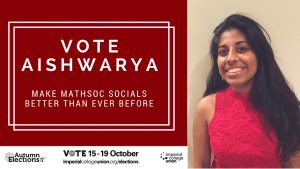
After missing out on being elected in by a few votes last year, by chance the position of social events officer on MathSoc committee became available and I created a campaign to run for the position. It was a tense week as voting opened and I found out I was running against 5 other candidates but to my delight people voted for me and I was elected in! So much has happened since I joined the committee, we’ve organised numerous socials including pub crawls, ice skating an of course a Christmas Dinner, but most of all I’ve really enjoyed working with the rest of the team and making some great friends.
A successful campaign
I have always wanted to promote better wellbeing care within my department so when the year reps elections came around, it seemed like a no brainer to apply to be my year group’s wellbeing rep. Over the past few weeks I have enjoyed the insight I have gained into what goes into making changes and decisions within the department. We have also held a number of events with the aim of just giving people a break from the stresses of daily life and coursework. In out most popular event people came along the the study room, the heart of the maths department, and helped us put up the Christmas tree, adorn the MLC with tinsel and consume nearly 15 boxes of mince pies!
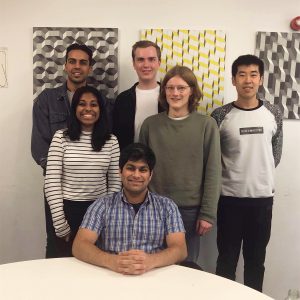
MathSoc Committee 2018/19
Being a part of all of these amazing things has meant that I have made so many new friends and had plenty to keep me busy where last year I didn’t really feel like I was making the most of my free time. I will however warn everyone in saying that I wouldn’t recommend taking on this much all in one go. Over the course of the year I have sometimes found it difficult to prioritise and have definitely had to make sacrifices including missing out on seeing my friends outside of maths from time to time. However the feeling of creating a successful event or having a good time with my netball team or the MathSoc committee has made it so worth it. This term has been absolutely phenomenal and can’t wait for what next term has to offer!
For those of you who don’t know me and I mean really don’t know me (anyone who has ever met me will now be rolling their eyes) I took a gap year. At school, I didn’t know what I wanted to do. I was nearing the end of two highly turbulent years and the last thing I wanted to do, was have another three years of the same.
As a child of an accountant and a political activist it was presumed that I would go to university, so I applied at the same time as everyone else, filling my personal statement with platitudes about my love of pure learning and the importance of education and clicked the submit button. It could be said that I lacked enthusiasm for tertiary education. My one act of defiance was to tick a wrong box. And just like that I had a year which was, for the first time in my life, entirely my own. I waited tables for 4 months and worked in Senegal for 8 if you are interested. And you know what I found (apart from myself)? I found that there are people who would kill for a chance to go to university, let alone Imperial. I saw what life without a degree is like. I remembered why I had once been a nerd, reading ahead in the textbook for the sheer thrill of knowing and understanding more about the world. I heard the stories my school friends were telling about being surrounded by intelligent and exciting people and I thought I might just like a piece of that.
Don’t get me wrong. I loved my year off. I grew up more in that year than I had in the four previous ones and made friends and memories that will stay with me long after I have forgotten everything that I learnt at university. If you offered me the chance to go back and do it all again I would in a heartbeat, but I must be honest. As an 18 year old school leaver I felt very small in, what I learnt was, a very big world. What did I have to offer? A-level biology seemed pretty useless as you try to remember who was allergic to pepper and where to put the steak knife. In comparison, university, where my grades meant something, sounded easy.
Sure I was worried about having fallen behind but I think that only made me keener and more eager. Unlike people who had come straight from school I was hungry and didn’t take lectures for granted. I wrote up notes each evening and took advantage of everything London had to offer. I realised that the time I had at university was precious because I had seen the alternative.
So my advice for anyone reading this is simple: Go and do crazy amazing wild things after school. Maybe you will want to come back to university, maybe you won’t. If you do though, you will be able to appreciate the opportunity you have much more because you have tried life off the conveyor belt and your time will be much better spent because of it.
They say white is the combination of all colours. This is an ideal concept to welcome you to join me on my journey or at least, its beginnings. I promise it will be colourful, but for now, let’s stick to white.
A white envelope was the first thing I ever received at my arrival at Woodward Buildings. It contained a few documents, but most importantly, a white card. Had I known that I would soon be locked out of my room because of forgetting it, I would have grabbed it tighter. Besides that unfortunate event, all the ones that proceeded it were far from disappointing.
I opened the door to the four walls that would instantly become my home for the next year. Although some may say that it was a procedure like many others, leaving my things inside it was the first page of a next chapter, a white page to be filled with so many new friendships and experiences.
During that weekend, over white kitchen tables or stuck in White City underground station due to strikes, everything started to fall into place. I found myself in a city that no longer called me a stranger. I connected with this place and its people. I was a fresher having the time of my life (but also suffering the so-called “freshers’ flu”).
Then, without even realising so, Monday arrived and I somehow managed to make my way to the Great Hall, where I was welcomed by important personalities in white shirts and suits. This talk was followed by many others, briefings and other introduction.
The first week flew by and, similarly, the paradise disappeared. Lectures started and whiteboards were soon filled with algebraical expressions I had never seen before. I didn’t really understand much and I even panicked a bit, but my inner self told me that this was what I signed for when choosing an engineering at Imperial. I guess I will manage to decipher my notes at some point.
I read that white is usually associated with positivity and that it helps to get mental clarity. I think I might try to imagine a white void from time to time. I’ll keep you updated how this theory turns out.
As you (might) know, I’m a second year now (yayy… not so much T.T) and this year I’ve decided to stay in Evelyn Gardens.
For those of you who don’t know, Evelyn Gardens is an Imperial-owned student residence for returning undergraduate students (meaning second years and above). There are three halls in Evelyn Gardens, namely Willis Jackson, Holbein and Southwell. Unlike freshers’ halls, it has a 51 weeks contract period (instead of 39 weeks). You can read more about it here.
Having lived (and am living) in both a first year hall and a senior hall, I decided to compare these two so it’ll be easier for those of you who might decide to consider staying here next year.
APPLICATION PROCESS
Now I’m not sure why exactly, but I’ve heard quite a lot of stigma surrounding the senior hall in my first year. Normally I’m not usually one to listen to rumors, but there were so much bad reput. about the place (cough- Felix and some of my ex-floormates- cough) that I was quite nervous about applying here initially.
However, being the lazy ass and cheapskate energy-and-financially conservative person that I am 😉 , Evelyn Gardens is very strategically placed. It’s relatively cheap(er compared to Princes Gardens), it’s a reasonable distance from campus (~15 minutes walk from South Ken. campus) and there’s a Sainsburys Local AND an M&S Foods (and cough- a cinema -cough) right up my doorstep.
Long story short, after some contemplating (and pressure from my parents who happened to guess that I’d probably be too lazy to travel > 15 minutes if I only have ONE lecture on a particular day), I decided to just apply there and see for myself.
The application process itself is fairly straightforward. You go to the website after it opens sometime in ~April and fill in your name, student ID, etc. Then, you get to pick 3 choices/ room preferences, and… you’re good to go.
Yup, it’s that simple! They’ll send you a confirmation that they’ve received your application and (here comes the hard part) you just have to wait until ~June/ July ’til they allocate you a room.
P.S Remember to confirm if you’re happy with your offer once they come out. They’ll think you’re rejecting it and offer it to someone else if you don’t and then you’ll be left homeless😱
REACTIONS
I didn’t get my first choice of en-suite single, instead I got a standard single room in Willis Jackson.
My first reaction (when I first got the offer VS when I moved in for the first time)?
Offer:
Nooooo, I have to go outside to go to shower or use the toilet!!! (hey, in my defense, it’s quite a hassle to have to bring your toiletries, your key AND wear your headscarf every time you have a tummy ache or need a quick shower, y’know)
&
Oh well, at least I got a single room. And moreover, it’s pretty cheap. Yesss, my bank account is grateful…
Moving in:
While lugging luggage, “Of all the places, *pants* why *curses* do I have to get a room on the freaking third floor?! And there’s not even a lift? Curse my luck!”
&
Finally got in the room, takes one look, “That’s it, I’m moving out right now!”
P.S Now that I think about it, I really feel for my friend who was helping me move in… not only did she have to help me carry several huge and heavy suitcases, she had to deal with my whining. Thank you and I’m sorry, Bam :’) #appreciationshoutout
&
That night, all alone, *rolls around in bed screaming “I’m lonely” *fake cries
Umm that sounded pretty bad huh *sweat drops* but really, I was ~mostly~ just being a drama queen. Honestly, after venting to my mum (who was sadly but understandably very unsympathetic about my situation) and cooling off, I realised (after viewing it more objectively) that it wasn’t that bad after all.
COMPARISONS
I’ll put it in a table so it’s easier to compare them.
Linstead Hall (Freshers Hall)
Willis Jackson Hall (Senior Hall)
All en-suite,
£ 232(1)
Room types and price
(pw for the room I got)
Various (but I got standard single),
£ 191
39 weeks
Contract period
51(2) weeks
~5 min. walk
Distance from South Ken. campus
~ 15 min. walk (3), ~10 min. bus (4)
Yes
Lift?
No (5) :'(
Friendly, welcoming environment suitable for coaxing introverted, shy freshers out of their shells lol.
You do pay £ 2 per week (included in rent) for hall activities and there’s where the subsidised tickets, etc come from.
Environment
Everyone ~mostly~ keeps to themselves. We do say hi when we see each other in the hallway or kitchen, but we don’t make an effort to see each other, or go out together, nor do we have subsidised holidays/ trips/ dinners.
Also, no hall-wide celebrations/ parties/ BBQs/ brunch.
(For all it’s worth, I miss my floormates in Linstead *sigh)
Priority towards first years (unless you apply to become a hall senior). Any vacancy is then opened to returning students earliest sometime in ~September
Availability
All returning students considered equally as long as you apply before the application deadline.
1 I think they increased the prices slightly this year though.
2 This is including the summer, so ideal if you’re planning to apply for an internship or UROP in London that year.
3 It’s closer than walking from Pembridge Halls (~ 25 min.) if you’ve ever lived there.
4 There’s a bus stop literally right in front of the road. I’m ashamed to say that I’ve taken the bus more often than not.
5 Bad news if you’re like me and got a room on the top floor. Not so bad if you got a room on ground or basement floor. Part of why I now do most of my grocery shopping online (Thank you Tesco delivery guys who have helped this very-much-weak-and-not-fit girl carry her groceries to her floor kitchen <3 ).
*I’m so sorry, for some reason idk why the footnotes won’t appear as footnotes in the real post
IZRYNNE’S (hopefully helpful) ADDITIONAL NOTES
In terms of security and cleaning, they’re fairly similar. You need a card and/ or a key to get into the building + room + kitchen. The washrooms are cleaned every two days (?) and the kitchen once a week (don’t quote me on that), while rooms monthly (this one’s I’m sure of).
Regarding room sizes and conditions, I do feel like my current room is slightly smaller than my room in Linstead but I’ve never actually measured them so it might just be me being biased. One thing to note is that the wardrobe is quite small (aka ~half or two-thirds the one in Linstead) so you might consider bringing less clothes or being creative about where you put them. Instead of a lockable drawer, you have a safe in your wardrobes to keep your valuables. Also, although the toilet and shower are shared, you do have a sink inside your room (I suggest buying a rug to put under it so you won’t get the carpet wet).
So that’s it! I think it was more of a description rather than a comparison, but hopefully it’ll still be useful and/ or informative read on Evelyn Gardens. Hope you enjoyed it and thanks 😀 Byeeeee
View from my window with the shining sun. Apologies for my atrocious photography skills (‘=.=)
That was my first thought when confronted with the challenge of the Imperial College Graduate School Masters 3.60 competition. Can anyone actually present their research project to a panel of judges and an audience of peers in only 3 minutes? That was indeed the challenge of the competition and I have to say that initially I doubted if it were possible. However, since I was at that time very much mired in the ‘slough of despond’ with my project, trying to figure out what my research design was really supposed to be, I thought that condensing the whole thing into a three minutes overview might help focus my mind on which elements were really critical. A sort of academic segregation of wheat from chaff or sheep from goats?
Then I met my first real obstacle: the competition was in fact competitive. In order to enter I had to prepare a 2 minute audio pitch and a single slide, containing a range of stipulated content about my research. Hang on – I thought 3 minutes was impossible, but now I learned that in order even to be accepted to enter I had to squeeze it all in by another 33%, down to only 2 minutes. Ridiculous!
Or is it? That’s 120 seconds, or perhaps about 250 words. Which is possibly about a quarter of this blog? Hmmm? So certainly very difficult, but maybe not totally impossible. OK then, let’s go, bash something off and get into the competition proper…
But then who really wants to hear about social science research techniques to investigate the potential role of major international oil & gas companies in the transition of the global energy system to a lower carbon future? So I reckoned I needed a plan B. How can I create an angle which might keep the audience awake, even if it is only for 3 minutes? I needed a hook, I thought – and by a hook I don’t mean an old-fashioned upper-limb prosthesis for a wicked sailor caricature locked into an eternal battle with a fairy-boy of everlasting youthfulness… But that did get me thinking along literary lines: perhaps a literary allusion might cover over the inherent dullness of my topic and make it more appealing. It also occurred to me that it is a truth universally acknowledged, that an academic man with a good research story, must be in want of an audience. “Eureka” I cried, leaping up and rushing out of the library (fortunately dry and fully clad), I had my hook: Pride & Prejudice.
And so my esoteric research into the energy transition became a story about pride on the part of major oil & gas companies, successfully delivering energy and fuelling development and economic growth for more than 100 years, and increasing prejudice on the part of society at large. “I’m in!”, I thought as I bashed off my 2 minute script, and it certainly looked like the competition organisers agreed with me as I found myself through to the final 16 entrants selected to make their presentations in person in the final last week.
So there we were, 16 of us. Primed and eager. Ready to unleash our well-practised presentations on the judges and assortment of mildly curious types in the audience, who had mainly turned out to cheer on one or another of the contestants. 3 minutes each – not a second longer if we wanted to avoid automatic disqualification. Four slides, covering project title (OK easy enough so far), research problem and why it’s interesting (hmm, is it interesting?), research method (yes, it would probably help to have one), and impact of the research, benefits to academia, society, economy and the environment (now it’s getting a little far-fetched). Anyway, only 3 minutes, and well-practised: let’s go then…
One of the reasons my wife married me, I’m sure, was to move up the alphabetical queue: Si- to Sh-. Not huge jump I realised when I discovered that we were to present in alphabetical order, meaning that I was to go second to last. So I plenty of time to learn about pelagic sharks and how they have been greatly maligned by certain Hollywood films portraying them as man-eating monsters. Also about various forms of cancer and other illnesses which I should aspire to avoid unless I was really confident of the outcome of the speakers’ research projects, which invariably promised a radical new cure just around the corner. Eventually we were running out of letters in the alphabet and so it was my turn. Pride and Prejudice. 3 minutes later it was over. Easy.
I was very confident that I’d pick up at least one of the prizes. My main concern was how I should react if as well as picking up first place from the judges I was also voted by the audience as the ‘people’s choice’? Would it really be fair to take two prizes? Should I donate one to charity? Maybe cancer research?
I returned to my seat to listen to the final presentation by a young lady researching prostheses for limbs, specifically how to advance the technology beyond the old-fashioned hook. This researcher – let’s call her Jill, shall we? – seemed also to have cottoned-on to the need to find a link, or a hook, to draw in the audience. “Have you ever wondered what you can do with your hair?”, she asked slyly as her opening comment. With everyone now wide-awake and fully focused (well, at least all the women in the crowd), Jill went on to explain very simply and effectively how keratin coating for bone-anchored implants really is the future, and how keratin from our hair is the key to making it a reality. Wow. Fantastic – first prize, and well worth the wait through the entire alphabet.
As for me and my grand literary allusion? – well they do say that pride comes before a fall: no problem for me being overburdened with too many prizes. Or as they say in the Eurovision competition, which has certain similarities with the Masters 3.60: “nuls points”!
Four years of hard work, finally completed. Sitting on the coach on the way home from London seems like a fitting place to write this blog post…
A little over a week ago I officially handed in my final piece of work for my Imperial undergraduate degree – my dissertation. It was a huge piece of work, entailing many hours in the library, last minute meltdowns and far too much coffee. On the day of hand-in I was exhausted, having given it my all, handing in the 44 page document was a bit of an anticlimax. Let’s put it this way, my friends and I celebrated completing our dissertations with some time at the union – we all ordered soft drinks and food. Sitting opposite us were freshers who had just finished their first university exams, they ordered 12 sambuka shots at midday. How times change…
The following week I faced my disseration viva, needless to say grit determination to finish my degree pushed me through right to the end. Then came the freedom, the freedom of never having to do university work again. If I’m honest, at this point, freedom felt a lot like being lost – I had lost my sense of self. My university degree had defined me and my actions for the past four years and, in what felt like the blink of an eye, it was all over. One thing the freedom has afforded me is the time to think, to think about my life at Imperial and the university experience it brings.
Looking back at the past four years, life at Imperial has certainly had its ups and downs. It’s a place like no other, filled with scientists and engineers all eager to make a dent in the world. When I think back to when I was a fresher, I remember being very overwhelmed by it all. I was fresh from sixth form, excited to start my semi-independent life. London had huge promise, the constant hustle and bustle was quite different to what I was used to. In many ways that sums up first year for me – things were quite different to what I was used to.
First year was tough – I had to learn to cook for myself, do laundry, navigate a new city, live without my parents, make new friends and cope with my university degree. Despite many rocky moments, my newfound friends helped me get weather the storms and survive. Second year was comparably a lot better, I felt like I belonged at Imperial and I wasn’t totally out of my league, I knew my way around London and began to really settle into city life. Third year came as a break from Imperial for me, I went off an explored the working world, settling into working life at a zoo in Devon. Although there were some hiccups, life was very relaxed, working whilst gaining hobbies I hadn’t had the time to try in university. Final year hit me like a tidal wave, adjusting back to life at Imperial and in London was a challenge, but one I knew well enough to deal with. It was very much head down and work until the end – exhausting but necessary.
When I think about my university experience, it was far from the party all night, booze culture you come to expect as a teenager. It was rather a huge learning experience. Imperial pushed me hard from day 1, and although there were many moments of intense pressure and stress, it made me to produce some of my best work. It taught me how to compete with the best in the world and showed me that I am capable of producing work of quality beyond anything I previously thought I could. It taught me resilience and that everything will work out in the end (although at the time, that’s quite a hard reality to swallow). Most of all, I learnt a lot about myself – how I deal with pressure, tight deadlines and balancing different aspects of life. For me, university was as much an experience where I gained knowledge about biology as I did about myself. I’ve changed hugely since I first stepped into Wilson House in 2014.
If you take anything away from this blog post, make sure it’s this: If you’re thinking about coming to Imperial as an undergraduate or you’re currently in the midst of your degree, know that it will push you hard, harder than anything else you have ever done. More importantly however, know that you will overcome any hurdle that stands in your way. You have worked hard to get here and you deserve to be here just as much as anyone else. Take a deep breath and dive into university life, do as much as you want and remember that your university experience is unique to you – you don’t need to compare it to anyone else’s.
Although I’ve technically finished, I’m yet to get my final degree grade, so no popping champagne (prosecco – we’re still broke students) just yet! I just thought now would be a nice time to show that if I’ve survived and grown at Imperial, then you can too. Trust me, you’ll be better for it.
UPDATE: I passed my degree and got the grade I wanted – YAY!