Happy Chinese New Year everyone! It’s the joyous time of the year again but for the second year, I won’t be able to return home to my family back in Malaysia for Chinese New Year. This is essentially the most important celebration all year, where all members of the family from all corners of the world return back home, cooking up a feast together in the kitchen, sharing good laughs and cracking jokes about each other’s antics since young. Ah such joyful and heart-warming times. Since we can’t skip classes to return home, (I’m not suggesting any of you to do this yeah 🤣) here’s what I’ve come to figure how to recreate your own reunion here right in London!
1. Gather up with people from your home
What better way to recreate this festive celebration with people who celebrate the same way as you do with all the cultures that you’ve grown up with! Gather around the kitchen hob and whip up those traditional Chinese New Year dishes! Steamed egg with pork mince, Fu Zhou Steamed Fish, Grass Jelly Pudding are just some of the stuff I grew up having, but one that I can’t possibly recreate is my Grandma’s Chicken Soup with Mee Sua. I guess I’ll have to wait till summer break to get my chicken soup fix. I swear it’s the best thing ever and no one can recreate the beautiful marriage of complex flavours. Not even my mom 🤣 so I doubt I’d be able to.
2. Cook up and celebrate with your new friends
What better way to bond with your new friends and introduce them to your culture than cooking up a feast together! Introduce them the dishes that you grew up eating because food is such a beautiful thing! It brings people together in such beautiful ways. Show them how to properly use a pair chopsticks, challenge them to the beautiful spices of your motherland and more! If cooking isn’t your forte, there’s always hotpot. Just get a soup base and ingredients from any Asian grocery store and you’re all set!
3. Call your family and friends
There’s a very likely chance that most of our family will have welcomed the New Year earlier than us here in London so celebrate with them on the phone with the wonderful invention of the internet! We can’t live those booming fireworks or choke on the smog, but that’s the best we can do until VR technology advances. Basically, just remember to call your family. They are surely missing you as much as you are missing them.
4. Watch the Chinese New Year’s countdown shows
If you’re from a country that celebrates Chinese New Year’s with huge TV shows filled with performances from the top celebrities, you’ll surely be able to catch them live on any streaming service like YouTube! Watch firework shows from the comfort and warmth of your bed, that sounds pretty good too doesn’t it?
5. Visit friends!
It’s a customary tradition in Malaysia to visit friends and family starting on the first day of Chinese New Year so visit your friend’s houses just like you would back at home! Prepare food just as you would, with delicious buttery cakes, fizzy drinks, mouth-watering Chinese cuisine. It would feel all the same just that you won’t be getting red-packet money for it, but I’m sure our family will still give us our red-packet money to our parents for safekeeping till we return home 😉.
6. Visit Chinatown for the festive cheer
For sure, Chinatown will be packed to the brim with people. Filled with red coloured decor; from lanterns to calligraphy banners, this is as close as it gets to our hometown so come here to experience the “ong,” meaning blessings. As per usual, when visiting a central location during major celebratory seasons, always be extra mindful of your surroundings.
All in all, gather and spend time with people you love and care for, in this joyous occasion! It makes all the difference and we can create just a little bit of home here in London ❤️. Happy Chinese New Year to you all and may we all be blessed bountifully in the year of the rat!
For theatre addicts London is like a bar for alcoholics: a paradise and a hell at the same time. Since the beginning of my PhD I’ve spent a bit too much money and time on plays and musicals — more than I’d ever publicly admit. Meanwhile I’ve mastered the art of getting cheap tickets, so if you’re also a theatre lover on a student budget, read on! This article isn’t sponsored by any of the companies I mention (unfortunately).
The Globe, one of my favourite London theatres.
Install TodayTix on your phone. You’ll be able to book tickets with one swipe, get some additional offers (e.g. 24-hour-long sales) and, most importantly, participate in lotteries. This way I managed to get affordable tickets for “Everybody’s Talking about Jamie” just a few hours before the show — and the seats were great!
Check out Shakespeare’s Globe. In the summer season standing tickets cost only £5, the price of lunch in the student canteen. Yes, you’ll have to queue before the play to get a good spot. Yes, your legs will hurt after three hours of “Macbeth”. And yes, you’ll get cold and wet in case of bad weather. But you’ll also get a chance to interact with the actors and literally get inside the play. Even if you’re not a fan of Shakespeare, give it a go, as the theatre features plays by other authors as well.
Join Entry Pass at the National Theatre. If you’re 16-25, you can sign up for free to get £7.50 tickets for all plays, from ancient to modern, from funny to tragic, from classic to experimental. Some plays took my breath away (“Amadeus”), some almost bored me to death (“Follies”); all in all, I book for every season, before I get too old.
Consult the Theatre Monkey. Especially if you decide to splurge on some must-see play, make sure you get the best possible seat for your money. This website contains advice on choosing seats in all London theatres.
Get £10 tickets at Young Vic. For under 25-year-olds they offer £10 tickets for each play as well as “lucky dip” tickets: you find out your seats on the day of the show.
While London isn’t the cheapest place to live in, here you can enjoy theatre even if on a budget, especially if you’re lucky enough to be young and a student. Now, enough writing, time to book some tickets!
We were celebrating my friend’s birthday in a pub, when someone mentioned that “something happened on London Bridge”. Soon I got a message from my mum, who wanted to make sure I was fine. Not much later the news were getting more and more upsetting. A van? A stabbing? How many victims?!
When we were going back home, some random people approached us on the train station to check if we were aware what happened (because we were actually heading in Vauxhall/Borough Market direction). I think only then I realised how serious it was. I felt safe-ish only when I finally made it to my room…
Many of you might have had similar experiences last night. Also, if you’re pretty new to living in a big city, it could have been the first time you had to deal with such news (or second, if you happened to be around during the Westminster attack). The big question is: what now?
First things first, make sure your relatives know you’re fine. Yes, it’s very unlikely to be a victim of a terrorist attack, but emotions play a role too. I’m a statistician, so I actually checked the numbers. According to Ashley Kirk from The Telegraph, in the UK the risk of being killed by terrorists is relatively low; you’re much more likely to die in a car accident. Having said that, I still contacted my friends (or used the Facebook “safe check”, which is a surprisingly good idea), just in case.
A few friends suggested that I should stay home today, or even move back to Poland. I know that they care about me and I really appreciate it, but it’s definitely not the solution. This is exactly what the terrorists want. They want us to surrender, to resign from our normal activities, hide at home. I was pleased to see that Londoners did the opposite. Cafes and restaurants are full, people are enjoying the sun, just the way it should be. Yes, I felt a bit uneasy crossing the bridge. Yes, I took a closer look at all the big vans passing by. However, I realised how irrational my fear was and carried on.
Of course I’m not encouraging you to be careless. Pay attention to your surroundings, report anything unusual or worrying. Better safe than sorry, really! In the worst case scenario (very unlikely, but let’s be prepared) of a terrorist attack, follow the instructions issued by the Metropolitan Police: “run, hide, tell” (get out of the area if possible; hide and silence your phone if not; and call 999 if safe to do so).
Remember that your mental health is important too! If you feel overwhelmed by what happened, make sure you talk to somebody – a friend, a family member, or maybe a professional (Imperial College offers the Student Counselling Service, free of charge). I think everyone feels sad, scared or angry today – and that’s ok.
If you’re a Muslim, you might need to prepare for some painful comments. For some weird reason one can still find people who believe that your religion is the source of terrorism – AND THAT’S NOT ACCEPTABLE. My advice would be to completely ignore them, because these attacks have nothing to do with you and any suggestions that “we should get rid of immigrants” shouldn’t be tolerated.
Last but not least, make sure that these people didn’t die in vain. Last night’s events helped me put things into perspective and reminded me what really matters. Terrorists use fear and hatred; we can fight against them with love and friendship. So find a hippie in yourself and enjoy your life – because every day is a miracle.
Let’s face it: living in London is expensive. It might sound scary, especially that for some of you the first year of the university will be also the first year when you have to be fully responsible for your finances. Don’t worry, you’re not alone! Here are my survival tips.
Find a good accommodation. This is the key, since paying rent will be your biggest expense. Remember that you’ll also need to cover bills – and you might underestimate how high they’ll probably be. Having said that, I must stress: don’t go for the cheapest option. If something looks too good to be true, it probably is. And cheap rent usually means a big distance from Imperial, which leads me to my second point.
Consider transportation costs. Sometimes it’s better to pay more for a room closer to Imperial, because commute expenses can easily add up. Make sure you get a 16-25 Railcard and link it to your Oyster card, which might reduce the cost of rail and tube journeys even by one third. And seriously consider cycling – it’ll save you A LOT of money.
Start cooking. If you eat out every day, soon you’ll call your parents begging for extra money. If you’ve never cooked before, fear not, it isn’t as hard as it seems. When I first moved out, I couldn’t even cook pasta. I’m still not an excellent chef, but I’m getting better with each meal. My tip: on Sunday night prepare food for the whole week. Cook a lot of pasta/rice, add some veggies, pulses, sauce (even store-bought), sprinkle some nuts and herbs – and you have a few meals ready in 15 minutes. If you have a freezer, you can even freeze a few portions, so that when you come home tired, instead of ordering pizza you’ll just defrost one of your meals. Cheaper and healthier.
Use Imperial’s sport facilities. Did you know that you can use the gym for free (excluding £40 induction fee)? If you prefer fitness classes, it’s £14.50 a month for unlimited access – way cheaper than anywhere in London. You can also go running or cycling completely for free. Or attend one of the complimentary Sweaty Betty in-store classes. So no, you don’t have to be rich to exercise in London!
Drink less alcohol. A pint will cost you more than a burger with fries – choice is yours.
Of course whatever you do, London won’t get cheap. However, I believe that studying at Imperial College and living in the centre of Europe is worth it!
Did you get accepted to Imperial College? Congratulations! Now it’s time for the real challenge – finding a place to live in London. Something nice, clean, quiet and close to the campus.
Well, unless you’re a millionaire, I don’t think such a place exists. If you’re based at South Kensington campus, you probably won’t be able to afford living close to the college, since its neighbourhood is one of the most expensive parts of London. The only exception: student halls, which are offered only to undergraduates, so not for me L But worry not, you aren’t doomed! Everyone finds a place, sooner or later. I went through this process last year, so you can learn by my mistakes.
Don’t start looking too early.
I expected that finding a room in London would be challenging, so I started looking for it about a half a year before I was supposed to move there. Big mistake. I was going from one agency to another, only to get frustrated by agents smirking at me and telling me to come back a month before I need a room, preferably even later. The market in London changes really quickly: you see an advert and an hour later it’s gone. I rarely do that, but this time I can recommend acting last minute – it’ll save you a lot of time and stress. You won’t find anything earlier!
Never ever pay any money without signing a contract.
It sounds obvious, but really isn’t. When you understand HOW quickly rooms appear and go, you’ll be tempted to pay as soon as you see something reasonable. Resist the temptation! I know it’s hard, especially when you’re moving from abroad. However, it’s better to spend some money for a hotel, where you can live until you find a permanent place, than donate all your savings to a “scam charity”. It happens more often than you think!
Consider a student accommodation.
If you’re an undergraduate student, you can apply for a room in one of the Imperial halls. But even if you’re beginning your postgraduate studies, there are options for you. In London you can find a lot of private student halls, such as Gradpad. Yes, they’re more expensive than a shared flat. However, at least you know what you’re paying for, it’s safe and stress-free. Also, it’s a great way to make friends!
Ask, ask, ask.
Keep asking around: in person, on Facebook, by e-mails. People prefer to rent a room to a friend of a friend than to a complete stranger. So let people know that you’re looking for a place to stay and ask them to keep an eye out for any adverts. Many Imperial students have found a nice flat that way. Also, renting a place from a person you (or your friends) know is a bit safer (though not completely safe!).
Read your contract.
Twice. Three times. Ten times. Learn it by heart. Make sure you understand every single part of it. You can even take it to the Student Hub, they could help you check if everything in your contract sounds right. You don’t want to be surprised by extra fees, restrictions or any other ideas of imaginative landlords. Ask if anything isn’t clear and don’t hesitate to negotiate parts of the contract.
“Here’s your first summative assignment.”
03/11/15
“1st term’s over! Merry Christmas and a happy new year!”
18/12/15
“Welcome back. How were your holidays?”
11/01/16
“This term’s tough. More assignments and labs!”
15/02/16
“Yeah, I’m going home for Easter.”
23/03/16
“How are exam preparations coming along?”
25/04/16
“The first exam actually went pretty well.”
29/04/16
“I’m really glad they’re over.”
01/06/16
“Congratulations on passing the year. See you in the 2nd.”
19/07/16
I finished my 1st year at Imperial several months ago, and it truly went by too fast. Maybe it’s because as I’m getting older, every other year is a lesser fraction of my life, but who knows in fact.
Besides that, I tried to make the most of it, and in some aspects, I did. That makes me really happy, but there are other things that I wanted to try out or accomplish (like rock-climbing or a more regular club attendance), but did not in the end.
Of my first year at least.
So, from all my highs and lows over this past, eventful and simply wonderful year at Imperial, here are 11 tips for you to own your 1st year.
1.Be the one to say “hi” first
At Imperial, you will come to meet lots of new people from many different places, and make some pretty good friends. I say, be the one to muster up the courage to walk up to the cool guy or pretty girl you have your eyes on, and simply introduce yourself without expecting anything in return.
Be as glamorous as you need to be.
You may end up as friends, or you may not click with that person. Anyway, you will come to develop your courage and conversational skills. Soon enough, you’ll learn how to approach different people and how to start and lead a conversation.
2.Try as many new things as humanly possible
If you’re moving to a large city like I did, then there will probably be many more activities or opportunities available to you as a university student. This may include activities like calligraphy, pole-dancing, kendo, photography, skydiving, or even archery.
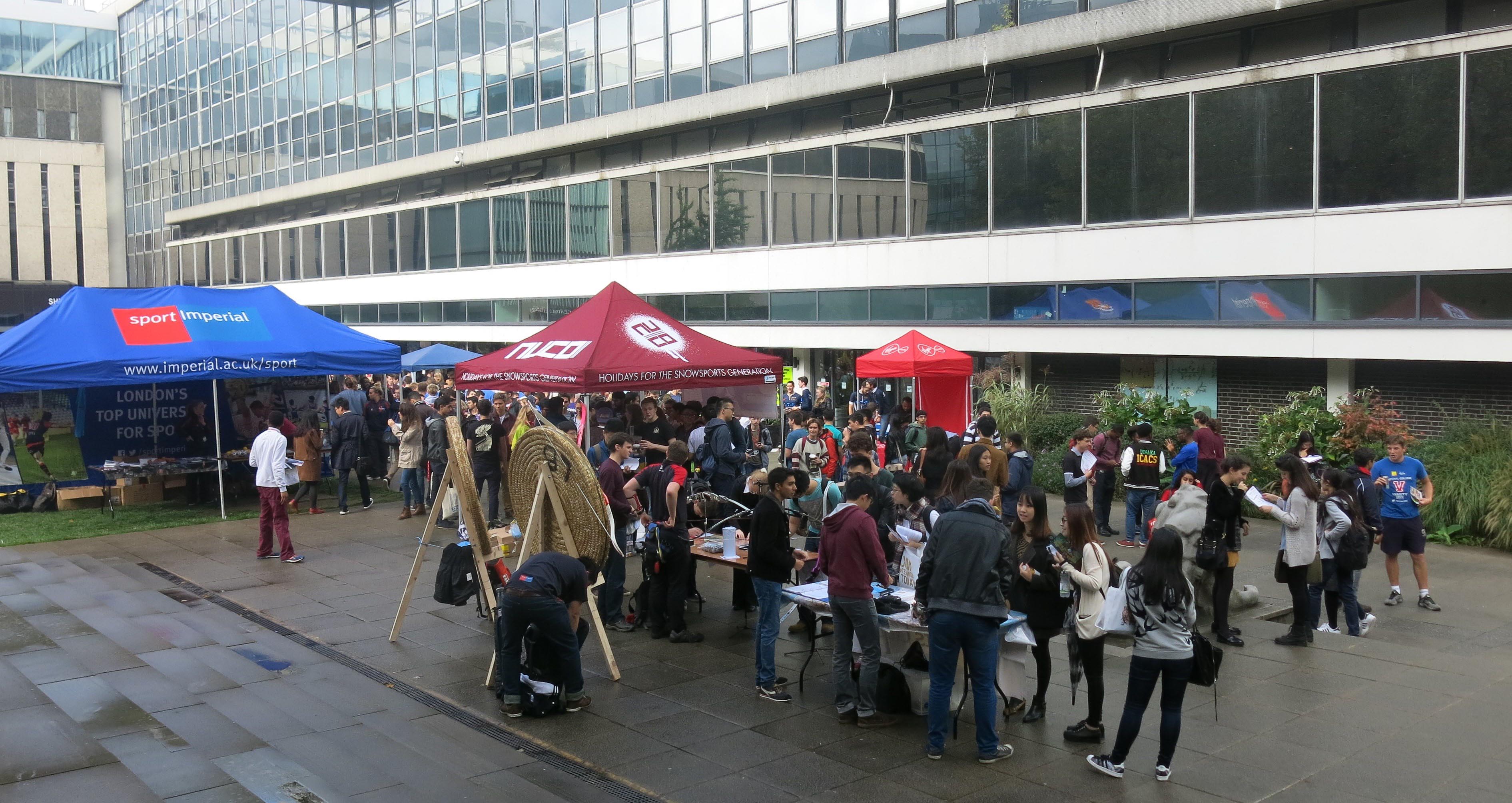
Your No. 1 mission is to go to ALL the stalls at the Freshers Fair on October 4th.
In a bigger city, there are also many charitable causes to volunteer for, and many opportunities for a part time job, like bartending or tutoring.
The point of trying lots of new things is to genuinely learn what you’re into and not, rather than saying “I don’t think I’ll like it.”
3.Learn how to learn
The lecture starts, and you pull out your paper and pen, but you see your classmate across the room with a Microsoft Surface Pro 4 with his stylus ready to jot notes down on MS Word.
We all have our learning styles – these are whichever helps us learn more effectively. See what things you have available to aid your learning, apply them and evaluate how helpful they are, in order to find out your most effective learning method.
And I mean whichever method aids your learning. (Taken during our Halloween dress-up)
Personally, writing things down helps my learning a lot. I vary from using pen and paper to a laptop depending on the pace at which the lecturer speaks. If lecture notes are already provided, then I would print them or work on an iPad or other device to edit the .pdf file.
4.Not everything is a competition
If you’re sportive, you may understand the competitiveness of a race – from start to finish, your efforts are invested into the steps you need to take in order to win. But at university, I don’t believe there should be competition where your academic performance is to be compared to those of your classmates. Sure, you may want to get good/great grades, but don’t seek to get the best grades.
When I started my 1st year, I felt I had get (one of) the highest grades in my year group. I did for our first summative (graded) assignment. Afterwards, however, I felt unnecessarily stressed in trying to maintain that standard. Instead, I felt I was not performing as well as I knew I could. Took me a while to realize and accept this as I am within a group of students who normally perform academically excellent.
5.Figure out what you want out of your time at uni
You may be starting your studies at university because you want to become a doctor and open up a hospital, or you want to contribute to the development of bionic prosthetic devices (this one’s mine). If your goals are crystal clear to you, and advancing your education at university is the next step, then figure out the following steps you need to take to get to your goal at whatever pace you want.
However, you may not be 100% sure about what you want. And that’s fine. Your first step is not to worry too much about it. Then spend some time exploring the many opportunities available to you. One of them must resonate at your frequency. When you’ve got it, take massive action on those first steps and accelerate towards your goal.
6.Keep a budget and track your expenses
As you’re moving out of your home, leaving your parent(s) or guardian(s), you will need to be on top of your finances if you want to survive.
Just kidding, you will definitely survive! However, knowing exactly where you’re spending your money allows you to cut back on the unnecessary costs and save up for what really matters to you.
Want to purchase a new computer/camera? Then start saving up a couple pounds a day by, for example, making your own food rather than buying food at the cafeteria.
7.Don’t be afraid of disappointing anyone
Give it your honest, best shot. You’ll realize you’re more capable than you think.
In your years ahead at university, you will come to face great challenges that will test your will. These may be mostly academic, but they may also involve another person, group, business/company, etc. Whatever the case, lose the fear of what anyone will think about you if you don’t get that job, or fail the test, or not end up as the top student, or simply lose.
Honestly, it’s a toxic feeling that will eventually break your will, no matter how try you hard to fight it. I experienced it during my exams. As I was afraid of disappointing one particular person, I did not perform as well as I really could on two exams. I’m glad I still passed both, but I learned my lesson the hard way.
But I didn’t lose. No. Battles are only lost if you learn nothing from them. But I definitely did.
You may be asking yourself how. I asked myself that so many times. It all boils down to accepting yourself as you are at any moment, and simply focusing on the task at hand and nothing else. Sounds easier said that done; it is, but it also becomes easier with practice.
8.Be encouraged, rather than discouraged
Here at Imperial, you will come to meet people who have a deep passion about what they do – whether that is their degree course, a sport, or even an art – and they’re really good at it.
But instead of “comparing your chapter 1 to someone else’s chapter 20” (Yahya Bakkar) and feeling discouraged, talk to that person about their passion and learn from them. Ask them what makes them passionate, and how they’ve been able to keep at it for however long.
So if you share an activity as a mutual interest with someone else, learn from that person instead of distancing yourself from the activity altogether. Trust me, I understand that it could be quite scary being honest, but if you truly want to grow in that area, then have faith it will all be alright, because it will.
9.Cherish your time at university
Make friends and spend valuable time with them.
I was once hiking through the Seven Sisters Country Park toward Eastbourne, and I came to meet a UCL graduate. Curious to know what advice she had for a fresher like me, she told me this: Cherish your time at university.
She helped me to remember the position I am in, that after 3 years I may start working for a company and may no longer get to experience the spontaneity and liveliness of a university campus. I have come to know that I greatly enjoy it, and I will dearly miss it.
So I give you the same advice as you’re about to start uni. From start to finish, spend every second doing something significant to you, be happy and appreciate what you’ve got.
10. Do more than the expected minimum
While being around London, I once met an Imperial alumnus who studied Physics and later on went to do a PhD at Oxford in Physics as well. At such encounters, I always try to ask for advice a new student like me could use. He told me that though I receive a minimum amount of work in my course, which is expected of me to complete/do, to go beyond that and seek further knowledge.
This means that, for example, though your lecturers will assign problem sheets for the next session, do not only complete those, but also seek extra problems from the list of supplementary books. And more! Your lectures will probably be a collection of specific details from different sources, like mines were, but do search for those reading materials and read up on extra details, which may help you understand the whole subject!
Remember to never do less, but more.
11.Love and develop yourself
I am beautiful no matter what I wear, do or have.
You are a body, mind and soul, and you can develop all of these three with appropriate training.
Body: As a university student, gym memberships are normally cheaper, so set up a routine, go with a more-experienced friend, or whatever else may work out for you and build the beautiful temple that is your physical body.
Mind: Here you will come to learn new things that will challenge all that you’ve learned previously, which you also may find truly interesting. If so, invest the necessary amount of time to expand your knowledge and understanding of your degree course or anything else that may interest you.
Soul: As for your soul, happiness is key. Carefully pick the activities you take part in, the people you spend time with, the places you visit, and how you spend your time in general. Make sure that whatever you’re doing, you are genuinely happy or know that you will be happy after having finished/overcome something.
Note that I am not an expert in any of the three. I am still learning of ways to develop myself in these aspects, and I’ve come to realize that there is also no deadline. Anyway, for further inspiration I would suggest meeting those that are experienced in person, or following them online.
As I post this, it’s September 30th and the final batch of freshers arrive at the halls tomorrow. For my 2nd year at Imperial, I chose to be a hall senior and have worked with the other hall seniors, sub-wardens and wardens of the Woodward Buildings (and the Costume Store this year!) to organize a fortnight of daily events that we’re sure our freshers will enjoy.
This year, I aim to be much more consistent with my studies and extracurricular activities, which also includes blogging. Though my 1-year term as an Imperial blogger is coming to and end, and I am uncertain that I will get the opportunity to continue. Though for the length that this blog is up, I’ll try to promote it as much as I can. If I could help to spread some advice to at least 1 fresher, I’ll be more than happy! 😀
If you have found any of these tips useful in any way, please let me know in the comments! I like comments. 😀 It lets me know people actually read this stuff (because I have no way to track views) and appreciate it enough to say it or ask a question.
Another great trip started off pretty well as the glorious leader, who wasn’t going anyway, fell ill and couldn’t do the shop. While the previous glorious leader dealt with that, three freshers managed to deal with boats. Then people arrived, things happened and we ended up leaving half an hour late anyway. But hey, we tried.
The tall clumsy one, being a pain by nature, needed picking up from Luton, which sucked, but at least we successfully implemented the grab-and-eat-in-bus attitude to food, saving a bit of time. We arrived, tried to create warmth by hoping for it and closing the doors. In the morning, the fresher keen-team and tall-clumsy managed to make breakfast without casualties and we headed fairly early to The Duddon. There were two potential sections to run, respectively 3.5km and 6km in length and the decision was made to do both, increasing the need for reduced faff. Get-on was rather fun, as we lost two people in a car, since some people drive minibuses faster than others drive cars. After a good while of working out what to do, since we had no signal and they had no guide book, we realized that the odd red object directly in front of us could also be used as a phone. In the common tongue, I believe they call it a phone box. Having found humans, sent a shuttle and put correct clothing on, we went to get cold. The river was on low, so not particularly much of anything. Some sections scraped your butt the whole way down, but it did contain 5 or so nice rapids, which saw the capsize of two humans, one of whom ended up with a cracked, duct taped, but nonetheless leaking boat. It suddenly turned out to be a good thing that someone took two boats and we had a spare. Tall-clumsy decided to increase the level of havoc he causes, so threw his paddle gracefully over directly into a tree branch, so we had a minute while he climbed a tree to retrieve them.
As a side note, I confirmed that drysuits are magical and mine is kind enough to work. Being warm almost felt wrong, so maybe its good that my hands were still freezing. I also discovered that I am capable of losing my watch by storing it in my mouth due to lack of pockets, while finding out just how much fun it is to need to pee in a drysuit with no crotch zip of any kind.
We got off the river surprisingly much before dark and the existence of a car-wielding human made changing and leaving wonderfully quick. Chili was chiliful and it was worked out that poorly washed rice tastes much better when shaped in a volcano, because science. By nine, we were done and tired, so beer pong kept us entertained. A small handful of us then stuck around to observe ginger beer getting suspiciously darker and tall-clumsy failing at spinning a coin.
The second day started off with a really long decision making process. Some rivers were too high, one was too low, some were too far and some were too hard for us little ‘uns. On top of that, we had to drive just to obtain signal and once again lost the car. We settled on the last chunk of The Kent from the rapid before the L shaped drop to Force Falls. We took it really slow, so I had the opportunity to confirm that I can roll in a drysuit while waiting. WHOOP. Since we were only running one section, we had the chance to run it twice and the experienced few went again to search for lost paddles. The Kent was a morning mission last Lake District trip, so it was nice to run part if it again on higher, since it almost felt like a different thing entirely but I still had an idea of what was coming.
Also, no throwing up occured, other than once on the way to rivers. Major WHOOP. We were home damn early and I got free store cornflakes. Overall, I obtained a nice feeling of a good Lake District to balance the previously eugh one.
Now that I’m a chunk into term 2, I finally understand enough of term 1 to talk about it. This is due to my own stupidity and laziness, not the difficulty of the course, so don’t be put off much. Here’s an overview of what happens in the first bit of 1st year Physics. I’ll include the not-particularly-physicsy bits and everything to do with the year in Europe and Theoretical courses too. If you are reading this because you want to study this stuff, do remember that you may have different lecturers and some of the aspects may change.
LECTURES
The first term contains five lecture course, none of which span the term, though I believe mechanics comes close.
Functions – This is basically a chunk of A-level maths plus a bit more. There’s some limits, integration and its uses, differentiation, including partial and total derivatives and a bunch of polar coordinates. I would recommend going over how polar coordinates work if you haven’t used them before. The course was well structured and paced and enjoyed on the whole. There is a full set of notes, which were handed out by chapter, so it as easy to keep track.
Mechanics – This starts with the stuff that you already know, but moves into things like non-inertial frames, center of mass frames, rotating extended bodies and angular momentum. This was probably the best lecture course in the 1st term, though an argument could also be made for functions. The structure and pacing was really comfortable, i.e. the perfect balance between boring and impossible. Most people enjoyed this course the most, possibly because it created the nice feeling as though you are doing physics. There is no official set of notes, but there are a few student-made ones circulating. I actually liked having to make your own notes, as it felt less like being a lazy cheat.
Complex Analysis – If you have seen and worked with complex numbers before, this course is hardly anything new until the end, where you get into differential equations. There is also a full set of notes for this, produced by the lecturer, which was helpful.
Vectors – Once again, this is nothing new if you’ve experienced further maths A-level and there is also a full set of notes.
Vibrations and Waves – Most people were fine with the vibrations bit, but some got put off by the fast pace (due to lack of lecture time) and got lost during waves. The lecturer has created a bunch of extra material though, so I think we’re mostly fine now, though we still burst out laughing when a lecturer mentions an assumption of out vibs and waves knowledge.
PROFESSIONAL SKILLS
There are four tutorials a week, each lasting 50 minutes. Due to the magic of some lecture courses being shorter than others and some not overlapping, each course will have its own tutorial, at least for a bit. The fourth 50 minutes is dedicated to the wonders of professional skills. This course may be tedious, but it is useful, since it consists of writing CV’s and covering letters and a mini group research project. Spoiler: term 2 then contains a topical review and problem solving.
LANGUAGES
As part of the year in Europe course, there is an hour a week dedicated to special language, which is to prepare you for the part where you actually learn in German, attend lectures in German and pretend that you know what the hell you’re doing, but in German. My favourite chunks of knowledge obtained so far are the names of tools, the word for oxyhydrogen and an extensive idea of the Brazil nut effect.
There is also a program called Horizons, which allows you to go learn more useful stuff, such as employability skills. As part of YiE, it’s obligatory to take your language. This is two hours a week.
Overall, it can get intense, since an hour of language technically requires an hour of homework. Then again, if you are serious about running off abroad, you are probably also serious about learning the language.
THEORETICAL
The theoretical and straight courses are absolutely identical so far, which also means that you can switch between them for now.
BAH stands for Bad ad Hoc Hypotheses, which is rather self-explanatory and already promising, but the host was a comedian and the improvised key note speaker used paint for his presentation. Perfection. It was a really good laugh and probably the best source of nerdgasms, other than the SciFi library.
The event was spread over two days and consisted of Evolution on Friday and Big Science on Saturday. I was busy on Saturday, leading to increased appreciation of the live stream on Youtube. Speaking of
Imagine a massive crowd of 500-ish people, dressed as Santa, playing christmas music and skating through the streets of central London. That’s pretty much all there is to it, but there’s just something so awesome about hijacking the roads. I went along with a handful of people from Imperial SkateSoc, who didn’t know I was coming so I was rather lucky to find them right at the beginning.
I also missed the fact that you could actually buy a santa suit from the people organising it. I’m hence dressed in rainbows and tinsel, as you can see in the video at around 5.30. T’was an awesome night and much thanks to the organisers!!
No, it’s not my footage (how did you guess?). It’s taken from Lilbizkit.