In light of recent developments, I thought it’d be good to share some thoughts as an International Student here. The situation at home (Malaysia for me) and here in the UK seems to be developing at a similar pace, with numbers rising day after day. There are a lot of uncertainties at this moment, especially regarding borders; the possibility of a lock down both here and back home.
From all I can see, the expansive coverage by social media and traditional media in general, fear mongering is real and it’s undoubtedly spreading panic to the general public. What I’ve decided to do, is to limit the COVID-19 information that I am exposed to, on all my social media. In my opinion, I think that constantly being updated with every single information down to the 3rd decimal point really won’t change anything. There’s nothing I can do to bring the numbers down. It’s not to say that I completely stop reading about the development of the disease. I choose selectively, the sources I get the information on and limit checking it to just one or twice a day.
There’s nothing I can directly do to help bring the numbers down, but the decisions that I make can make a difference. So, I’m choosing to socially distance myself and self quarantine at home to limit the possibility of spreading the virus. On the bright side, this is the perfect time for us students together what we always crave for; sleep. I’m also able to spend so much more time in the kitchen, cooking up dishes and desserts worthy of Michelin Stars! What’s growing out of this is not only my ego but my waistline too.
Now that Imperial has opted for remote teaching, all the departments are in the midst of transitioning. We’re using Microsoft Teams, Skype, Blackboard and more to facilitate this. We’ve yet to know how exams are going to be run but we are patiently waiting for our department to update us on this. The staff have been working tirelessly and many if not all have worked through the weekends, trying their best to keep the students updated with the latest developments. Major kudos to all the staff at Imperial in keeping the institution running and to everyone out there helping fight this pandemic!
What am I going to do now? I’ve decided to return home to Malaysia. As of now, our borders are still open for overseas citizens to return so I thought it’d be wise of me to go back home. I have been imposing self-quarantine here in London before I return. My intention is to limit myself to risks as much as possible as I will be returning back to my family at the end of the week. When I arrive home, I will impose self-quarantine again for two more weeks. Sounds horrible, and why is there be a need to go home if I can’t go out and see my loved ones anyway? I figured that this was the most responsible decision I could have made. Knowing how my parents are, they would go through sleepless nights knowing that we are far away from them, exposed to all these risks and that they aren’t by our side to care for us.
I really don’t know where I am going about with this but I thought that it would be beneficial to some, to learn that they aren’t alone in going through this. There are a lot of uncertainties and we’ve just got to be patient and resilient. Best way to go about with it is to “Be alert but not anxious!” as Dr Mike says it. I wish that all of you and your loved ones are healthy and well. To those going home, please I know how hard it is to not be able to meet your loved ones but take the wiser decision to self-isolate for 2 weeks. This will make all the difference. I am no expert on this but I know we can get through this together (in isolation of course)!
Welcome to Round 2 of the Imperial Survival Challenge! Getting back into the ‘zone’ after weeks of slacking off and chilling on the couch during Christmas break does take a lot (especially if you forgot how to write over Christmas :))
Start of Autumn Term
I remembered what the start of the Autumn term looked like. All the “freshers week” events, so-called ice-breakers, socials and “introduction” lectures to the various courses ran through my exhausted mind. The time I got to spend with new faces, exploring the city and attempting to sort out finances (clearly didn’t work for the first few weeks, thanks to my amazing cooking skills). More than anything else, it was about getting myself sorted mentally and emotionally (and obviously learning to hate the weather a tad bit less..). This is the period of learning life skills and also having your dose of adventure.
Start of Spring Term
Fast forward a month later. After all the standard protocol of wishing everyone a great new year, the Department of Electrical & Electronic Engineering has its own way of wishing its students. No matter how cool the department name sounds, pretty much love to keep its students on their toes! My Christmas was hijacked by a portfolio deadline during the holidays, and if things couldn’t get any worse, within a day or two of returning back from my relaxed holidays in Jakarta (the capital of the country which has Bali!), I confronted my first, formal examination consisting of a 2-hour long Maths exam (what can I more fun than that!). The fun ended with yet another assessment, this time a programming one.
And the final words…
All in all, for most people, it was a reality check of the academic standards and rigor that Imperial expects. Better to have to it now than later, because before I realize, within 3 months, the great grand finale round, i.e the final exams will arrive, ready to challenge my capacity (and ego!)
Time is a funny thing. As physics students, we learn that our most basic assumption of time is, in fact, true: its silent immutability, that cold, heartless pace of the clock, is a lie. Of course, time doesn’t actually run slower in a queue, when one minute feels like five, or run faster in an exam, when the last five minutes feel like one; spacetime is warped by inertia, not boredom. But even if this agreement between perception and reality is coincidental, the subject makes for some thinking.
I’m writing this from home, 14 days and 500 miles away from Imperial, and though there is much to celebrate about being back – not having to cook every meal, or being around people who actually know how to iron, or simply just being able to get up at noon without feeling guilty – there is equally a curious feeling of trying to peddle back lost time. The autumn term lasted 10 weeks, or 70 days, or 1680 hours, or 6048000 ticks of the clock, but you can’t quantify, really, how fast and how slow that runs. In that time, for example, you will learn to cook, if you haven’t already, and you will spend an eternity chopping fruit and veg – if you doubt that, I assure you that I now have enough scars on my hands to prove it. You will answer infinitely many questions, or really the same questions an infinite number of times – what you’re doing, where you’re from, where you went to school, where exactly the English accent comes from if you’re supposed to be Scottish (that one might just be me). You will make your morning walk to campus more times than you could possibly count, in sun and rain and in glee and despair and boredom and, in the last few days, contemplation.
Because Cantor proved a hundred years ago or so that our infinities are bounded; that we cannot count all the numbers between one and two, and yet we can still pass them all – it’s the first maths we learn, to jump up to three and four and five and yet on, leaving infinities unexplored in our wake. An infinity can be bounded by the finite, and that’s the lesson of ten weeks. You will find the time more than the sum of its parts; you will find the time to miss your family (but maybe not quite as much you’d think you would), to spend hours amongst the spires of London, or in the oppressive quiet of the galleries, or in the shadows of morning waiting for the sun to rise, and you will even find the time to do your degree – though it will never feel like you have quite enough time for it.
So, in our little infinity of ten weeks, what changes? Everything and nothing, of course. You are still you. But you are a different you; most importantly, you’re an independent you. And that freedom deserves emphasis: that shared history, all the time that came before, is lost to everyone else at Imperial. You are no longer defined as a sibling or a child or a cousin, but as a housemate and a student and a blank slate – you are free, in effect, to largely redefine yourself however you want. It’s freedom, but you lose a sense of familiarity for a while. And, of course, it takes some time.
This doesn’t have anything to do with the post, but I needed a photo and the Christmas decorations around Wilson House deserve to be seen.
There’s one last concept in physics pertinent to this discussion: entropy. Entropy is a degree of the ‘disorder’ of a system*, and, critically, it cannot decrease in a closed system. This increase is time’s immutable arrow, and it is the difference between the past and the future.
And so, when I say that, back at home, you feel an effort to peddle back time, what I mean to say is that you feel a need to decrease the entropy of the situation, and to pretend that the last ten weeks – an amount of time at once negligible and hyperbolically significant – didn’t happen. But perception tells us this is impossible, and so does physics. You will miss the contours of life before university, but that is the invariable price of change, of growth, and of time. And change and growth, of course, are not loss: you are still a child and a sibling and a cousin and all your other identities, and though a different you will wear those labels, they will wear them just as well.
So, I guess what I’m trying to say is it takes coming home to realise just how much you grow at university, and just how much you’ve seen. And, if you feel like becoming more mature seems like one task too many on top of studying, going out, exercising, exploring and all the other little infinities of Imperial, don’t worry: there’s world enough and time yet.
*This is a vast oversimplification. It’s not my fault I don’t understand my degree well enough to properly explain it.
For those of you who don’t know me and I mean really don’t know me (anyone who has ever met me will now be rolling their eyes) I took a gap year. At school, I didn’t know what I wanted to do. I was nearing the end of two highly turbulent years and the last thing I wanted to do, was have another three years of the same.
As a child of an accountant and a political activist it was presumed that I would go to university, so I applied at the same time as everyone else, filling my personal statement with platitudes about my love of pure learning and the importance of education and clicked the submit button. It could be said that I lacked enthusiasm for tertiary education. My one act of defiance was to tick a wrong box. And just like that I had a year which was, for the first time in my life, entirely my own. I waited tables for 4 months and worked in Senegal for 8 if you are interested. And you know what I found (apart from myself)? I found that there are people who would kill for a chance to go to university, let alone Imperial. I saw what life without a degree is like. I remembered why I had once been a nerd, reading ahead in the textbook for the sheer thrill of knowing and understanding more about the world. I heard the stories my school friends were telling about being surrounded by intelligent and exciting people and I thought I might just like a piece of that.
Don’t get me wrong. I loved my year off. I grew up more in that year than I had in the four previous ones and made friends and memories that will stay with me long after I have forgotten everything that I learnt at university. If you offered me the chance to go back and do it all again I would in a heartbeat, but I must be honest. As an 18 year old school leaver I felt very small in, what I learnt was, a very big world. What did I have to offer? A-level biology seemed pretty useless as you try to remember who was allergic to pepper and where to put the steak knife. In comparison, university, where my grades meant something, sounded easy.
Sure I was worried about having fallen behind but I think that only made me keener and more eager. Unlike people who had come straight from school I was hungry and didn’t take lectures for granted. I wrote up notes each evening and took advantage of everything London had to offer. I realised that the time I had at university was precious because I had seen the alternative.
So my advice for anyone reading this is simple: Go and do crazy amazing wild things after school. Maybe you will want to come back to university, maybe you won’t. If you do though, you will be able to appreciate the opportunity you have much more because you have tried life off the conveyor belt and your time will be much better spent because of it.
Firstly, a disclaimer. I am in no way trying to slander Imperial College London and the Physics department. They are being very supportive and understanding of my newly developed situation. This is more of a personal account of what’s been happening in life, because answering the question ‘Hey, you’ve not been around…what’s going on?’ gets tedious a hundred iterations in.
Around June, I had my last two exams of first year postponed to the September re-take period. I spent a healthy chunk of the summer revising and felt on track to do just well enough to be ready for second year. Sitting in the exams, I frantically counted up how many marks I was absolutely certain I would be awarded. Happily sure that I had at least passed, I continued with life.
Skip forward to a holiday to Tenerife with my step-mum and sister. After a great day of diving, surfing and getting ridiculously sun burnt, I got an email telling me I had failed one of the exams with a mark of 37. This was, of course, devastating for someone with the anti-failure mindset fairly common at Imperial and such places. I had a cry, called my senior tutor, had a moan, accepted my fate, and ate an entire Sambuca watermelon. My poor sister and step-mum just decided that leaving me to be was easier than trying to tell me that it wasn’t actually the end of the world. One – because I responded with more crying when she tried, and the other – because she was three and it was bedtime. Luckily this was the last day of the holiday, so the only obstacles between me and my bed was a flight.
Regrouped and at a healthier level of sadness a week later, I found out that my retake next June would be capped at 40%. So, I had to do something for a year, take one exam, get my pass and continue with my course – It all started to seem less terrible and more survivable.
The only thing I could do to improve the situation was fight against the decision to cap the exam. I filled out a few forms, talked to a few people and sent off the appeal application, promptly forgetting it existed. Meanwhile, since I was not receiving student finance, I couldn’t even nearly afford the room I was living in and moved out into a family friend’s spare room. It was very cheap and there was a cat, but it took me about an hour and a half to get to uni. All I needed here was a few societies, some meetings, Outreach work and therapy, so the long commute was worth the low rent. I also couldn’t go live back at home because my room had been redesigned for my little sister and it’s way too far away for a daily commute.
I got called into a meeting by my senior tutor with the subject ‘urgent’ sometime in November. Mildly panicked, I was then told that the meeting would be in the office of the department head, since it was such an important matter. Completely panicked out of my mind, I was introduced to the people present and it was explained to me that I actually never failed and a clerical error had occurred instead. I had actually scraped a 2:1 for the year, which is all I needed to achieve the main goal of staying on the year in Europe course.
I then had two options: wait for a year and rejoin the 2nd years or rejoin my year then, taking the missed lab cycles instead of the tutorials and spending any hope of free time on those tutorials and extra help from my personal tutor and senior tutor. This sounded like being busy to the point of death and I figured it would be just about possible if I hadn’t now obtained another 3 jobs to pay for this all and wasn’t living so far away. I firmly decided to not die for physics yet and wait out the year.
To add to the plot, it then turned out that, although the department takes responsibility, I had also added to the chain of events by wrongly marking one of the booklets in the exam, which was then not assigned to anyone and was simply 15 marks flying around unclaimed in the spreadsheet. This was due to a combination of errors, unfortunate coincidences and general bad luck.
The department has been great since – they are paying for my tuition next year, offering me help and access to the online resources and, as always, I have the amazing support of Mery Fajardo who is a beacon of fabulosity for anyone who knows her. A meeting has taken place to basically change every aspect of the marking system that broke down and to ensure none of the same issues ever occur. Realistically, these things happen in all departments, in all universities and in most parallel universes. It’s just a big fat boo when it happens to you.
To sum up:
If you count marks in the exam and you can see an easy 40 your’e certain you have, don’t just believe that that didn’t happen – at least ask to see your paper.
It’s not the end of the world if you fail!!!
Sambuca watermelons are not designed for a single sitting.
Really focus on labeling your answer booklets correctly. Everyone is mega stressed in exams and things like that are so easy to mix up in that state.
Don’t read important emails until the last day of your holiday.
“Here’s your first summative assignment.”
03/11/15
“1st term’s over! Merry Christmas and a happy new year!”
18/12/15
“Welcome back. How were your holidays?”
11/01/16
“This term’s tough. More assignments and labs!”
15/02/16
“Yeah, I’m going home for Easter.”
23/03/16
“How are exam preparations coming along?”
25/04/16
“The first exam actually went pretty well.”
29/04/16
“I’m really glad they’re over.”
01/06/16
“Congratulations on passing the year. See you in the 2nd.”
19/07/16
I finished my 1st year at Imperial several months ago, and it truly went by too fast. Maybe it’s because as I’m getting older, every other year is a lesser fraction of my life, but who knows in fact.
Besides that, I tried to make the most of it, and in some aspects, I did. That makes me really happy, but there are other things that I wanted to try out or accomplish (like rock-climbing or a more regular club attendance), but did not in the end.
Of my first year at least.
So, from all my highs and lows over this past, eventful and simply wonderful year at Imperial, here are 11 tips for you to own your 1st year.
1.Be the one to say “hi” first
At Imperial, you will come to meet lots of new people from many different places, and make some pretty good friends. I say, be the one to muster up the courage to walk up to the cool guy or pretty girl you have your eyes on, and simply introduce yourself without expecting anything in return.
Be as glamorous as you need to be.
You may end up as friends, or you may not click with that person. Anyway, you will come to develop your courage and conversational skills. Soon enough, you’ll learn how to approach different people and how to start and lead a conversation.
2.Try as many new things as humanly possible
If you’re moving to a large city like I did, then there will probably be many more activities or opportunities available to you as a university student. This may include activities like calligraphy, pole-dancing, kendo, photography, skydiving, or even archery.
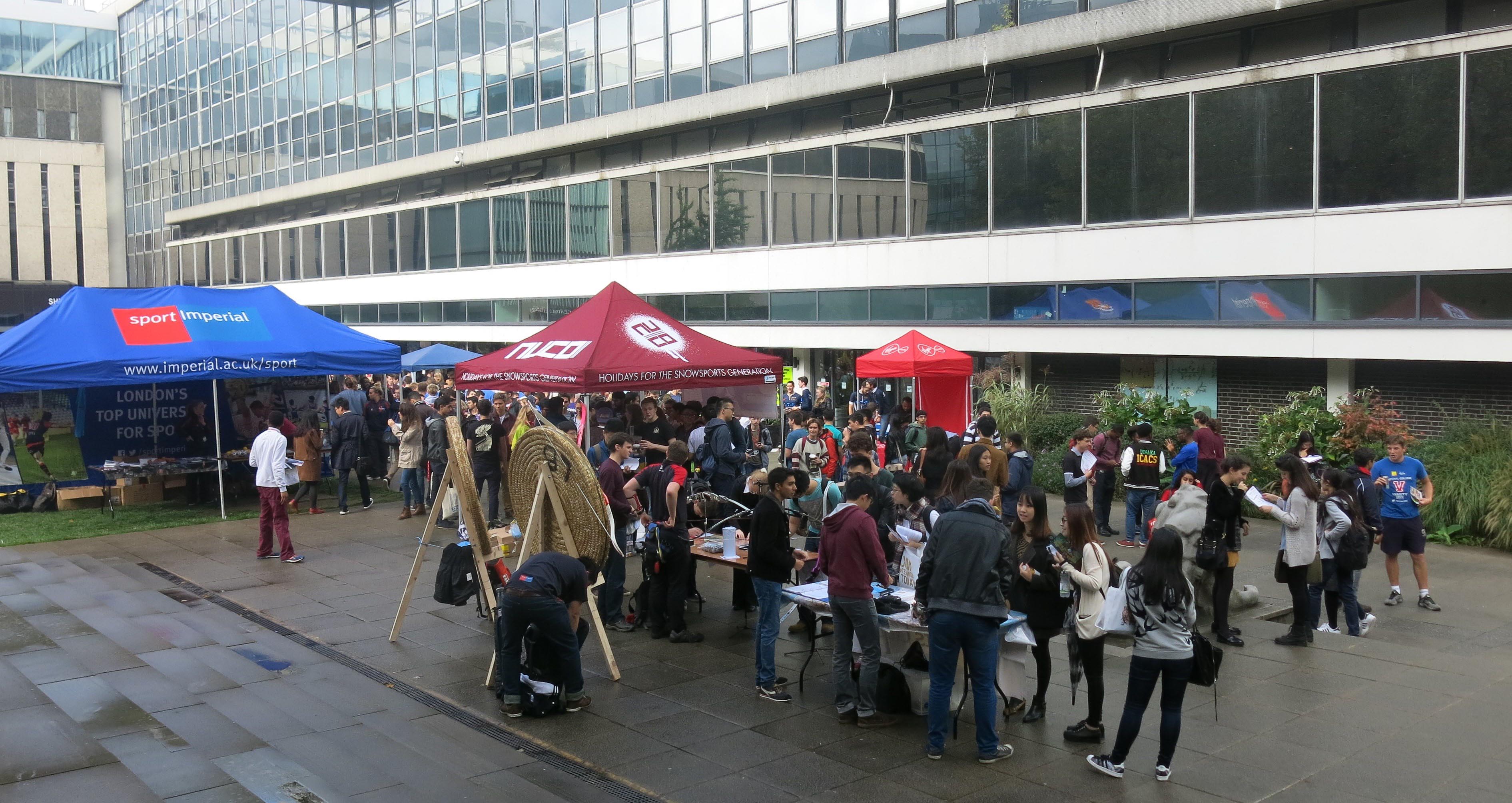
Your No. 1 mission is to go to ALL the stalls at the Freshers Fair on October 4th.
In a bigger city, there are also many charitable causes to volunteer for, and many opportunities for a part time job, like bartending or tutoring.
The point of trying lots of new things is to genuinely learn what you’re into and not, rather than saying “I don’t think I’ll like it.”
3.Learn how to learn
The lecture starts, and you pull out your paper and pen, but you see your classmate across the room with a Microsoft Surface Pro 4 with his stylus ready to jot notes down on MS Word.
We all have our learning styles – these are whichever helps us learn more effectively. See what things you have available to aid your learning, apply them and evaluate how helpful they are, in order to find out your most effective learning method.
And I mean whichever method aids your learning. (Taken during our Halloween dress-up)
Personally, writing things down helps my learning a lot. I vary from using pen and paper to a laptop depending on the pace at which the lecturer speaks. If lecture notes are already provided, then I would print them or work on an iPad or other device to edit the .pdf file.
4.Not everything is a competition
If you’re sportive, you may understand the competitiveness of a race – from start to finish, your efforts are invested into the steps you need to take in order to win. But at university, I don’t believe there should be competition where your academic performance is to be compared to those of your classmates. Sure, you may want to get good/great grades, but don’t seek to get the best grades.
When I started my 1st year, I felt I had get (one of) the highest grades in my year group. I did for our first summative (graded) assignment. Afterwards, however, I felt unnecessarily stressed in trying to maintain that standard. Instead, I felt I was not performing as well as I knew I could. Took me a while to realize and accept this as I am within a group of students who normally perform academically excellent.
5.Figure out what you want out of your time at uni
You may be starting your studies at university because you want to become a doctor and open up a hospital, or you want to contribute to the development of bionic prosthetic devices (this one’s mine). If your goals are crystal clear to you, and advancing your education at university is the next step, then figure out the following steps you need to take to get to your goal at whatever pace you want.
However, you may not be 100% sure about what you want. And that’s fine. Your first step is not to worry too much about it. Then spend some time exploring the many opportunities available to you. One of them must resonate at your frequency. When you’ve got it, take massive action on those first steps and accelerate towards your goal.
6.Keep a budget and track your expenses
As you’re moving out of your home, leaving your parent(s) or guardian(s), you will need to be on top of your finances if you want to survive.
Just kidding, you will definitely survive! However, knowing exactly where you’re spending your money allows you to cut back on the unnecessary costs and save up for what really matters to you.
Want to purchase a new computer/camera? Then start saving up a couple pounds a day by, for example, making your own food rather than buying food at the cafeteria.
7.Don’t be afraid of disappointing anyone
Give it your honest, best shot. You’ll realize you’re more capable than you think.
In your years ahead at university, you will come to face great challenges that will test your will. These may be mostly academic, but they may also involve another person, group, business/company, etc. Whatever the case, lose the fear of what anyone will think about you if you don’t get that job, or fail the test, or not end up as the top student, or simply lose.
Honestly, it’s a toxic feeling that will eventually break your will, no matter how try you hard to fight it. I experienced it during my exams. As I was afraid of disappointing one particular person, I did not perform as well as I really could on two exams. I’m glad I still passed both, but I learned my lesson the hard way.
But I didn’t lose. No. Battles are only lost if you learn nothing from them. But I definitely did.
You may be asking yourself how. I asked myself that so many times. It all boils down to accepting yourself as you are at any moment, and simply focusing on the task at hand and nothing else. Sounds easier said that done; it is, but it also becomes easier with practice.
8.Be encouraged, rather than discouraged
Here at Imperial, you will come to meet people who have a deep passion about what they do – whether that is their degree course, a sport, or even an art – and they’re really good at it.
But instead of “comparing your chapter 1 to someone else’s chapter 20” (Yahya Bakkar) and feeling discouraged, talk to that person about their passion and learn from them. Ask them what makes them passionate, and how they’ve been able to keep at it for however long.
So if you share an activity as a mutual interest with someone else, learn from that person instead of distancing yourself from the activity altogether. Trust me, I understand that it could be quite scary being honest, but if you truly want to grow in that area, then have faith it will all be alright, because it will.
9.Cherish your time at university
Make friends and spend valuable time with them.
I was once hiking through the Seven Sisters Country Park toward Eastbourne, and I came to meet a UCL graduate. Curious to know what advice she had for a fresher like me, she told me this: Cherish your time at university.
She helped me to remember the position I am in, that after 3 years I may start working for a company and may no longer get to experience the spontaneity and liveliness of a university campus. I have come to know that I greatly enjoy it, and I will dearly miss it.
So I give you the same advice as you’re about to start uni. From start to finish, spend every second doing something significant to you, be happy and appreciate what you’ve got.
10. Do more than the expected minimum
While being around London, I once met an Imperial alumnus who studied Physics and later on went to do a PhD at Oxford in Physics as well. At such encounters, I always try to ask for advice a new student like me could use. He told me that though I receive a minimum amount of work in my course, which is expected of me to complete/do, to go beyond that and seek further knowledge.
This means that, for example, though your lecturers will assign problem sheets for the next session, do not only complete those, but also seek extra problems from the list of supplementary books. And more! Your lectures will probably be a collection of specific details from different sources, like mines were, but do search for those reading materials and read up on extra details, which may help you understand the whole subject!
Remember to never do less, but more.
11.Love and develop yourself
I am beautiful no matter what I wear, do or have.
You are a body, mind and soul, and you can develop all of these three with appropriate training.
Body: As a university student, gym memberships are normally cheaper, so set up a routine, go with a more-experienced friend, or whatever else may work out for you and build the beautiful temple that is your physical body.
Mind: Here you will come to learn new things that will challenge all that you’ve learned previously, which you also may find truly interesting. If so, invest the necessary amount of time to expand your knowledge and understanding of your degree course or anything else that may interest you.
Soul: As for your soul, happiness is key. Carefully pick the activities you take part in, the people you spend time with, the places you visit, and how you spend your time in general. Make sure that whatever you’re doing, you are genuinely happy or know that you will be happy after having finished/overcome something.
Note that I am not an expert in any of the three. I am still learning of ways to develop myself in these aspects, and I’ve come to realize that there is also no deadline. Anyway, for further inspiration I would suggest meeting those that are experienced in person, or following them online.
As I post this, it’s September 30th and the final batch of freshers arrive at the halls tomorrow. For my 2nd year at Imperial, I chose to be a hall senior and have worked with the other hall seniors, sub-wardens and wardens of the Woodward Buildings (and the Costume Store this year!) to organize a fortnight of daily events that we’re sure our freshers will enjoy.
This year, I aim to be much more consistent with my studies and extracurricular activities, which also includes blogging. Though my 1-year term as an Imperial blogger is coming to and end, and I am uncertain that I will get the opportunity to continue. Though for the length that this blog is up, I’ll try to promote it as much as I can. If I could help to spread some advice to at least 1 fresher, I’ll be more than happy! 😀
If you have found any of these tips useful in any way, please let me know in the comments! I like comments. 😀 It lets me know people actually read this stuff (because I have no way to track views) and appreciate it enough to say it or ask a question.
You can find the official stuff on horizons here, but I’ll try to give an idea of the experience behind it. Either way, I’d recommend the course, as it’s a nice non-course-related thing to do with your life.
Background: as part of the Year in Europe part of my degree, I have to study the appropriate level of the appropriate language (as well as a special language course which I’ve mentioned elsewhere). For me, this was level 4 German, since I had studied it up to A-level. The course outline, assessment details and learning objectives for this particular course: bam.
Briefly and in an as helpful as possible way, here are the main things I wish I had known/I didn’t expect/think of your own classic list title:
– Yes, this is a proper course. The lessons are two hours long and anything that lasts that long elsewhere in the course has a break between hours. There is also a lot to cover, so it ends up being rather intense with at least an hour of homework a week.
– There are exams and an oral assessment at the end, which are mildly important if you have to do the course. They are nothing too stressful, but some preparation would be good.
– It really is up to you how much you put into the course. There is always stuff to do in addition, if you happen to care and really want to learn the language. There is also not too much pressure to actually participate in the lesson or put much effort into the work if you want to chill through it instead.
– It’s another nice way to meet people you have things in common with. Joining clubs is more fun and less stressful, but yey, people.
Exam Update
When you arrive at uni, you hope to get a 1st. Around the wonderful Christmas test, you start thinking that a 2:1 might be okay. Now, we all just want to pass the exams and not fail problem solving. At least “we will all go together when we go”.
Current state: eeeeeeeeeeeeeeeeeeeeeeeeeeeeeeeeeeeeeeeeeeeeeeeeeeeeeeeeugh
People who I know and are trying to find embarrassing things to run my face in later will have hopefully got bored by the official stuff up there ↑ and stopped reading by now, so I can write more honest things. <secretwhispers> I feel that it would be healthy to be stressed about exams and it feels strange that they’re not bothering me that much. I don’t feel particularly homesick either, because I’ve been away from home a lot and I see my parents often. I don’t feel lonely, because there are always people around and there are at least some I could go to for complaining purposes. I just feel meh. Highly meh. I think I ran out of life. I feel like a Morty. Meh. </secretwhispers>
Everyone has questions about accommodation, so here’s another cheesy helpful extract answering questions you may or may not care about the answers to. For background: I currently live in Beit hall, in a single without en suite. I pay £192 a week, £2 of which are for hall activities, like karaoke, Netflix & chill nights and Beitan’s got talent.
So here are questions stolen from places, provided by the union and invented by my brain.
Every hall has a different atmosphere; how would you describe the atmosphere in your hall?
Beit is probably the party hall, if anything just because it’s attached to the union. No, the union is not too loud, because the windows have two layers and when both are closed, the screams of happy students are only a distant nightmare. Then again, if you wish to join and scream along, you know you’re not pissing off your hall-mates and it’s not like you have far to go. It’s generally nice and friendly, though I assume all halls are going to be like that.
What’s been the best event at your hall so far this year?
Beitan’s got talent was really fun, but unfortunately under advertised in my opinion. It was a great night nonetheless. The karaoke nights were a particular hit with me, as a brave soul joined me in singing some Slipknot and, I would like to add, knew all the words and put me to shame. Free breakfast on Sunday mornings is an absolute saviour for those days when both our cupboards and fridge are hungry.
What’s your top tip for new students applying for accommodation?
Don’t panic, you’ll be happy anywhere. No hall is perfect and each has it’s advantages. For example, Beit is great, but my bank account is crying.
What do now know about living in your hall that you wish you had known before you moved in?
People will be messy, loud and annoying, but you’ll love it anyway. From time to time, you’ll realise that you’re being the messy, loud, annoying one and you’ll suddenly forgive everyone for everything!
What the best thing about living in your hall, and the worst?
Best: It’s just so damn close to everything! The union, sci fi library and club stores are all right there. The physics building (the building you want to be in) is on the other side of the road and you can see any red carpet events held at the Royal Albert Hall. Bam.
Worst: It is expensive. It’s the third most expensive hall for a single room, after Eastside and Southside. Along with those two, it’s located right on campus, so bearing in mind that it’s close to stuff, the price is alright. It is also rather loud, but as mentioned previously, one can deal with that.
How do I apply for accommodation?
You fill out a form online before you come, where you list the 5 you fancy the most. You unfortunately can’t give them any priority and they are allocated almost randomly, maybe based on some of the extra information you give. Who knows? I heard rumour that if you apply for any double room, you’re likely to get it.
What options of contract length are there?
All contracts are however many weeks means you’re there all year, other that the summer holidays. Obviously, yes you can leave during Christmas and Easter, but you still pay.
When and how do I pay for my accommodation?
You receive an invoice well in advance and pay online. The payment is due the day after student finance comes in. I had a problem with my Santander account, as the overdraft can take up to a year to increase from £250 to £1500. My loan is small and my fee is big, so I was really just ending up with -£600, hence really needed that overdraft. I basically had to ask to pay later and wait until Santander let me use the overdraft the account actually came with!
What do I need to do before moving in?
Make sure you know what to bring. You don’t need lamps, a laundry basket or a mattress, but you do need pillows, duvets and sheets. There will be a list of what is already provided. I suppose that’s really it. Pack your stuff, don’t forget documents of sorts.
Features of Beit
There is no closed and locked bike storage area, but there is one just behind the Physics building (i.e. not far). There is a bike shelter, but it’s in the outdoor land of the quad.
As in all halls, to my understanding, there is a laundry room, which has recently been equipped with Circuit machines. This means no change and online top up.
Aaand the single rooms have sinks in them. What else must one know?
I’ve lost all control and can’t stop going on trips. It was was meant to be to Devon, but ended up heading to Wales almost last minute. This worked out pretty well as we got lovely, all be it expensive, accommodation with a cute old couple that gave us food and actual real beds with actual real pillows! Bam.
A few experienced people went off to paddle some nice grade 4, called Nantygwyryd…or so we thought. They returned displeased and it turned out to be a lovely grade 4 scrape. Apparently they actually had to exit the boats and walk a few times. Once we reached put in, pretended to be a rollercoaster, pretended to be Gazolphins and generally had some great merry times, we met a lovely lady, who warned us about angry farmers and gave the whole group a rather unimpressed glare when we mentioned what the morning mission consisted of.
The river Seiont (usually a grade III with a pleasant grade IV rapid, but more a III-(III+)) was initially just pleasantly bouncy and contained a few nice drops, but ended up presenting us with a damn good view of Caernarfon Castle. Due to the flat water at the end and the fact that paddled 11km, we were rather ready for chili. Taking boats out by climbing out of them directly onto a ladder and then heaving them up with a throw line was also oddly fun. I think an important addition to the level of pure funbags was the fact that my typhoon drysuit was still functional and kept me pretty warm.
dang pretty
We were off the water with plenty of light left and popped for a quick shop, because apparently we didn’t have enough mushrooms. The evening was the usual blur of chili, card games and *hot chocolate*.
The next morning was slow for most of us, as the two experienced ones went off to lose their glenginity i.e. paddle the Fairy Glen (a grade V(V+)). A few exciting things did occur while packing up though, as the owners locked the drying room with a bunch of kit still contained within it and promptly left. There is absolutely no way that we had to open a window and gently climb into the drying room. We decided to meet the glenginity losers at the Betws y Coed train station, where we found them enjoying some proper breakfast. One of them managed to obtain a mildly impressive cut on his eyebrow, which had luckily stopped bleeding before they ate food and met us.
Eventually, we decided to paddle the Ceirw, which began with a death gorge i.e. a compulsory portage. We decided to get on the river after it, so we got a lovely look from a bridge and path alongside the river. It looked like pure, never ending, beautiful death. After finding the appropriate put in, we made the decision that 2 miles is a ridiculously short paddle, despite the fact that we were 2+ hours later than we really should have be. Hence, we decided to paddle past the confluence with the Alwen. This was also a short paddle, but contained a pretty fun weir adventure. We approached a rather smooth looking weir, though remembered the guide book mentioning one to portage. Luckily, we did get out and look at it, which allowed us to see the disgusting tow back on the second drop and the fact that getting out in between the two drops was not likely to be easy.
It was overall a really good trip, as it contained 5 rivers and the ones I got to paddle were just lovely. Unfortunately, the next trip was cancelled, but not only was it okay to leave paddling for the term on such a high, but it was also replaced by a half-trip to Lee Valley. This means that I will finally get a Legacy assessment in two days, making me less incompetent 🙂
Before my interview, I called anyone I knew who had anything to do with Imperial and read every student blog that even mentioned the word. If that’s why you’re here, hey. Hopefully an extra insight will prove useful.
Outline of the day
This can obviously change between subjects and years, but the general outline is likely to stay the same.
The general idea is that you get a tour of the university from a student, along with a lunch, before meeting the human that decides your fate interviewer. This is the opportunity to ask questions about student life, stresses, work load and living in London, which may be more helpful answered by someone freshly going though it all. Also, I’ve done some of these tours since I came here and they are really fun, interesting and rewarding, but frankly awkward if no one asks anything.
After that you meet the interviewer and get a tour of the department, which is there to show you what the university can offer you. You get a brief look at the facilities and an idea of where and what you learn.
The actual interview is then there for you to show what you can offer the uni. Achtung: no, the interviewer does not directly decide anything! They make a comment/recommendation and it is one of the things considered when taking you into account. Basically, the interviewer could hate you, but you still get in, and vise versa.
How to prepare
– Bring the correct documents. You’ll be told what they are before the day. Don’t be the one that forgets them.
– Make sure that if anything in your personal statement isn’t true, it becomes true damn golly fast!
– Even if it is true, go over books you’ve read and projects you’ve participated in, to ensure you can talk about them comfortably.
– Be fairly up to date on what you’re learning, as problems to solve may involve such knowledge.
What you’ll be asked
WHO KNOWS? It’s just a massive mystery. Some people on my course only got asked about their personal statement and what they’d done before. I was only asked to integrate for 25 minutes and explain some assumptions I had made.
– Be prepared to answer questions like “Why physics?”, “Why Imperial?” and any about your personal statement in case it goes like not mine.
– Be prepared to use your prior knowledge in case it goes like mine.
What to wear
This is pretty much the least important aspect that has the least effect on anything, but people seem to care. Feeling comfortable on the day is naturally important and feeling like you’re dressed out of place may of course ruin that entirely.
Something comfortable, professional and simple is the best. I wore a black and white skirt with a navy blouse. Partially because it’s the only smart-ish clothing I own, but also because it sort of fulfills the criteria.
After the interview
Just don’t stress. Whether Imperial is your first choice or not, just concentrate on the other bits of life. Good grades always come in handy, so working on those may be best anyway.
I was stupid enough to stress out about the interview for ages, so when I got the offer, I had to suddenly start preparing for exams again.
General tips
– Sometimes the correct answer is “I don’t know”. I was asked for examples of an event that doesn’t exist.
– Don’t panic and make sure you know where your towel is. (If you don’t get the reference, then you’re silly, but please don’t actually bring a towel to your interview.)
– Try to talk any thoughts out loud, as it shows that you can think through a problem, which is important.
– You’ll be fine.