In the blink of an eye, spring term was over

The Spring Term lasted from the 11th of January to the 23rd of March, which fell on a Wednesday. This was a bit odd, as I would have expected the term to end on Friday, but apparently Easter came early this year.
On that note, happy belated Easter! I hope you spent some quality time with your family and loved ones, and that your celebrations for the resurrection of Jesus Christ were lovely.
As for me, I spent Easter with my family. I am very glad to have come back home after 6 months. If you don’t know, my home is Sint Maarten, a beautiful, tiny island in the Caribbean. Having arrived back made me realize that while I study in one of the best cities in the world, I live in paradise.
Anyway, to the topic of this blog post: Spring Term. As the term progressed, I gained more knowledge about my different modules and the Bioengineering field, and I got to work on an electrical engineering project that I am very proud of. Because a lot has occurred, in this post I will only cover what impacted me most:
1 – Electronic Stethoscope
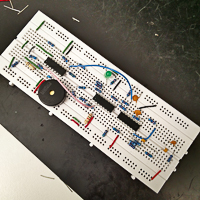
As part of our Electrical Engineering Labs module, we got to the opportunity to design and implement a device that is meant to amplify the sound of the human heartbeat – all with simple resistors, capacitors and operational amplifiers (op-amps)! We didn’t jump on to work on the stethoscope at once, however. We began by designing and simulating different circuits based on op-amps on LT spice IV, a software that facilitated the process.
After getting some experience using the software and truly understanding how the op-amp-based circuits operated, we moved on to design the stethoscope. The module was then moved from the computer to the laboratory, in which groups of students started off by building the simple circuits we designed at first (to get a grasp of the building units) and finally our stethoscope design. I worked in a pair, as most of us did, so my lab partner and I divided tasks to make things easier. At the end of the project, we managed to get the whole circuit to work!
2 – Programming language C
Coming to Imperial, I had basic programming knowledge – input/output, loops, if-statements, arrays. But through the Programming 1 module, I expanded my knowledge of programming and learned a completely new language (C), with more interesting codes to use in my programs! The module included the aforementioned topics, but also using different datatypes, casting data, errors such as truncation and overflow, selection statements (if-else & switch), iteration statements (for, while, & do-while), using functions to return one or more results, arrays, memory allocation, pointers, and using streams to read data from a .txt file and create another with the results.
The module was assessed in two ways. The first were 20 questions asking about what programming achieves and how. The next involved correcting or writing 8 short programs with the different codes that we had learned in the term. It lasted 2 hours long and one of the programs was quite challenging to write! I am currently awaiting my grade, but I believe I did well.
3 – Fourier Series and Transforms
You may know about Taylor and Maclaurin series, which can represent any function by the sum of an infinite number of polynomials. But Fourier series are more interesting. This was one of the new things I learned in our Mathematics 1 module, and the concept is slightly different, as functions are represented by the sum of sinusoidal terms instead. This type of series can be further applied in the Fourier transforms, which are used to turn a function from one domain (say time, measured in seconds s) to its inverse domain (frequency, measured in hertz, Hz). This can be applied to investigate signals and differentiate the significant ones from the noise.
For example, as we were dealing with electronic signals – generated by a microphone picking up the heartbeat sound – in our stethoscope project, Fourier transforms could be used to figure out the frequencies of the subject’s heartbeat sounds. Knowing this, the filters can be designed such that more noise is attenuated, while amplifying the significant signal.
4 – Wet Labs
Back in high school, I really liked working in the laboratory. I appreciated the environment, its formalities and working with the apparatus in different experiments. Back then, I remember wanting to work in a university laboratory. I wondered what else would be available, if the formalities were similar or different, and most of all, what bacteria I could play with.
And I got to play with some bacteria alright.
Ok, not necessarily play with, but worked with and investigated under a microscope after testing if they were gram positive or negative.
Another one of our modules this term was Wet Labs Skills, in which we got the opportunity to access two labs that belonged to the Life Sciences and Chemistry departments.
What’s a good college if the departments don’t share labs, right? That makes Imperial a great college!
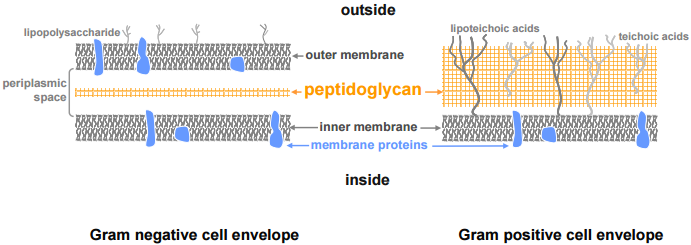
We had two lab sessions, and in the first one we used a Gilson pipette to transfer 0.000025 L of liquid, which is so insanely small! Our first experiment involved transferring small amounts of liquid from vial to vial for a suspenseful result. In our second experiment, we dealt with several bacteria colonies, and we had to determine if they were gram positive (indication of having a thick cell wall made of peptidoglycan) or gram negative (the opposite and having an additional lipid membrane). For this experiment, we also used a microscope, and had to identify the strain of bacteria with a dichotomous key. Honestly, it was very exciting, especially working with a lab partner to divide tasks with.
Other modules that we had this term were: Electromagnetics 1, Heat and Mass Transport 1, Molecules Cells and Processes and Mechanics 1. They each enlightened me with new and interesting knowledge, but I enjoyed the 4 things I listed most.
Thinking about what I shall write next, it will probably be on something more personal, if not an upcoming race with the Cross Country team in the Netherlands! Stay tuned for more 😀
Remember to write any comments if there’s anything you’re wondering about. I try to answer asap.
I promise I don’t bite.
– Franz T. C.