For theatre addicts London is like a bar for alcoholics: a paradise and a hell at the same time. Since the beginning of my PhD I’ve spent a bit too much money and time on plays and musicals — more than I’d ever publicly admit. Meanwhile I’ve mastered the art of getting cheap tickets, so if you’re also a theatre lover on a student budget, read on! This article isn’t sponsored by any of the companies I mention (unfortunately).
The Globe, one of my favourite London theatres.
Install TodayTix on your phone. You’ll be able to book tickets with one swipe, get some additional offers (e.g. 24-hour-long sales) and, most importantly, participate in lotteries. This way I managed to get affordable tickets for “Everybody’s Talking about Jamie” just a few hours before the show — and the seats were great!
Check out Shakespeare’s Globe. In the summer season standing tickets cost only £5, the price of lunch in the student canteen. Yes, you’ll have to queue before the play to get a good spot. Yes, your legs will hurt after three hours of “Macbeth”. And yes, you’ll get cold and wet in case of bad weather. But you’ll also get a chance to interact with the actors and literally get inside the play. Even if you’re not a fan of Shakespeare, give it a go, as the theatre features plays by other authors as well.
Join Entry Pass at the National Theatre. If you’re 16-25, you can sign up for free to get £7.50 tickets for all plays, from ancient to modern, from funny to tragic, from classic to experimental. Some plays took my breath away (“Amadeus”), some almost bored me to death (“Follies”); all in all, I book for every season, before I get too old.
Consult the Theatre Monkey. Especially if you decide to splurge on some must-see play, make sure you get the best possible seat for your money. This website contains advice on choosing seats in all London theatres.
Get £10 tickets at Young Vic. For under 25-year-olds they offer £10 tickets for each play as well as “lucky dip” tickets: you find out your seats on the day of the show.
While London isn’t the cheapest place to live in, here you can enjoy theatre even if on a budget, especially if you’re lucky enough to be young and a student. Now, enough writing, time to book some tickets!
It has been a busy end to the term and it really is getting close to the end now- I only have 4 weeks of clinical time left on the wards after Christmas before finals. There is so much going on right now. I have been busy at interviews for my foundation programme, getting my final competencies done on wards and we recently did the Situational Judgement Exam (which counts 50% to allocations for junior doctor training)! However, this term I have also been feeling how close we are to becoming actual doctors (hopefully). This was made even more clear a few weeks ago when I did CPR for the first time.
I think medical school prepares you so well for clinical practice, but really nothing can prepare you to the emotional toll of watching a patient pass away. As a final year medical student you can no longer take a huge step backwards when they ask “can you help with chest compressions”. Instead, if you don’t take the chance to help the team, the next time you are faced with this could be when you are the doctor responsible. I can’t begin to tell you how many thoughts were going through my head when the consultant asked for our help. But the “autopilot” mode steps in and all of the 6 years of training suddenly comes to life. We had a de-brief after we stopped chest compressions- an opportunity for the members of the team working on the patient to come together and touch base which was hugely supportive.
I was also lucky enough to work for 3 weeks with the Health Inequalities Team at Imperial. The insight into homeless medicine, prison medicine and refugee medicine was eye opening into the impact health inequalities really has on patients’ lives.
Homeless Health Conference
The patients, the family, the wider team. Getting nearer to the end of medical school makes me think about how much of a privilege it is to work in the NHS. I am nervous for what 2019 will bring- finals, elective, being a real doctor. But also I am comforted by the fact that Imperial has got us to this place. I look back on my 5.5 years so far at Imperial and I can’t believe how far our year has come and how far we are yet to go.
For current and future med students: Take all the opportunities you can. Build a good support network. Make the most of the whole medical school journey (clubs, societies, wards, lectures….). Medical school really flies by.
A term in university thought me one thing, it’s to attend your lectures and actually listen to the lecturers, (don’t spend the entire 2 hours lecture scrolling through instagram feeds, I made that mistake). Most of the time, you’re probably already tired after a full day of lectures, and weekends feel more like a relaxing day than hustle days. So, I personally find being interactive in lectures (taking notes and ask question) should help a lot in your studying, also some of the lectures are actually really interesting.
Prepare your own meal
I know, this feels like a hassle, especially if all you want to do is sleep, I feel you hun. But, uni life is expensive, uni life in London, is pfffffffff… well.. unless your last name is Gates, preparing your own meal is a good idea. Not only that you know what you’re putting into your body, but it saves a lot of $$$.
Stay fit and active
It’s typically easy to just be a couch potato in uni, I mean you spend your entire day sitting, from a 9AM to 5PM lectures, then you sit on the tube during commute, and you sit again doing revision, I mean you get my point, it’s a lot of sitting. As important as revision and attending lectures, it’s also so important to stay active. Personally, I study better if I do a workout in the morning, I’m less lazy and more focus on what I’m trying to put into my brain.
Do the things you love
Uni is not all about lectures and revisions, despite what people think, we still have a life and we still have time to enjoy doing what we love. I love fancy dinners and going out with friends, so I always make time to catch up with my friends over dinner. London is practically the place to be, you wouldn’t run out of things to do, despite the busy days in uni, you’ll still find so many things you can do and with Imperial running so many different clubs, you get to do the things you love (also, Wednesday lecture ends at 12, so you can enjoy your non-academic life).
They say white is the combination of all colours. This is an ideal concept to welcome you to join me on my journey or at least, its beginnings. I promise it will be colourful, but for now, let’s stick to white.
A white envelope was the first thing I ever received at my arrival at Woodward Buildings. It contained a few documents, but most importantly, a white card. Had I known that I would soon be locked out of my room because of forgetting it, I would have grabbed it tighter. Besides that unfortunate event, all the ones that proceeded it were far from disappointing.
I opened the door to the four walls that would instantly become my home for the next year. Although some may say that it was a procedure like many others, leaving my things inside it was the first page of a next chapter, a white page to be filled with so many new friendships and experiences.
During that weekend, over white kitchen tables or stuck in White City underground station due to strikes, everything started to fall into place. I found myself in a city that no longer called me a stranger. I connected with this place and its people. I was a fresher having the time of my life (but also suffering the so-called “freshers’ flu”).
Then, without even realising so, Monday arrived and I somehow managed to make my way to the Great Hall, where I was welcomed by important personalities in white shirts and suits. This talk was followed by many others, briefings and other introduction.
The first week flew by and, similarly, the paradise disappeared. Lectures started and whiteboards were soon filled with algebraical expressions I had never seen before. I didn’t really understand much and I even panicked a bit, but my inner self told me that this was what I signed for when choosing an engineering at Imperial. I guess I will manage to decipher my notes at some point.
I read that white is usually associated with positivity and that it helps to get mental clarity. I think I might try to imagine a white void from time to time. I’ll keep you updated how this theory turns out.
More and more research is suggesting that our environmental experiences can be passed down generations. Here’s a brief introduction to the weird world of transgenerational epigenetic inheritance (yes, it is a bit of a mouthful).
So… What is it?
Epigenetics investigates mechanisms that change gene expression separate from the A’s, T’s, C’s and G’s of the genetic code. These changes are often environmental.
It’s the reason why, if you start having a glass of wine every evening with the 10 O’clock news, you’re going to start needing two glasses of wine to get the same relief as you listen to Huw Edwards delicate drawl.
Your DNA hasn’t changed, but the expression of proteins involved in processing alcohol has. It’s all thanks to epigenetic modifications. Cells pass these modifications to their daughter cells when they divide but more recently, some evidence suggests that epigenetic alterations can pass down through generations.
This theory is called transgenerational epigenetic inheritance.
It sounds wrong. We all are familiar Darwin’s theory of evolution, natural selection drives evolution through the survival of organisms with preferred genes. Transgenerational epigenetics adds another dimension to evolution.
Look, I’m not going to try uproot 150 years of Darwinism in a small student blog. Evolution is supported by inordinate amount of data from every scientific field. However, recent studies have shown that some traits can be passed down from generation to generation, outside of alterations in the genetic code.
Weird Worms
The worm C. elegans has shown some of the most remarkable phenomena. These worms had a gene for fluorescence introduced into them. When researchers gave them a little holiday into a container at a tropical 25°C, the gene was activated and they began to glow. When they were moved back to a cooler 20°C, they kept their inherent light display and continued to glow.
The worms have an environmental memory.
The scientists noticed that the offspring of worms grown in warmer temperatures glowed brighter for up to 14 generations, despite not experiencing the warmer temperature themselves. These worms are all genetically identical so it is not a genetic change. It appears these worms have passed on their environmental memory.
Researchers’ are still looking into how this exactly works and whether this applies to other species as well. If this was true of humans too in some capacity, then it could mean that our recent ancestors’ lifestyles have more of an impact on who we are than we thought possible before!
Human Evidence?
Obviously, you can’t do these sorts of experiments in humans but that doesn’t mean there is no evidence for this occurring.
During a Dutch famine in 1944-1945, particularly good health records were kept. So good that we can track the grandchildren of those who were there and measure lots of variables. It has been shown that grandchildren of undernourished fathers were more obese than those who were not from undernourished grandparents.
Some scientists think that this is evidence that environmental responses can be passed down epigenetically in humans.
Others are more sceptical. Food habits tend to pass from generation to generation socially, which could have played a role outside of an epigenetic change. The debate surrounding this topic is huge. Can we really prove that the transmission we can see in C. Elegans occurs in humans?
Comparing Species
It is always possible that these transgenerational epigenetics play very different roles between species.
One argument is this style of transmission to future generations is more advantageous to species that reproduce quickly in more rapidly changing environments. It may have been somewhat evolutionarily bred out of us long-lasting mammals. It isn’t always a good thing to inherit traits your parents have gained in their lifetime.
Most likely, your personality is not the result of a crepe your grandmother ate back in ’55.
Concluding Remarks
The evidence for transgenerational epigenetics is much more contentious in mammals than some other species. C. elegans are used in studies of human disease and development as most core biological pathways remain the same due to evolutionary conservation of gene function.
However, transgenerational epigenetic mechanisms may not have been conserved completely between species. That’s not to say the future may hold some important revisions in our concepts of evolution.
As you (might) know, I’m a second year now (yayy… not so much T.T) and this year I’ve decided to stay in Evelyn Gardens.
For those of you who don’t know, Evelyn Gardens is an Imperial-owned student residence for returning undergraduate students (meaning second years and above). There are three halls in Evelyn Gardens, namely Willis Jackson, Holbein and Southwell. Unlike freshers’ halls, it has a 51 weeks contract period (instead of 39 weeks). You can read more about it here.
Having lived (and am living) in both a first year hall and a senior hall, I decided to compare these two so it’ll be easier for those of you who might decide to consider staying here next year.
APPLICATION PROCESS
Now I’m not sure why exactly, but I’ve heard quite a lot of stigma surrounding the senior hall in my first year. Normally I’m not usually one to listen to rumors, but there were so much bad reput. about the place (cough- Felix and some of my ex-floormates- cough) that I was quite nervous about applying here initially.
However, being the lazy ass and cheapskate energy-and-financially conservative person that I am 😉 , Evelyn Gardens is very strategically placed. It’s relatively cheap(er compared to Princes Gardens), it’s a reasonable distance from campus (~15 minutes walk from South Ken. campus) and there’s a Sainsburys Local AND an M&S Foods (and cough- a cinema -cough) right up my doorstep.
Long story short, after some contemplating (and pressure from my parents who happened to guess that I’d probably be too lazy to travel > 15 minutes if I only have ONE lecture on a particular day), I decided to just apply there and see for myself.
The application process itself is fairly straightforward. You go to the website after it opens sometime in ~April and fill in your name, student ID, etc. Then, you get to pick 3 choices/ room preferences, and… you’re good to go.
Yup, it’s that simple! They’ll send you a confirmation that they’ve received your application and (here comes the hard part) you just have to wait until ~June/ July ’til they allocate you a room.
P.S Remember to confirm if you’re happy with your offer once they come out. They’ll think you’re rejecting it and offer it to someone else if you don’t and then you’ll be left homeless😱
REACTIONS
I didn’t get my first choice of en-suite single, instead I got a standard single room in Willis Jackson.
My first reaction (when I first got the offer VS when I moved in for the first time)?
Offer:
Nooooo, I have to go outside to go to shower or use the toilet!!! (hey, in my defense, it’s quite a hassle to have to bring your toiletries, your key AND wear your headscarf every time you have a tummy ache or need a quick shower, y’know)
&
Oh well, at least I got a single room. And moreover, it’s pretty cheap. Yesss, my bank account is grateful…
Moving in:
While lugging luggage, “Of all the places, *pants* why *curses* do I have to get a room on the freaking third floor?! And there’s not even a lift? Curse my luck!”
&
Finally got in the room, takes one look, “That’s it, I’m moving out right now!”
P.S Now that I think about it, I really feel for my friend who was helping me move in… not only did she have to help me carry several huge and heavy suitcases, she had to deal with my whining. Thank you and I’m sorry, Bam :’) #appreciationshoutout
&
That night, all alone, *rolls around in bed screaming “I’m lonely” *fake cries
Umm that sounded pretty bad huh *sweat drops* but really, I was ~mostly~ just being a drama queen. Honestly, after venting to my mum (who was sadly but understandably very unsympathetic about my situation) and cooling off, I realised (after viewing it more objectively) that it wasn’t that bad after all.
COMPARISONS
I’ll put it in a table so it’s easier to compare them.
Linstead Hall (Freshers Hall)
Willis Jackson Hall (Senior Hall)
All en-suite,
£ 232(1)
Room types and price
(pw for the room I got)
Various (but I got standard single),
£ 191
39 weeks
Contract period
51(2) weeks
~5 min. walk
Distance from South Ken. campus
~ 15 min. walk (3), ~10 min. bus (4)
Yes
Lift?
No (5) :'(
Friendly, welcoming environment suitable for coaxing introverted, shy freshers out of their shells lol.
You do pay £ 2 per week (included in rent) for hall activities and there’s where the subsidised tickets, etc come from.
Environment
Everyone ~mostly~ keeps to themselves. We do say hi when we see each other in the hallway or kitchen, but we don’t make an effort to see each other, or go out together, nor do we have subsidised holidays/ trips/ dinners.
Also, no hall-wide celebrations/ parties/ BBQs/ brunch.
(For all it’s worth, I miss my floormates in Linstead *sigh)
Priority towards first years (unless you apply to become a hall senior). Any vacancy is then opened to returning students earliest sometime in ~September
Availability
All returning students considered equally as long as you apply before the application deadline.
1 I think they increased the prices slightly this year though.
2 This is including the summer, so ideal if you’re planning to apply for an internship or UROP in London that year.
3 It’s closer than walking from Pembridge Halls (~ 25 min.) if you’ve ever lived there.
4 There’s a bus stop literally right in front of the road. I’m ashamed to say that I’ve taken the bus more often than not.
5 Bad news if you’re like me and got a room on the top floor. Not so bad if you got a room on ground or basement floor. Part of why I now do most of my grocery shopping online (Thank you Tesco delivery guys who have helped this very-much-weak-and-not-fit girl carry her groceries to her floor kitchen <3 ).
*I’m so sorry, for some reason idk why the footnotes won’t appear as footnotes in the real post
IZRYNNE’S (hopefully helpful) ADDITIONAL NOTES
In terms of security and cleaning, they’re fairly similar. You need a card and/ or a key to get into the building + room + kitchen. The washrooms are cleaned every two days (?) and the kitchen once a week (don’t quote me on that), while rooms monthly (this one’s I’m sure of).
Regarding room sizes and conditions, I do feel like my current room is slightly smaller than my room in Linstead but I’ve never actually measured them so it might just be me being biased. One thing to note is that the wardrobe is quite small (aka ~half or two-thirds the one in Linstead) so you might consider bringing less clothes or being creative about where you put them. Instead of a lockable drawer, you have a safe in your wardrobes to keep your valuables. Also, although the toilet and shower are shared, you do have a sink inside your room (I suggest buying a rug to put under it so you won’t get the carpet wet).
So that’s it! I think it was more of a description rather than a comparison, but hopefully it’ll still be useful and/ or informative read on Evelyn Gardens. Hope you enjoyed it and thanks 😀 Byeeeee
View from my window with the shining sun. Apologies for my atrocious photography skills (‘=.=)
Studying Maths at Imperial does not only mean living in one of the most vibrant cities in the world, but also being a part of a top world ranking Mathematics department, boasting two field medalists. However as a woman in this department what I have appreciated the most is having female role models such as Professor Emma McCoy. Through lecturing me in first year, she not only taught me statistics in such a thorough and engaging manner, but who has also inspired me to focus my studies on statistics. By bringing in real life scenarios, including her own passion for cycling statistics, marathon times and rather controversially road traffic accidents, McCoy managed to convince my entire cohort that statistics was one of the most enticing areas of mathematics with countless applications in the real world.
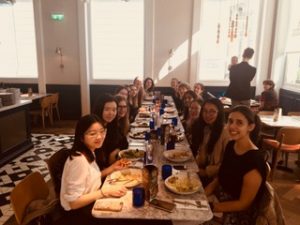
Professor McCoy is just one of the amazing women in the department, something that is highlighted by our biweekly “Women in Maths lunches” where we have already heard from four fascinating women working in the department including McCoy this year. At these events, all members of the department regardless of gender, are invited to hear female alumni, current PhD students or lecturers speaking about their research at the university or how they have applied knowledge from a degree in their career. Speakers are always willing to answer questions at the time or in the future, many offering to mentor and advise students on finding jobs and progressing in careers. For more information, to sign up to the mailing list or if you’d be interested in giving a talk at this event, please contact Women in Maths’ expert organisers and third year maths students Alma Fredriksson and Manlin Chawla.
Whilst walking around Huxley, it becomes apparent that there is a slight gender gap however our undergraduate liaison officers create a friendly environment in which we are encouraged to speak out about issues affecting us and suggest improvements for the department, including events to bring together the community of female home students, the smallest minority. Through outreach programmes including visiting schools there is a strong focus to bring more women into the department.
Being a woman in a field dominated by men has never deterred me from pursuing a degree and a career in mathematics, if anything, it has motivated me as there is something special and more unique about studying such a fundamental subject when perhaps people don’t expect you to be able to. It’s so empowering to see a new generation of mathematicians more equally split in gender than ever before as it proves how there is nothing stopping women from excelling in this subject. Everyday I am surrounded by some exceptionally talented young minds, people who one day will be world leading researchers, thriving in finance or generally excelling in their field. But for now they are frighteningly intelligent and hard working peers who make up a community that I am thrilled to be a part of.
Given my overwhelmingly positive experience, the advice that I would give to any young women keen on studying Maths at a higher level is that loving maths will be enough to carry you through your degree regardless of whether there is a gender gap because, at the end of the day, it is your passion that is most important. But most of all, be proud to be a woman in STEM.
Final year is going at full speed- with only (gulp!) 7 months to go until our finals exams are done. We have received our GMC numbers now and from Monday will have our account details to apply for our first job in the NHS.
So as the real life stuff is ramping up, so is the training to help us be junior doctors. I am currently on my emergency medicine attachment and as part of this we had a simulation daybased at West Middlesex Hospital. It was fantastic!
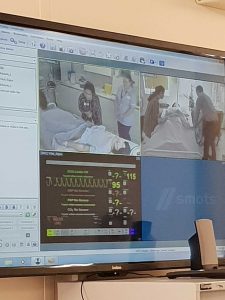
The aim of the day was to give us experience handling emergency situations in a “safe”environment. In pairs, we were placed in a simulation room with a student nurse too. Thesimulation dummy patient had a voice (someone was speaking through a microphone nextdoor), pulses and breath sounds in their chest. We were given a situation such as “You arethe F1s and have been called to see X patient on the ward as the nurses are worried abouther, please assess”. Then we had about 10 minutes to play out the acute situation and seehow we would handle it when left to our own devices. Meanwhile, our peers were watchingour every move in the room next door and would feedback on our return having “saved” thesimulation dummy. The simulation room was set up like a normal ward and a useful partabout it was we could call for help on the phone to our teaching fellows who would give usadvice as if they were the medical registrar on call.
Honestly, simulation training in our final year has a huge impact on us. It gives us the chanceto make the mistakes and be more confident in our own skills before we hit the wards soon.Imperial has combined clinical skills, patient safety and simulation technology to create usfab teaching sessions – and it must be an absolute mission to organise them for our wholeyear.
For now, it is interesting for me to reflect that in first year (back in 2013!) all I wanted to dowas to go and see patients and get out of lectures, but now all I want to do is improve on myknowledge and fundamental skills before I go out and see the patients as a doctorsoon…Scary!
You picked Imperial to become a scientist, engineer or a medical doctor. What do these careers have in common? You’ll need to write a lot: scientific papers, grant applications, lecture notes, popular science articles. Unfortunately, university curricula lack writing courses, so we end up with thousands of unreadable scientific papers. In my research I’ve chosen some mathematical methods just because the authors made them easy to understand; nobody has time or energy to look for interesting science hiding behind word clutter.
Some scientific papers look like this…
I’m a mathematician, not a writer, and my writing is far from perfect. Let me share five tips to improve your writing so that you can learn from my mistakes.
Keep it simple. You won’t impress the reader by sophisticated vocabulary or complicated sentence structures. To be a better researcher, you don’t have to utilise instead of use or terminate instead of stop. Nevertheless doesn’t sound smarter than but, by way of example more elegant than such as. In fact, in most cases you won’t even need the transition word as a logical paragraph construction will suffice.
Use verbs, avoid nouns. Don’t get me wrong, we need nouns. But please decide, don’t make decisions; conclude, don’t reach conclusions; estimate, don’t obtain estimates. Strong verbs drive the language and make your paper lively. Just ensure you pick the correct, precise verb. For example, instead of XYZ predicts that approximately…, you can write XYZ estimates… And when you find a nice verb, don’t turn it into a noun: We rejected the hypothesis sounds better than Our study has resulted in the rejection of the hypothesis.
Use active voice. Treatments aren’t found, phenomena observed and theorems proven – someone finds, observes or proves them. Own your achievement, announce proudly what you’ve done! But also take the responsibility, don’t hope that if the mistake has been made, nobody will realise it was you who made it!
Research isn’t ‘being done’ – someone works really hard to make it happen!
Be direct. Instead of writing It was found that drinking gummiberry juice twice a day reduces the headaches by 30% you can just state: Drinking gummiberry juice twice a day reduces the headaches by 30%. Focus on the facts, don’t pack them into it seems that, the study shows, it is believed that – it’s usually clear from the context which study you’re talking about.
This elongated yellow fruit has a name: BANANA.
Watch out for repetitions. You learned at school to reach for thesaurus whenever you’re about to repeat the word. In most cases you can avoid this word altogether, for example In this article I share some tips on scientific writing and provide guidance on avoiding common mistakes could easily become In this article I share some tips on scientific writing and avoiding common mistakes. But when you really need to repeat a word, just do it. Please don’t call a banana an elongated yellow fruit. Just don’t.
Bonus tip: write! The more you do it, the easier it becomes. Check out my first articles on this blog, I’m sure you’ll notice an improvement in my writing. Seriously, give it a go!
I haven’t written for a while as I recently moved to Exeter for a summer internship in Met Office. If you’re interested in what the research here involves, check out my popular science blog. However, my Exeter adventure involves way more than work.
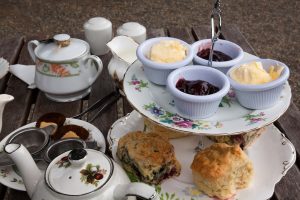
Cream tea: scones, clotted cream, jam and tea.
While London and Imperial are as international as it gets, Exeter has a very British (or rather English) feel. Today I spent ages queuing for cream tea and discussing with English colleagues what being British actually involves. Here’s the list of very British things I experienced only today.
Queuing. I come from a Central European country, where your place in the queue depends pretty much only on how cunning you are. Today with amusement I was observing the patience of Met Office employees waiting for their afternoon treat. No queue jumping, no tricks. This can happen only in this country!
Cream tea. When I first heard this term, I thought: putting milk in the tea is outrageous, but cream?! Time to leave this country! Luckily cream tea means scones with clotted cream and jam, of course followed by a cup of tea. Very, very popular in South West England. And no wonder, it’s so delicious!
Wimbledon. I don’t care about tennis, but there’s nothing more British than drinking tea and watching Wimbledon game (yes, this too happened today in Met Office). Apparently one should also consume strawberries with cream at this point, but British strawberries are terrible (and expensive!), so scones seemed to be a better choice.
Weather talk. I admit that weather talk is definitely expected in Met Office, but it actually happens everywhere, all the time. Awkward silence in the lift? “It looks like it’s going to rain”. Stuck with a boring colleague? “It’s hot today, isn’t it?”. You can’t go wrong with weather talk!
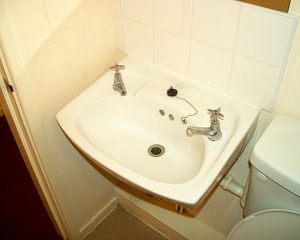
Boiling or freezing? CC BY-SA 4.0 (https://creativecommons.org/licenses/by-sa/4.0)], from Wikimedia Commons.
Separate taps. You can’t leave England without scars from being burnt by a boiling water from the red tap. I’m still puzzled why in the 21st century in a developed country in so many buildings hot and cold (or rather boiling and freezing) water is separated. You’ll appreciate a proper mixing tap after experiencing it, trust me!
If you decided to study in England, or even just visit for a few days, make sure you give this list a go. To get a full British experience.










 the most is having female role models such as Professor Emma McCoy. Through lecturing me in first year, she not only taught me statistics in such a thorough and engaging manner, but who has also inspired me to focus my studies on statistics. By bringing in real life scenarios, including her own passion for cycling statistics, marathon times and rather controversially road traffic accidents, McCoy managed to convince my entire cohort that statistics was one of the most enticing areas of mathematics with countless applications in the real world.
 eekly “Women in Maths lunches” where we have already heard from four fascinating women working in the department including McCoy this year. At these events, all members of the department regardless of gender, are invited to hear female alumni, current PhD students or lecturers speaking about their research at the university or how they have applied knowledge from a degree in their career. Speakers are always willing to answer questions at the time or in the future, many offering to mentor and advise students on finding jobs and progressing in careers. For more information, to sign up to the mailing list or if you’d be interested in giving a talk at this event, please contact Women in Maths’ expert organisers and third year maths students
  ments for the department, including events to bring together the community of female home students, the smallest minority. Through outreach programmes including visiting schools there is a strong focus to bring more women into the department.
 ee regardless of whether there is a gender gap because, at the end of the day, it is your passion that is most important. But most of all, be proud to be a woman in STEM.