So It’s nearly the end of the Christmas holiday. After staying at my room and revising for the whole day (not lying), I’ve decided to do some blogging before sleep…(or it’s because I can’t FALL ASLEEP!!!) I’m gonna write about my trip to Edinburgh over new year. This is my first trip I’ve ever took since I got to UK …and Edinburgh, undoubtedly, has become the furthest north place I’ve ever been. So many ‘firsts’ make this one of the most memorable trips I’ve ever had.
Experience on the British Railway…
I got up really early (6am) to catch the train leaving from King’s cross (7:30am). The train ride took around 4 hours with severe delay en route!!! I have to take this opportunity to say that comparing to China, British railway system sucks. Seriously, some stormy wind would easily force the train to restrict the speed down to 50 mph… I know this is a safety precaution but a better-designed train should be able to endure extreme weathers. And the trains were shaking like madness… Please visit China one day and try the Chinese railway system. You’ll love it and it’s much cheaper! Oops…Kinda missed the topic of this blog…
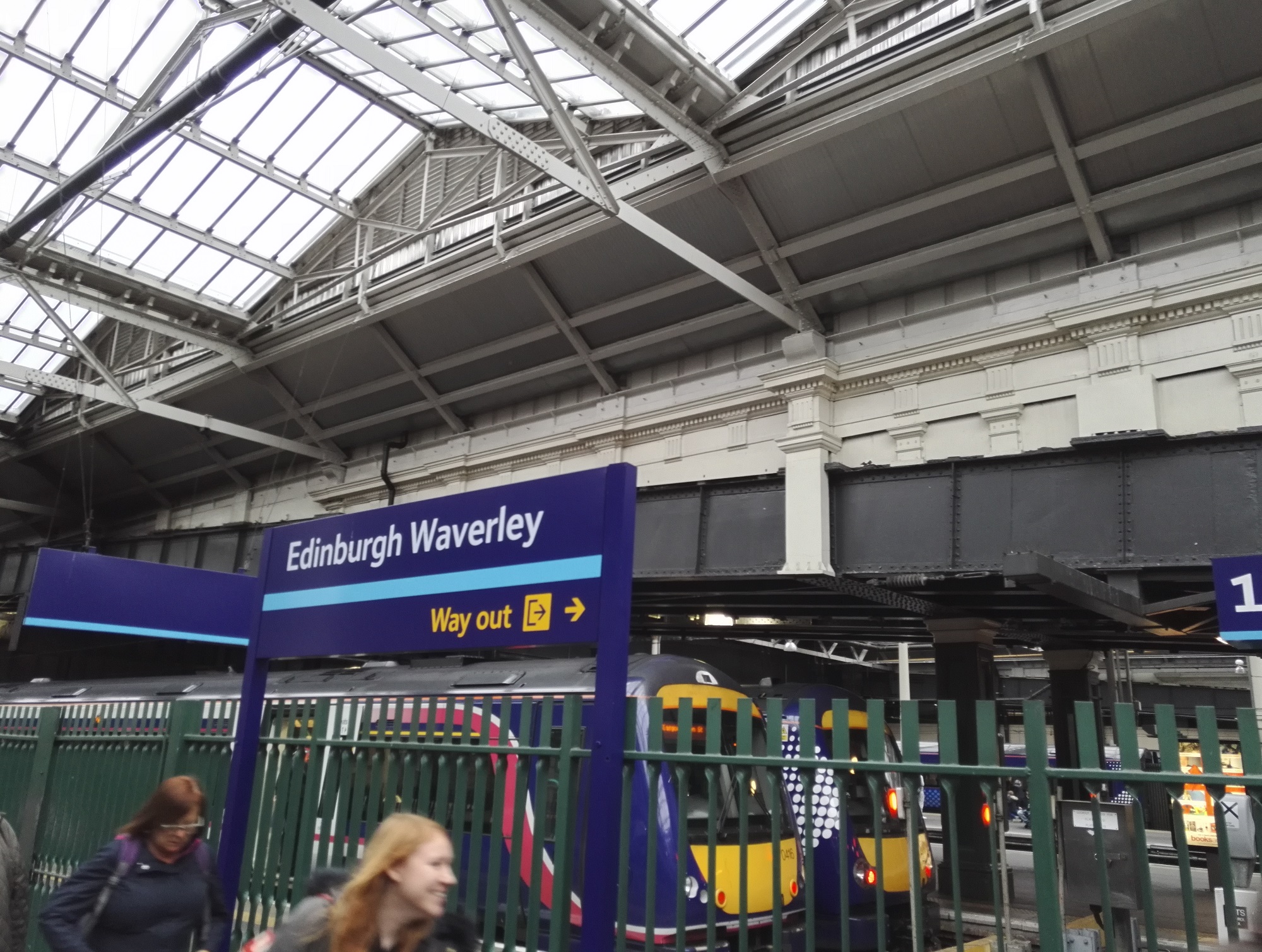
So I have arrived. Hooray! Next stop is to find my airbnb house. It’s right in the middle of the Old town Edinburgh and only a 2 min walk to the Palace of Holyroodhouse. After getting everything settled down, we are ready to our first event of the new year trip…the LIGHT TORCH PROCESSION! (or witch hunt as my mate Tony likes to say)
The Marvelous Light Torch Procession
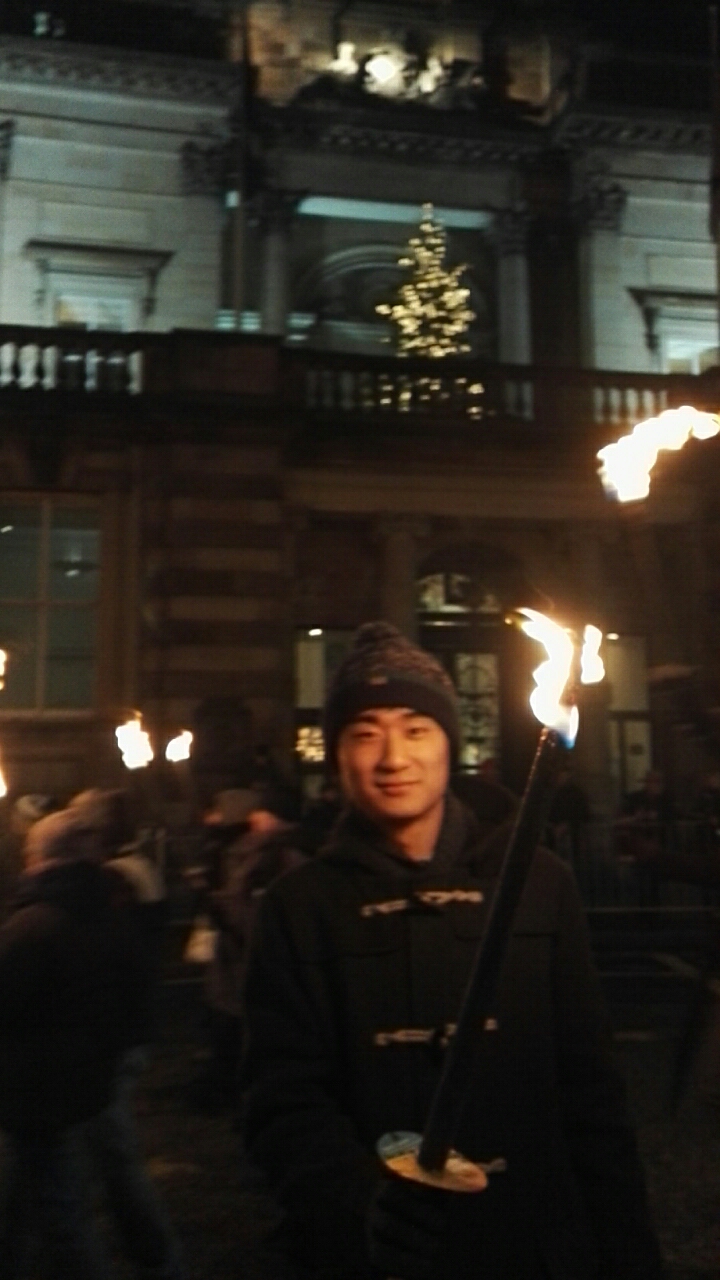
So we left the house for the procession. We first get onto the Royal mile, a long road that witnessed nearly the entire history of Edinburgh. It passes through the old town with the most famous tourist sites on its two ends, Edinburgh Castle and The Palace of Holyroodhouse. We have collected the torches and getting ready to wait in the queue. ERHHHHH I wish you could hear the beautiful Scottish music in the background! Anyways, the waiting in the queue part took longer than expected…40 minutes or so in the strong winds (Temperature easily drops to below 5C) Later we follow the crowd walking through Royal mile, Pricnce’s street and to the destination, Carlton hill where we saw the first fire work show before the new year.
So that’s all for Day 1. Stay tuned for more exciting stuff from Day 2 where we visited the Castle and ….to the Hogmanay street party for the new year countdown!!! Again, guys please leave comments for questions and special requests. Thanks!
I hope you had a great time with your friends and family, wherever you are.
It’s just been a few days since the start of the new year and I’m excited to continue my studies here in the Spring term.
But what happened in the Autumn term?
Well, for one thing, I became an Imperial student blogger, which I’m really amped to be. I know I haven’t written as often as the other bloggers (do check their blogs out – they’re great!), but I’ve been busy.
I’m not lying. Seriously…
Alright. To be honest, I could have made some time to write a post or two.
Anyway, in this term we had the following modules:
Bioengineering in Action: Academic staff of the Bioengineering department gave presentations to our year on what sort of research they have been doing in their labs, showing us real-world applications of the things we are and will be learning in our lectures. The range of research topics in the department is so vast that I learned about many branches in Bioengineering that I didn’t know about before.
Biomolecular Engineering 1: When making parts of a bionic limb, for example, it is crucial to consider how the materials it’s made of will react under stress. Will it break? Will it bend? Will it stretch? Are these responses beneficial or undesirable? In this module, we started off at the atomic level and built it up to the macro-scale level to see how different materials, which are made differently, react to different levels of stress.
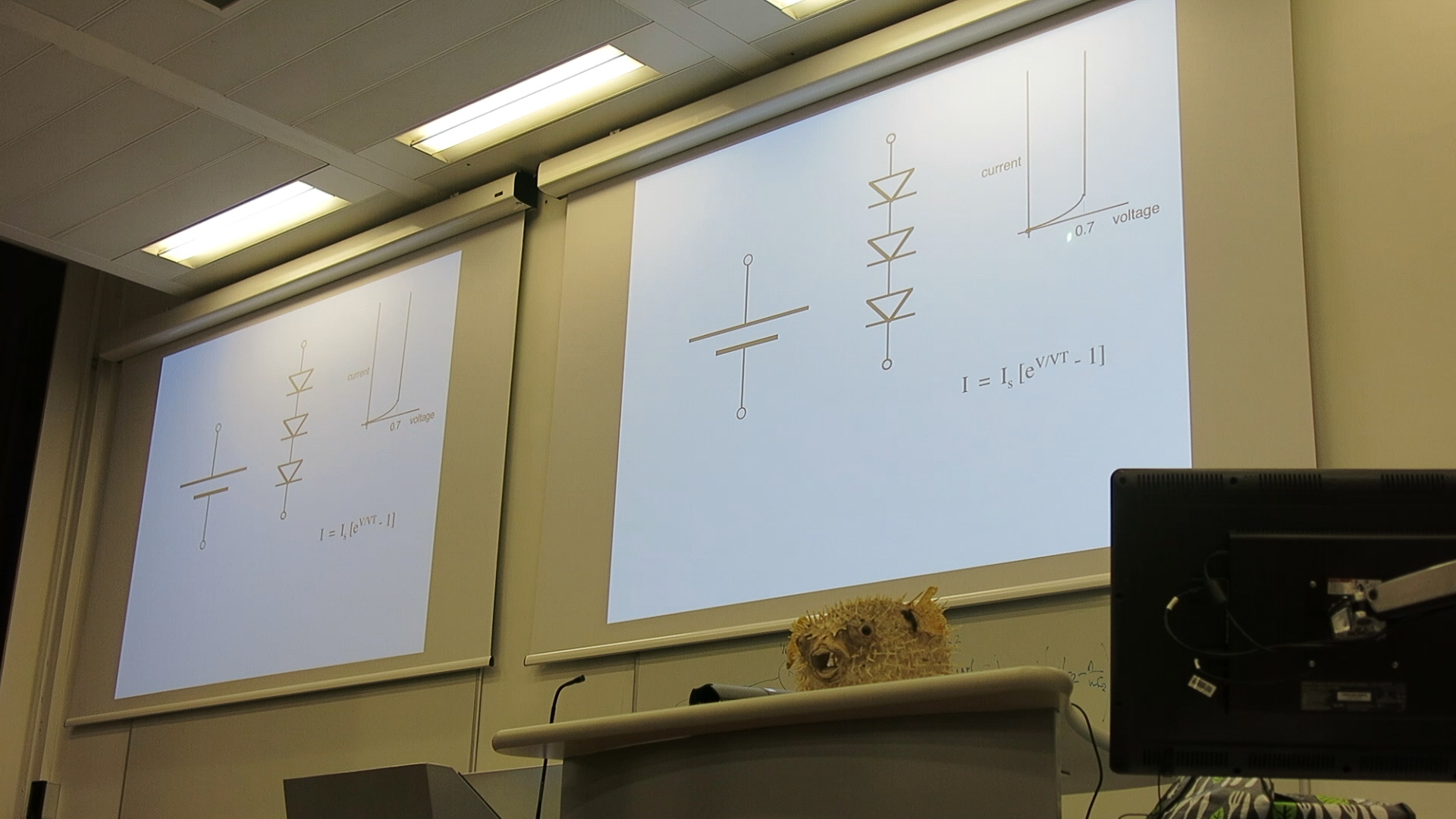
Electrical Engineering 1: If you didn’t cover electrical circuits in high school or further education, you’ll learn about them from the very beginning in this module, so worry not. If you did, you will still learn new things you may not have thought about. Now, this aspect of engineering is important; think about it. How would I power my bionic limb? And carry the messages from one end to the other? And have it do what it’s supposed to do?
Also, a puffer fish once gave one of the lectures:
And I thought there was something fishy about the lecture that day.
Logic and Digital Systems: In the world of today, computers exist to make our lives easier. Their language, however, is only restricted to 0’s and 1’s. Computers cannot understand anything else, so how is it that you’re able to watch cat videos on the internet? These input 0’s and 1’s are carried through logic gates, generating new output messages (again in 0’s and 1’s), which when specifically programmed, will carry out a certain command. For example, memory. All your music and pictures are stored in sequences of 0’s and 1’s, after all.
Mathematics 1: From functions, to vectors and complex numbers, to calculus. This module is crucial in any sort of engineering, as it will help to design any parts needed for our bionic limb, but also to help us understand the world around us, like propagation of action potentials in our nervous system as waves. We will be continuing this module in the Spring term.
Medical Science 1: Bioengineering is all about improving the health of human beings, but to do that, we need to understand how certain aspects of the human body function. Whether we want to design a bionic limb (I know I keep mentioning this, but this is my goal as an aspiring biomedical engineer), build a pacemaker or model the circuitry of the brain, we need to obtain deep understanding of the physiological concepts.
Mathematical Tools, Vibrations & Waves: The light emitted from the screen where you are reading this is an electromagnetic wave that travelled across air and to your retina. But can we model its motion and path? Starting with mathematical principles, moving on to oscillations and finally wave motion in transmission lines, this will be one of the most interesting modules you’ll get. We mainly covered the propagation of voltage and current waves in circuits containing resistors, inductors and capacitors, and later transmission lines, which can be compared to the nerves in your body.
Walking & Running: This module involved executing an experiment very early in the term; in fact, the first week. Through laughing at how your peers walk and working with them to make a presentation, you will learn about the basics of how humans walk or run, and what implications this has on our joints.
The course involved identifying various challenges, or issues, the humans of the world are facing. Different groups work on different challenges, and report our findings back on a wiki page that we write ourselves. From scratch. Sounds great, right?! I believe the purpose of this scheme is to expand our knowledge about something else than our degree subject. I know I did, as my group investigated the occurring refugee crises, most especially the ongoing Syrian refugee crisis.
I also attended various Imperial Plus workshops to develop my volunteering skills. From them, I learned new things that I could do at my volunteer positions that would improve my experience and impact.
I really enjoy volunteering; I have been doing it for the past 5 years, but mainly for the past 2.5 years. During the term and my winter break, I volunteered at a charity in London that focuses on people with disabilities. More on that to come on the next blog.
How could I forget clubs & societies?! As I have already mentioned, I am a member of the Imperial Cross Country & Athletics Club, and I have attended various training sessions, weekly runs and races, but I was not very constant throughout the term. For this new term, I aim to be more constant, at least 2 sessions a week (there are daily sessions, you know!).
I participated in the 3rd London College’s League race in Wimbledon, where the conditions were forest-y, rainy, muddy and fire-y. There was a large, wildfire in the forest, and I had to run next to it – twice. That was a unique experience indeed. At the end of the race, the conditions of my legs and shoes were like this:
Those socks used to be white.
This, my dear readers, was blog #02.
Do comment with any questions you may have, and I’ll respond as soon as I can!
There is one week left of the holidays (sorry medics, I know you’ve gone back already….) and I am feeling the stress. If you are studying at Imperial then there is no doubt that you had a stellar academic record before you came here. You got all of the A*s and did all of the extracurriculars and all that jazz, which is great, and you probably thought that university wouldn’t be much different. I don’t want to sound too depressing, there are many people in my year who I really admire for their intelligence and their ability to understand difficult concepts and write nuanced essays and hold down positions on various different committees. But I really would be lying if I said that my experience at Imperial has been completely plain sailing.
The simple truth is that university is hard. I love my subject and I love to learn but I’m not naturally good at taking in information and commiting it to memory. The exam style of writing multiple essays doesn’t suit me and I find labs really hard work. I made good grades at sixth form and I performed very well in all of my exams, but coming to Imperial really knocked my confidence as I realised that biology is actually pretty hard and I was, in fact, a small fish in a very very big pond. For some, university is just a it more challenging than it is for others and I’d hate for anyone to feel ashamed if they’re finding this out right now. So let me make it slightly easier for you: My name is Izzie and I find Imperial tough.
For one thing, I did not set good habits from the off when I arrived in London. It took a long time for me to figure out a good note-taking process in lectures, I did not study as I went along and when faced with having to code for early pieces of coursework, I was utterly clueless. I fell behind pretty easily and never really caught up until exams were staring me in the face and I had no idea what was going on. In addition, I struggled with undiagnosed health problems during my first year that made life a bit of a nightmare. All things put together? I failed the first exam I sat.
There it is. I failed an exam. I was heartbroken. My entire academic career thusfar had been building up to my coming to Imperial, the best university in the country to study my subject, and I’d let myself and everyone who had supported me down. I just wasn’t the kind of person who failed anything, ever. I passed my resit that summer and things have picked up since then, but let me tell you a few things that I have learnt through all this drama:
1. Sometimes, life gets tough and that’s not your fault. I couldn’t control the fact that I was poorly a lot and that those problems affected my study habits and my exam performance. Your health is so important – you don’t need to sacrifice it for the sake of getting a first every time.
2. Life will go on even if you fail. As someone who has always placed a great deal of pressure on myself to perform academically, failure, at the time, seemed like the worst thing that could possibly happen to me. Turns out, I know a fair few others who also failed exams that year and had to do resits. It happens, it’s not the end of the world and it won’t completely ruin your degree.
3. It’s important to ask for help when things are going south. Your tutors and lecturers aren’t just cold, emotionless robots who teach you course content and then run back to the labs and never think about you again. If you are struggling, it’s important to reach out and ask for help, whether that means going to their office hours to get help with coursework, sending an email to clarify something you didn’t understand, setting up a meeting to figure out why your note-taking is so bad or seeing your DUGS or senior tutor to get help with mitigating circumstances paperwork. It doesn’t make you weak or less worthy of your place at Imperial to ask for that kind of help. (I hope it doesn’t anyway. I’ve done all of those things I just listed!)
4. You’re not letting anyone down as long as you do your best. Yes, that’s a cringey statement. But seriously, if you give it your best shot at come out with a 2:2 at the end, then you still know that you did everything you could have and that getting a lower result than other people isn’t something to be ashamed of. You do you, let others worry about themselves.
Be kind to yourself, work hard, relax often and never suffer in silence! Life at Imperial is hard work but I promise, it will also be some of the best years of your life.
In the age of social media, being connected is incredibly easy. Not only that, for our generation, its as instinctual as breathing. Conversations between people blend seamlessly from online chat to real life, you can check if your friends are “attending” an event you’re considering, and keep up with their day to day activities by scrolling your newsfeed. In a way, this makes us ‘better’ friends than ever because we’re so in touch with each others lives.
But this intimacy reaches a whole new level, when you realise the person you’re messaging lives two doors down, you saw them just twenty minutes ago and you don’t need Facebook to know they had a 3 hour lecture this morning, ate pasta for lunch and are currently struggling with their maths coursework. All of that and you weren’t even TRYING to be social.
In halls, you become close to people not because you share common interests or passions, but because you know what foods they like to eat, what movies and music they like, and because at 3am on a Tuesday night you stay up watching funny cat videos together. You just accept them because you know them as they are when they’re at home, not the mask they put on. All of us have lives outside of halls, but when we walk into the kitchen at night everyone needs to relax. Going home to your family isn’t a chore, you’re never more yourself because you know that no matter what they’ll support you. So in halls, its important that you forge an environment that facilitates that. I think, this is something everyone understands inherently, and even I’m surprised how relaxed I am around my hall mates. It’s all those sarcastic comments you think but don’t say, the bad jokes you usually keep to yourself. When all those start blurting out of your mouth while you’re making dinner? You know you’re at home.
One of the most poignant examples of this camaraderie was when I casually mentioned that I needed to lose some weight for an upcoming taekwondo competition. My friend suddenly said he had been thinking about doing the same and that we should try and do it together. We then asked another person on our floor, who we knew worked out a lot, for his advice on the matter. We discussed what dietary changes we would make and set a regular gym routine. By the end of the day whenever I tried to eat anything sweet or generally unhealthy someone in the kitchen would remind me of my goal. If one of us wanted to go to the gym we’d invite each other, then we would go shopping together to make sure we didn’t buy unhealthy foods. Staying motivated became so much easier and it was amazing watching all of this unfold, everyone being so supportive. But then of course we still get the occasional “Look! ICE CREAM!… I know you want some but HA you can’t.”
Living in halls might require developing a whole new level of people skills, but if you do it right? It’s totally worth it. Where else will you find friends that will stuff their face with your ice cream, just because they know you’re dieting?
This week the 3rd year medical students sit their first clinical year exam: Ethics and Law, and I was reminded of sitting the same exam a few years ago.
For many studying ethics and law seems a bit strange. The course involves studying ethical issues in medicine from a range of different viewpoints. This can be great at times, with lots of discussion and interaction, but can also be rather challenging as you begin to work through your own viewpoint and why you hold it. At the time I remember this seemed more challenging and exacerbating than anything else as I desperately tried to justify my viewpoint on a range of hot topics. However, not so long ago I realised the importance of considering medial ethics.
I was sat in a medical outpatient clinic like any other. The room was warm, I was feeling sleepy after lunch and every patient was scheduled for medication follow ups, so I settled myself in for a long clinic. However in the space of one clinic I faced almost every medical ethical scenario I could. I could not make this up, it was like sitting a practical ethics exam!
First came in ethical patient number one. He had recently been diagnosed with a common but infectious disease. He had started treatment and was sticking to it well so was very unlikely to infect those around him. However his boss had decided he would be infectious to other colleagues, so had fired him.
This was clearly inappropriate and unfair, but as doctors what was our role? Should this be a case to peruse forwards? Are as medical professionals we also responsible for a patients well-being and mental health? Or is this a poor use of resources? Is it fair to delay the clinic and take away time from other patients who have medical problems?
Then a little later in came ethical patient number two. This was a lady who had recently been started on a treatment, but during the last clinic a monitoring urine dipstick had discovered she was pregnant. The medications she was taking were safe in pregnancy and she was in a safe stable home with another child already. However she decided that she wanted to have an abortion, as she only wanted to have one child. The patient had already been counselled, and as the doctor explained that the pregnancy was healthy and that the family seemed stable for a new addition, this raised questions: Is this a valid reason for abortion? When does a fetus become viable? What is a valid reason and time for abortion? Why are so many babies and children unwanted?
A little later in came ethical patient number three. This patient had seen the doctor a number of times before and was about to be discharged from hospital care. He had bought a gift to show his appreciation to the doctor and also another gift for the nurse who helped him.
This was a very kind gesture, but is it appropriate to accept gifts from patients? Is there a limit to how much I would feel comfortable accepting? Can some gifts be too big? Would receiving a gift change how I approached and treated the patient in the future?
By now we were nearing the end of the clinic and my mind was beginning to spin with all the issues. Then came in ethical patient number four. This patient was a little different as he did not speak English and was with two security guards, one of which he was handcuffed to. It turned out he came from the local detention centre and from his open wounds it seemed that he had escaped a horrific life of torture.
As we examined him, his guards present at all times, I questioned common public opinions on migration: what has this man done to deserve this? Why do we keep him locked away? Is this all his fault? Has he not suffered enough? As a doctor I should treat everyone equally, how do I manage that here? How do I protect patient privacy when we can’t see our patient alone?
Head spinning I left the clinic for a long night of pondering ethics.
Appropriate at this time of looking backwards to the previous year and forwards to the next, this #ThrowbackThursday covers my interview which lead me to be a PhD student in the first place!
If any of the 2 or 3 people who will read this celebrate Christmas, happy Christmas-was-two-days-ago! 🙂
I spent it in the company of family, family friends and their cat. She’s one of the coolest cats ever; she woke me up with paws and rekindled my need for my own feline creature.
Other than the early drysuit, I got a Totoro t-shirt and a mini gorilla, which sounds random, but was a response to my love for gorillas, which I’ve displayed a lot since visiting Bristol zoo last February. Both were due to the boyfriend, so it’s his own fault, really.
I’m back in accommodation, since my dad, stepmum and sister and going to Russia for New Year and my mum is visiting me here in about 4 hours. And then I go back home to make sure the dog feels loved enough while he’s left alone.
fluffy bear thing
I need to do a lab report, some German, a CV and covering letter, go work out what actually happened last term and buy food so my mum thinks I have life sorted. Eughhh
I’ve seen the new Star Wars and I can say spoiler-free that it was damn awesome and you need to see it if you haven’t yet.
Also, where’s the snow? I didn’t sign up to such warmth during Christmas and I disapprove.
With the joys of the winter carnival on a Friday night few weeks ago, we have officially finished the first term at Imperial. Christmas holiday officially begins! Holiday means having a butt load of fun and spending time with your loved ones. It is also a great time to think about what we have achieved last term and how we would have improved to make our life easier next term. Here’s my personal reflection upon the academic experience in term 1. (Short and Concise)
PLAN YOUR TIME WISELY
This might sound so cliché, but it’s just that important to be discussed over and over. Last term I made some ‘unwise’ decisions that gives me inadequate amount of time for some courseworks. Lucky for me, I still managed to achieve good grades on these works. However it has made me realized that if I’m this clumsy in term 1 of year 1, things could get pretty nasty for me in the following terms. So if you have decided to make the plan (General plan would do, don’t plan things one after another, give yourself some breaks in one day, you never know what will come up next to disrupt your plan), then STICK TO IT.
PERSONAL TUTOR IS GREAT
My personal tutor, who I shall not disclose his name, is a diligent scientist specialized in plant physiology. He has given me so much help on choosing different programs of my study here (Like sandwich year of year in industry/abroad) and ways to look for internships/research assistants positions. Try to book an one-to-one appointment with your PT to actually discuss things with him/her face to face, instead of sending an email which could take forever to get a reply. There are so much more things that can be done in an face-to-face talk that are impossible in emails.
R? The earlier you know it, the easier your life will be in the future
Software R is a statistics-analysis tool to interpret a large quantity of Biological data. Its interface is entirely different from excel (everything needs to be typed in the command line). According to some seniors and R lecturers, once you get the hang of it, it will be much more useful/handy than excel.
So what does studying Computing at Imperial involve you ask. After one term here… I’m no expert but I can rewrite the course descriptions the department provides in a brutally honest student point of view.
This will be quite long, but at least now its here as a resource for all you prospective Computing students out there right? Happy reading.
In the Autumn Term we study Programming, Maths Methods, Logic, Hardware and Discrete Maths.
Programming
Content
6 weeks of Haskell and 5 weeks of Java. No experience with coding was assumed, but we definitely moved quickly. Our first Haskell assignment was due in Friday Week 1 (so much for freshers week…) and it only got exponentially more difficult. For Haskell, I probably spent close to 10 hours battling through the problems we were set each week. Java was easier as I had some experience with with C before uni, but in general Haskell is a much better introduction to the thought process behind coding. Haskell is seriously awesome though, I loved it. We continue Java in the summer term and in Second Year as well, so the Java material we covered was pretty basic in relation to the power of the language.
Teaching Structure
Aside from two 2 hr lectures and 1 hr of ‘ask the lecturer any questions you have’ per week (the programming lectures were my fave tbf …). We had weekly assignments to complete and weekly Personal Programming Tutorials (PPTs) with an undergraduate teaching assistant (UTA) where we discuss the assignment we submitted last week and any difficulties with the current one. Get in on the acronyms guys, it makes us feel cool. This is incredibly useful for ironing out bad coding style and allows discussion about the different approaches people took.
There was also about 5 hours of labs scheduled weekly where we could go in and ask any questions we might have to the lab assistants. Attendance wasn’t marked at these, so it was up to you to decide whether to attend. Personally, I usually skipped the ones at the beginning of the week and waited until Thursday or Friday when I had properly attempted all the questions before heading in to have my questions answered and problems resolved. (i.e. find that devastating bug thats been preventing you from compiling)
Assessment
There was a ‘driving test’ for Haskell and Java to check if you’re up to scratch. Nothing with wheels is actually involved, but in theory the name is meant to imply it tests whether you can drive adequately not race a circuit and do a triple backflip off a ramp. They do count towards your degree, but to be frank if you put it into perspective, the percentage it counts for is absolutely miniscule. The weekly assignments are marked and graded, but are technically ‘unassesssed’ because they don’t count towards your degree. Its still good to have some kind of benchmark for your current level though.
Maths Methods
Content
This was basically an extension of the maths we did in high school. I did the IB, so I’m not sure what it was like for A Level students, but after doing the Calculus option in HL Maths there was really nothing new. Complex Numbers was again straightforward, but Linear Algebra was a whole different story. Things suddenly started going super fast, everything was new and it was difficult to get in the zone after slacking off the first 6 weeks.
Teaching Structure
4 hours of lectures and 1 Maths Methods Tutorial (MMT) per week with a PHD student. All tutorials are with the same group of 6 – 8 students so you’ll get pretty familiar with each other. We had weekly problem sheets to complete and we would discuss either answers to last weeks or problems with this weeks sheet. As things start to speed up, and the lecturer make less and less sense, these tutorials meant someone else teaching us the material in a more approachable way, but its important as a group to learn how to get the most out of your tutor and being considerate of varying skill level in maths.
Assessment
There was a coursework for Calculus where we were given an additional problem sheet to complete and had to submit the answers to be marked. Unlike the weekly sheets, this could count towards our degree. This was relatively straightforward, as were weren’t particularly busy at the time and Calculus was largely manageable. Maths Methods was also one section in the Christmas Test, but that only tested Linear Algebra. I’ll talk about the Christmas Test at the end, because it involves the other courses.
Logic
Content
This was material most people probably hadn’t seen before, and its quite difficult to explain. Essentially its very important for computer scientists to be able think logically and apply logical thought processes, and this is formalised in a way to avoid misinterpretation of meaning the way natural language often does. Often, what we presume to be logical in our day to day lives really isn’t and logic teaches us how to explain that. Its quite interesting and its definitely one of those things where you either get it, or you struggle.
Teaching Structure
4 hours of lectures and a 1 hour tutorial conducted in the lecture hall where a few tutors wander around answering questions as we all worked through the problem sheet which had to handed in that week. This was complemented by our Personal Maths Tutorials (PMTs) where a UTA would discuss our problem sheets and any common mistakes she saw in our work. Logic quickly got quite difficult and the small group size was really good for facilitating the discussion that we needed to get our head around weird logic concepts.
Assessment
The weekly problem sheets were again unassessed but marked and graded. Logic was also a section in the Christmas Test.
Hardware
Content
I have absolutely no idea, because after Week 6 I stopped attending lectures and by about Wk 9 I stopped trying to keep up on my own at home. Something to do with digital circuits?
Teaching Structure
3 hour block per week involving an hour of lecture, an hour of a lecture hall tutorial followed by another hour of lecture. There was no ‘personal’ tutorial or contact outside of lectures for this course, and personally I could really have used one, because Hardware was hella confusing. In general lecture hall tutorials are pretty useless, so essentially I was one lost crazy person very quickly. There were weekly problem sheets, and solutions, but after falling so far behind so early on, it was pretty difficult to find any motivation at all to catch up.
Assessment
There was a coursework due in Week 5, on content we essentially covered by Week 3. The problem sheets didn’t need to be handed in and Hardware wasn’t on the Christmas Test. All together not a motivational set of circumstances. Hardware problem sheets also weren’t put on the normal site for dealing with our weekly assignments so it easily slipped under the radar. Just thinking about the imminent catching up i’ll need to do over the holidays is giving me shivers.
Discrete Maths
Content
Again, not maths I had come across in high school, but some people from various parts of Europe seemed to have seen it before. Involved set theory, binary relations, functions and some other weird things… There seemed to be a lot of definitions we had to learn tbf.
Teaching Structure
We only started Discrete Maths in Week 7 after completely our Haskell work, but we were expected to had that on top of our new Java work. I guess they assumed Haskell to be more time consuming? idk. 3 hours of lectures per week and while there were no problem sheets, questions were assigned from the exercises in the notes and discussed at PMTs (where we also continued to discuss logic). To me, it rather felt like they’d forced it into a structure that was working well, then hoped we’d just get over the disruption. We raced through the content, same level of crazy as Linear Algebra in Maths Methods with the added downside of most people having never seen anything of the sort before.
Assessment
Nothing special, there was a section on it in the Christmas Test and the problems were marked but not assessed. We continue doing discrete maths in the Spring Term because we only did it for about 5 weeks this term. Hopefully, it’ll get more manageable?
Christmas Test
This test was on the last day of term (what a killjoy), lasted 90 minutes and had 3 sections: Maths Methods, Logic and Discrete Maths. Obviously they couldn’t assess anywhere close to the amount of material they actually covered so revision was a bit hit and miss. Personally, I don’t feel like I did particularly well, but again perspective -> percentages -> learn from it and I’m a happy chappy. The results for this test formed some of the coursework mark for logic and discrete, but most of the marks for them would be from the end of year exams after the Easter break in the Summer Term. Yes we do have to retain all this knowledge from now until then, despite moving onto different courses next term… Notemaking = essential.
Well I hope you guys found that useful in some way, if you have any questions drop them down below 🙂











 A little later in came