As an international student, I feel the need to see as much as I can while I’m here in the UK. And although I love living in London, I will readily admit that sometimes it’s nice to get out of the city.Fortunately, this islandis well-connected by rail,which I’ve found allows for a variety of inexpensive day or weekend trips. And, perhaps less fortunately, I get to indulge my amateur travel-blogger side here on this site.
Dover
My first daytrip upon arriving to the UK was to Dover, an hour or so to the southeast. I didn’t know much about Dover beyond some vague notion of white cliffs, but that was enough for me. My housemate and eternal travel companion Joyce and I got to Dover Priory station early afternoon on a Friday and spent the rest of the day walking along the aforementioned White Cliffs. Along the way wesaw blackberry bushes, wild horses, and even a glimpse of France across the sea.
Cost: ~£17
Trip rating: 5/5 for a beautiful stroll, the ocean, and horses
Tips for a perfect walk: just add horses
Avebury
Our next trip took us west to visit the Avebury henge and stone circles. Avebury is sort of like Stonehenge’s lesser-known cousin but with just as much historical significance. Getting to the site was a little more involved than Dover, requiring catching a bus from Swindon. The stones were indeed impressive, but the outing was somewhat tarnished by the rain which picked up as we walked through the fields. Even worse was the wind, which was at umbrella-destroying levels. We still stubbornly completed a full walk around the area, before retreating to a local pub. Most of the evening was spent thrift-shopping back in Swindon before being able to catch the train home.
Cost: ~£21
Trip rating: 3/5 for prehistory, sheep, and a lifetime’s worth of mud
Ancient stone appreciation
Edinburgh
Finally, we headed up north to Scotland this past weekend for a full weekend getaway. The plan was simple: take a sleeper train Friday night to arrive Saturday morning, spend Saturday and Sunday in Edinburgh, and then catch another sleeper train Sunday night to arrive back in time for class on Monday. Travel was a nightmare in both directions: our train up got rerouted to Glasgow while the returning one was crippled by engine failure. However, Edinburgh itself more than made up for the trouble. The city was the ideal combination of scenic nature, interesting museums, and student-friendly restaurants. Out of all the places I’ve been to so far in the UK, it’s the one I would most like to return to.
Cost: £77 (though most of this was refunded and I only ended up paying for the hostel stay)
Trip rating: 4/5 for views and art, -1 for spending 12 hours on a train and missing my Monday class
View from Arthur’s Seat
Trip Tips
Get a Railcard: If you’re eligible, a 16-25 Railcard gives discounts for National Rail travel as well as on pay-as-you-go trips within London if you link it to an Oyster. It pays for itself within one or two trips!
Research evening activities: If you’re bound to a return train time, make sure you know what’s around for entertainment before you find yourself stuck killing time at the station for hours because the shops have closed. Or else, bring a good book and a cushion.
Prepare for delays: Most of my rail experiences have come with some form of delay, from the minor to the multi-hour. Fortunately, the various rail networks have Delay Repay systems to compensate travelers for delays (Amtrak, take note). Our whole train journey to Edinburgh ended up being refunded.
You’re a student. You don’t have enough time! Or money?
I recently went on a weekend trip to Dublin, Ireland with friends and it was amazing. The weather was decent for mid-February, atmosphere was chilled and loads of cool sights to see all within walking distance of the city centre.
I thought I’d share my experiences travelling and give a couple tips that you may (hopefully?!) find useful.
Flights
This usually determines whether you’ll actually end up going abroad or not. Flights can be notoriously expensive, but the key is to be more flexible with your dates and book way in advance. Flying mid-week tends to be cheaper so planning ahead and looking for days when you’re free is advisable! Skipping lectures to go to on holiday is *not* recommended and proceed at your own risk. Websites like ‘Skyscanner’ and ‘Google Flights’ are good as you can look at many destinations and their respective ticket prices over an entire month. No, this post is not sponsored before you ask.
Accommodation
This varies hugely depending on where you are going. Shop around and don’t book the first hotel you come across. Look for good reviews, a good location and decent amenities. If it looks too good to be true, it is. If it looks dodgy, well, it’s probably dodgy. Simple. I’ve used ‘Airbnb’ before which was great as we could split the price of the apartment between us rather than all booking individual (expensive) hotel rooms.
Transport
Walking is obviously ideal, but to explore as much as possible public transport is often needed. Some cities offer 1 or 2-day unlimited travel passes- but be wary and do the maths to see if you’ll actually get your money’s worth.
General Tips
Take your student ID with you as certain places will offer student discounts which you may miss out on if you don’t ask! Try to fly from the more accessible London airports (i.e Heathrow- shout out the Piccadilly line) to airports near the centre of your chosen city, to avoid spending a fortune on transfers. Do NOT forget your passport. Check that said passport is in date and do your research on whether you’ll need a visa or not. Some banks require notice before you travel, so check with yours to prevent your debit card being blocked.
The Isle of Skye will ruin scenery for you forever.
You have been warned. There is no place more dangerous for your sense of beauty, especially if you go when the sun is out. After that, no other scenery will seem to measure up. Future holidays will be spent passive-aggressively trying to get fellow travellers to look at pictures of Skye on your phone.
I mean, just look at these photos from Talisker Beach.
Blue skies, crystal clear water, black sand and green pasture behind us. Just shocking.
And the scandalous seafood lunch with Talisker Bay oysters going at ~£1 a piece.
We also visited the Fairy Pools in Glen Brittle, which is a huge misnomer because they were not fair at all. Not to any other place with “scenery” anyway.
Two beautiful dogs appearing at the right place, right time, right pose with sunbeams streaming into the aperture? Well played Skye. Well played.
That’s not all. We took a boat ride out from Elgol to Loch Caruisk and there were dolphins and seals flopping around on the ride.
And again, more scenery to spoil all other holiday plans.
The bottom line is, if you still want to be awed and amazed in this life, don’t go to Skye. You’ll only miss the most ridiculous scenery on earth and I’m sure you won’t mind that.
I’m definitely a social animal. While I need some “me time” once in a while, I tend to surround myself with people. This is why when I embarked on my first PhD journey, I wasn’t too thrilled to learn that I’d be travelling alone. That sounded so scary, I was afraid that something would go wrong or, in the best case scenario, I’d just feel lonely and miserable for a few days.
Finally I don’t depend on anyone. I do whatever I want, I don’t need to consult my plans with anyone, I don’t even have to plan anything. I just walk whenever I feel like walking, stop when I need some rest, eat whatever and wherever I fancy, just enjoy the moment. No need to compromise, to suffer through art museums just because my mum loves them, to skip a lovely walk in less touristy places because my friend is tired or to get hangry when my boyfriend thinks it’s too early for lunch.
Travelling alone requires some selfie skills 😀
Good company is great, and who’s a better companion than the person I know and understand more than anyone else? Sometimes spending a lot of time just with myself is exactly what I need. Usually I don’t get many opportunities to read, listen to the music, go for long walks or just think. And I forget how much I enjoy these activities.
When I start the journey alone, it doesn’t necessarily mean I end it alone! Usually I spend a lot of time with strangers. Best places to meet them? Hostels or “free walking tours”, where many travellers are in a similar situation. Hostels basically guarantee meeting very interesting people from all over the world. If I don’t stay in a hostel, I like to google “free walking tour [city I’m in]”, walk around the city with a local guide and chat to other participants. Usually we form little groups afterwards and spend the rest of the day or weekend together. A few years ago in Cologne I even managed to meet one of my best friends on such a tour. Worth trying!
During one of my lonely travels I met a good friend!
My main concern used to be safety. However, I realised it’s not such a big issue as long as I’m not going to a jungle or a battle field. In European or American cities I feel perfectly safe, when in doubt I ask locals if a particular neighbourhood is fine to visit alone. I just make sure to stay in touch with my relatives, so that someone knows what I’m up to, in case I disappeared. Better safe than sorry, but don’t worry, it’ll be ok!
There are times when I wish I had a friend with me. For example, I felt a bit lonely spending a Friday night alone in Paris, while everybody else seemed to enjoy dinner with friends or family. I could have prevented it by making plans with other conference participants or using meetup.com, but I was just too tired to be bothered. But after a quick dinner (in a great vegan burger place, I doubt I’d drag there any of my meat-eating friends, so yay, lonely travels!) I ended up in Pompidou. After seeing a few pictures, I decided it’s enough modern art for one day, so I sat down on the terrace and enjoyed the view. Would I have done it with someone else? Probably not.
I could keep persuading you that travelling alone is great. But instead I suggest an easy exercise: find a cheap flight or train to a random place and find out yourself!
If you’re thinking of going to Amsterdam, go to Haarlem instead. No, seriously.
Haarlem is a smaller city just 15 minutes away from Amsterdam by train. It’s got far fewer tourists, cheaper and nicer accommodation, and way better food. PLUS, it’s a mere 20 minute bus ride to the beach!
With the final assignment of term 2 done and dusted, we decided to take advantage of Eurostar’s new direct train from London to Amsterdam (£35 one way). Well, almost direct. It does do a short stop in Brussels and the total journey is about 3.5 hours. Nevertheless, it’s still way more convenient than a flight.
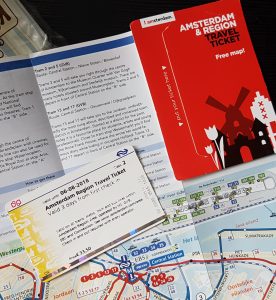
The train gets you right into Amsterdam Centraal Station where you can get a regional travel ticket, which basically opens up all of the little cities, towns and parks around Amsterdam to you. That includes Haarlem, the Keukenhoff Gardens, the beach at Bloemendaal, the little windmill village of Zaanse Schans.
The Sights
Okay tbh, my wife and I aren’t typical sightseeing travellers. To us, an authentic meal in a local restaurant is far more appealing than any old monument. But Holland is most definitely home to some beautiful sights.
The Amsterdam Regional Travel Ticket gets you unlimited rides on buses, trams and trains during your stay.
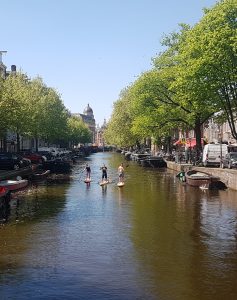
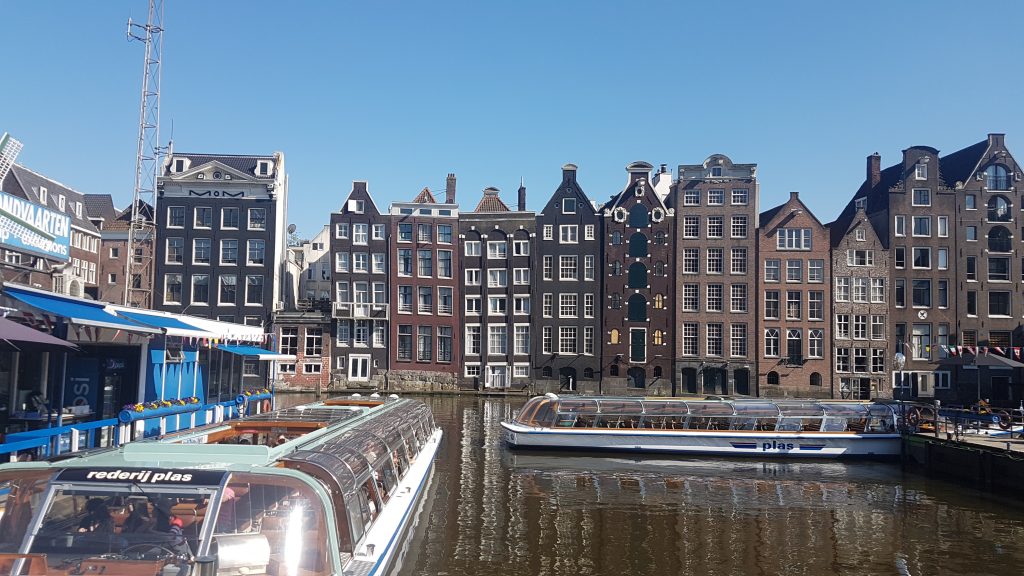
Amsterdam is a gorgeous city and, in the sunshine, it’s simply glorious. There are paddle boarders in the canals, leafy trees dappling the streets with sunlight, and people out and about, even playing giant games of chess. In fact, it was so sunny while we were there that the tulips were wilting in the heat, although even in death, they exuded a surreal beauty.
We spent a day in Amsterdam just wandering the streets without an agenda. Amid all the hustle and bustle, there were little pockets of tranquillity, like the old book market we found at Oudemanhuispoort, where second (or third or eighth) hand reads are still being peddled from old wooden booths bolted to the stone walls. Perhaps fittingly, the book market is just adjacent to the law faculty of the University of Amsterdam, whose gardens are worth taking a stroll in.
Is it a consequence of studying in a medical school that I thought the building was having a stroke?
Another treat was sitting down by the Oude Kerk and listening to its bells play, surprisingly, the Sesame Street theme song. It put a grin on the face of everyone in that square! Interestingly, the church is right smack in the middle of the famous Amsterdam Red Light District. The story goes that it was built there so sailors could pop over for some quick absolution before another long and dangerous voyage. Today though, the Red Light District is mostly closed. Only one or two windows were open as the city clamps down. If allegations of human trafficking and abuse are true, that’s definitely a good thing, but you’d better hurry if you still want to see the place for yourself.
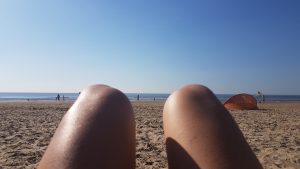
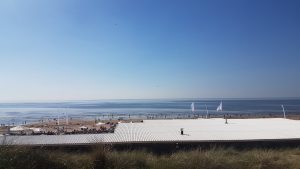
For all its charms though, Amsterdam is really only worth a day. There is so much else to see around it. We found a lovely loft apartment in Haarlem that could easily sleep three and made short day trips from there. First place on the list, THE BEACH. Bloemendaal aan Zee will never be able to compete with the likes of Portugal or Spain. But after 8 months in gloomy London, this was a dose of vitamin sea that was sorely needed. We got to soak up loads of sun, play in the sand and started to look vaguely Southeast Asian again.
The beach at Bloemendaal aan Zee. It’s not Ibiza but my sausage legs ain’t complaining.
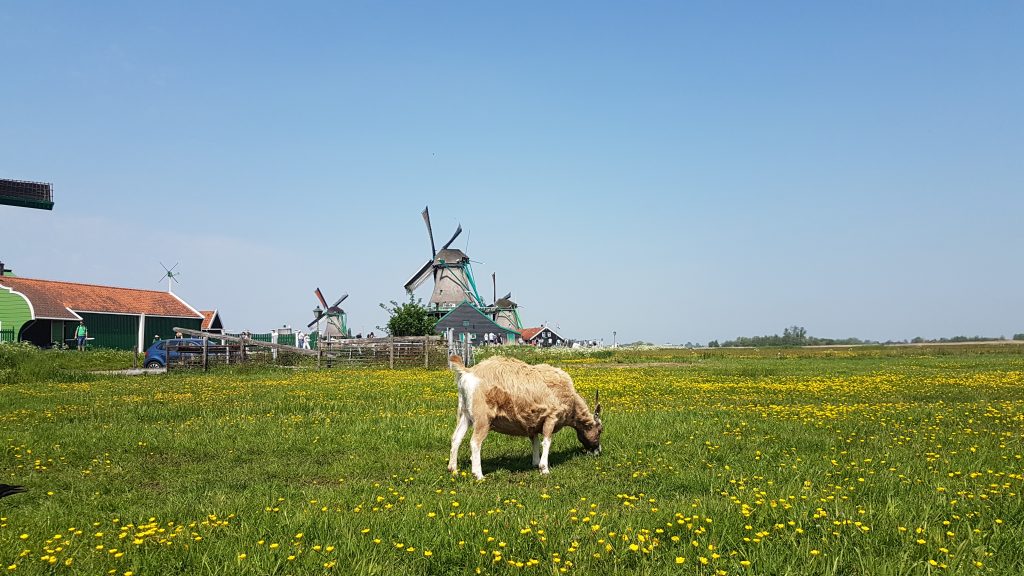
If you can spare the time, the windmills of Zaanse Schans are also worth a quick visit. They are still grinding out some delicious old mustard, and there is also a huge cheese shop where you can taste pretty much everything in the shop. We ended up with a delicious smoked cheese that we can’t wait to break into.
The old windmills of Zaanse Schans, still merrily churning out flour and mustard.
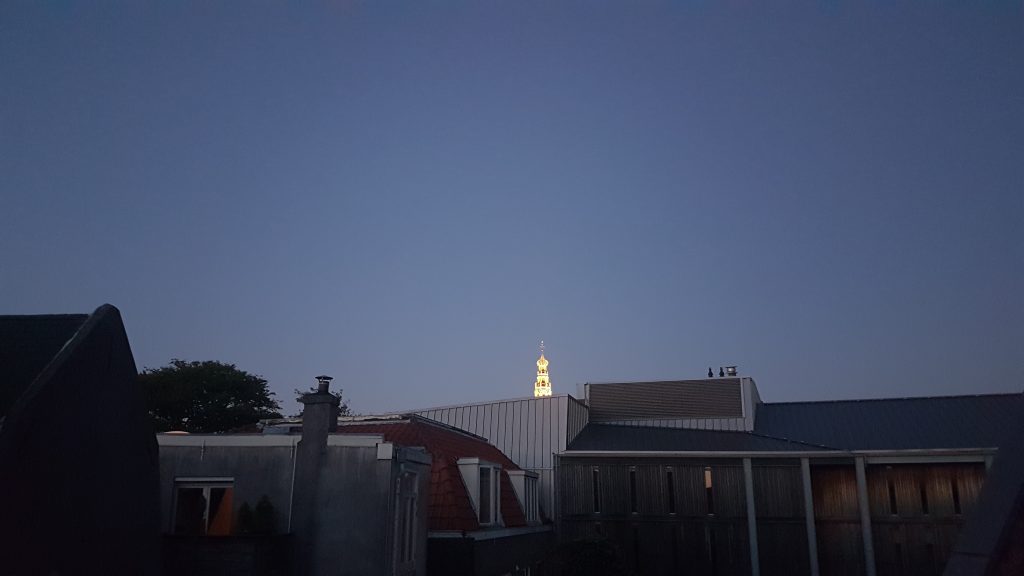
Sadly, we didn’t take many pictures of Haarlem but perhaps that is a reflection of how at home we felt there. Every night, we were serenaded to sleep by the softly chiming bells of the Grote Kerk, its tower brightly lit on the horizon. Since 1562, the bells have been rung between 9 and 9:30pm to signal the closing of the city gates and the tradition has carried on ever since.
The Food
Holland, where toast comes in a beer bottle and coffee comes in a wine glass. Both tasted great.
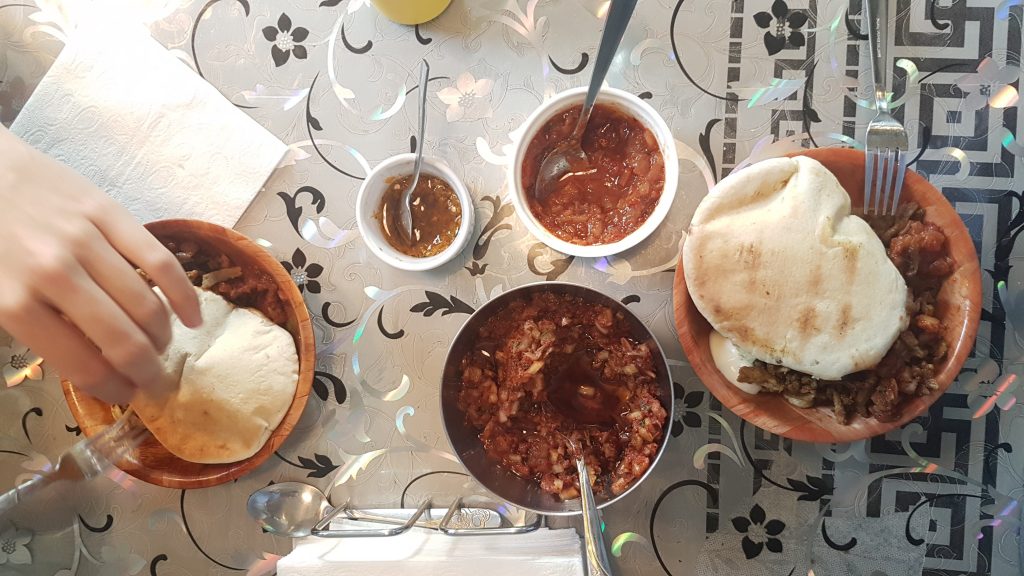
We are proud gastrotourists so no trip is complete without a huge serving of local food. I like having a good kebab on the first night in Haarlem and a quick Google search brought us to Shalom Grillhouse, which turned out to be a whole new culinary experience. Here the shawarma is served alongside plates of Middle Eastern “sambal” which you mix into the meat until it’s as tasty and spicy as you like. I love that it was proper spicy too. None of that middling Tabasco mildness. This was an absolute revelation and I really wish we’d had enough time to go back.
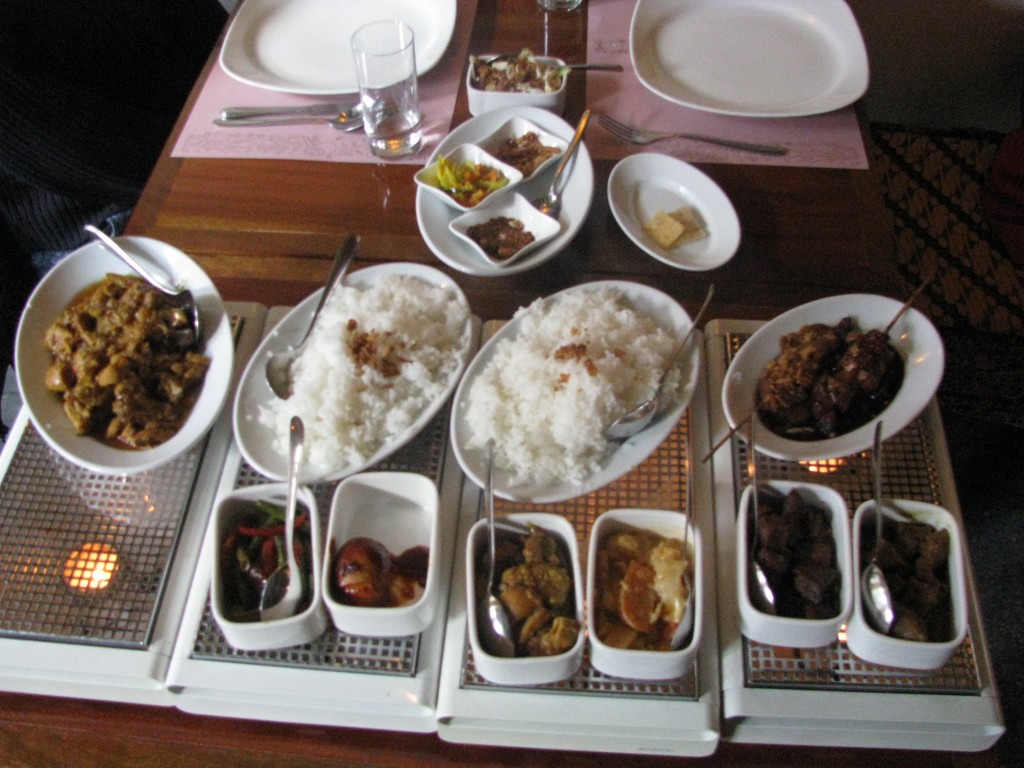
But Haarlem has treats galore. On our second night, we went for the famous Dutch rijsttafel. Literally translated as “rice table”, this is a set meal of rice with 10 to 12 Indonesian side dishes that the Dutch took home with them from their adventure in the Indies. De Lanchende Javaan is a Haarlem institution run by three brothers who moved to the Netherlands from Indonesia more than 30 years ago and are still cooking up a storm. Their version of rijsttafel includes satay, sayur lodeh (curried veggies), achar (spicy pickles), beef rendang (spice paste), gado gado (Indonesian salad with peanut sauce), sambal egg and much more. It was so good we literally forgot to take any photos. I could hardly believe I’d found better rendang in Holland than in most places in Malaysia and Indonesia.
The rijsttafel at De Lachende Javaan was so delicious that we forgot to take a photo, so I’m going to have to leave you this one from Pierre Vanderhout’s Travel Blog
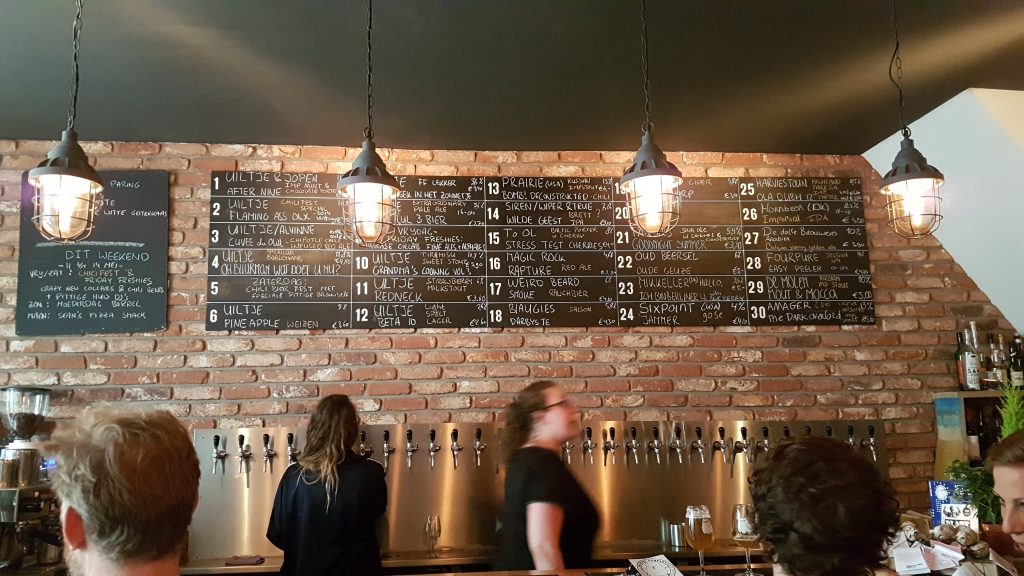
We needed something to wash down all that good food. Luckily, the Uiltje craft beer bar was just around the corner. Uiltje is Haarlem’s very own craft brewery who have 30 or so different beers on tap at any one time. You can get tasting flight for just €10 and they do some amazing things with stout especially. Before Uiltje, my experience with stout had been limited to Guinness. Then I spent an afternoon sipping stout laced with liquorice, cherries and tiramisu and now things will never be the same. I also had my first taste of smoked beer, which is made from malted barley dried over an open flame and fills your nose as it pleasures your taste buds.
Uiltje’s tasting bar in Haarlem has more than 30 beers on tap and tasting flights to get you through them. From L – R: Baltic Porter with Cherries; Tiramisu Stout; Heavy Stout with Liquorice; and Smoked Rauchbier
Perhaps the only downside to Dutch craft beer is its high alcohol content, usually 9 to 13%, which limits how much you can drink. But I suppose that’s a good thing. Dutch beer is for savouring, not getting sloshed. Still, that didn’t stop us from popping into the local supermarket and hauling some of the good stuff back home.
Best part of doing a PhD? Conferences! When you finally manage to do some meaningful research, it’s time to present it to a wider audience. In other words, pack your suitcases and bon voyage! I know that attending conferences might be a bit overwhelming in the beginning, so here are a few tips to make the most of them.
Find a good conference. If you’re as lucky as I am and have a great supervisor, she or he will suggest interesting events to you. Otherwise you’ll need to do the work yourself. However, at Imperial we’re flooded with e-mails advertising scientific events, there’s also Google and your colleagues who can give you some advice. Personally I like to choose small conferences where you can actually talk to other participants, but you’ll need to figure out yourself what you prefer.
Poster on a fabric – a pretty cool thing.
Send your abstract before the deadline. Yes, I mean it – even if you think you aren’t ready, apply to give a talk or present a poster. Some conferences are pretty competetive, so don’t worry if you get rejected (it happened to me many times in my first year). If they accept you though, get preparing! I already wrote a few words about giving oral presentations, hope that helps. For the poster, one important thing: make sure the airline you’re flying with is ok with a poster tube (Ryanair isn’t). Otherwise I strongly recommend a poster printed on a fabric, you’ll definitely get attention of other participants 🙂
At the actual event it might seem hat it’s obligatory to attend every single talk you possibly can. Don’t even try… After one day you’ll be exhausted and you won’t understand a word, trust me. It’s ok to skip some talks that don’t seem interesting so that you can fully focus on the ones you really want to hear. Having said that, don’t stick to the topics you feel comfortable with. Ask around, maybe there’s an excellent speaker coming up who can introduce you to a completely new field? Broaden your horizons, seriously! You’ll have enough time during your PhD to focus on your tiny area.
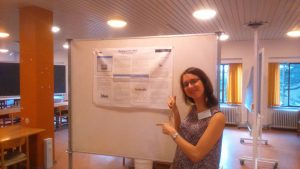
Poster presentations are also a great opportunity to chat.
Talks, presentations… they’re all important. But conferences are all about networking! I always get excited when I can see faces hiding behind names I know from the key papers in my field. Coffee breaks, dinners, informal chats – you can learn way more talking to people than sitting in lectures. And make great friends, that happened to me already 🙂
A weekend in Vienna after a very intense conference.
Most importantly, have fun! Make sure you learn new things, but also that you enjoy the experience. Spend as much time with other participants as possible, join the trips, conference dinner, visit local attractions in your free time. I like to add the weekend to my stay at the conference venue, to get a mini-vacation. This way I visited Paris, Vienna, Copenhagen, Philadelphia… Trust me, you want other researchers to remember you as a cheerful young scientist, not an exhausted zombie. This will pay off in the future.
London is a big place, 1,572 km² to be exact, so you definitely need to know your way around. Whether it’s to shave off those precious seconds on the morning commute so you can lie in bed that bit longer or simply because you don’t want to walk in the rain, one of the most iconic transport systems has got you covered.
The Underground: A.K.A The Tube
Riding at high speed in a metal tube down a very dark tunnel, miles underground sounds like a great way to travel, right? Well, that’s basically the Tube! The massive network of underground tunnels crisscrossing all over London is one of the quickest (and more pricey) ways to get round on public transport. The underground system is currently made up of 14 lines, each one useful and unique in their own way:
Bakerloo – Think old and rickety but ultimately useful line. Beware of the seats though, if someone sits next to you, you will end up jumping 3ft in the air – just accept it.
Central – If you manage to avoid getting your head decapitated by the closing doors, enjoy a journey in a moving furnace – especially in summer!
Circle – The one that never turns up. Trains every 10 minutes + tourists = HELL.
District – Probably one of the most useful lines, especially when living further out in later years – is there anywhere this doesn’t go!?
Hammersmith and City – See Circle line, but with less tourists.
Jubilee – Think fancy businessman with slick silver hair that is almost always on time.
Metropolitan – Wait, this is a thing!? (never used it in my life)
Northern – As useful as the District line but just cooler and more edgy.
Piccadilly – Hello, 1973 calling – We’d like our trains back please.
Victoria – Ah, sweet sweet Victoria, fast and reliable like a tube should be.
Waterloo and City– See Metropolitan line.
DLR (Docklands Light Railway)– There are no drivers – that’s totally normal…
Overground – Great for getting to those hard to reach, far out places that are still in “London”.
Trams – I’ve never used them but I like the colour green…
BONUS: Crossrail/Elizabeth Line – a new Underground line coming in full in 2018 (#hypeisreal)
Of course, riding the Underground comes with some serious etiquette – here are the essential Do’s and Don’t’s of the Tube:
Do:
Stand on the right, walk on the left of an escalator
Link your 16-25 railcard with your Oyster (money saving everywhere)
Stand behind the yellow line – tubes create a lot of wind when they arrive at the platform (not that kind of wind…)
Mind The Gap – you’ll hear that so much, imitating it will become your signature party trick.
Be nice to the staff – they have a rough day most of the time dealing with tourists, grumpy Londoners and working underground.
Know where you want to go before you get in – achievement unlock: True Londoner.
Don’t:
Stand on the left of an escalator – just don’t.
Crowd at the platform/tube carriage entrance – move on down y’all there’s plenty of space!
Drop your phone down the gap – they’ll have to stop the everything all because you had to like that meme whilst getting on the Tube…
Put your bag on the seat next to you at peak times; a bag is not a person – it doesn’t need a seat
Most of all, enjoy riding the Tube – it’s a magically unique experience that gets you efficiently (most of the time) from A to B with some surprises along the way (think signal failures, leaves on the track and mariachi bands).