A couple of weeks ago, the MSci projects for next year were announced for us to choose from!
MSci projects are projects that you do in the fourth year if you are taking an integrated Physics Masters, though I think there is a lot of overlap in the projects with regular Master’s projects—for people who come into Imperial just for the year.
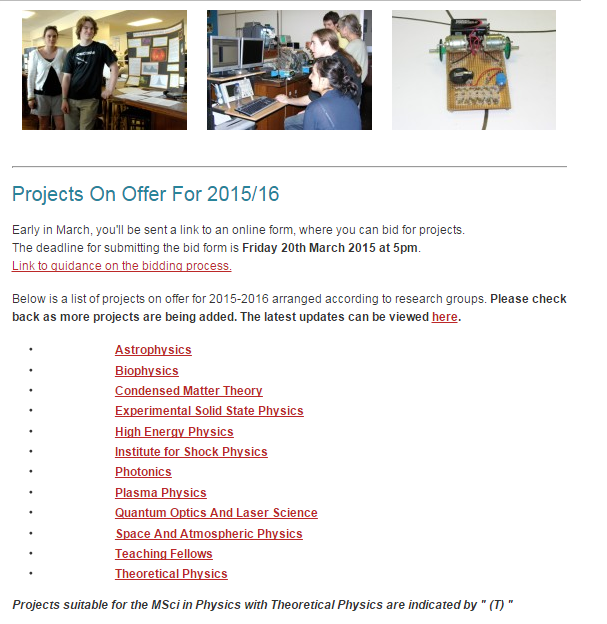
They are pretty exciting— I think you have to log in to see the choices on the website, but I took a sneaky screenshot:
As you can see they cover pretty much every Physics topic. The actual names of the projects are like ‘A Search for Dyson Spheres and Cool Astronomical Bodies using the Wide field Infrared Survey Explorer’, ‘Physics beyond the Standard Model at the LHCb experiment… ?’ and ‘The physics of cooking’ and those are just three of the ones I am applying to!
The application process isn’t the smoothest thing in the world—for a start you need to find a project partner who is interested in the same choices as you. This is easy for some people, but turns out harder for others—many people are leaving next year, and choosing a project you will actually like is pretty important, as otherwise a lot of fourth year could be pretty miserable.
You get four choices, and as far as I can tell, just need to apply online and write a bit about why you want the project, as well as link up your choices with your partners. It has yet to be seen how many people will end up with choices they want…
You are also encouraged to go along and talk to the supervisors offering your projects—this is the fun part!
The two I’ve been to so far have been really interesting—both departments which I could see myself enjoying working in, even though they are both on completely different topics—as you can tell from my illogical list above, I have no idea which area of Physics is my favourite!
How are you meant to decide between high energy particle Physics and searching for new particles in weird quark interactions, searching for aliens by looking how they harvest the energy of stars, looking to use artificial intelligence to discover new laws of Physics, or finding out scientifically how cooking works?
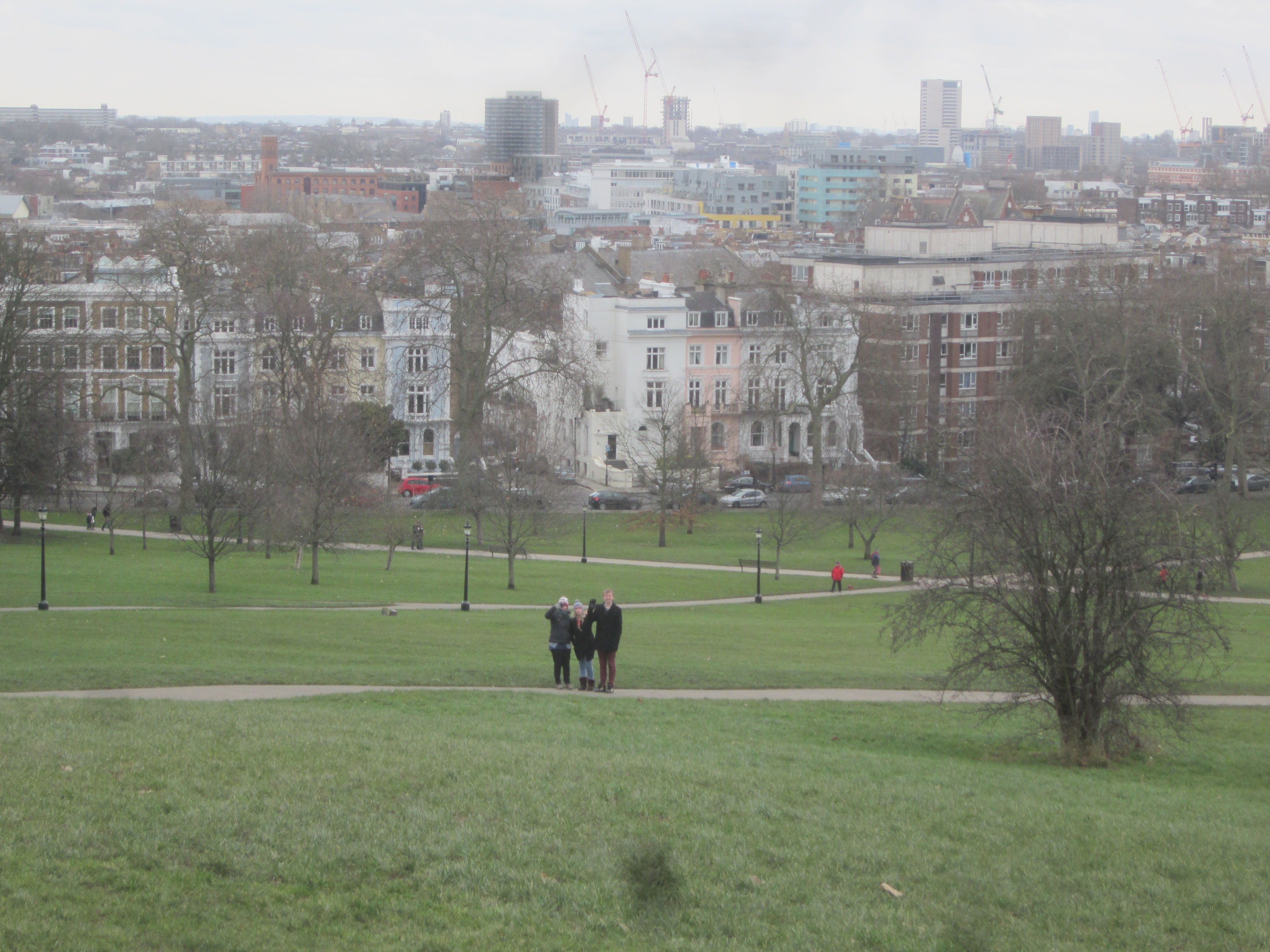
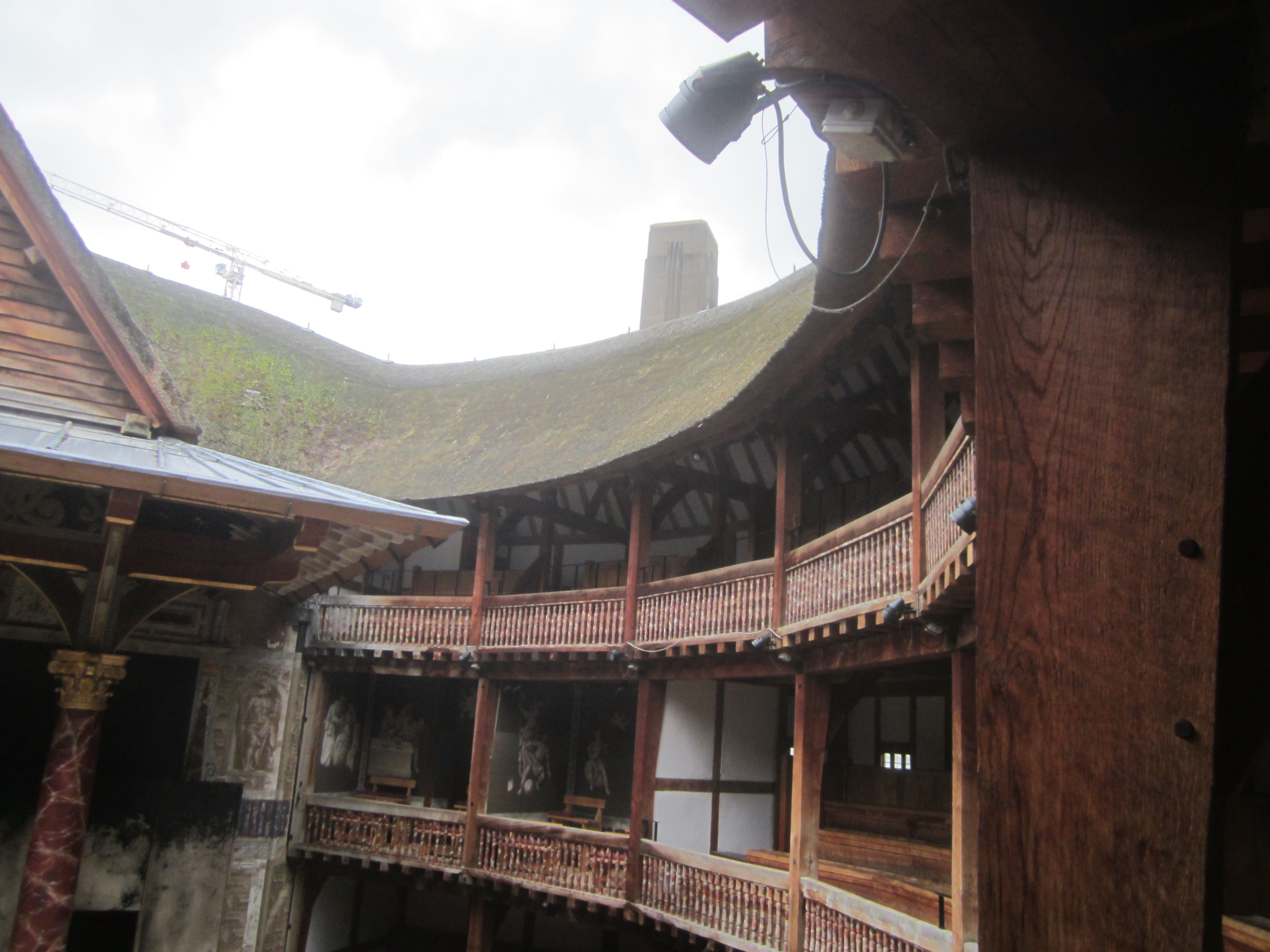
This weekend my parents came down, and we spent the weekend being tourists. We went to Chinatown to see some of the Chinese New Year decorations, had a tour round the Globe theatre, and explored Primrose Hill. There is so much to do in London that it’s always really easy to entertain visitors!
Real life dragons!
Real life fish doughnut things!Happy Chinese New Year! (Even if our fortune cookies did all say ‘exchange at the Casino for a free key ring’. The translation of that is obviously ‘your lab work will not go well for you’)Why Horse?Primrose HillThe Globe
Last week was pretty busy as I was ill, writing my extended essay and lab report, it was pancake day, my housemate’s birthday, a Great Gatsby party on Wednesday, and Oscar, one of my old housemates came back from Germany where he is taking a year abroad to see everyone. Hopefully this week will give me a chance to catch up on some sleep!
I also had an interview with the science museum for a summer internship, but unfortunately they turned me down, because apparently I had too much experience and someone else could benefit from the role more. I’ve been turned down for Work Experience many times before, but this has to be the worst reason considering I’ve been trying so hard this year to get experience so that I can get an internship! Thanks Science Museum. If only you weren’t such a great museum and I could hate you.
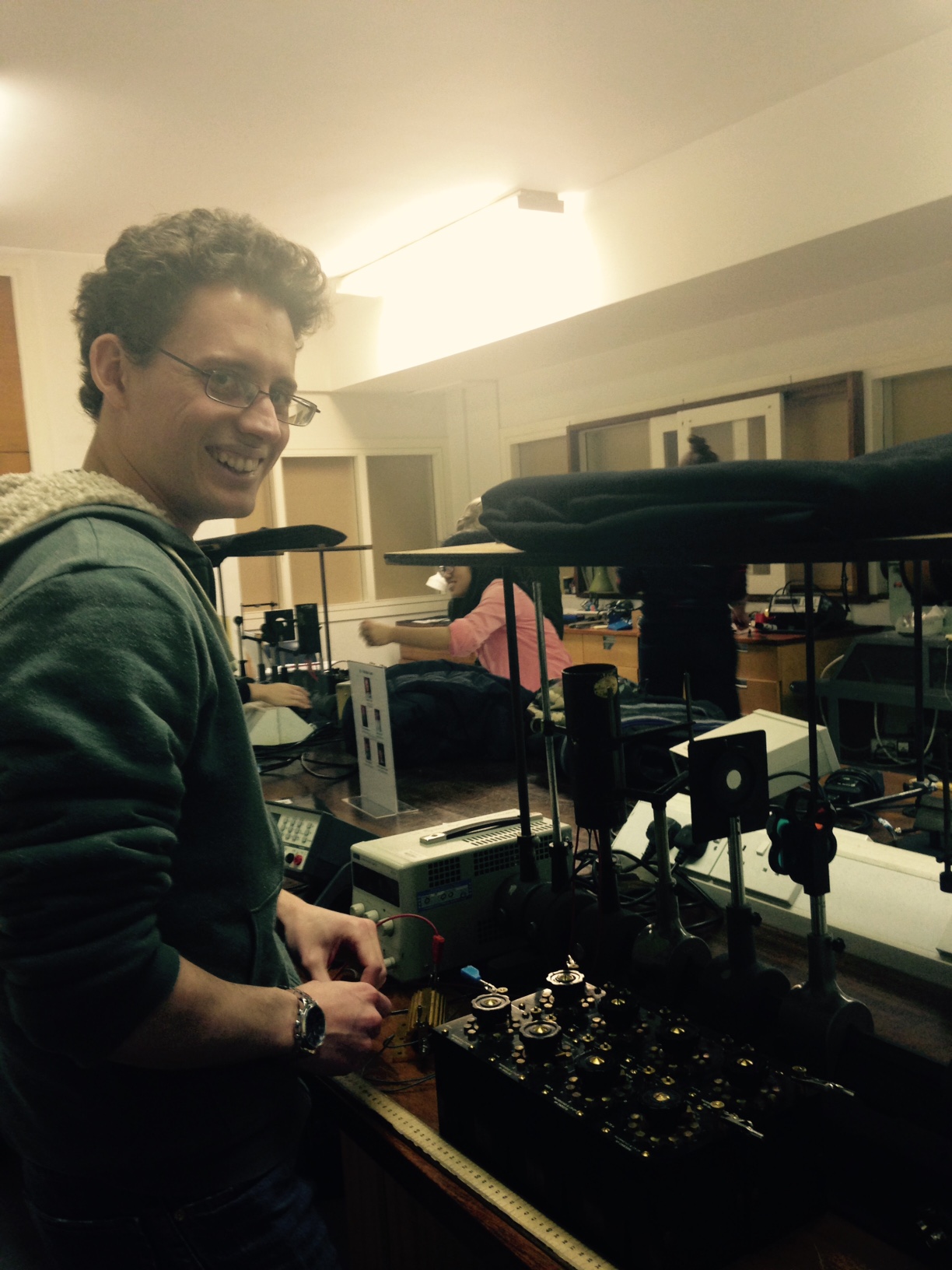
It turns out third year labs are completely horrible, by the way. Twice now, my partner and I have thought in the first week that our experiment was totally sorted and brilliant, and twice we have been rushing to retake results and try to understand what was wrong days before the deadline. Not much fun. Maybe the third and final lab cycle will work out better (bitter laugh [ahahahahha]).
Before the madness set in…
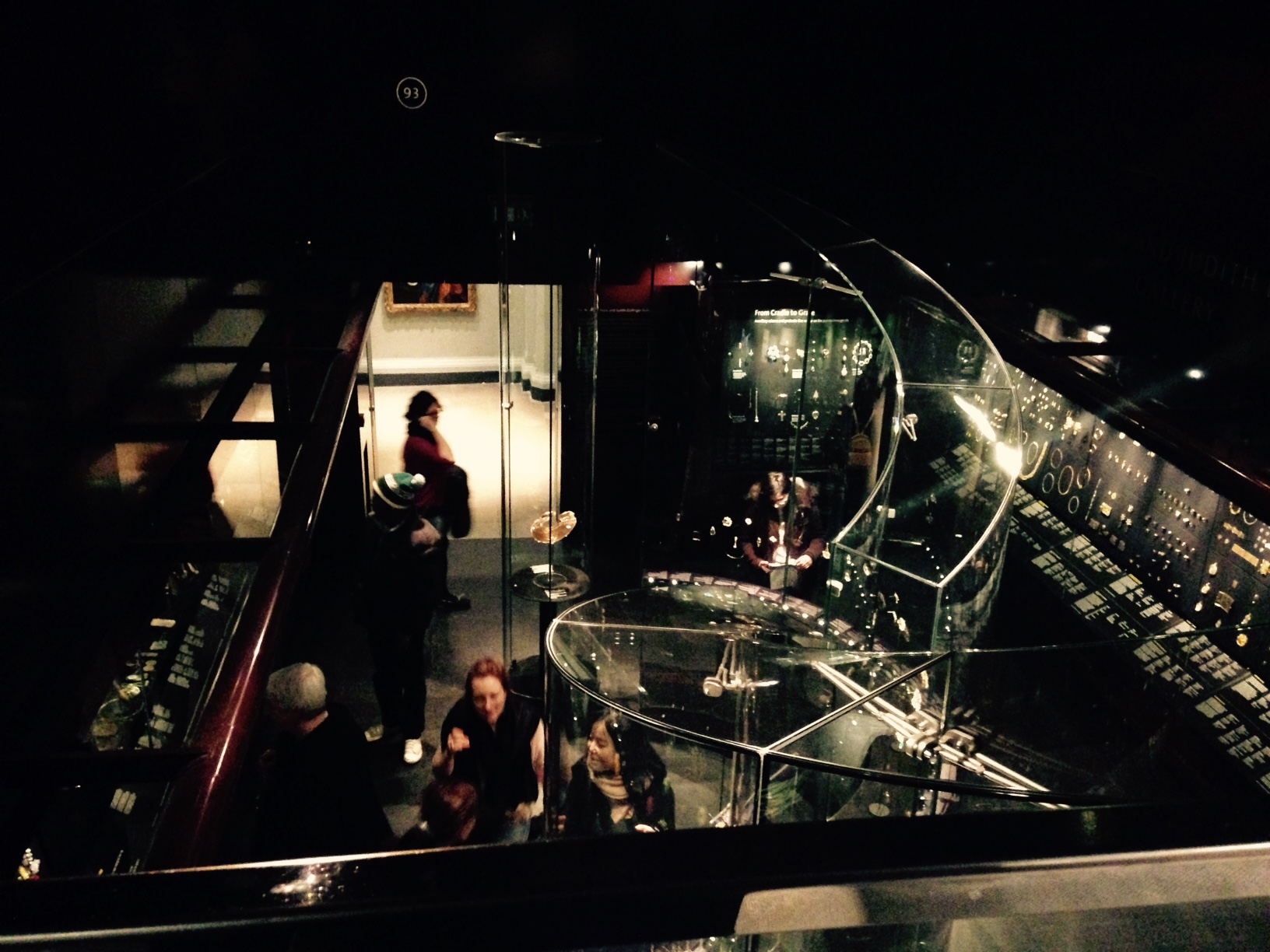
Anyway, the take home positive message of this blog is meant to be that London is a great place to live. I am hoping to see something cool before I go home from Easter, and in no other city could I choose between a Great Gatsby Ballet, the new Tom Stoppard play and an Opera. Also I had an hour to kill today, so I went to the V&A and found the most amazing Jewellry Gallery literally filled with Jewels…. :0
Often people will say they don’t understand my blogs, so this one is split into three bits (imitating nature as we shall see) depending on how much physics you care to know.
Bit one: the standard model
The standard model is a theory about our best knowledge of particle physics to date, and it includes a toolkit of particles with which you can build a universe from. Each of these particles has different properties, but there are lots of patterns and links between them (just like the periodic table in chemistry).
There are two types of particles overall- the ones that make up stuff– the matter particles, and the ones that make the stuff do stuff– the ones that carry the forces. I am only talking about the matter ones in this blog 🙂
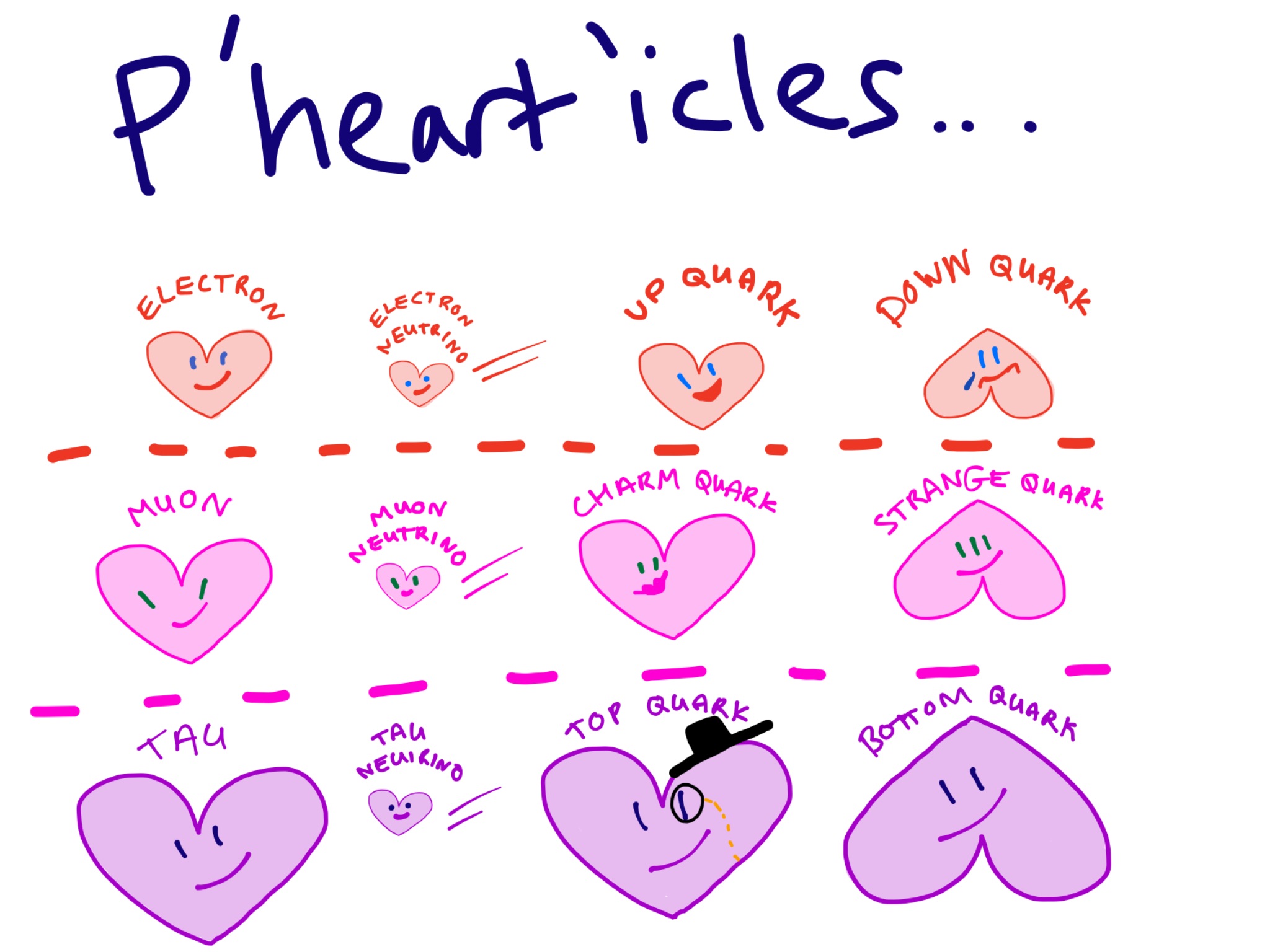
All the matter particles are laid out in this snazzy diagram I have drawn– they are hilariously titled p’heart’icles what with Valentine’s Day coming up 😛
Bit two: why the three rows?
The top row of phearticles includes a electron, an up quark and a down quark, which are the things you need to make up all everyday matter like you and me and planets. Until the muon was spotted, everyone thought they were all that the universe was made up of. A particle physicist at the time of the muon’s discovery, I.I. Rabi, was famously meant to have asked of its existence: ‘who ordered that?’
The muon is on row two– it is the same as the electron but is just heavier. Everyone was baffled about why the universe had come up with this heavier version of the electron– especially as it didn’t seem to be using it.
After this discovery, all the other particles were eventually filled in on rows two and three. Each one on row two is a heavier version of the particles above it, and row three particles are the same again, but heavier still. Queerer and queerer.
When I first heard about this feature of the standard model, I thought ‘oh yeah well obviously there are going to be loads more generations of still heavier particles, but our particle accelerators can’t access energies high enough to create them yet’.
(Coz E= mc^2 and all that so you need higher energies to get more massive particles.)
This seems reasonable. Who is to say there isn’t another fourth, even heavier electron type thing lurking out there?
Bit three: I am to say there are only three generations 🙂
The proof for this comes from a simple experiment, but before that we have to consider the little neutrino phearticles. These are not like the other particles of the three generations, because there is not a big increase in mass between the rows. Until recently neutrinos were thought to have no mass at all, but it was then discovered that they change type as they are flying along– a phenomenon that means they must have a small mass difference i.e. they can’t all have zero mass!
Because the masses are so tiny, and neutrinos hardly react with anything at all, their masses haven’t been measured exactly, and it isn’t even known if they follow the same pattern as the other generations– getting heavier as they go down the rows.
However, because they have such small masses, it would be fair to assume that another fourth of fifth generation of matter particles would also contain a very light neutrino. This means we should be procuring neutrinos of any extra generations in particles accelerators all the time– E= mc^2 again.
An example of a reaction that should produce them is when two electrons collide and produce a Z boson (which is a type of force particle that I said we would be ignoring). This Z phearticle can decay into any of the other matter particles, including the three neutrinos. If there was a fourth generation, it would be reasonably expected to decay to this generation’s neutrino as well. However you can measure a lot of these reactions and measure the amount of times it decays to each of the different particles. As neutrinos don’t really react with anything, they are usually ‘seen’ by looking at the amount of missing energy. The amount of missing energy that is seen in millions and millions of these decays is exactly equal to the amount of energy needed to produce three generations of neutrinos. Hence, we have only three generations of particles.
I still find that weird… Why three generations? It turns out with less than three some crucial aspects of the strong force wouldn’t work out, but why not ten generations or fifteen? 😛
I can’t answer that just yet, so instead I leave you with some more cute phearticles…
Since I want to do science communication, there aren’t that many long-term internships that I am actually interested in, at least not compared to people who want to be various shades of banker. My boyfriend wants to work in insurance though, so I’ve seen two pretty different sides to applications for internships and work experience.
Both have their pros and cons—science communication is a very diverse field so it can be hard to find places that take interns, whereas it is easy to find a list of insurance companies with open summer schemes, but the applications for these are normally completely noxious. (This is probably to put you off applying if you aren’t that interested, which I expect does save them quite a lot of picking through candidates who don’t really care, but even so!)
Internships at Big Scary Companies
I will start with the insurance applications because the same kind of process seems to apply for all big companies, and Alex had his first assessment centre last week, so is further through the process than I am. 🙂
The first stage of the joyous process involves multiple pages of questions like ‘who would be your ideal client?’ and ‘tell me about the most innovative way you’ve learnt something’, as well as endless typing out of your personal details and a huge explicit breakdown of your degree modules and grades.
Once you’re through that section you have a barrage of online tests to deal with—numerical tests, verbal reasoning tests, personality tests. This is despite the fact that you have already negotiated your way through their chunky applications, so you can obviously verbally reason with the best of them, and are doing a maths degree. But of course, an online multiple choice test that takes twenty minutes is surely a much better criteria to judge candidates on than a lifetime of continual assessment in maths.
Even these hurdles only get you through to a phone interview. Alex has done one of these for Allianz already—they require a lot of preparation—researching the insurance industry, as well as the company and going over what you decide your strengths and weaknesses and similar rubbish.
If you get through all that, you finally get called to an assessment centre for a day of more interviews and presentations. Alex had his Allianz assessment centre last week in this awesome hotel just outside of London with towers and a lake and an all-you-can-eat breakfast. I went along with him for moral support and for the breakfast 😛
Anyway, his assessment centre was with seven other people also applying to underwriting, and consisted of a presentation about the company, an hour long interview, and a presentation that he had to prepare about where a new restaurant should open. Apparently everyone there was lovely and went out of their way to make the students feel comfortable. The whole emphasis of the morning seemed to be figuring out if the candidates fitted in personality-wise, which was kind of unexpected as Allianz is such a huge global company! Between the interviews and presentation there was a chance to talk to some people on the graduate scheme, and afterwards there was lunch with the interviewers.
It sounds like a pretty nerve-wracking experience, but it sounds like he got on with everyone and somehow managed to sustain his enthusiasm for an hour long interview at nine o’clock in the morning! Looking back on it though, it was not half as bad as it could have been—it genuinely was a chance for him to ask lots of questions about the company and get an idea of the type of people that he might end up working with. This is a huge benefit of dong internships and work experience before leaving university, because it gives you a chance to rule out what you absolutely don’t want to do.
Science Communication Applications
I am going down a different route, as I mentioned, and am not really applying to these huge companies. I have contacted a lot of people about work experience this year with mixed success—mostly just emailing people to see if I could come in and see what they do/volunteer. This starts off as quite a daunting task, but once you’ve done it a few times it becomes far more routine and less scary.
I’ve not heard back from over half of the emails I sent out, and some others that I have heard back from have been really strange and frustrating, and I have had to give up on them in the end. Yet others have replied once to say ‘yes we would like you to come’ but then never got back to any of my emails about sorting out dates. However, those few emails I have heard back from successfully have got me some really interesting work experience.
I am now in the process of sending out another wave of emails and applications for summer placements. I am going to apply to the Science Museum to help with exhibit planning for a month, to the Wellcome Trust for a longer, two month internship for an editorial placement and the BBC to work on ‘The Sky at Night’. I am also planning on emailing some production companies who produce documentaries and science programs, Imperial’s PR department, Sense About Science, the Royal Institute and Okido (a children’s science and art magazine), for shorter work experience placements that I can fit in around a main internship, if I manage to get one! (Fingers crossed!)
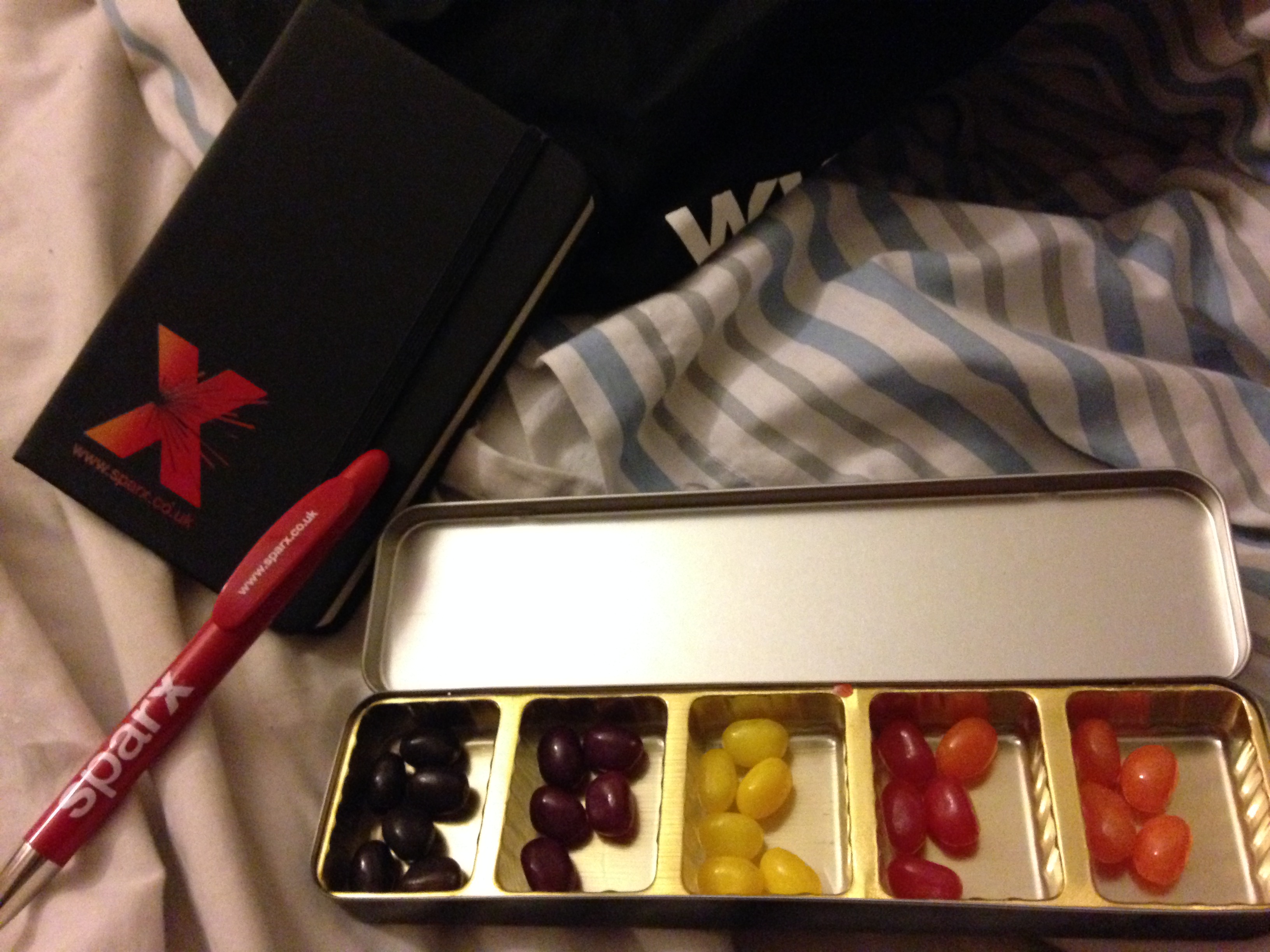
Imperial hosts loads of careers fairs, which are always interesting to browse around (not to mention I got this free pencil case of jelly beans from one today!!)
They are good places to look for job and work experience ideas, outside of what you might have thought of. Just today I went to a careers fair on the way back from lectures and found this really interesting company called ‘Sparx’ that is trying to use data analysis and scientific methods to determine how best to teach children maths. This company completely interests me, as I am fascinated by evidence-based education (my mum is a teacher and is constantly baffled by seemingly pointless changes in the curriculum based on what seems to be pretty sketchy evidence.)
Moral of the blog…
The word ‘internships’ can strike fear into undergraduate’s hearts, and for some good reasons… The application process can be time consuming and boring, and with so many excellent applicants applying for every place, there are going to be days and days of rejection.
However, if you look at it for what it really is, researching internships is a chance to find and find out more about whatever really interests you and how you can continue to do that. My list of applications above (Wellcome Trust, Science Museum, Sense about Science etc etc) are all institutions that I look up to immensely and would love to have a chance to snoop around, let alone work for. If you aren’t inspired enough to get through the applications, then it is probably better to find out now and think of something else that you really want to do, rather than wait until the end of your degree to freak out!
Good luck to everyone applying (unless it is for insurance or science communication of course) 😉
Tonight I went to a talk by the Physics department’s artist-in-residence Geraldine Cox. I’d somehow never been to one of her talks or exhibits before, though I had seen some of her paintings around Blackett.
I was actually kind of sceptical about her work at the start of the talk, because although I love poetry and plays and novels and all those kind of English-y ‘arty’ things, I am not really comfortable with ‘art’ in general—paintings and sculptures and such. My knowledge of art amounts to knowing that Monet might have been able to see UV light after he had surgery for his cataracts, and that that might have made his later paintings more blue, and also that Turner did some good sea.
I suppose I thought that her work would probably be kind of not very helpful science communication, because it communicated something that most people find a bit impenetrable (physics) into something that people still find incomprehensible (abstract paintings and stuff).
I am glad I went to the talk because it was clear that she absolutely believed the opposite—that art has the potential to enrich a large audience and interest them in some of the principles of physics, and I must say I am now completely converted to this point of view.
Geraldine Cox is an interesting character—she has a physics degree, and invented this job for herself after coming to the conclusion that she wanted to return to physics as the subject of her work, and she seemed really genuine and intelligent.
The talk started with her introducing how the department seemed to her when she first joined, talking about how the research groups are organised around the huge stairwell we have through the centre of Blackett. This might seem like sort of an obvious overview of the department, but it struck me that I have never been given a run-through of the research groups, let alone where they are situated in the building before, not even on an open day. In physics, everything is so compartmentalised, that it is hard to remember that there is a bigger picture, let alone that it is a poetic one, with floors of people involved in ‘democratising the Sun’s energy’ and chambers colder than outer space.
Her focus on the bigger picture, the applications and philosophical implications of physics, remained an important part of the rest of the talk, which included an overview of some of her work. I had no idea of the range of mediums she used—she showed us two videos she had made, one talking about an experiment on the electric-dipole moment of the electron, and another about clips of Physicist’s scribbled notes taken under a microscope. The first film was a nice juxtaposition of the deeply fundamental reasons the experiment was being done and the persistence of the researchers carrying out what can be very mundane and tricky tasks for year after year.
In addition to short videos, she also created a solar powered cinema and oil paintings about reactions in the sun and Fourier analysis to name just two subjects. She mentioned that art is a good teaching aid for children about science and I think that could absolutely be extended to undergraduate level. We spend so much time within our degrees stuck down by the details, trying to understand one step or struggling with one bit of maths, that the actual visceral implications of what we are studying just kind of wash over our heads as kind of footnotes. Taking that step back and trying to represent what physical theories viscerally mean through something completely different like art has to be a good thing—or else what is the point of struggling through in the first place?
My favourite part of her talk came right at the end with a prose piece that she had written to perform at a conference about light and resonance. It reminded me that even the simplest of scientific facts that we might be ‘familiar’ with are completely astounding when we actually think about them. She spoke about the size of the waves of light and invited us to imagine them and their origins and paths, from the huge radio waves washing over us, to the light of the early universe once scattered ceaselessly and then set free to travel everywhere. It was kind of hypnotic to sit there and imagine if we could see in these different lights: infrared ‘around the size of a needle-point and you can feel it on your skin’, that would reveal to us the friction of water falling on a fountain if we could see it. And light is caused by charges moving around—we all know that, but isn’t that amazing when you think about it? You shake a charge, and out falls the light– it doesn’t need poetic language to make it poetic, it just needs language that we are used to, to reveal to us how our perceptions are so, so limited.
It was really so lovely and immersive, that I will definitely have to try and hear the finished thing, as this was just a sort of rehearsal for the conference.
Anyway, as you can probably tell, I am now completely in love with the work of our artist-in-residence!
Science is full of completely incomprehensible things like the age of the universe. I can tell you that number, I can remember it, I can work things out using it and I can write about it, but have I ever sat down and tried to understand just how achingly, tiringly long ago that was?
‘By discovering the world through science we let in the light.’ That was something Geraldine Cox wrote on the side of her solar powered cinema. I think that is completely true—scientific ideas can be insanely profound and beyond our imagination that it seems vital we spend the time trying to understand this ourselves and communicate this celebration of knowledge to others—in any and every way that we can.
Here is her website if you want to see some of her work for yourself 🙂
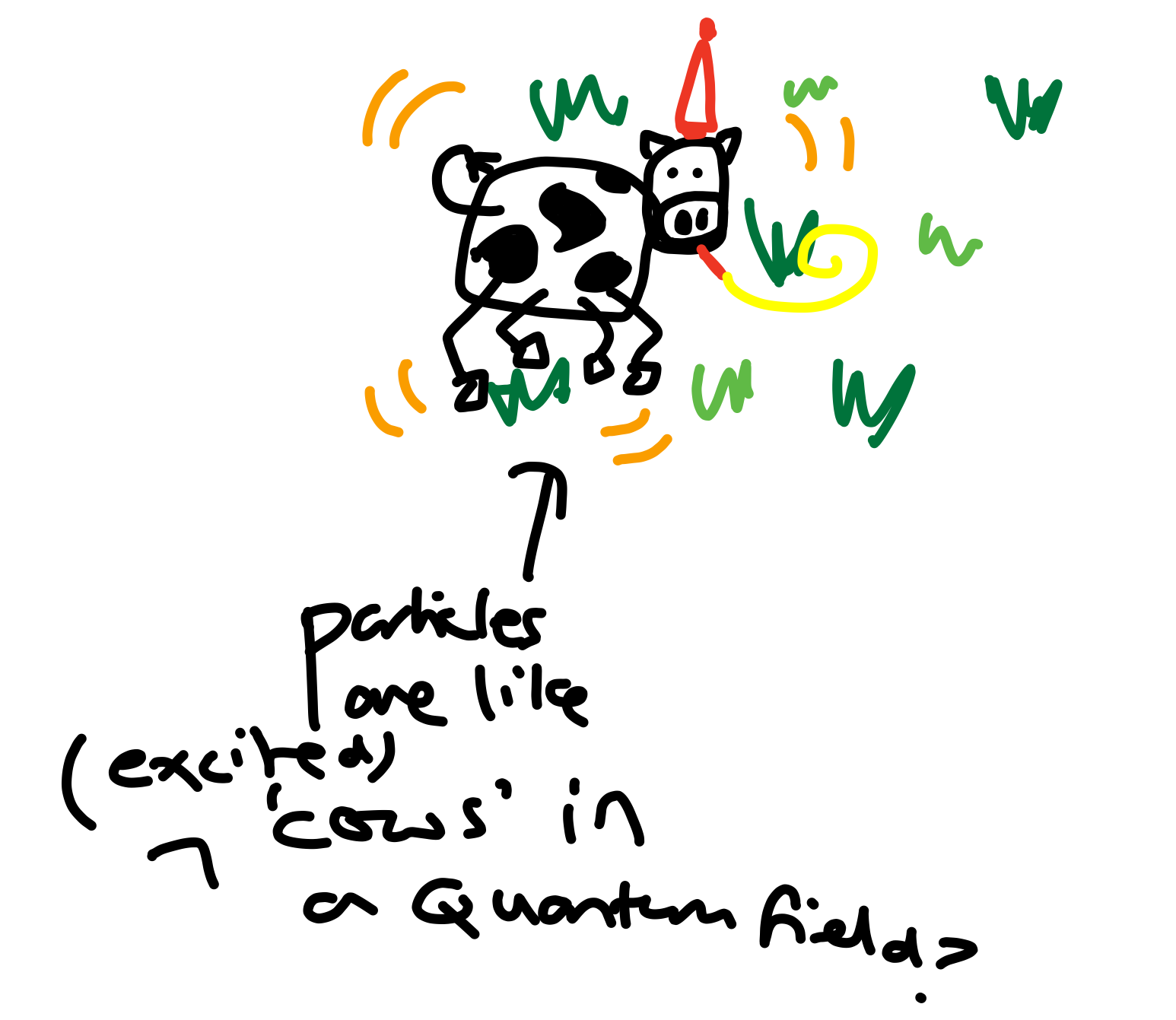
To start with, here is a picture of a strange quark holding a glass of champagne:
This is my second week back at Imperial after Christmas, and this term is looking set to be a brilliant one. For a start, I have only one lecture course this term, as all my options happened to be last term. This lecture course is called ‘Physics of the Universe’ and is about particle physics and astroparticle physics, and the lecturer is a completely inspiring man who literally flies out from CERN to teach us, and who you can just tell absolutely adores his job.
(The picture is a note I made in my lecture 😛 I think it’s a pretty accurate analogy…)
Particle Physics is an incredibly fun topic to study too, as even things you think might be boring like centre of mass energies, for example, turn into amazing things like ‘this energy is our time machine, and the faster we can wham these particles together, the closer we get to witnessing the dawn of our universe’. You can tell it’s an interesting subject when people feel compelled to say ‘our time machine’ and ‘the higher energies we can get’ like this is so important that it is a knowledge and theory that belongs to us all, even when we don’t really have the faintest idea of what is going on.
I still have comprehensive tutorials and labs this term too. A lot of labs actually—ten hours a week—I think we only had six in second year. I’ve actually missed lab work—the experiment we are doing at the moment is the famous photoelectric effect, which you will probably know like the back of your hand if you are doing A Level Physics. However, because the photocell we are using to detect our photocurrent (a load of electrons being pinged off a metal by light) is so dodgy, the whole point of our experiment seems to be: how are we dealing with the essentially bad equipment?
That makes it pretty open ended and interesting, so well done Imperial you have managed to turn terribly inaccurate lab gear to your advantage!
Now for the science baking section of the blog…
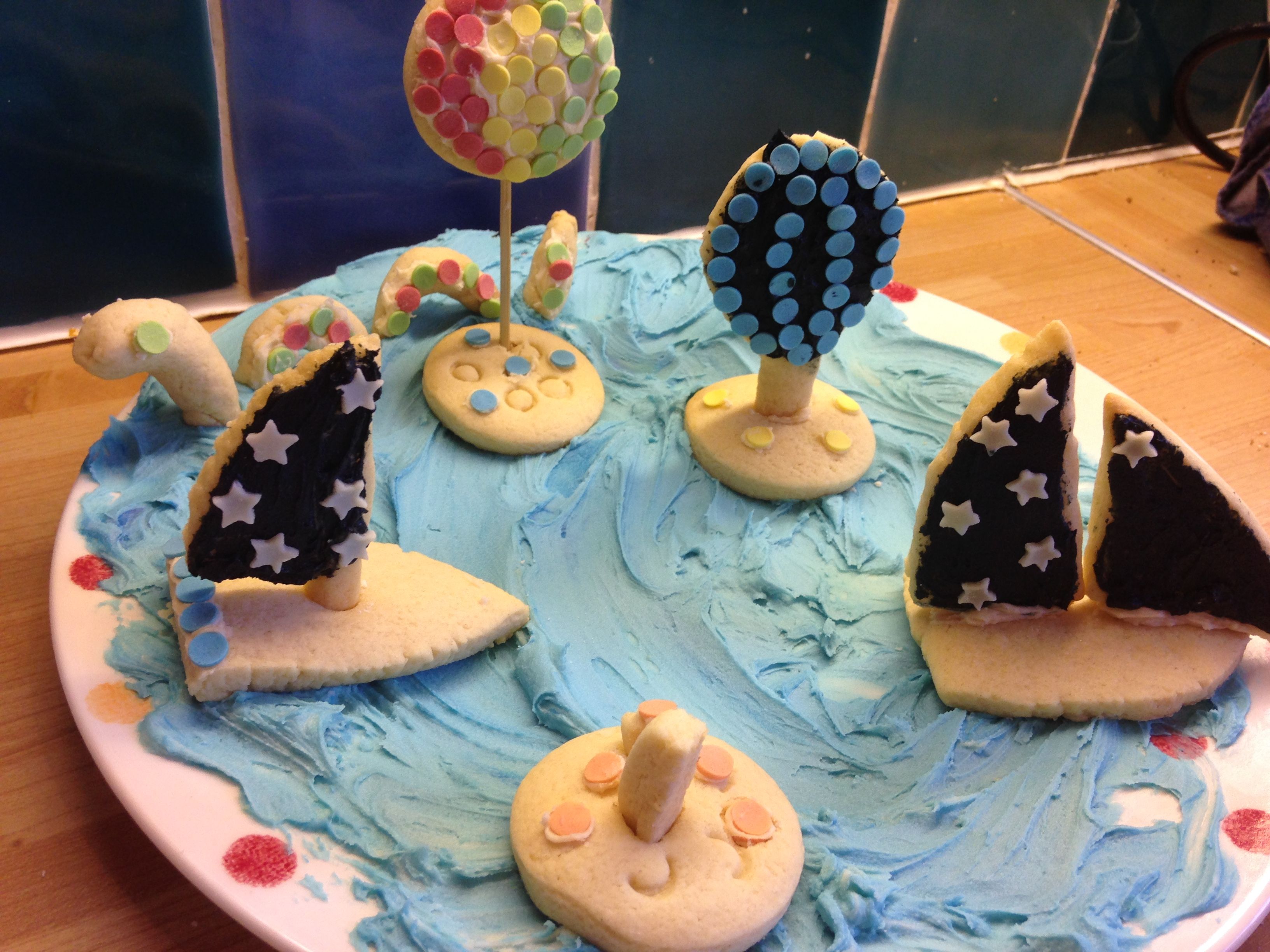
Here is a picture of some sailing ships on Titan cookies that I made:
(They are sugar cookies—if you have never made them before they are the best for holding their shape after baking, and are quite tasty too :P) If you’re wondering, the small round one in the front is meant to be the buoy mission that was proposed to float on the lakes, the sailing ships are what I imagine by ‘sailing on Titan’ (which might actually be possible due to the possible wind speed and composition of the atmosphere, the ones with balloons attached in the back are more buoys being let down from space. And the alien is the alien.
Putting a boat on Titan (one of the moons of Saturn) which has lakes of hydrocarbons and potentially underground/underice lakes of actual water(mixed with ammonia so it can be liquid at really low temperatures because chemistry) is one of my all-time favourite ideas for a space mission. It was actually proposed by NASA at some point but other projects were chosen instead.
Here is a really good article about what kinds of sailing would be available on Titan, or here is a limerick on it if you would rather read about space missions in silly poetry:
There once was a sailor on Titan
That the lakes did excessively frighten:
‘It is such a shame they are made of Methane,
And the land far too cold to alight on.’
That isn’t even the end of science baking news though! With Science London I am helping to organise a science bake off! It is an event for science week (organised by the British Science Festival) later on this year, and the idea is to get people to come along and bring a cake decorated with their best science to be judged by some scientists and cake experts. I really want to enter too!
There will also be a make your own bacteria cupcake area, and maybe a talk about the science of food, which is something I am already so excited about. Science. And cakes. What is not to like?
Only one day, one tutorial and one lecture to go before Christmas holidays! We had our house dinner yesterday, which was awesome, but this blog is on something a bit different…
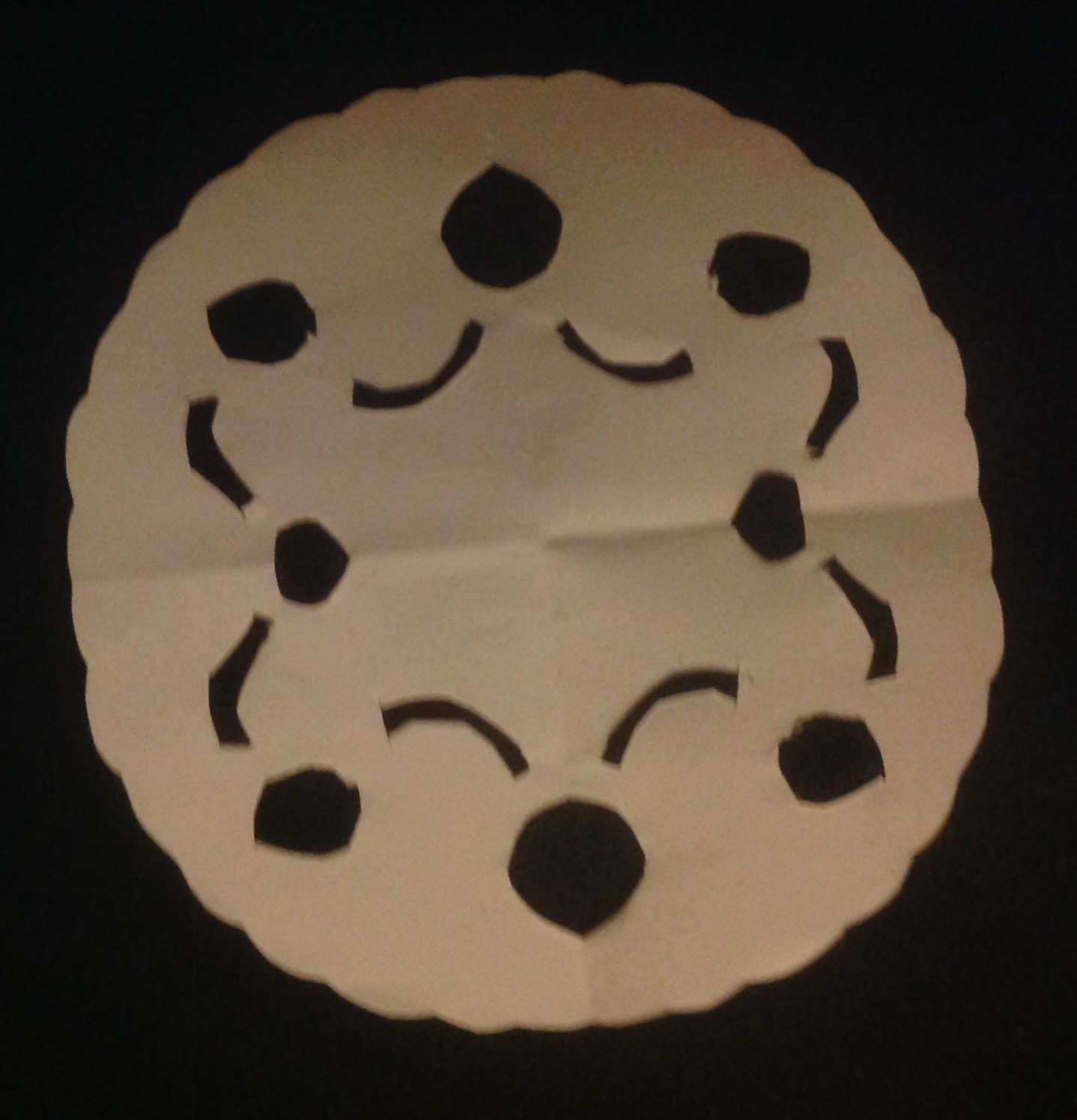
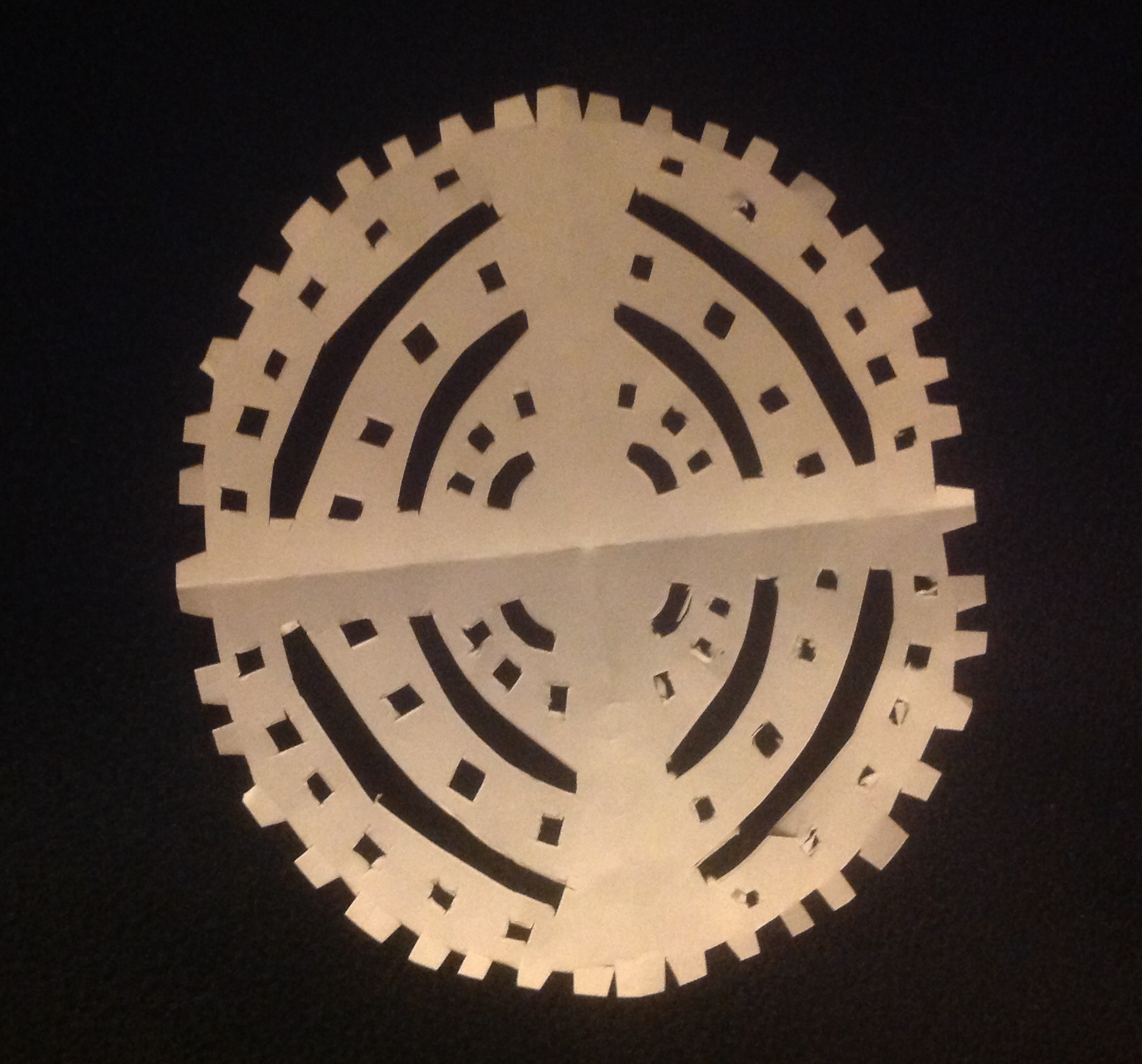
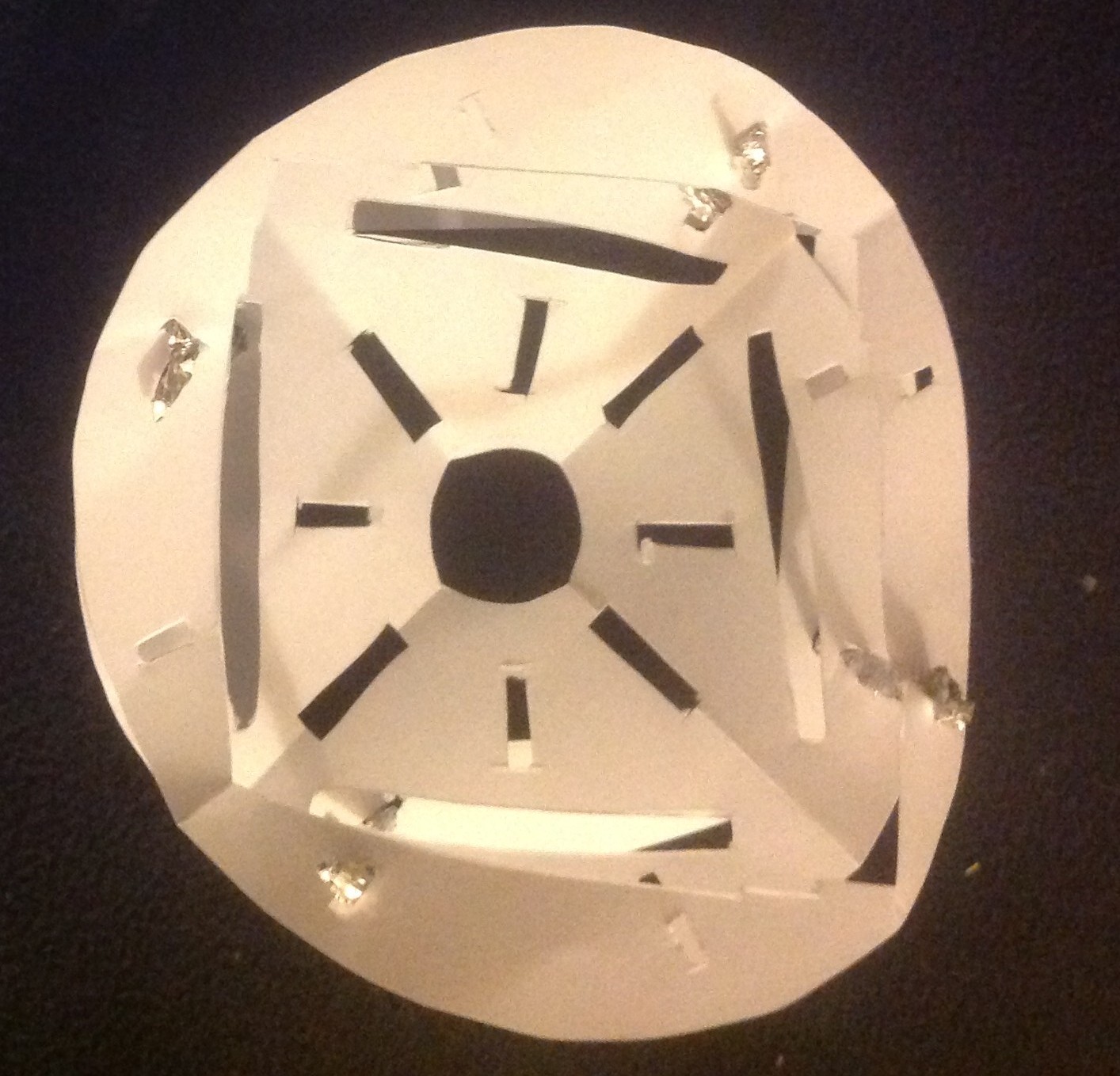
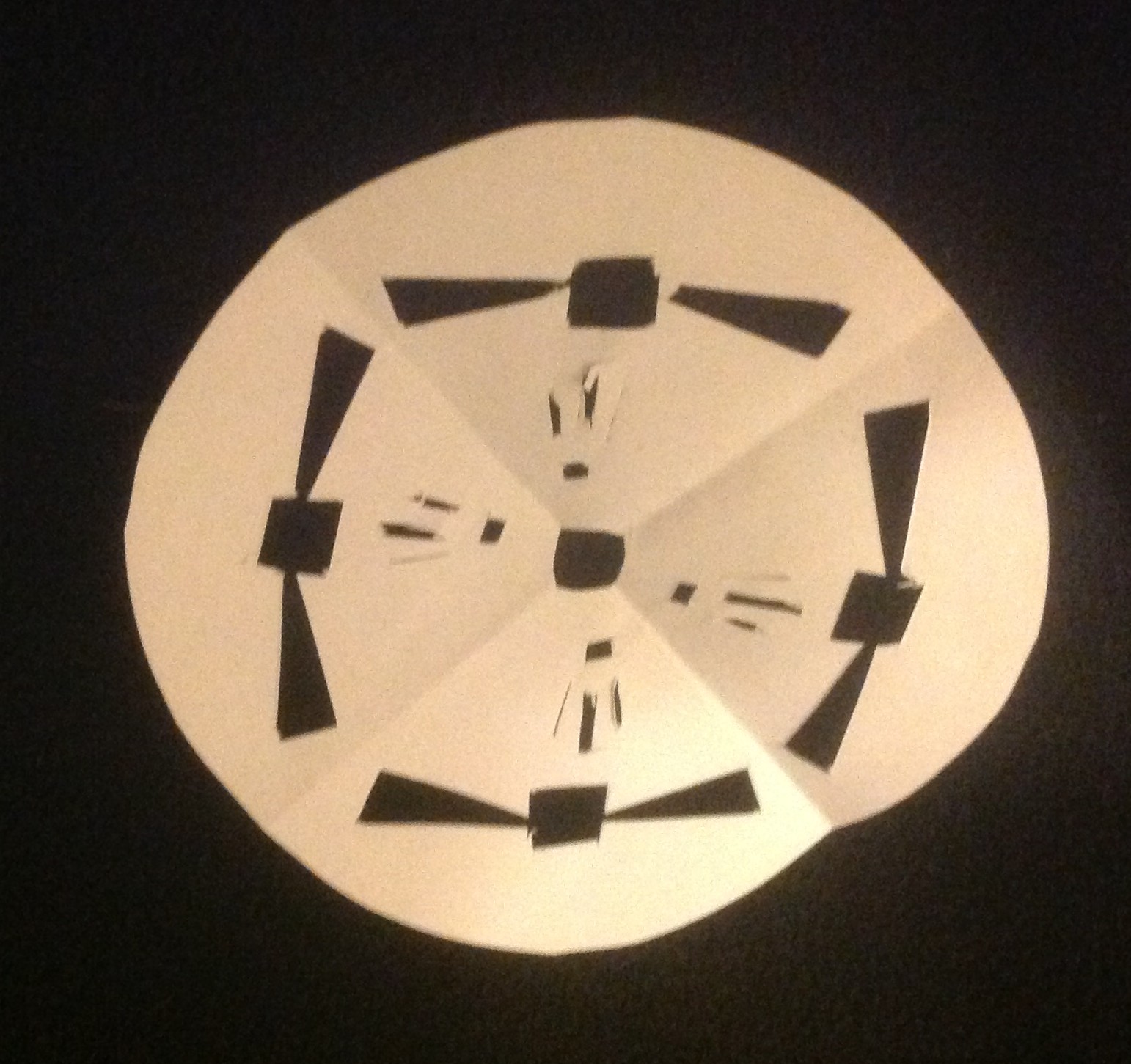
Basically, I was trying to listen to a lecture on matter reacting to magnetic fields, when I noticed a great tweet by symmetry mag showing their paper snowflakes in the shape of famous scientists. They look amazing, but are pretty intricate, and I don’t have a craft knife—also I was pretty sure I could make them even more nerdy, so I decided to come up with my own science inspired snowflakes.
So what part of science to choose?
As the lecture was on Magnetism, I decided on that Physicist’s firm favourite, Maxwell’s equations 😛
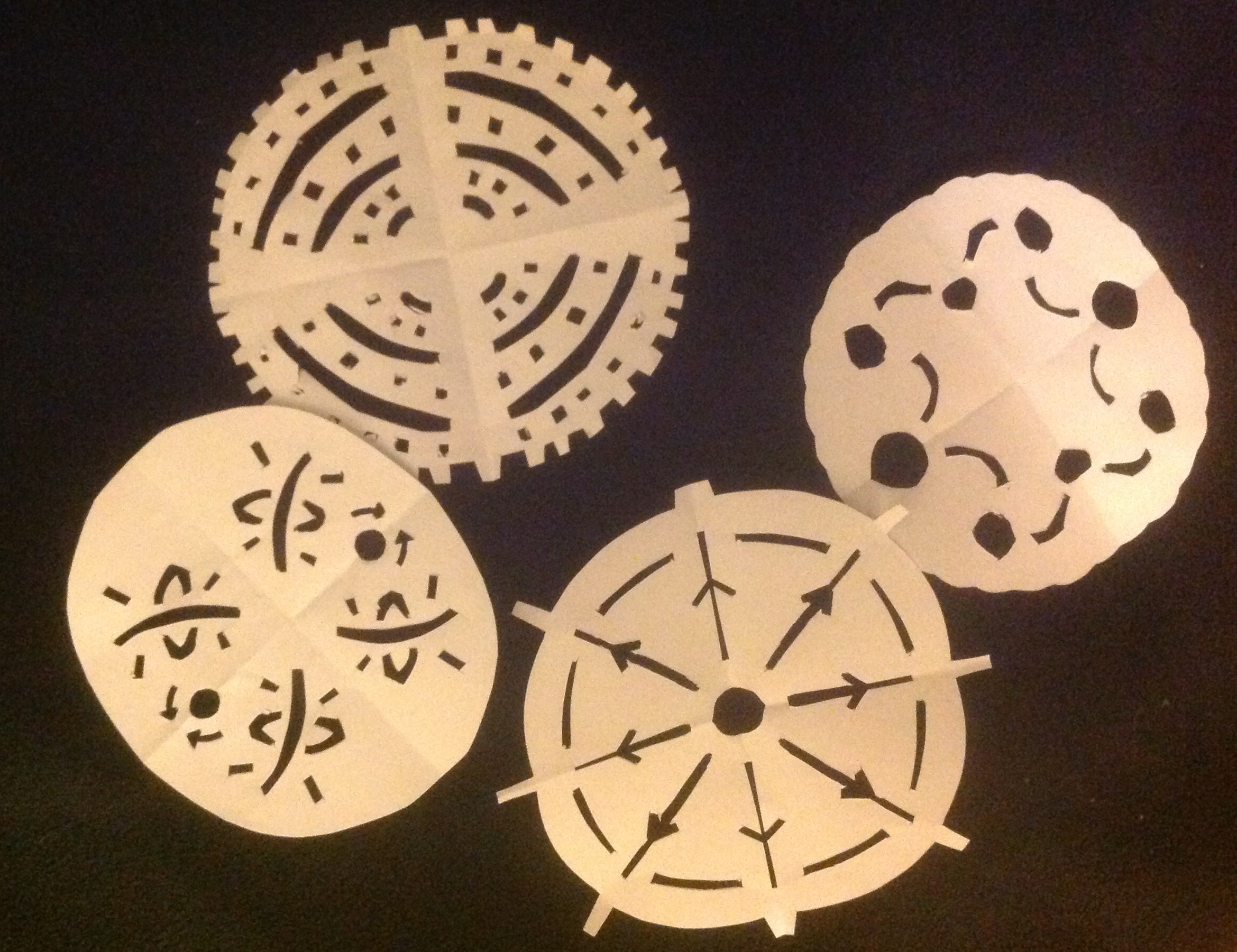
If you’re up for a challenge try and match the snowflake to the equation without reading on…
These are four equations (though ACP at the moment is trying to convince me you can introduce some nightmarish notation to write them down as one) that describe how the Electric and Magnetic forces behave and relate to each other. Check out these snowflakes to find out more 🙂
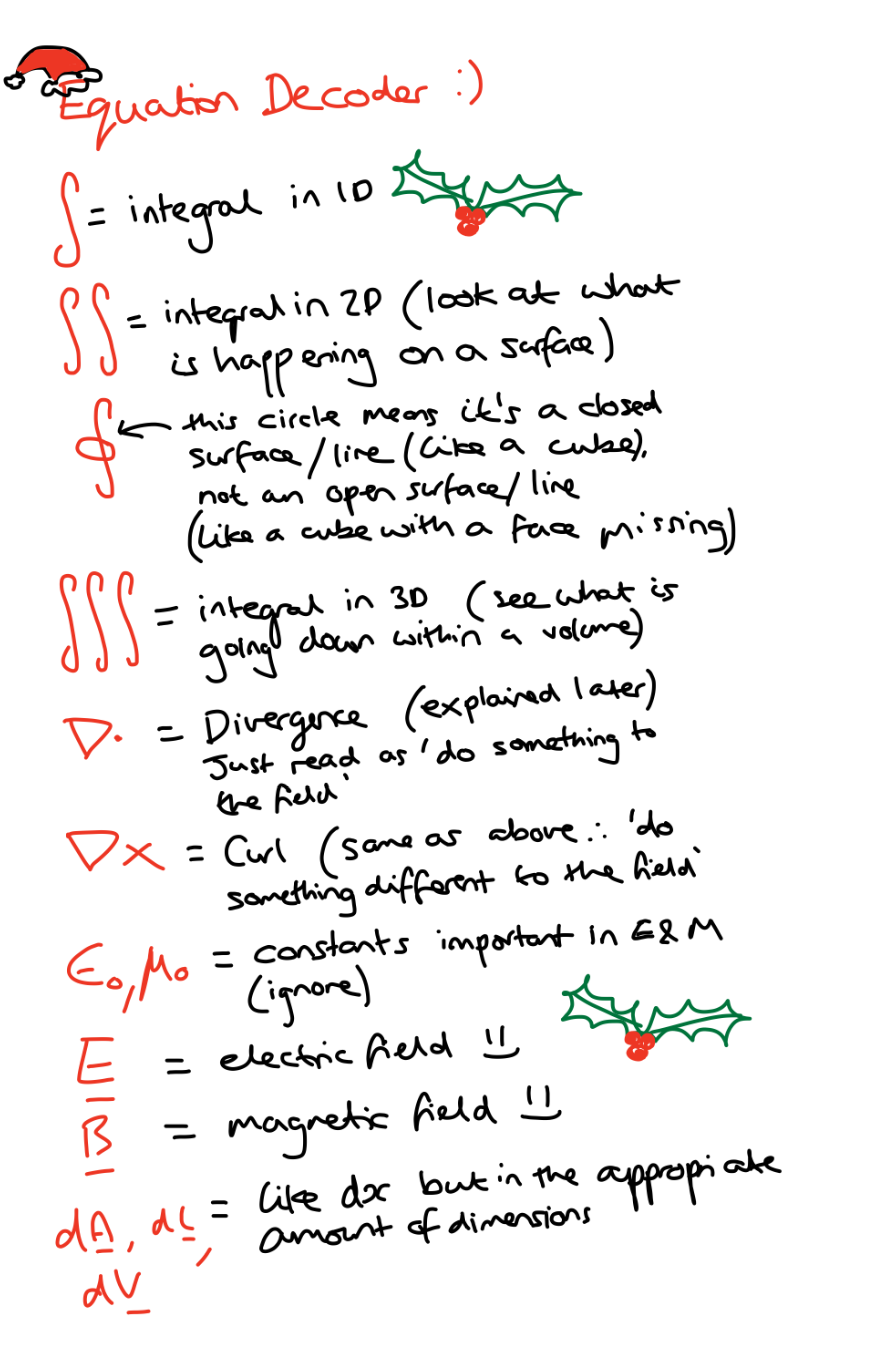
Before we begin, here is a handy equation decoder for the tricky bits of the equations:
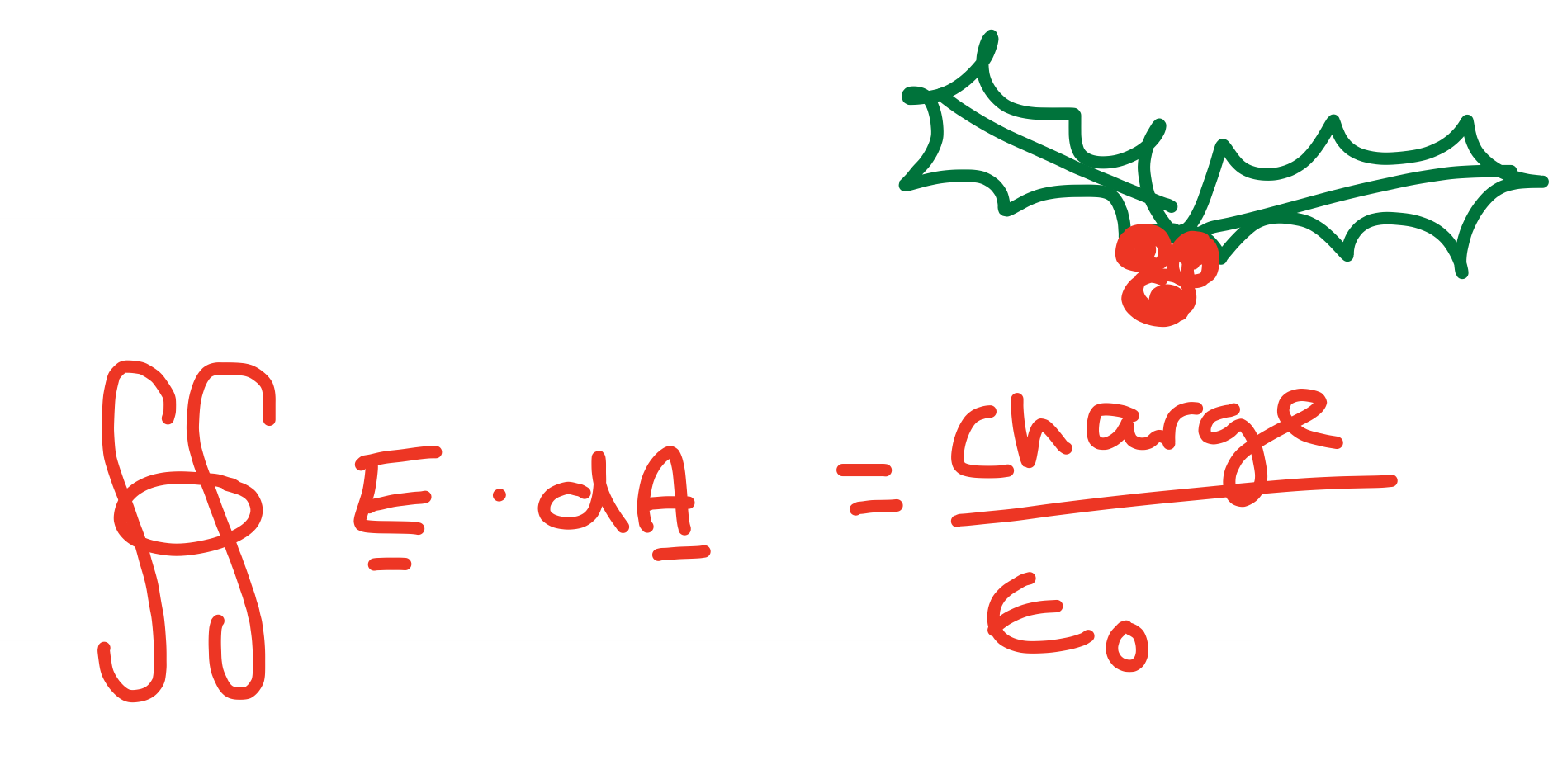
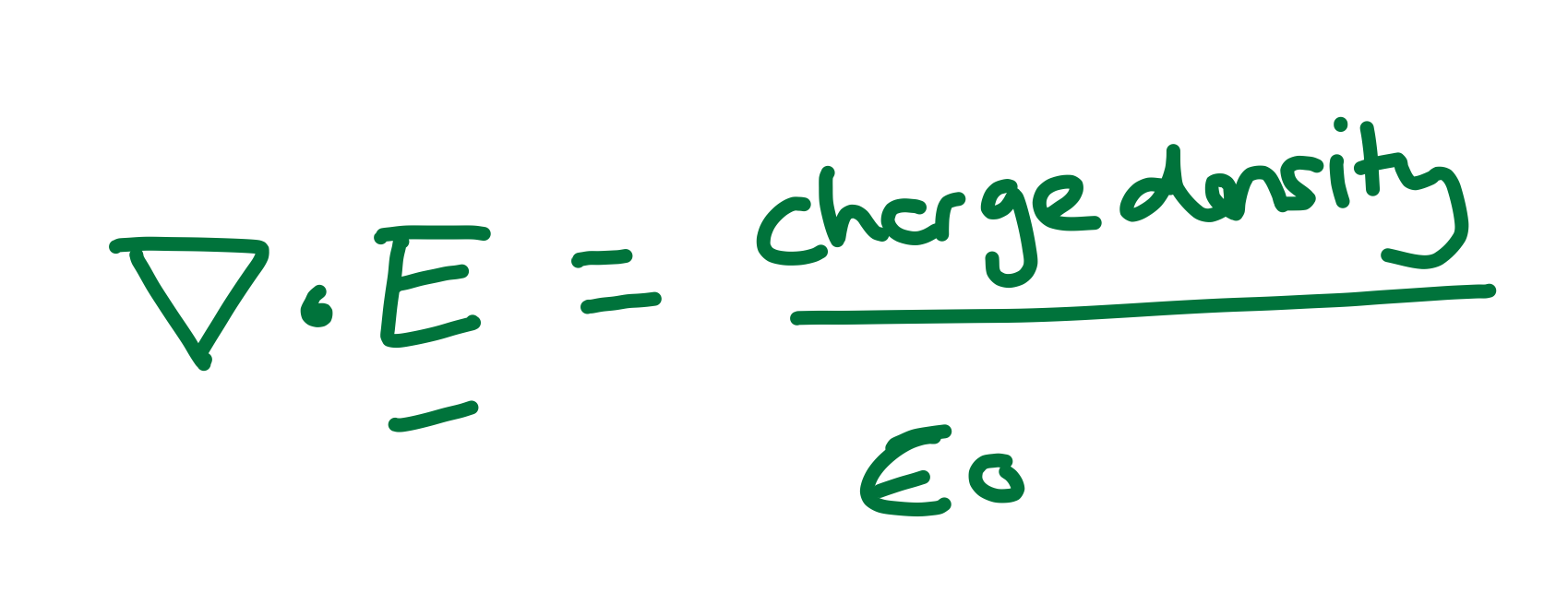
Gauss’s (Christmas) Law
This can be written as:
or:
or:
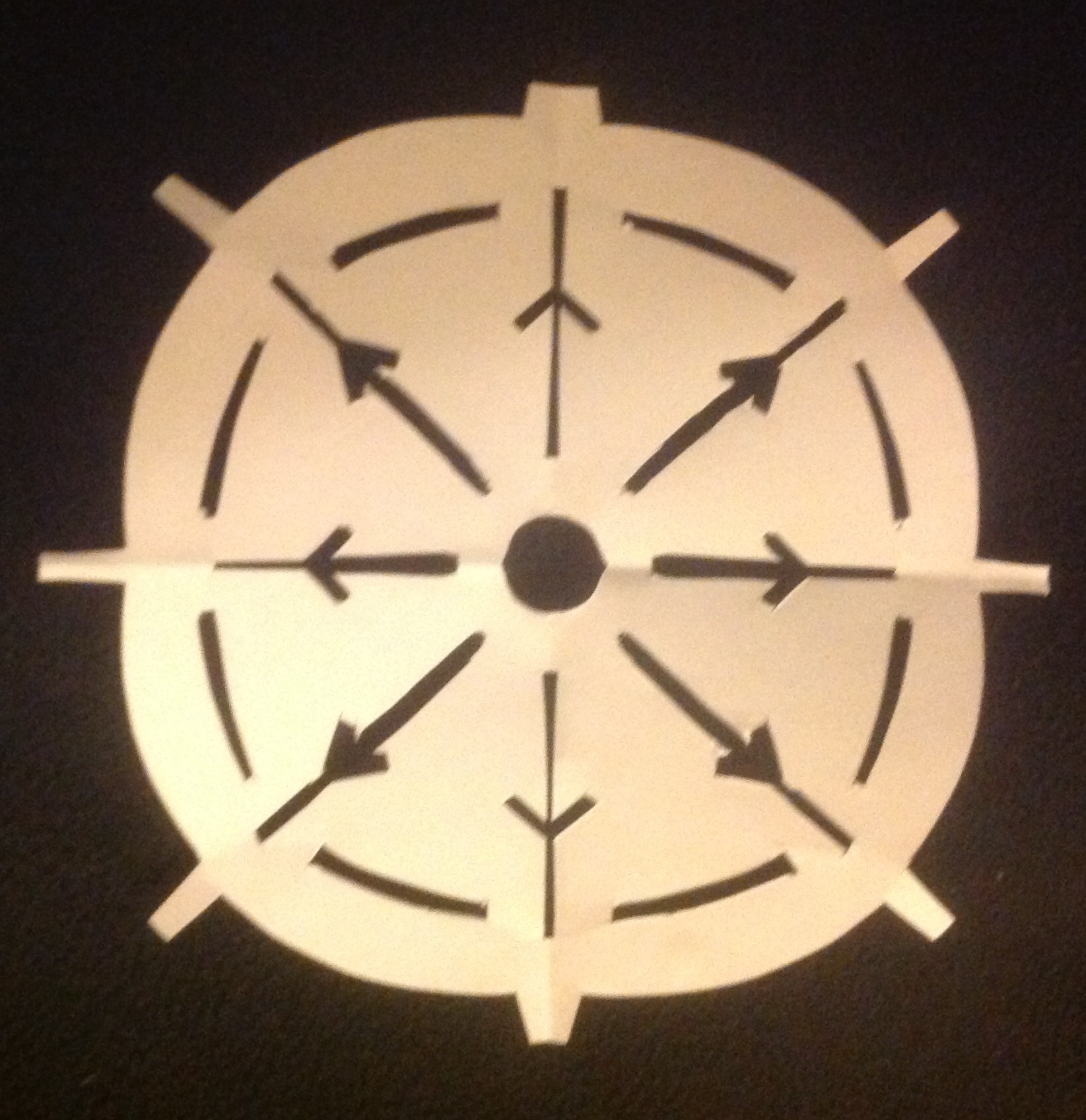
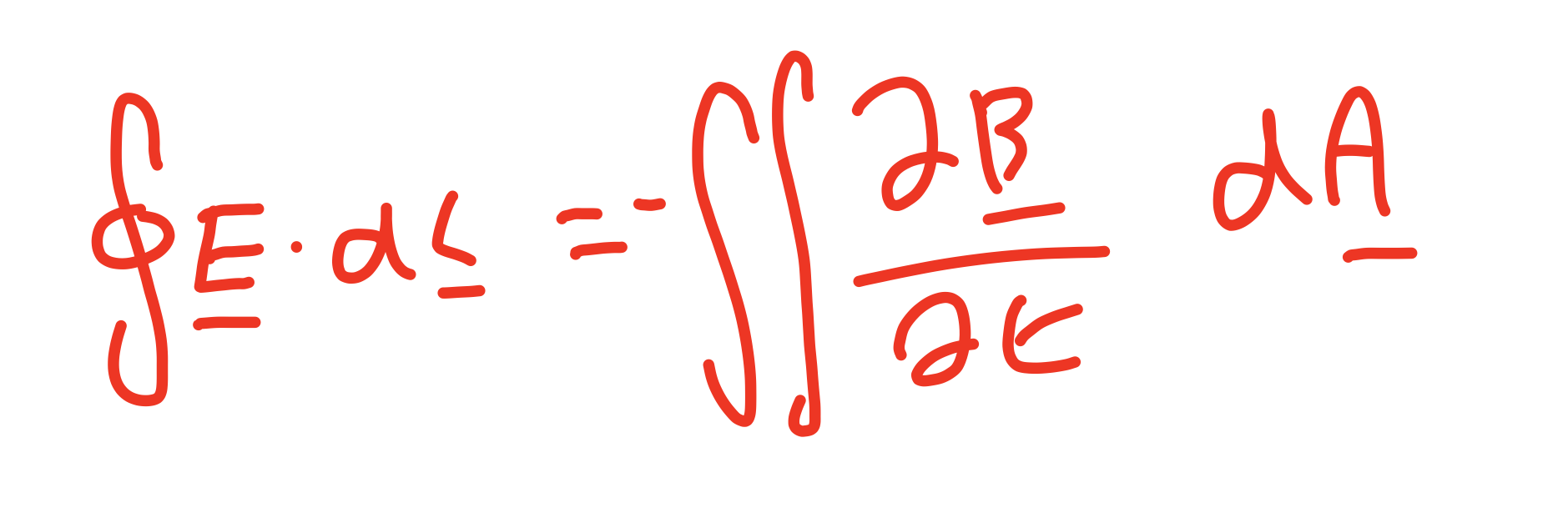
What the snowflake represents is a central positive charge with electric field lines radiating outwards from it (this is the ‘charge’ side of the equations). The circle round the edge represents the sphere you are integrating over, which is the other side of the red equation with the double integral sign on.
In practice, you can use Gauss’s equation to solve a situation where you know the charge (Q) inside a shape, to find an expression for what the electric field looks like. You try and pick a nice surface like a sphere which is easy to write down and in this case meets the field lines at 90 degrees so the maths all turns out easier 😛
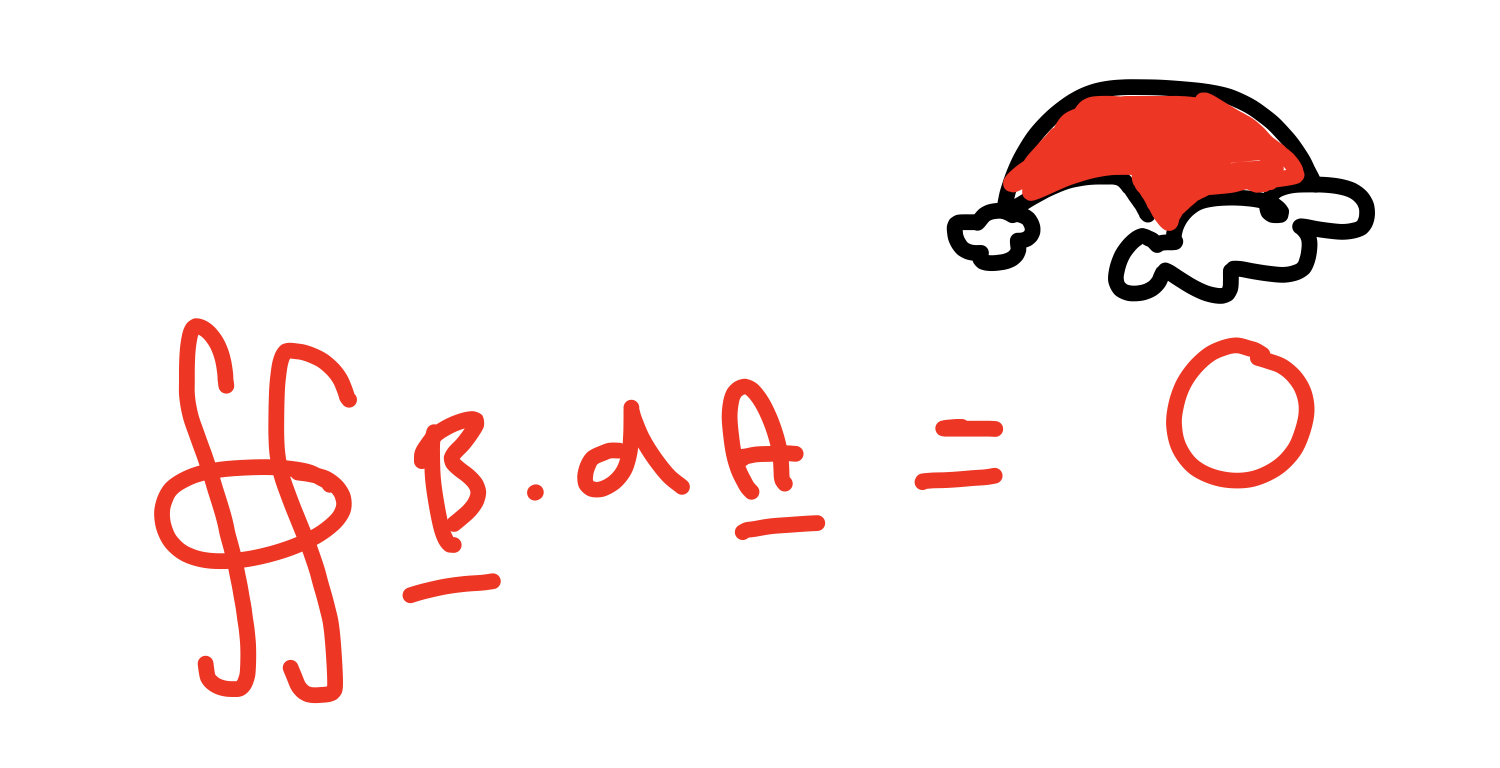
Gauss’s (Santa Claus is coming to town) Law for magnetism
This is always the first Maxwell equation people say when trying to remember them all because it only has one non-zero side 😛
You might think that this makes it a useless equation, but actually it’s pretty cool because it is basically a statement that there are no magnetic monopoles. A magnetic monopole is like having the North end of a magnet without the South end (and it turns out you can’t just chop a magnet in half—that was the first thing they tried :P)
It is written as:
or:
or:
The non-zero side is kind of the same as Gauss’s electrical law, which exposes a difference between electric and magnetic charges. You can obviously have a positive electric charge without a negative one right by it, which is why the electric equation is non-zero.
You can think of it in another way—that electric field lines start and end at the positive and negative charges as you can see from the first snowflake—the lines are starting right at the surface of the charge (well not really as the snowflake would have fallen apart, but in theory!) Magnetic field lines on the other hand, are always little loops. They never start or end anywhere, so when you try and make a nice surface to integrate over like before, you always get the same amount of lines coming into the surface as going out. This means the total ‘magnetic charge’ within any surface adds up to zero, because if you include a north pole (+1) you also have to take in another south pole (-1).
This is what this snowflake represents 🙂 The circles are the little loops of magnetic field lines and the wiggly line joining them is a desperate attempt to make some crazy path that takes in an uneven number of field lines, but of course, fails 😛
Faraday’s (Deck the halls with boughs of EM radiation) Law
This is a law you might have come across if you do A-level physics— it is the first equation on our list to contain both B and E (electric and magnetic fields) and relate the two together.
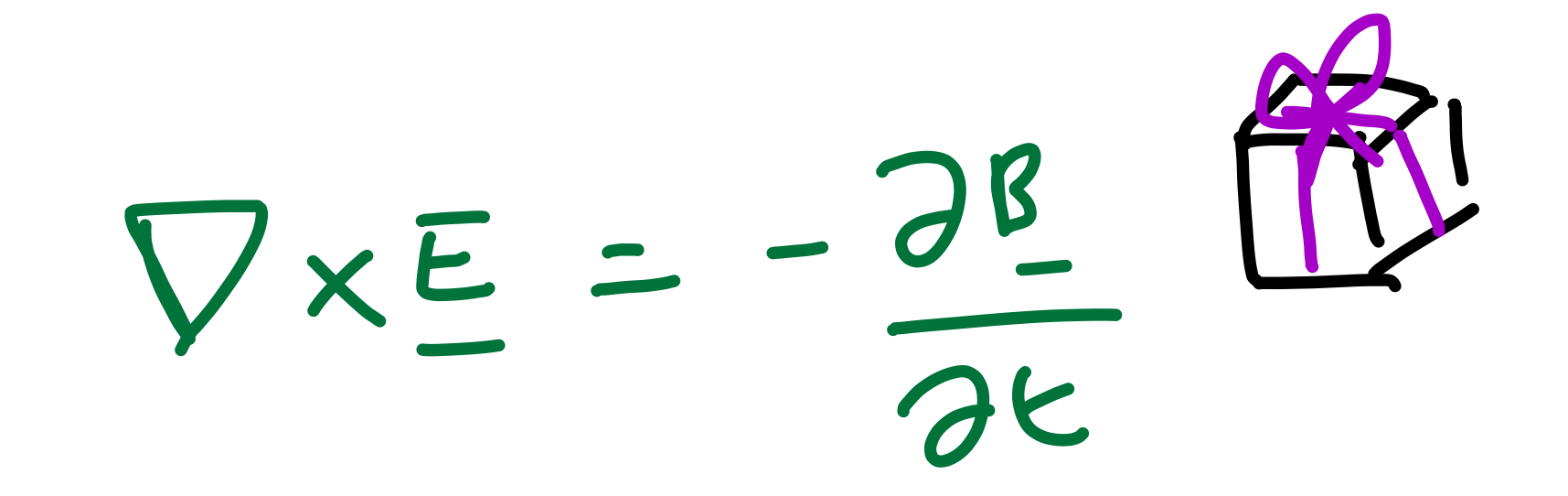
It is written as:
or:
or:
It simply says that if you have a changing magnetic field, then you get an electric field generated. This is probably the most abstract snowflake—imagine time starts at zero at the centre and goes out towards the ends. The expanding circles are meant to be the increase in magnetic field, and the little flicks are meant to be the electric field lines generated 🙂
(Alex was least convinced by this one :P)
Ampere’s (Be merry and mathematically bright) Law
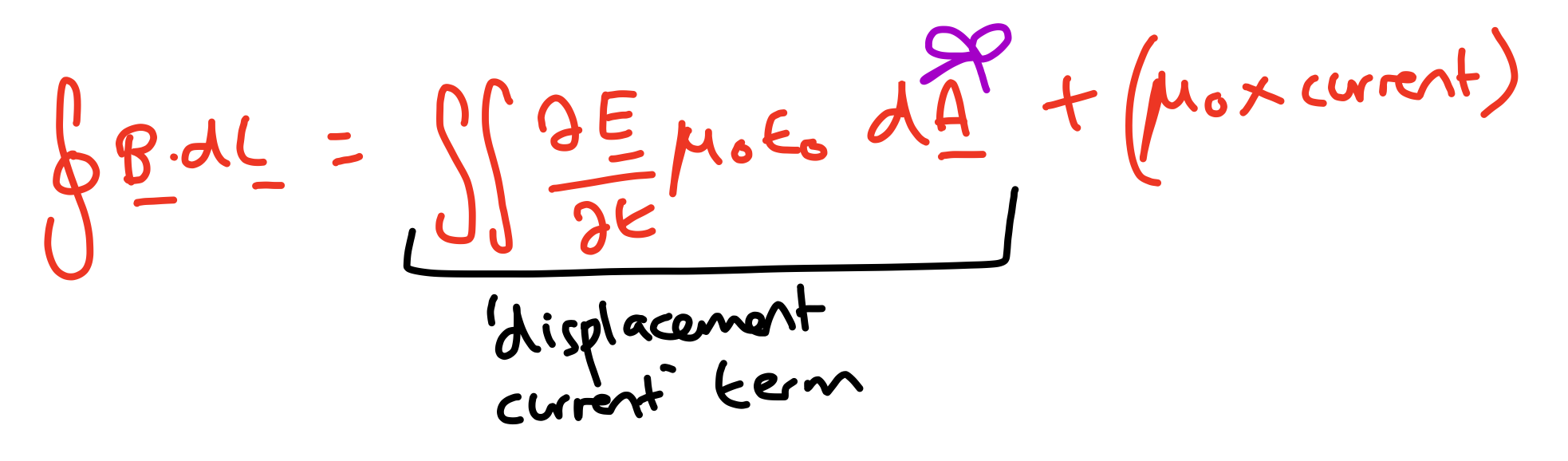
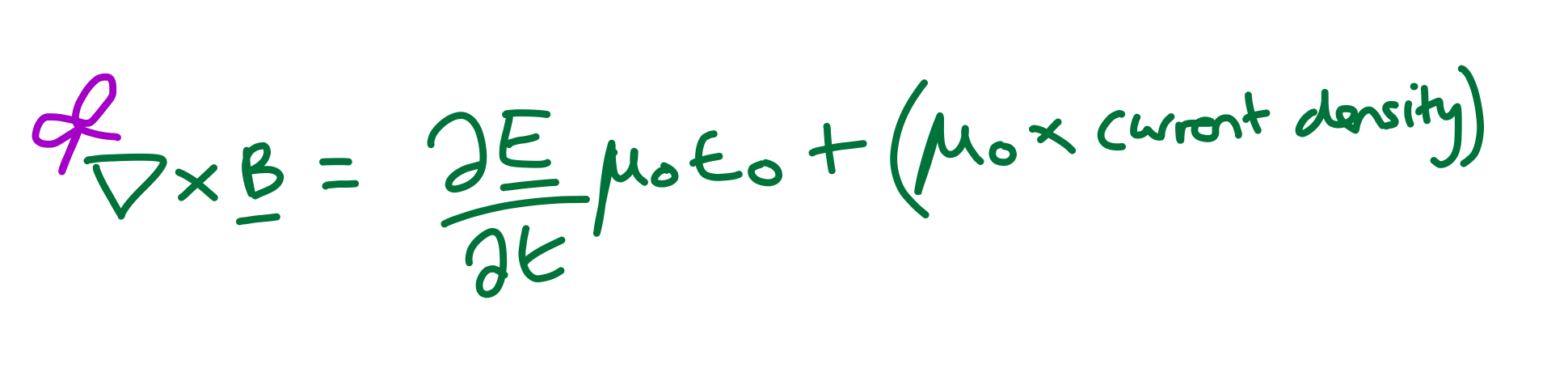
This is the final equation and I’ve decided to go the whole hog and use the full version that has a term to take into account ‘displacement current’—basically a changing electric field.
It can be written as:
or:
or:
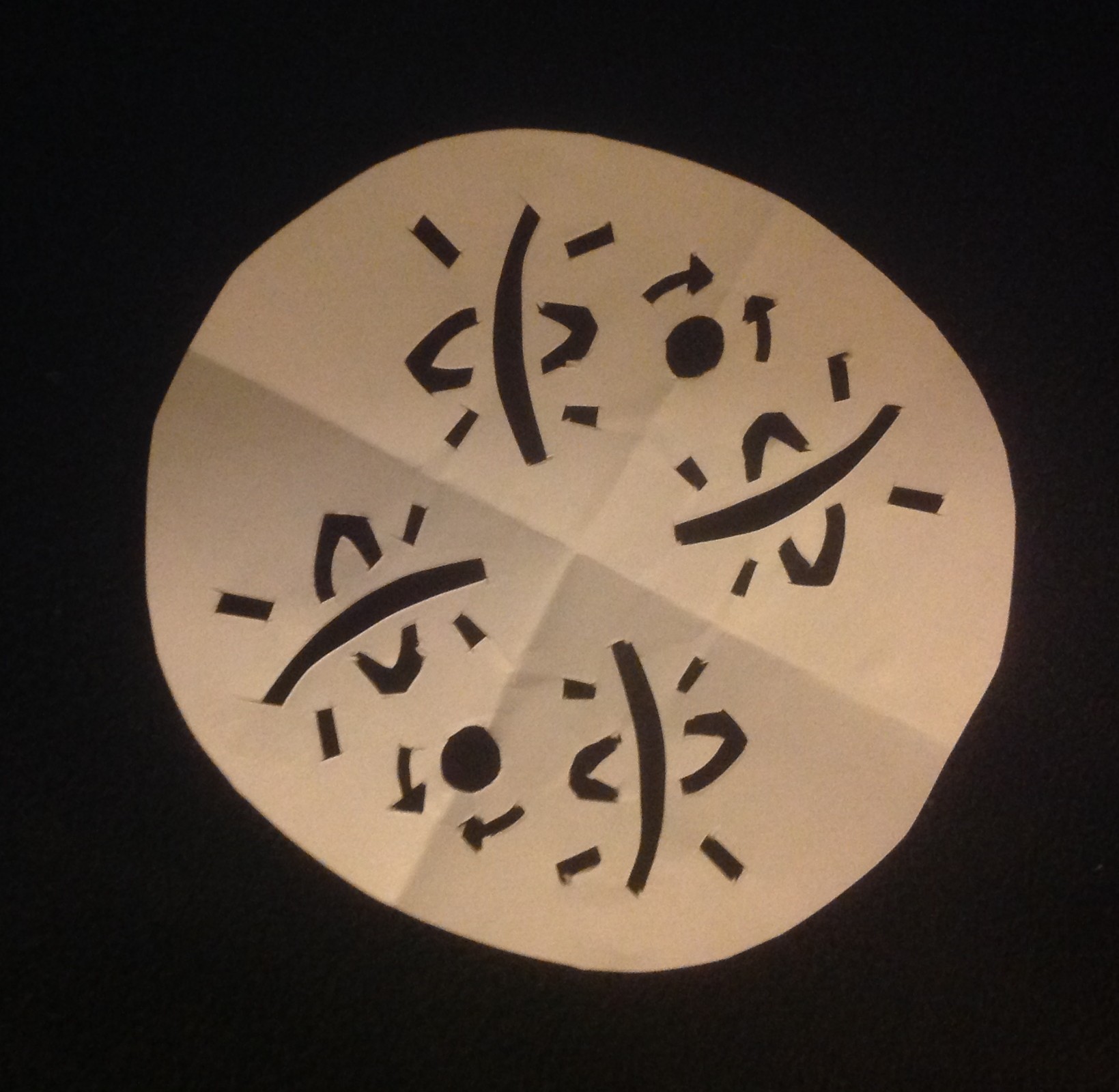
The bendy lines on the snowflakes are wires carrying current (as demonstrated by my signature flicks for the electric field lines of course), and the circle demonstrates the magnetic field that has been generated by the current flow. To factor in the fact we need to be wary of changing electric fields, I’ve put in two little dials with arows which are meant to demonstrate that the electric field is changing…:P
And that’s all of them!
You might be confused as to why I have written out two forms of all the equations… Surely one or the other version would have done? Well, the main reason is that I really like the differential (non-integral) versions, and the two relations you need to change one type to the other 😛
These two relations are called ‘Stokes’s Theorem’ and the ‘Divergence Theorem’ and I’m pretty sure I’ve mentioned them in blogs many times before because they are cool <3
So, in the spirit of Christmas (?) I have decided to make snowflakes to explain these guys too, because maths relations need holidays as well… 🙂
Stokes’ (Oh I wish it could be Christmas everyday [but that’s not mathematically possible]) Theorem
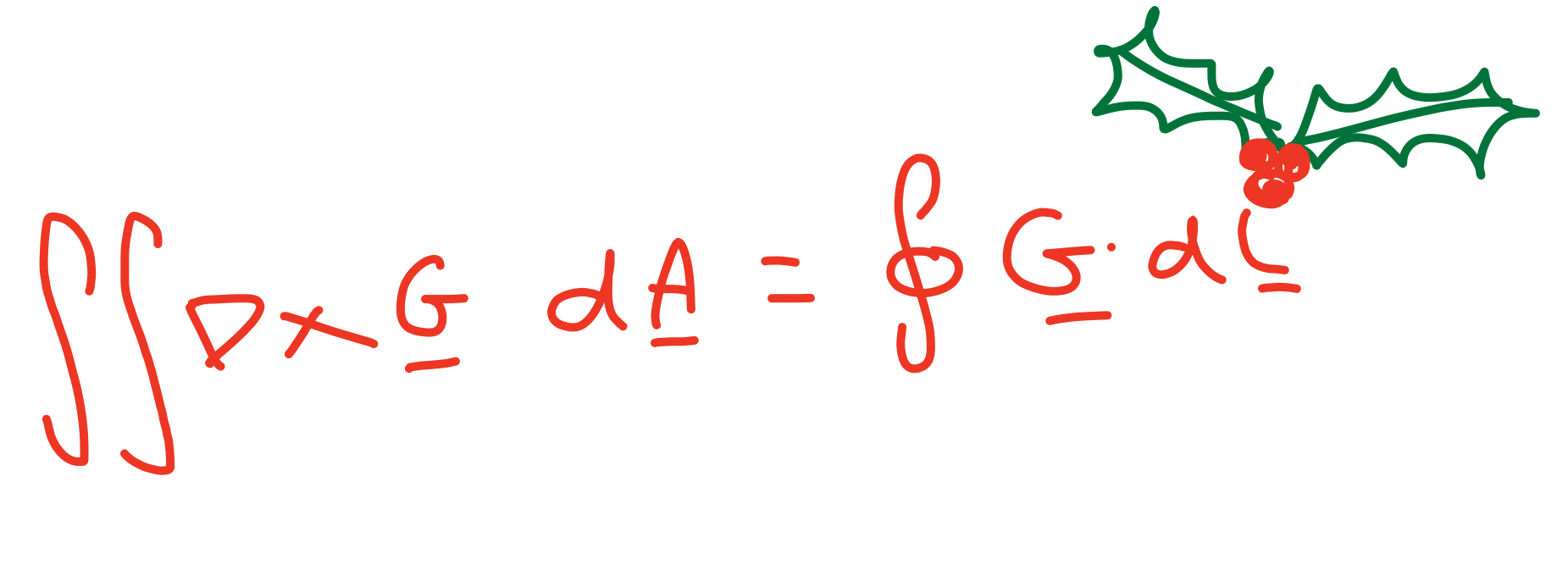
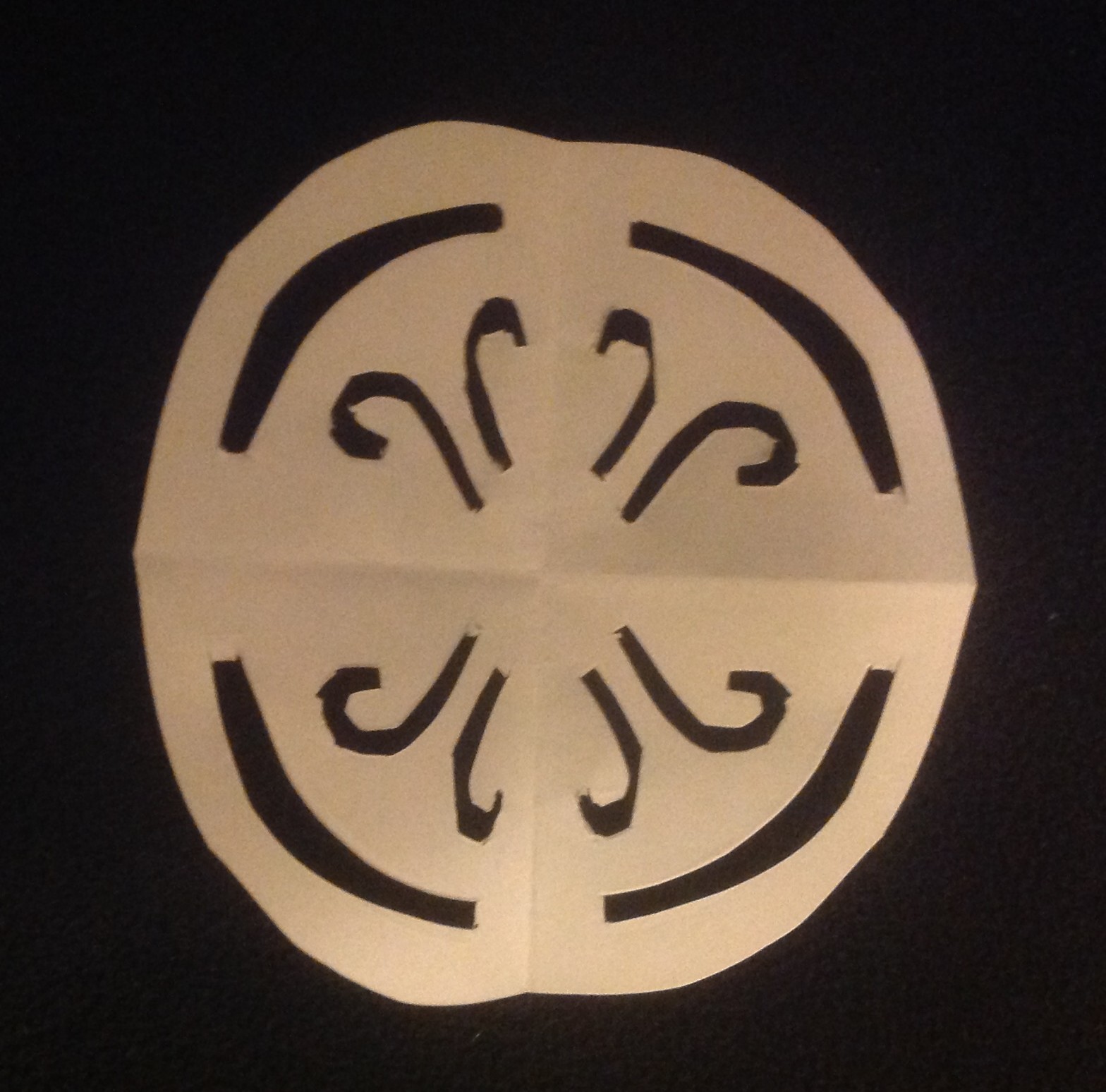
Stokes’ theorem says that if you find the curl (the triangle with the x next to it) of a field—here an electric or magnetic field—over an area, you can also get the same result by integrating around any curve that encloses that surface.
It can be written as:
or:
You can see the curl on the snowflake (the curls in the middle) and also the nice round curve that encloses them. 🙂
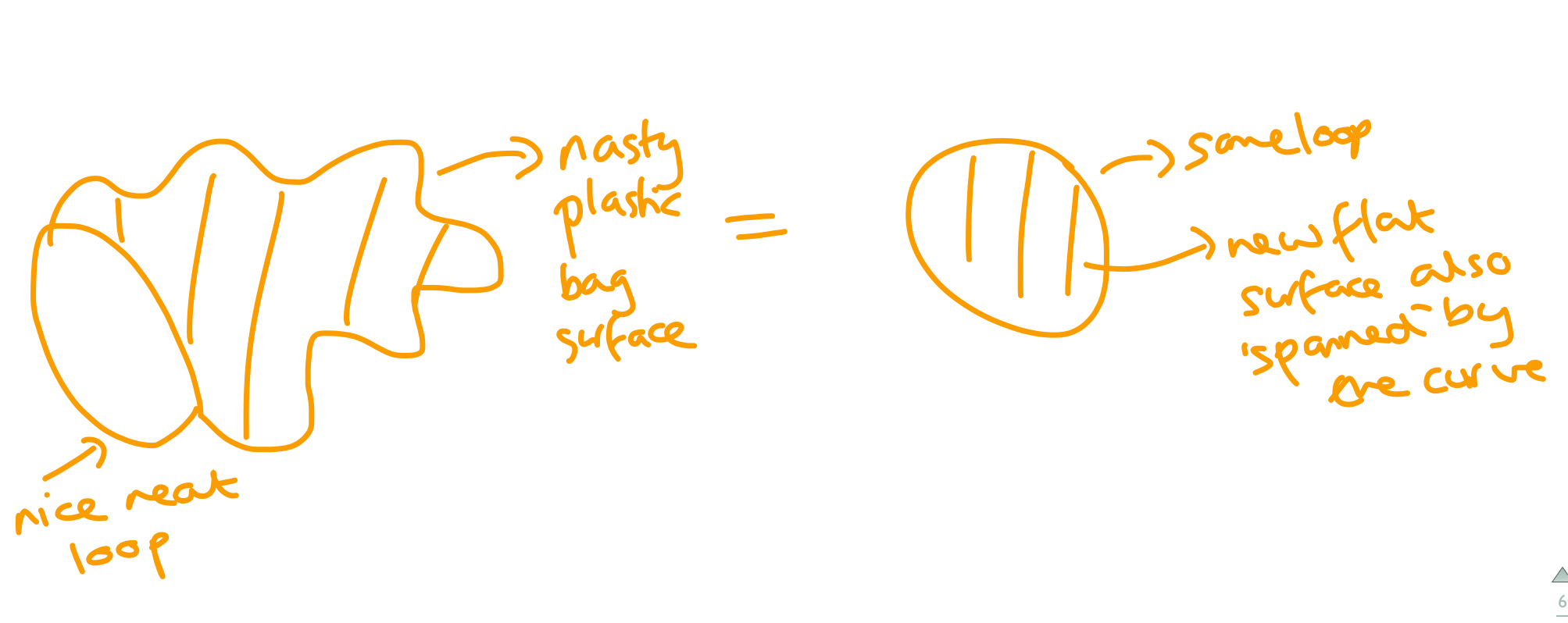
This theorem is pretty crazy because you can have a legit mental surface like a plastic bag, all crumpled up and folded over and be like omg this is going to take ages to write down as an equation… but you can instead just integrate around a nice circle at the opening of the bag that bounds it. Phew.
Also, even more weirdly, that means that that crazy surface must end up with the same result as a flat surface across the curve.
It’s like a Delia Smith cheat’s recipe for Physics. If it ain’t a straight line or a square you don’t want to know. Even with ellipses (squished circle) you usually perform a co-ordinate transform so you can get it back into a circle and breathe easy.
The (Rudolph the 620–750 nm-wavelength-light-nosed reindeer) Divergence Theorem
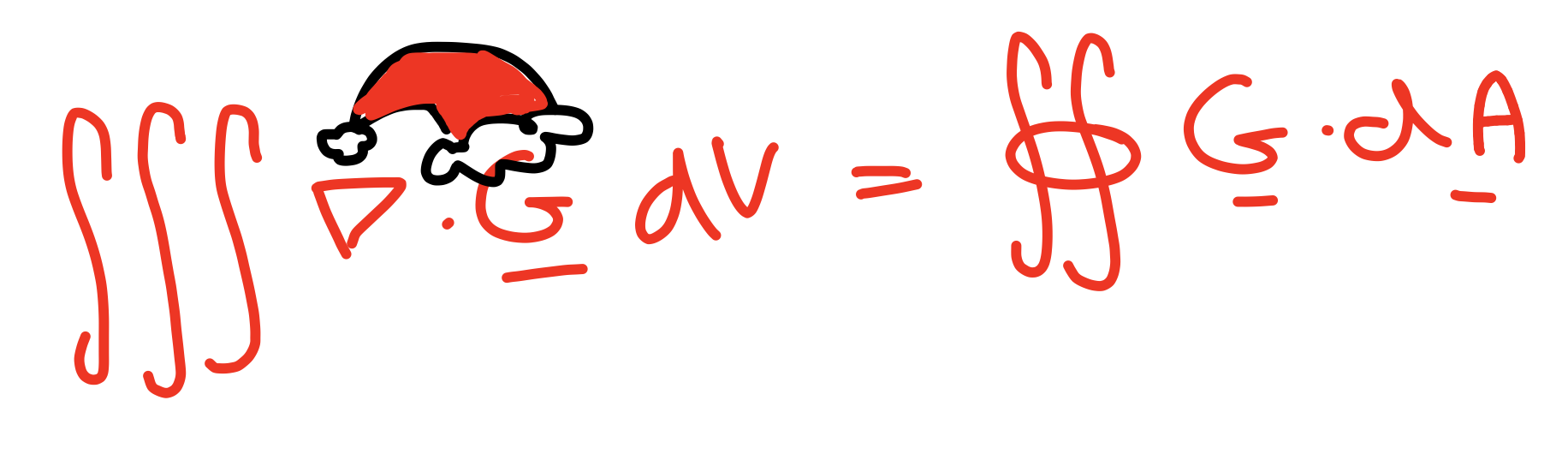
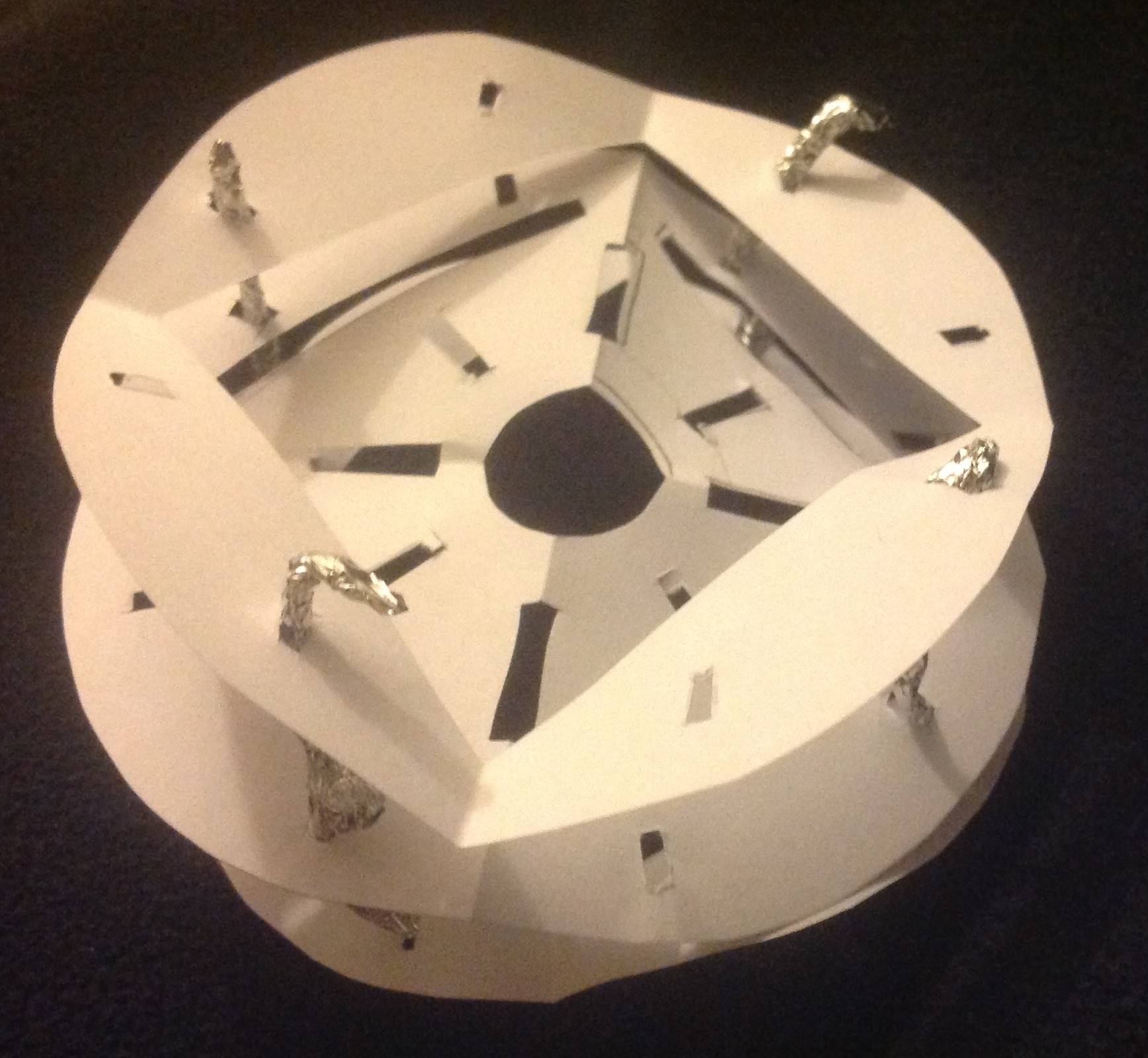
This is my most ambitious snowflake, no doubt. To demonstrate that this one is an integral over a volume, I thought I’d try and make it 3D so I stacked three snowflakes on top of each other. 🙂
It can be written as:
or:
What you can see in the snowflake is a little sun-shaped thing in a box that is putting out rays that are meant to look like they are escaping through the surface of the box.
The divergence theorem says that if you take the divergence (the triangle with the dot next to it) of the electric or magnetic field over the volume, then you get the same result as if you integrate the amount of field lines coming through the surface of the box.
(As you might have guessed you can try this for the magnetic field but you will always get zero [one line going in (-ve) for every line going out (+ve)] so give it up now ;))
Oh, and I also made this Rosette and Philae one, because #2014
The last couple of weeks have been… interesting. To start with the negatives, mice have invaded my house. They have chewed though the sink (!) and broken it, as well as tore up the bin in the bathroom and woken me up in the night with their horrible scratchy mouse feet partying in my bedroom. Our landlord has ordered us some electronic mouse repellers which I am slightly sceptical about so I have ordered in addition a whole host of things designed to get rid of mice.
I would like to do an experiment to see which ones work as they have so many mixed reviews, but the fact they are in my bedroom adds a level of urgency and drives out all thoughts of being a good scientist, so I will be deploying all methods at once!
Student houses in general can be quite depressing—the house we are in this year is theoretically very nice but it is obvious that no one has taken care of it for years and years, and is also literally the dampest place I have been indoors short of a swimming pool. You have to wipe water off the walls, and I’m pretty sure there are moulds on my roof that are unknown to man. Mind you, I do realise that I am in a very lucky position being able to rent any kind of house in London at all, so I am completely thankful for that, and will try not to moan!
In other bad news, Foundations of Quantum has (some [everyone] would say predictably) got completely incomprehensible these past few lectures. Unfortunately, I have no one to blame but myself for taking this course, but will keep telling myself that once I get it, it will be brilliant. I hope… 😛
Good things i: ACP, Satellites & Solar Storm presentations
Now for some more positive stuff! Advanced Classical Physics is still as mind blowing as ever. When I am revising it over Christmas I promise to write loads of blogs on why it is so cool, and explain where Newton’s laws come from and everything.
I’ve also joined the PR team for an Imperial group who are building a satellite that will be able to detect the position of distress signals to within a metre precision from anywhere on the Earth. Everyone working on the project is a student at Imperial, which is pretty amazing. When their website goes up I will definitely link to it, and tell you more as I find out the details of the design—I am meant to be PRing after all 😛 The deadline for launch is in two years, so I will actually have left Imperial, but will be desperate to come back and see if it has worked!
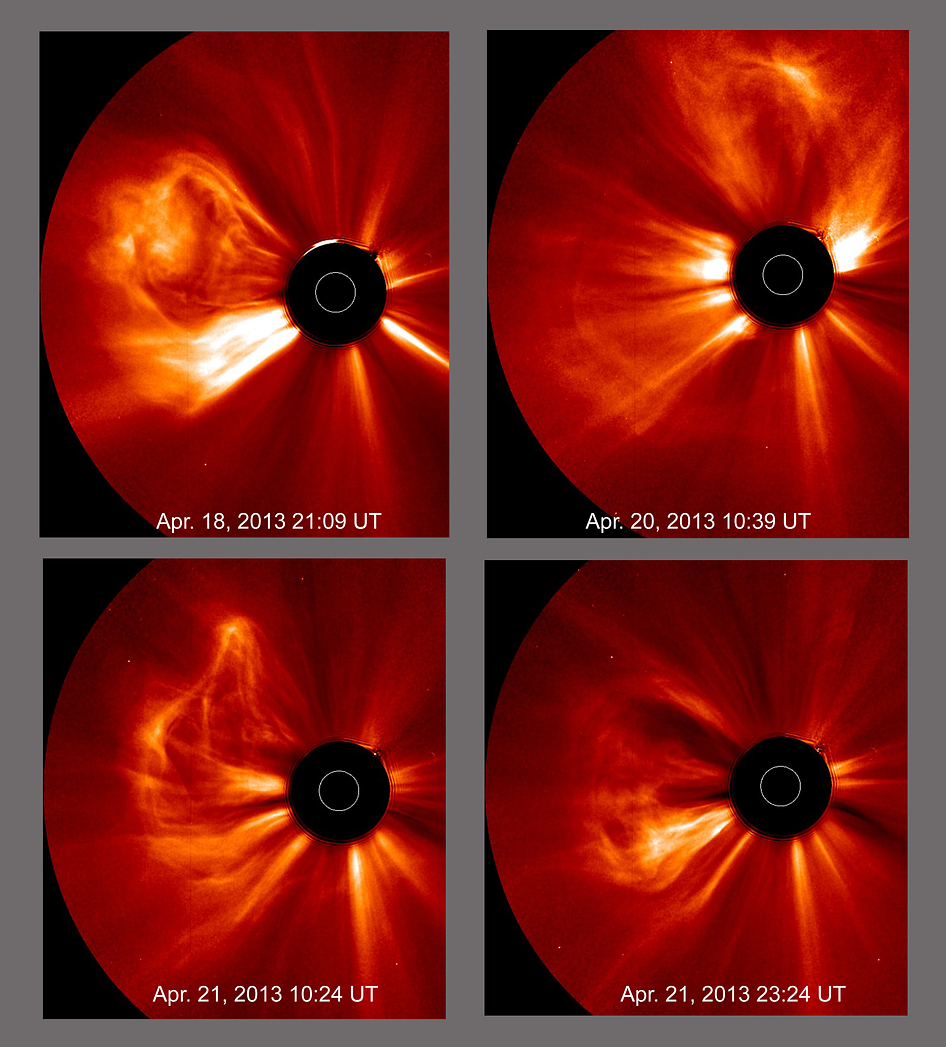
Coronal Mass Ejections! Credit: NASA http://www.nasa.gov/mission_pages/sunearth/news/gallery/CMEs_galore.html#.VIsVXjGsWSo
A couple of weeks ago I had to do a ten minute presentation for the professional skills module this year. I was initially pretty nervous as ten minutes alone talking on one topic seemed like a long time, but as soon as I started writing down ideas I realised it would actually be difficult keeping it less than ten minutes. We could pick any topic we wanted to talk about—the idea was to base it on a long article in Physics World or the Scientific American. I picked this article about the effects of a solar super storm on earth to talk about, because a potential catastrophe always keeps people’s interest!
(You have to be a member of the Institute of Physics to see the article by the way—this is free for Physics students of any age and worth signing up for!)
Anyway, my talk went well in the end I think 🙂 Everyone else had some pretty interesting ideas too—I heard talks on the Physics of Cocktails, how fast could Usain Bolt run, exoplanet detection, the struggle to accurately measure the radius of the proton and a whole lot of other cool things. It was a really fun morning in the end actually.
Good things ii: Science London & The Hobbit
With Science London I helped out at another event recently—this one was again about the science of sex and attraction (I promise I don’t try to only pick events about this) and was held in a very tasteful sex shop in Central London. It was actually a great idea for a science event because it got a whole different audience thinking about some of the scientific research that is going on and how it is carried out. The event was sold out, and had two great speakers—the first talking about a website that she had helped create designed to encourage the use of contraception, and the second talking about the National Sex Survey which was a massive project carried out all across the country.
The most interesting thing about both talks I thought was their focus on the methodologies involved in targeting the website to the audience, as well as the rigour with which the survey had to be carried out—it cost multiple millions of pounds to do, and gave some pretty interesting results. If you want to find out more about it is being included in the Wellcome Trust’s new free exhibition: The Institute of Sexology, which I really really must go and see. 🙂
Also last night I went to the midnight viewing of the new Hobbit film: battle of the five armies. It is so good! The cinema was practically empty though, so not exactly the massive hype you might expect from a midnight viewing, although there were no adverts… 😛
I’ve been taking part in a Bloomberg journalism class over the past couple of weekends, and this week the homework was to write a blog about our real passion: what we would still spend our time doing if we had all the money we wanted. As you might have suspected, mine is science, so this seemed like an ideal blog for me to post here as well…
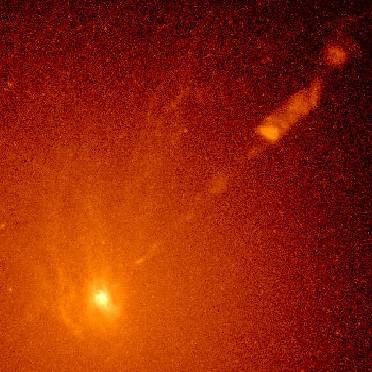
Super-energetic super-massive black holes spinning billions of light years apart, from across opposite ends of the universe, seem to have somehow aligned themselves. Time freezes as your spaceship approaches such a black hole.
A quasar! Credit: Space Telescope Science Institute
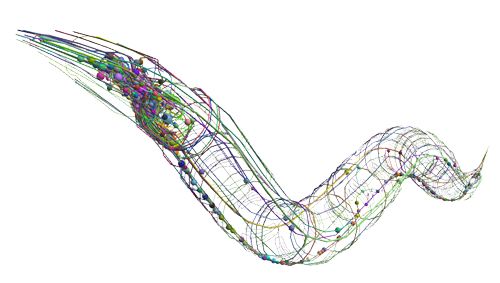
A digital worm is currently being created that will be an exact cell-for-cell copy of the real thing.
Is it possible to teleport yourself from one place to another?
Is it alive? Credit: http://browser.openworm.org/#nav=0.3,-0.83,20.72
What all these things have in common is that they are all science. They are also all things I have learnt about in the last week, some from my degree and some from outside reading. They are also all really, really exciting.
Science is more than just a list of cool statements and questions though. It is a whole complete and rigorous way of thinking that will allow you to give the best possible answer to any question thrown at you, be it ‘how many molecules of water have passed through that T-Rex’s fossilised footprint?’ or ‘how exactly is the floor holding us up?’
I think science is the most exciting and important discipline of all time, but especially so in recent history. We are living in a world where everyone has computers in their pockets, is connected to every person and all information at any time, using robots constantly held in free-fall around our earth, a world where people without legs can run on super advanced prosthetics, a world of vaccinations, where child mortality is dropping lower and lower.
All those things came about because for thousands of years we have been trying to understand the world around us, and because science works.
Even given all that, saying that science is the most important human endeavour is controversial. And of course, it can’t exist in a vacuum- philosophy and art and empathy are still necessary and fun, but none of those things could have made the Internet or been able to recreate a living worm from scratch. I love to read and write, but no novelist has the imagination to dream up facts and scenarios more extreme and brilliant that those that science can reveal.
And the great thing about science is that it isn’t subjective—a model might be superseded by one that takes into account scenarios not thought of at the time, but if an experiment or an equation is proven, it can be repeated by anyone, anywhere, and at any time in the universe. (Or, at least in theory: some people currently considering burning their lab books might disagree with me.)
It turns out that the facts are really quite nice ones too. Take even something trivial that you might have learned in school – Newton’s laws, for example, that you might remember as the whole F= ma rubbish and endless particles rolling down endless slopes.
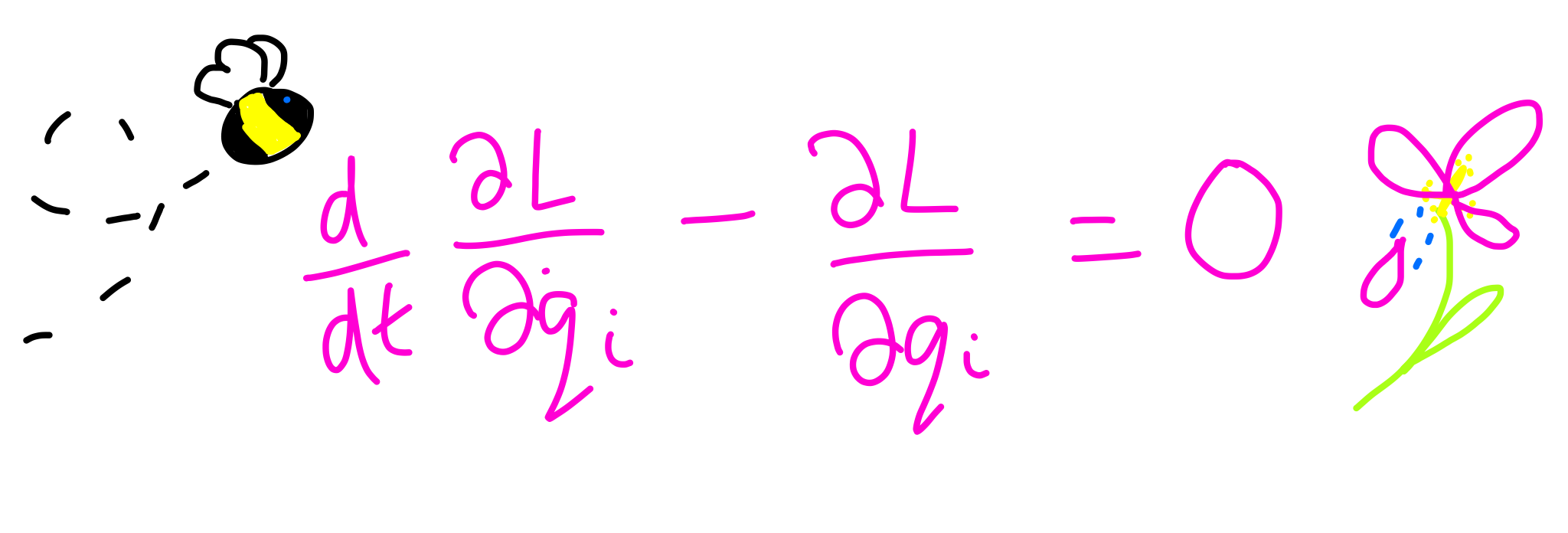
Well, it turns out Newton’s laws and so the equations that describe pretty much everything you can see happening around you right now, can all be derived from this simple statement: ‘stuff is lazy’, or more scientifically ‘an object takes the path from time a to time b and position c to position d that minimises the action’.
That statement can be expressed even more simply in this line:
Credit: Me & Lagrange (mostly Lagrange) 😛
Using those few symbols (minus the flower and the bee) you can fire a missile that will land with accuracy on your enemies, or set a pendulum in motion in such a way to prove that we are on a rotating earth spinning at over a thousand kilometres an hour. And a lot of stuff in between that too.
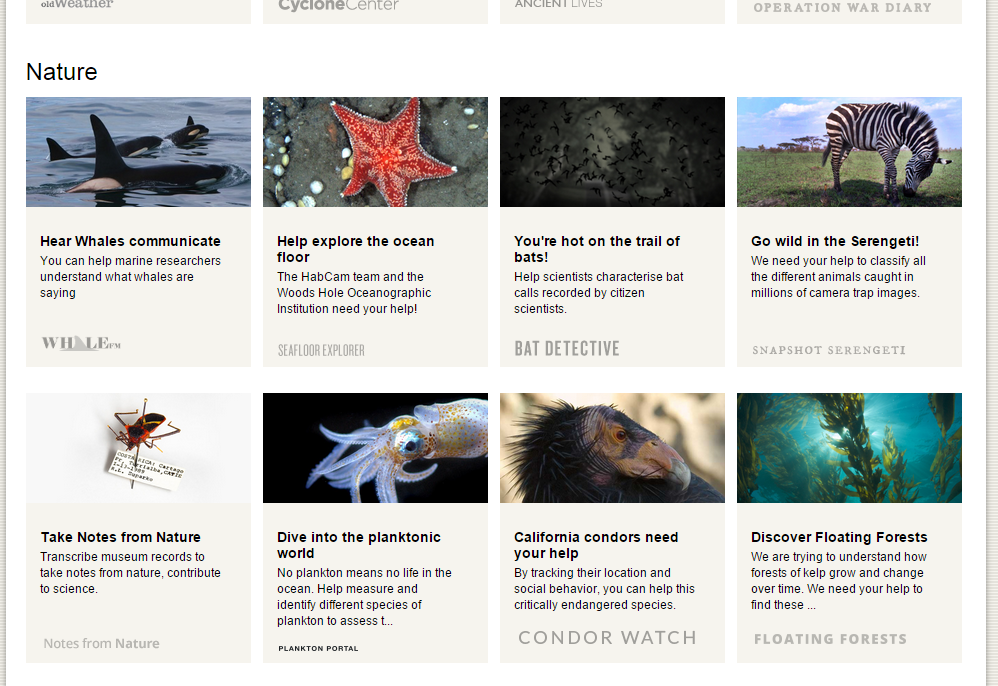
Another great thing about science is that has something to offer everyone. Its whole ethos seeks to improve and better itself, and it encourages people of all ages and talents to ask questions and think for themselves. Anyone can contribute to big science projects with hugely ambitious goals online in citizen science projects where you can discover exoplanets or help machines learn what cancer cells look like.
Zooniverse Credit: https://www.zooniverse.org/
Also I’ve been to loads of science events and seen people cutting up hearts, playing with magnets, chasing people who are dressed up as cancer-killing cells and playing the piano while a robot drums. Science is sufficiently robust to put up with people taking a relaxed and playful attitude towards it— it doesn’t need to be put behind a glass case and only commented on by people who feel suitably well-versed in Post-modernist sculpture (for example :P).
Science has created some of our species’ most memorable moments— be that walking on the moon, or discovering just how remarkably similar our genetics is to every other species on the planet. It requires only a willingness to improve and change your mind based on the evidence, and determination to follow logic. And it is the closest we can ever get to the truth of anything, our best chance to understand our place in the universe and just what it means to be human.
Further reading of exciting things I mentioned 🙂
See a future blog of mine for more on the derivation of Newton’s laws 🙂
Quasars aligned from opposite ends of the universe: article, and paper
So, the other day I had my first comprehensive tutorial. I’ve mentioned them before—they are the two three hour papers on the last three years of Physics that strike fear into everyone’s hearts. Since the start of term I’d heard people discussing their revision plans for them, which is always a terrifying conversation to overhear, especially when you haven’t even looked at a paper!
Comprehensives are actually supposed to be a selling point of an Imperial Physics degree I think, because they are all about whether you actually can do Physics not just remember stuff for a one-off exam. Of course, that’s what makes them scary—I think to some extent everyone thinks that their good exam results are a very improbable fluke—or maybe that’s just me… 😛
Anyway, the paper we looked at in my first tutorial was actually much less scary then I expected.
There are ten questions and you only have to answer four, so you should be able to avoid your particularly hated topics (although the questions do mix the courses up quite a bit so you might get a nasty shock half-way through!) My tutors are also both great. The real problem with them seems to be in terms of time to revise all the relevant topics—because it contains material from literally all the past core courses. I am actually looking forward to going over things like thermodynamics and differential equations, but when exactly I will fit those in on top of my current state of not keeping up with my current courses…. Hmm. I think a regular >6 hours of sleep is an impossible target for this year.
More cheeringly, this week I also went to my second London Forum for Science Policy Think-tank event. This was called ‘how to write a policy paper’ but also featured three people who worked in policy and told us about how their jobs worked and gave a little more insight into the world of politics and policy. It is a strange one.
The people who actually write policy—who are constant whichever government is in power— have to deal with the regular replacement of the ministers who are their bosses, and who all have their own ideas and their own agenda, that may or may not be in line with evidence, or indeed any kind of rational thought.
An example of this is Chris Mullin, a labour minister under Tony Blair who was environment minister, as well as other things, but whose greatest ambition in his career was to outlaw Leylandii—a type of fast-growing hedge.
A thing that struck me about the descriptions of the world of policy was the complete lack of scientific rigour about the process. Though evidence is gathered from Think tanks and academic literature on policy topics, anecdotal evidence from people who might be effected is apparently usually given a higher priority. The policy paper then has to be carefully worded so that any Leylandii hating minister will give it consideration. Then whether it actually goes through is a case of if the minister wants to put that particular policy to their name or wants to lay-low and not decrease their popularity before the next election. In addition, both civil servant speakers said that the assessment of policy—seeing quantitatively whether it has worked or not—is a relatively new idea, and is still not done in any great detail.
Despite this, one of the speakers had said earlier that in his opinion most policies did have positive effects. That seems like kind of wishful thinking, to me—how can he be sure of that if there is no data gathered? No-one can see how a policy effects everyone in society, or even a representative cross-section. This is obviously a very biased view of mine coming from a science background, but it seems absolutely loopy that for hundreds of years we have been happily bashing out policies effecting millions of people that no-one has actually bothered to check if they work or not…
However, if enough people want a change in policy, and if there is evidence to back it, I suppose it will eventually get changed. A recent report published about drug policy is an example of this.
This finally admits that our drug policy has been directly going against the evidence for years. Policy moves slowly, but I suppose it has to, because otherwise no one would know whether they were coming or going.
It was also interesting to note how the civil servants were almost apologetic about what they did, saying often that the process of policy needed to be improved—to get greater feedback, to have more authentic conversations with experts, and to generally get more bottom-up policy ideas rather than just ideas from the government.
The next step for the Think tank is for people to write policy papers of our own. I am not sure yet what areas I would like to get involved with, but the process should be a great insight into how things actually get put into legislation.