Over one year into my PhD now, and I had been hoping to blog a little reflection on this but things have been rather hectic! Instead here is a look back to some more earthworm fieldwork I volunteered on in November 2013, digging holes in Somerset and Berkshire.
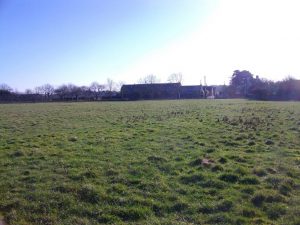
For eight days in November I returned for more earthworm survey work with the Natural History Museum Soil Biodiversity Group, this time in Somerset and Berkshire. A small team of volunteers this time, just myself and long-time SBG volunteer Irfaan, travelled first to the Somerset site to continue work started the previous week. We had been informed the Somerset site was the most beautiful yet but when we arrived on Monday the fog was so thick we had to take David’s word for it! Thankfully, by Tuesday the sun had returned to reveal a superb landscape, the countryside you imagine from hundreds of years ago, with little patchwork fields fringed with ancient hedgerows.


What a difference a day makes in Somerset
Four fields are sampled per farm, covering a spectrum of management intensity, such as how often the field is grazed, how much fertiliser (animal or artificial) is added and whether it has been ploughed or used for crops in the past. The field we worked first was the lowest intensity field at the Somerset site, not surprisingly as it was some distance from the nearest track, was steep and had springs running through it. This field had never been ploughed, giving an odd feeling of being possibly the first people to disturb the soil. It also had the biggest Yellow Meadow Ant (Lasius flavus) mounds I have ever seen!

Horse battered Yellow Meadow Ant (Lasius flavus) mound, at least two foot tall
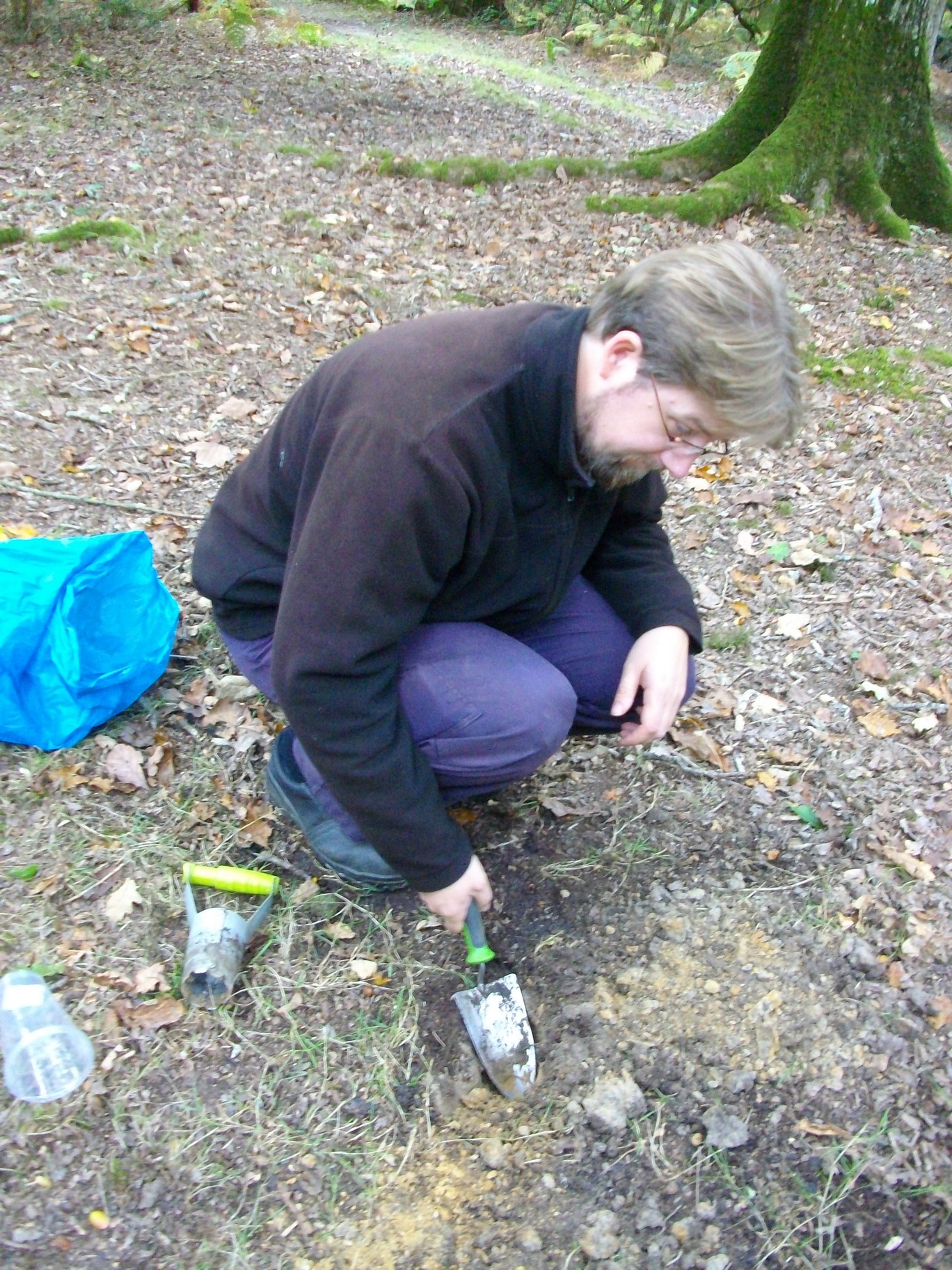
Digging and coring in Somerset, quite possibly the first time the soil has been broken by man!
For a change from sheep and cows the fields at the Somerset site were grazed by Shire Horses which noised around us and the kit expecting food and generally being a distraction, having to be chased away at intervals. As handsome as the Shires were, I was more excited and distracted by the lovely Noon Flies (Mesembrina meridiana).

Dipterological distraction: Noon Fly (Mesembrina meridiana) in Somerset (thanks to Georgie for this photograph from the previous week’s visit)
Within each field a bare minimum of 18, preferably 20, samples are made. Half of these are located at random using a combination of a randomly chosen direction and distance. The direction is decided using a super scientific method of David spinning around.
If he had fallen over I could have bagged £300 pounds!
It is double blind so that some else who is not watching calls out when to stop, although this sometimes has to be done a couple of times if the random direction is in an unsuitable place, such as too close to the edge of the field or trees which may have different micro-environment to the rest of the field. The distance from the previous pit to the next is then determined by a random number table. The rest of the samples are coverage pits which are spread out over the field.
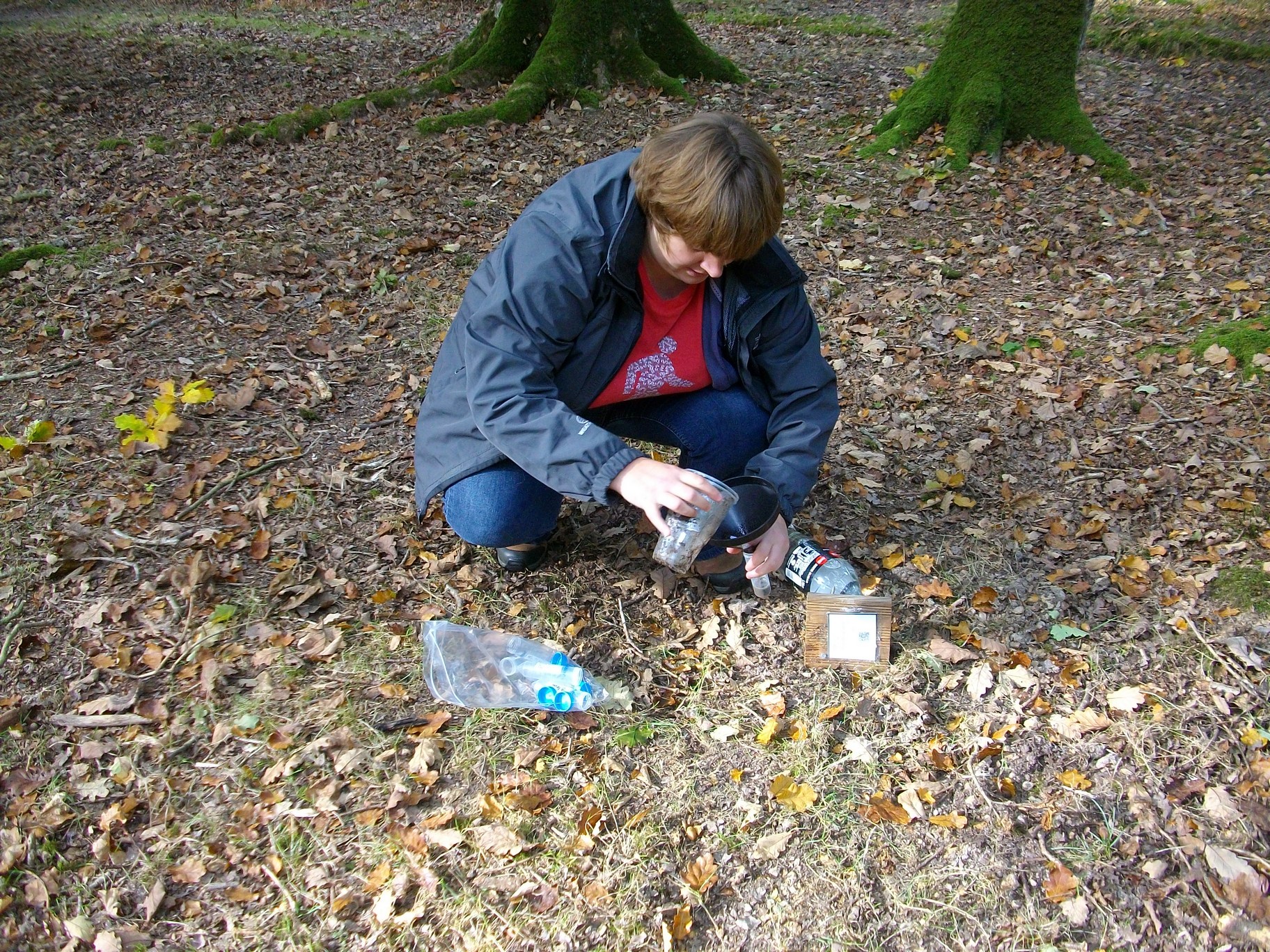
Once the location is marked with a flag it’s time to start over again taking measurements, digging a pit, taking samples and hunting for worms!

Irfaan and I intently sorting soil for worms
On this trip we came across one of my favourite species of earthworm, the Blue-grey worm (Octolasion cyaneum), this is the UK’s largest species of pale earthworm and is often a pretty bluish colour, with a yellow tail, but we did not get many of the big anecic earthworms that emerge after the mustard solution is added.
Blue-grey worm (Octolasion cyaneum)
On Thursday we left Somerset for Berkshire, unfortunately still with a field left to finish. The site in Berkshire was the Organic Research Centre Elm Farm.

Excitingly the very first pit had a bumper crop of the UK’s largest earthworm – Lumbricus terrestris emerge when the mustard solution was added, some were bigger than by baby snakes at home! Could this be because of higher organic inputs in this field than Somerset? The statistics will tell us in time (hopefully!).

Lumbricus terrestris expelled by mustard solution
Oh and yes the mustard solution is often made up in our hotel rooms, if your next stay has a whiff of Colman’s, maybe the SBG have been there!

Must get on with planning my own fieldwork!
Read Throwback Thursday – More earthworm bothering (November 2013) in full