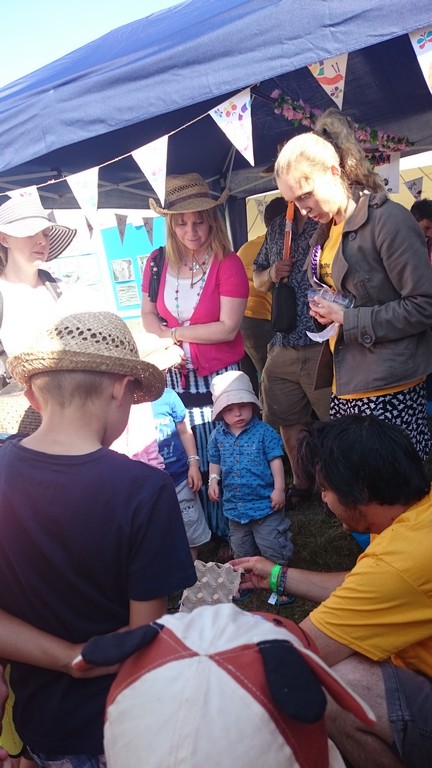
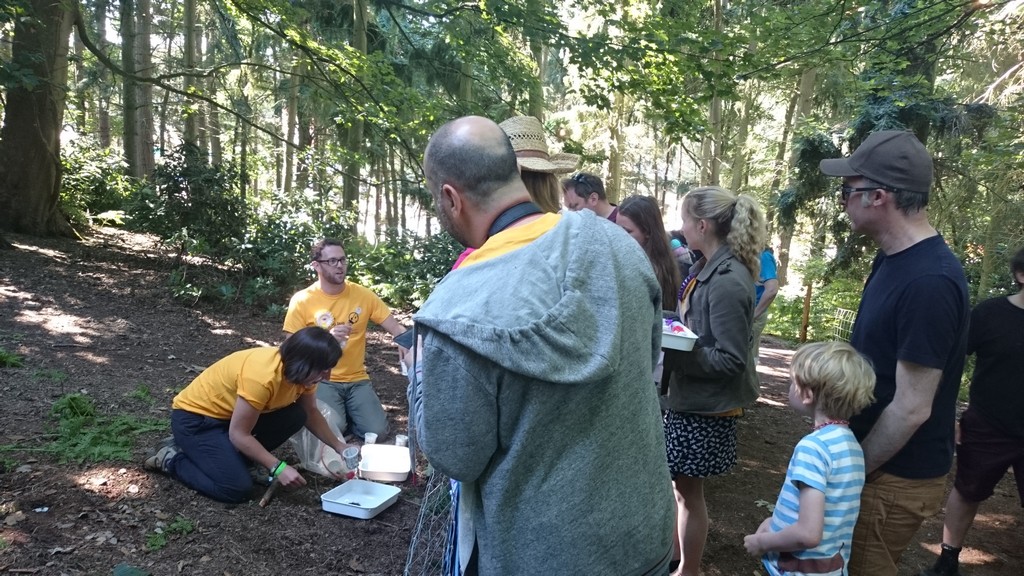
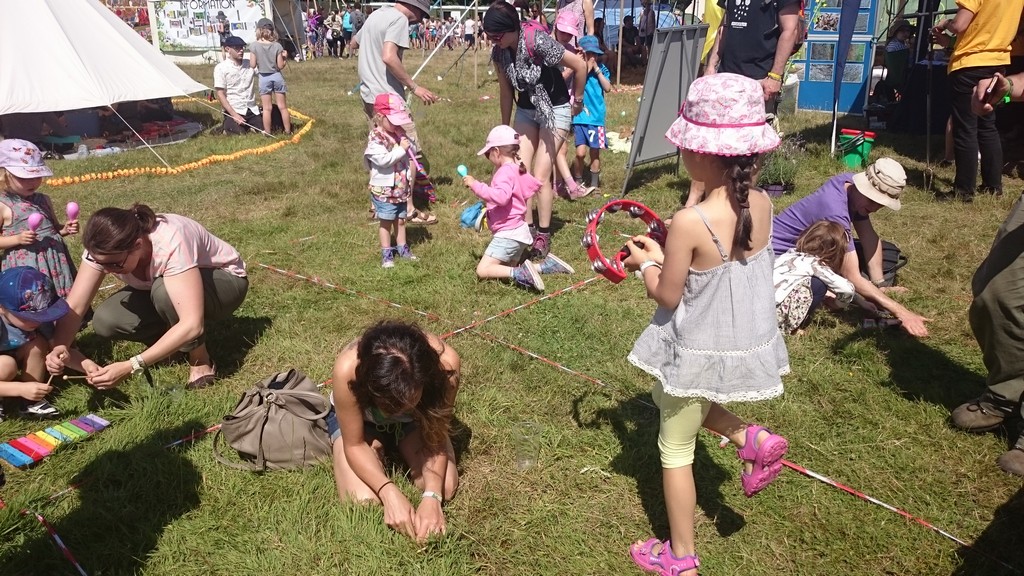
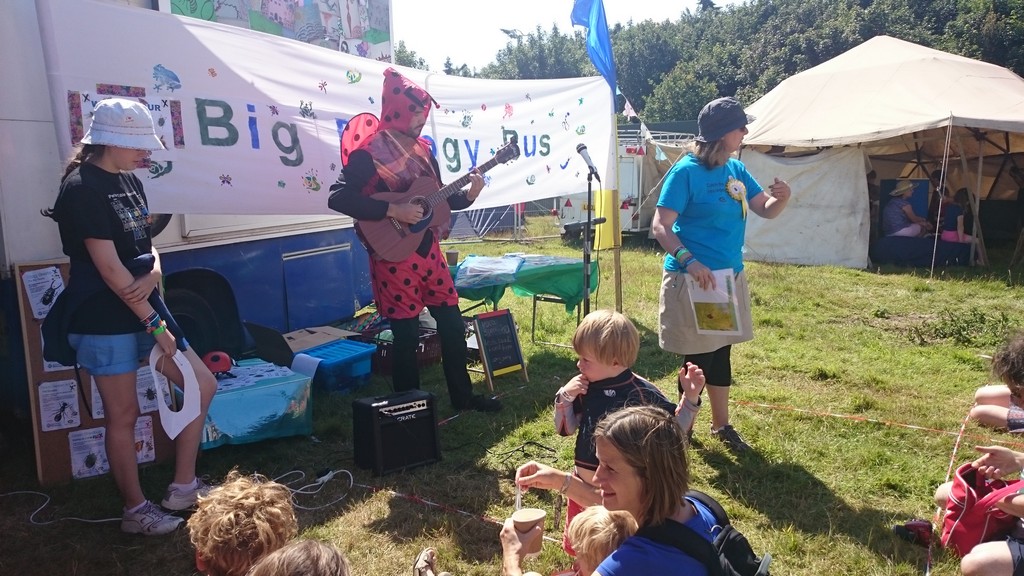
This weekend I was back at The Regent’s Park helping with their project Mission Invertebrate. This project is funded by the People’s Postcode Lottery and is investigating what invertebrates live in The Regent’s Park and how this relates to where the Park’s hedgehog population lives.
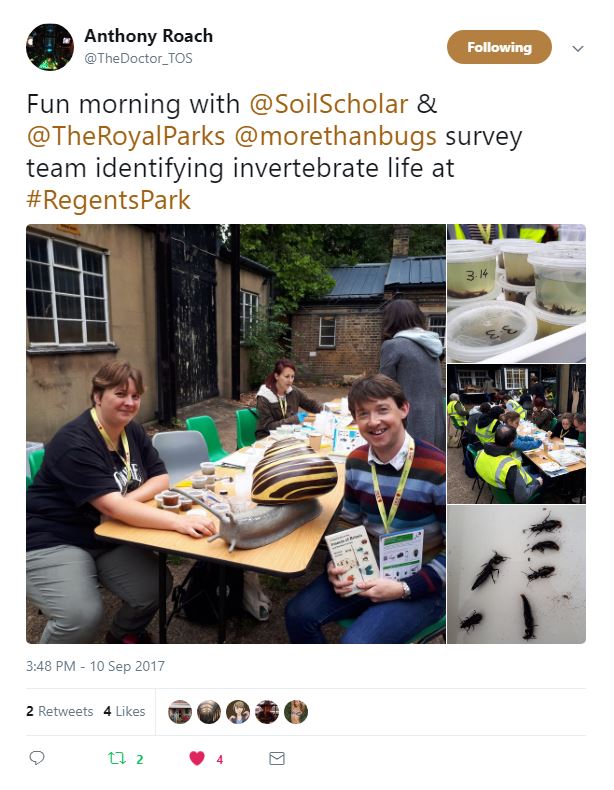
The project is a citizen science project – members of the public have been recruited to take soil cores, put in pitfall traps and count the number of slugs and snails in a set area. Myself and my colleague Anthony Roach were helping the volunteers identify the invertebrates collected in the pitfall traps. This involves picking each invertebrate out of each pot, identifying and counting them, and then putting them into a tub of alcohol to preserve them.
I have mostly been analysing data and writing at the moment so it felt really good to get outside and identify some invertebrates for a change – it reminded me why I am doing a PhD in the first place (I love the diversity of invertebrates!) and lifted my mood greatly.
After what feels like ages (actually, 5 months is quite a long time!) I have finished my fieldwork, hurrah! I sampled soil and leaf-litter invertebrates, and microbes, in total of 38 sites in 6 different land-use types (deciduous forest, coniferous forest, heathland, pasture, cropland and urban areas) with the aim to compare how species differ between them.
For the last couple of months I have been doing fieldwork in the New Forest – a National Park in my home county of Hampshire. The New Forest was previously sampled by the Natural History Museum Soil Biodiversity Group during the New Forest Qualitative Inventory in 2010 and I have been revisiting some of the sites and also new ones. The aim of my sampling is to collect soil and leaf litter invertebrates, and soil cores for microbial analysis in six different land uses which correspond to those used in the PREDICTS project: mature secondary vegetation, immature secondary vegetation (heathland), plantation forest, grassland, cropland and urban areas.
Many of the methods I am using are the same as I used in my MSc project, I dig a hole to collect earthworms and other soil animals, and sieve leaf litter which are placed in Winkler bags to extract invertebrates living in the leaves. I have also being doing pitfall trapping, which is the first time I have done it as part of a research project rather than casual recording of beetles. I really dislike pitfall trapping!
What a pitfall trap?
A pitfall trap is one of the simplest forms of collecting invertebrates for ecological surveys, it is simply a cup set into the ground so that the rim is at ground level. As the invertebrates run across the surface they fall in and are trapped. Usually the cup is filled with liquid which kills and preserves the animals until the trap is collected, although you can run them dry if they are checked often to prevent the captives eating one another. There are several variations of pitfall traps, including putting bait and using baffles to herd the animals in the trap, but I used the basic type for my research. They are not a very representative way of collecting invertebrates as they only catch things that run around on the surface – particularly predatory beetles, and I am not entirely happy with them as a way of comparing communities. However, they are commonly used for ecological surveys and I don’t think I could have got away without doing them, and I am not using them as a method alone. Eminent entomologist Prof Simon Leather discusses pitfall traps in much more detail than this on his blog – which I highly recommend.
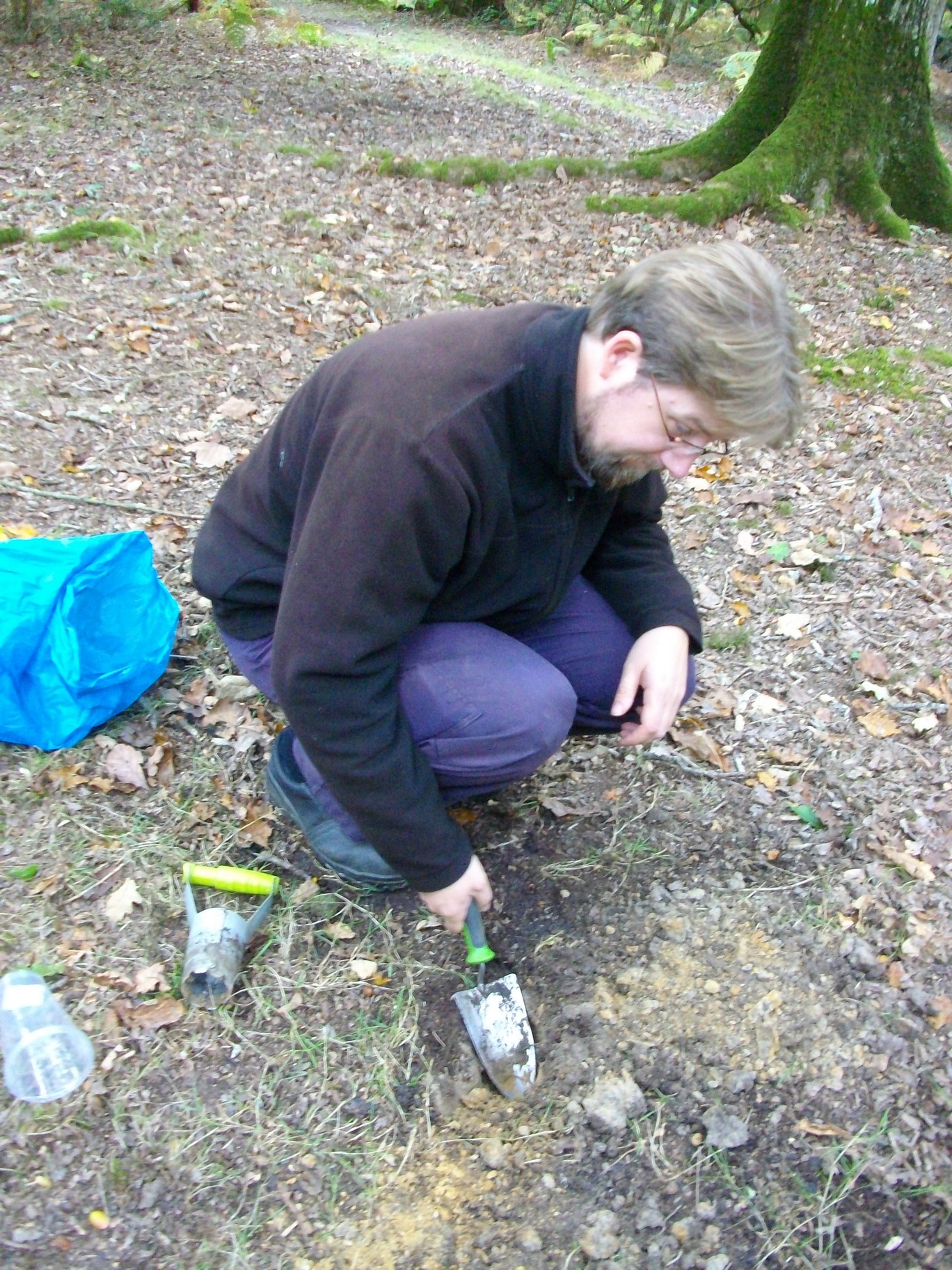
My driver/field assistant/significant other digging holes for pitfall traps
The New Forest is famous for its free roaming livestock, especially the New Forest ponies, but also cattle, donkeys and, in the autumn, pigs. It is also open to the public and popular with tourists, walkers, dog-walkers etc. so I ensured I used non-toxic preservative and covered the pitfall traps with a lid raised of the ground to try and prevent animals drinking from them. The lids also had my contact details and information on the project to avoid them being interfered with my well-meaning passers by. Unfortunately ponies do not read so I did loose three to being trampled and thrown about by ponies! So that is irritation number one.
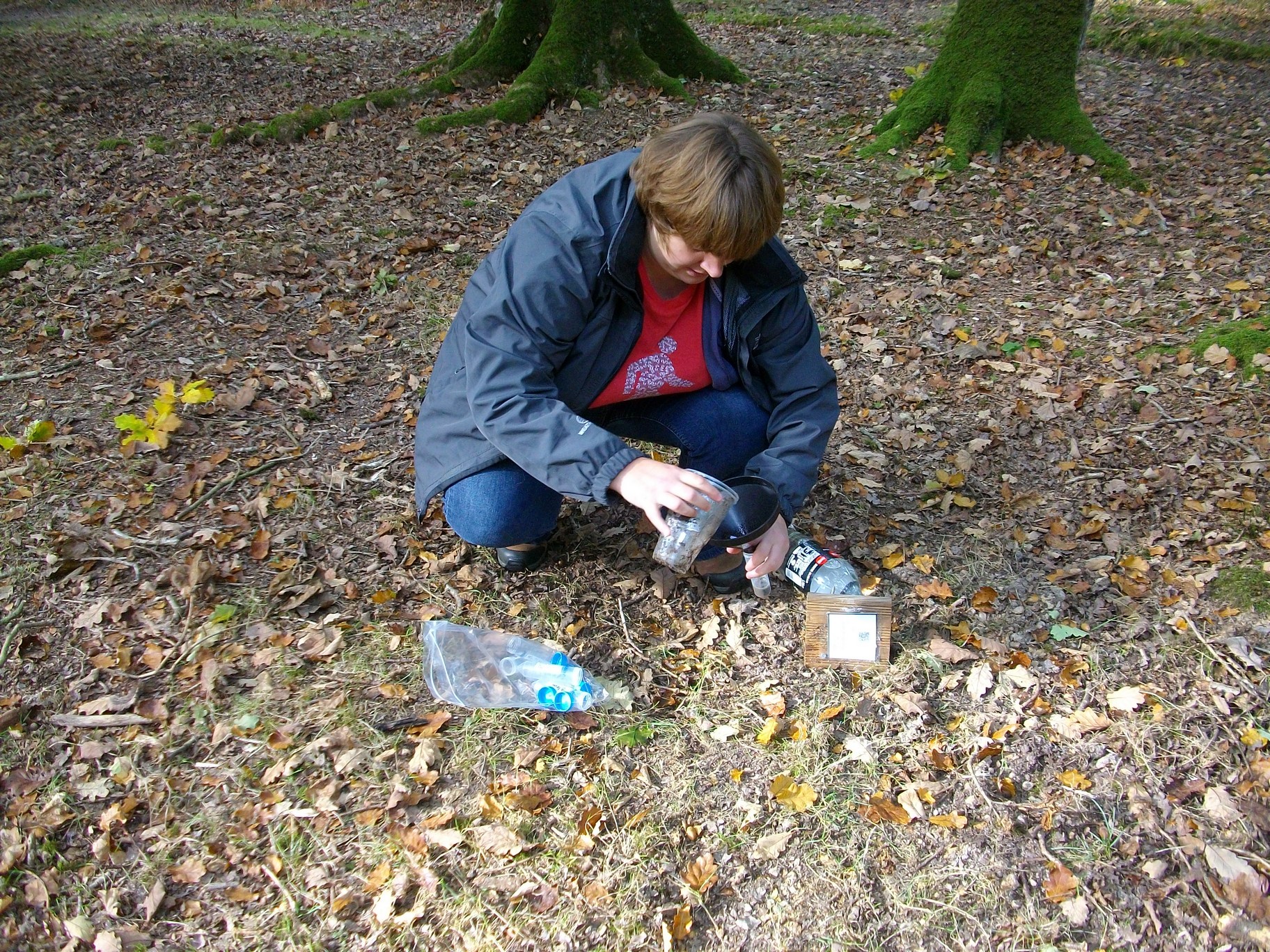
Collecting pitfall trap samples
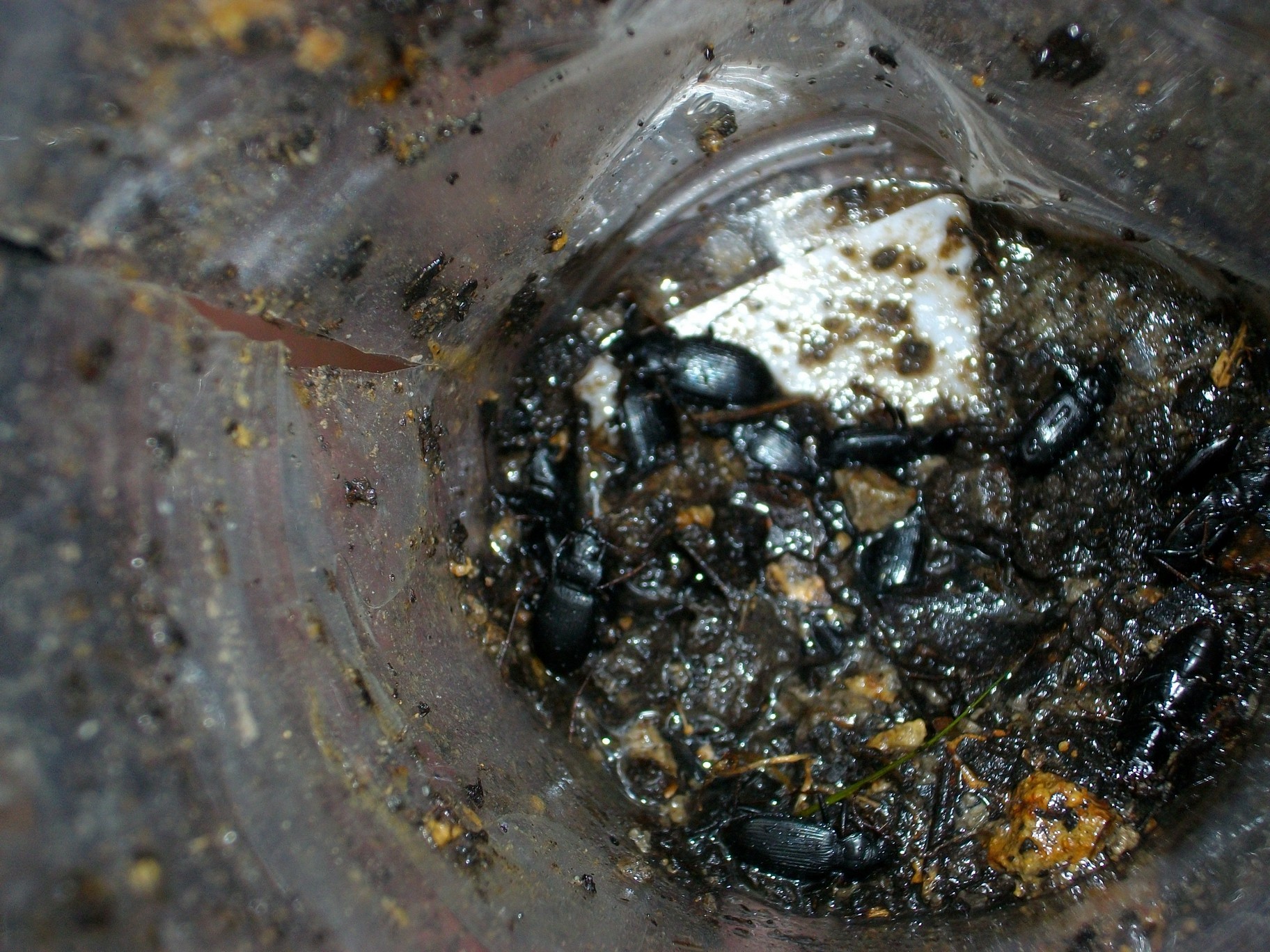
The pitfall traps were left and collected after a week, this was irritation number 2 as it meant coming back to the sites the next week, it was also sometimes challenging to find them even with GPS co-ordinates! One we never managed to find as the co-ordinates had not been recorded correctly. After all that work, here is what you get:
Yuk!
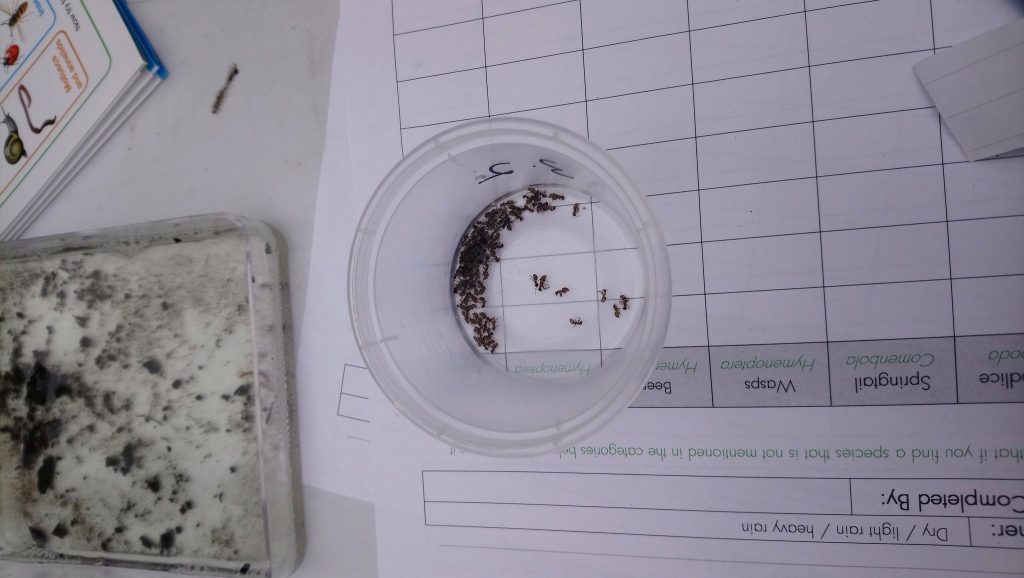
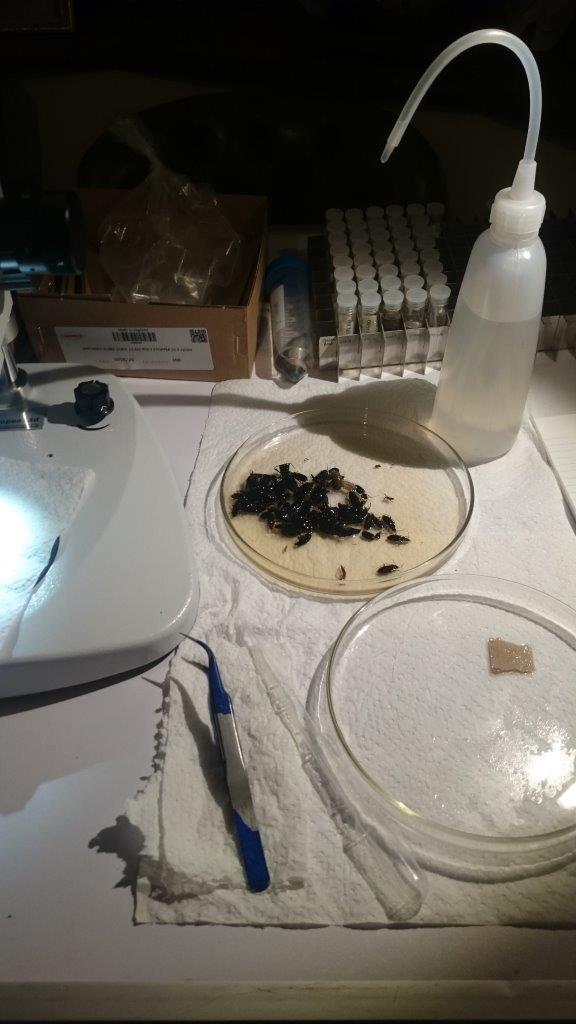
This was a particularly nasty one with lots of specimens and not much preservative, some of the others were not as bad. The worse invertebrate to find in your pitfall trap are slugs, they go horribly bloated and get slime all over the other specimens, but thankfully I did not have too many cases of those. The specimens are then rinsed off and preserved in alcohol until its time to identify them – that’s for another post!
Beetles from one of my pitfall traps awaiting identification
This Throwback Thursday is from my trip to Scotland with the Dipterists Forum in September 2013, a wonderful week in the highlands collecting flies which I wrote up as a guest post for the Natural History Museum Curator of Diptera’s Blog.
Between handing in my MSc thesis and my viva voce, I was fortunate enough to have the opportunity to join Dipterists from the Natural History Museum on a collection trip to Scotland as part of the Dipterists Forum Autumn Field Meeting. Despite the daunting prospect of a long journey and sharing a cottage with people I barely knew I couldn’t pass up the opportunity for an intensive week studying flies which was also my first trip across the border.
I had a fantastic time, proving to me yet again that no matter how scary something seems it is always worth doing it anyway. I even had the honour of writing up the trip for Erica McAlister’s Curator of Diptera’s Blog, so rather than blog the trip here is
Dipterists under the (double) rainbow, Knappach Cottage, Kingussie
Since the trip I have joined the Dipterists Forum committee and am now Treasurer. Sadly I have not had the time or money to go on another fieldtrip, but next summer’s is local to me in Kent, so hopefully I might be able to take a couple of days out and switch earthworms for flies!
This week’s Throwback Thursday is about the cabbage white butterflies I had on my London balcony back in August 2013 while I was studying for my MSc. This also formed the basis of an article in the Amateur Entomologist’s Society Bug Club Magazine.
It is true you do not have to go far to see wildlife, even in the midst of a big city. Invertebrate scholars are particularly fortunate in this regard as insects, arachnids etc. really are everywhere, in your home and even on you. Here in my student room in Earls Court, London I have a little balcony which I have used to grow salad and tomatoes. Being an entomologist I soon became more interested in the creatures eating my vegetables (and eating them!) than the produce.
I enjoy music, but until now had never been to a music festival, all those crowds of people, loud noise and camping was not something I thought I could cope with. However I was aware from talking to my colleagues at the University of Reading last year that festivals are not just about music, and often have stands and science activities run by universities and other institutions. This felt like something I would enjoy so I put it on my mental list of ‘things to do while studying for a PhD’. I was very excited to see a call from the Royal Society of Biology and British Ecological Society for volunteers to help run ecology themed activities and bioblitz (an event where you try to identify as many species as possible) at Latitude Festival in Suffolk. I duly applied and a few weeks later was off on a big adventure with my tent and sleeping bag!
Latitude Festival
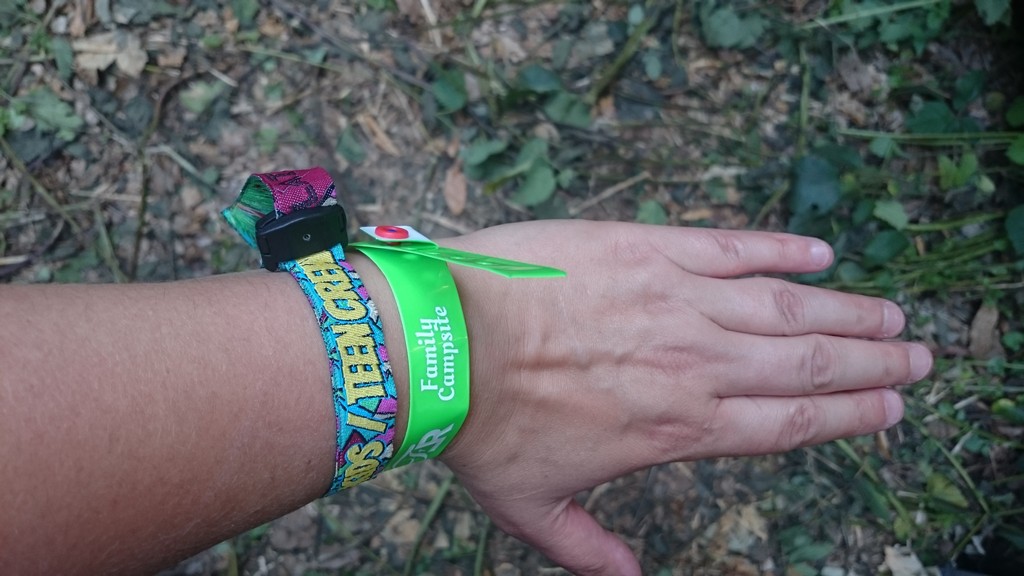
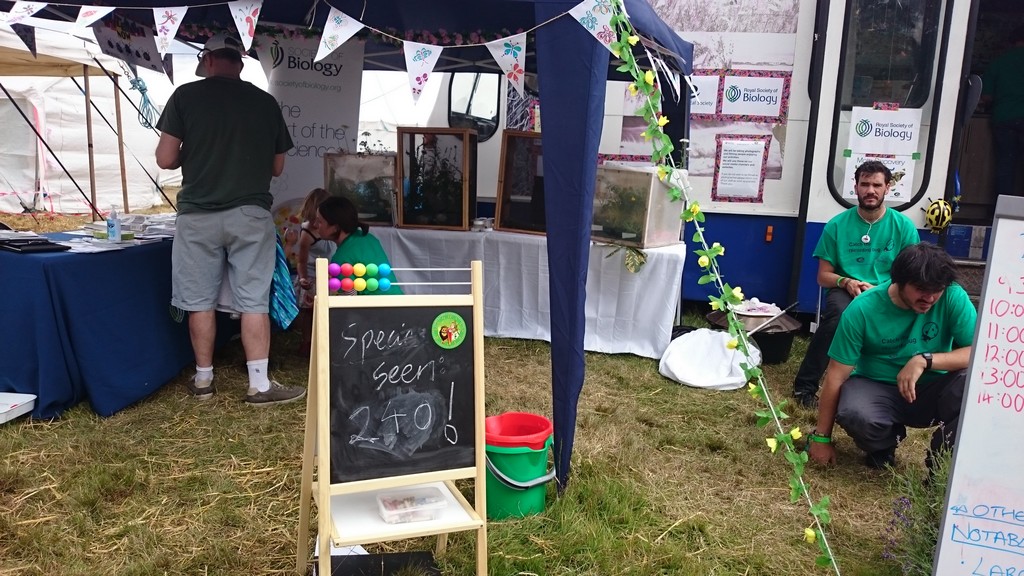
I picked up my festival wristbands and met up organiser Penny Fletcher and some of the rest of the team I would be working with the for the next few days – getting introduced to the ‘Big Biology Bus’ – a mobile home decked out with insect photographs and information to be used for activities. The first evening was spent preparing for these activities, cutting out plants for the ‘Power of Plants’ activity where children choose which plants and features to include in their virtual garden made of paper and learn about what makes a wildlife-friendly garden.
My Latitude Festival wrist bands
Then followed my first night in a tent since my family holidays as a young teenager, it was not a very restful sleep and the portable toilets and showers were as grim as I expected, although better than usual I was told, since we were in the performers’ area. I could have paid for b&b or ‘glamping’ but considered coping with camping to be part of the experience! The day before we officially opened to the public was spent scouting out suitable areas for bug hunts and setting up more activities, including making a butterfly life-cycle mobile from Butterfly Conservation and dragonflies out of pipe-cleaners and lolly sticks – it was good fun!
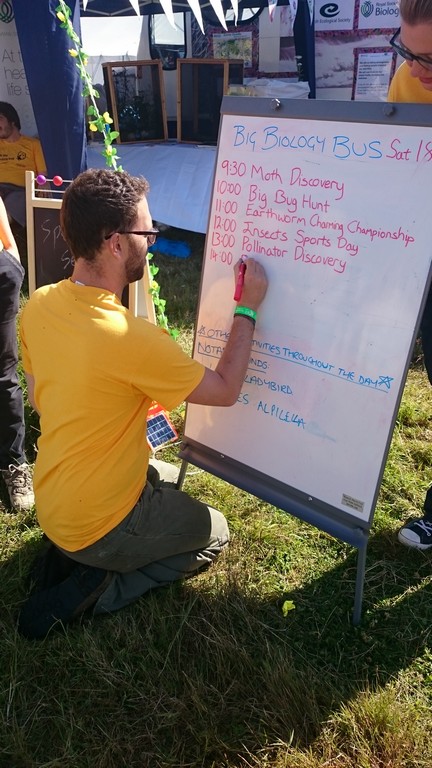
Activities at Latitude Biology Bus
The day started with opening the moth trap, with expert Marc Botham from the Centre for Ecology & Hydrology showing members of the public the moths and other insects trapped in the light trap which was left over night and adding to our species list for the Latitude site. Then it was off to inspect the pitfall traps that colleague Sara Ball had set out to catch beetles and see what other insects could be found on a public bug hunt – demonstrating beating (hitting a tree with a stick to knock insects off), sweep netting (sweeping a net through vegetation) and looking under logs.
Marc Botham from CEH opens the moth trapInspecting pitfall traps for beetles and other invertebrates
Kieron Brown from the Earthworm Society of Britain ran earthworm charming competitions, where the public has to make noise to drive earthworms out of the ground (it is thought to mimic the noise of moles or rain and force them to move upwards to escape). The soils here were very dry and sandy so not many earthworms were found but people still enjoyed learning about them and making lots of noise!
Earthworm charming at Latitude Festival
Ladybird expert Helen Roy of the UK Ladybird Survey gave talks on ladybirds and their parasites, accompanied by singing parasitised ladybird David Urry. In addition to craft activities, another event throughout the day was an insect sports day were people chose insect species to ‘compete’ in events such as high-jumping and sprint to see who would win and then see how they measured against them (my long jump was a pathetic 60 cm!). The public were also invited to vote for their favourite insect and could examine some of the invertebrates we had found during our bug hunts.
David Urry does the Ladybird song
It sounds like I didn’t really see much else of the Festival, and to be honest I didn’t really! I was much happier hunting for insects and adding to the species list for the bioblitz than going to see the acts, although I did go see a comedy show and listened to Portishead and The Vaccines from a safely muted distance.
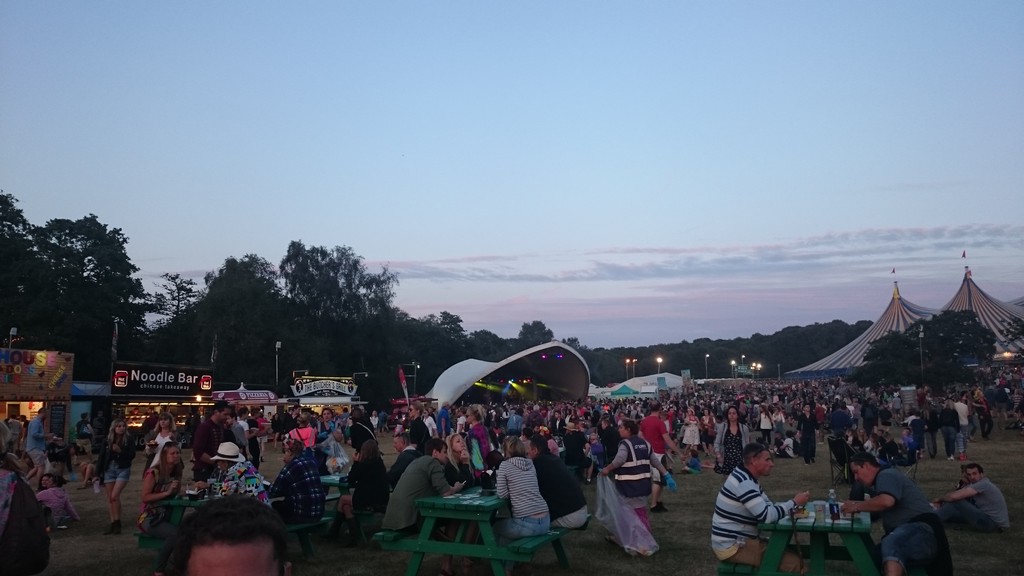
Latitude Festival stages and food standsLight displays over the water at Latitude
After three days of insect activities, bioblitzing and portaloos I was back off home, and sensibly I had taken the Monday off to recover. I had a fantastic experience – challenging, exhausting and fun in equal measure! and would definitely do something similar again. For more photographs and videos check out Twitter and Vine.
Bioblitz total at Latitude Festival – a respectable 240 species
I’ve been a bit lax with my blogging over the last few weeks as I have been busy writing and submitting my early stage assessment – a report of what I have done so far in my PhD and what I plan to do next. This will be followed up with a short viva from my panel – eek! So it was good to get a day out doing outreach at Imperial College Silwood Park a few days after submitting. Silwood Park is Imperial’s postgraduate campus near Ascot, Berkshire, with research and teaching in ecology, evolution, and conservation. One of my supervisors is based there, so I occasionally visit for meetings and eventually will be going there to extract and analyse microbial DNA from my soil samples.
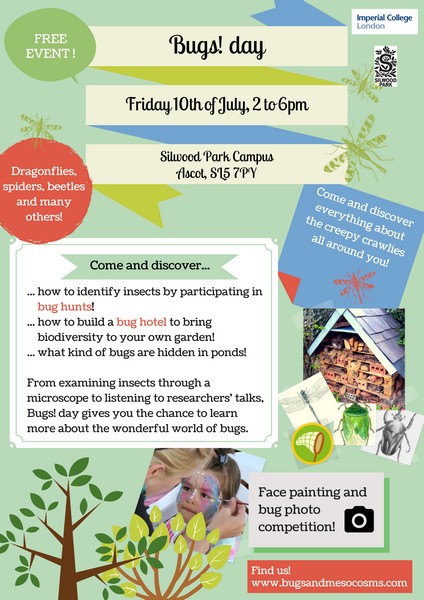
Silwood Park Bugs! day flyer
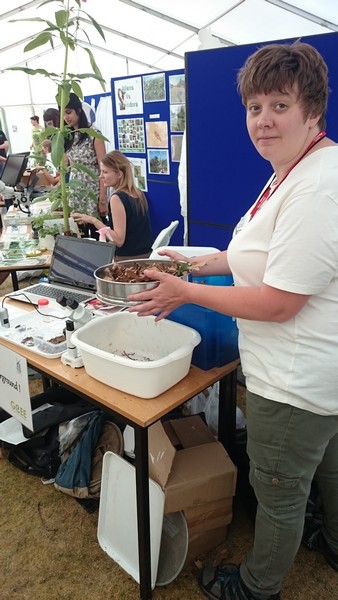
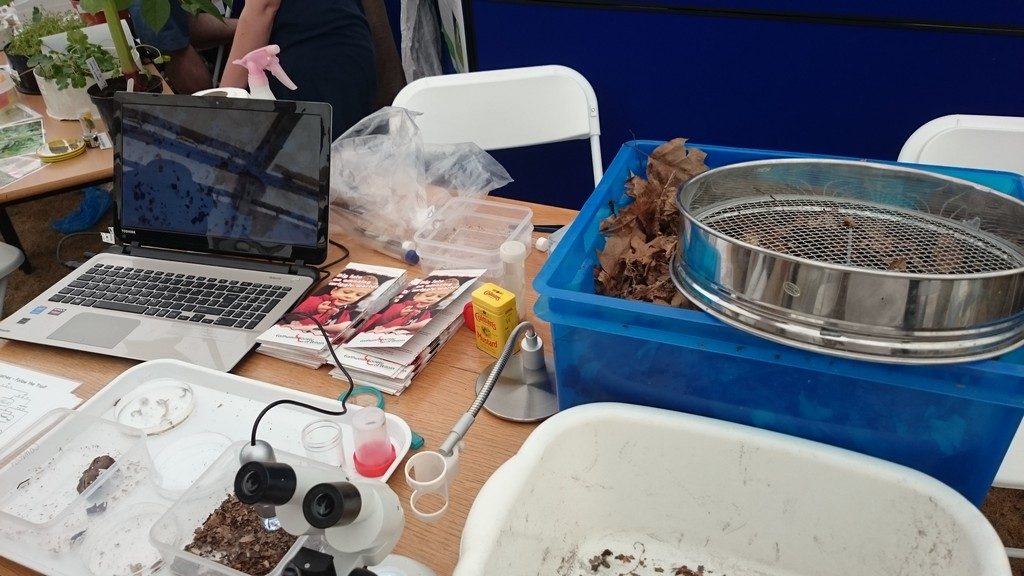
This time I was visiting for the Grand Challenges in Ecosystems and the Environment (GCEE) Bugs! event which brought together Imperial College researchers and local wildlife groups for a day off engaging visitors in research, bug hunts and pond dipping. I was exhibiting some of the invertebrates that can be found in leaf litter, encouraging people to sieve them from the leaves and examine them under the microscope.
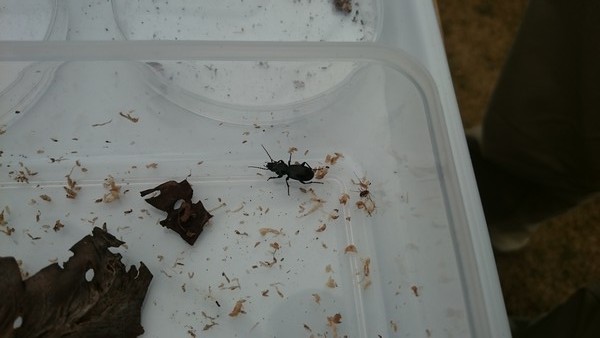
Me sieving litter at Silwood Park Bugs! dayEquipment for looking at leaf litter invertebratesA carabid beetle and harvestman found in the leaf litter
Other stands had activities to extract DNA from strawberries, examine aphids and their predators and parasites and fossil insects. I had a really enjoyable day finished off with a BBQ. More information and photographs from the day can be found on the Bugs! website.
I really enjoying learning how to identify wildlife, so not only do I spend time identifying soil invertebrates as part of my PhD project but I like to attend identification workshops and courses in my leisure time. On Saturday I was at a workshop organised by the British Entomological and Natural History Society (BENHS) learning how to identify land Heteroptera with Tristan Bantock and Jim Flanagan. Many people use the term ‘bug’ to refer to any invertebrate but in strict entomologist sense a bug is a member of the order Hemiptera. These are characterised by having a straw-like mouthparts (a rostrum) which they feed on fluids of various kinds, often plant sap but some on other insects and even blood. They include familiar insects such as aphids, bed-bugs and shield (stink) bugs. UK bugs species are split into three major groups and today I was looking at the Heteroptera which include shieldbugs/stinkbugs and assassin bugs. There are some bugs that live in water, such as the pondskaters and water boatmen, but this workshop was just to identify species which live on land.
Like most insects bugs are identified using keys, which provide a set of questions about features of the insects, progressively narrowing down possibilities until (hopefully!) the correct species is arrived at. There are several types of identification keys but the most commonly used is a dichotomous key which offers two options at each step (called a couplet). Unfortunately keys can be problematic, firstly they rely on knowing what you are looking for, which in some cases can be straightforward e.g. leg black or yellow but in others subtle or open to interpretation e.g. leg thickened towards base or leg equal width. With small species you will need a microscope to see the differences! Keys also have problems that new species may have be found since the key was published, sometimes a very variable species will not fit the description, your specimen may not be an adult, missing the part that you need to look at, or even deformed or unusual in some way. On occasion the keys can just have errors!
Identifying using keys can be frustrating, but I rather despite this I rather enjoy it, it’s like a puzzle. It helps enormously to have someone who knows the group and a reference collection to refer to, and that is where BENHS is very useful, their headquarters at Dinton Pastures Country Park has a library and labelled specimens which can be used to compare against your specimen to check if your identification is feasible.
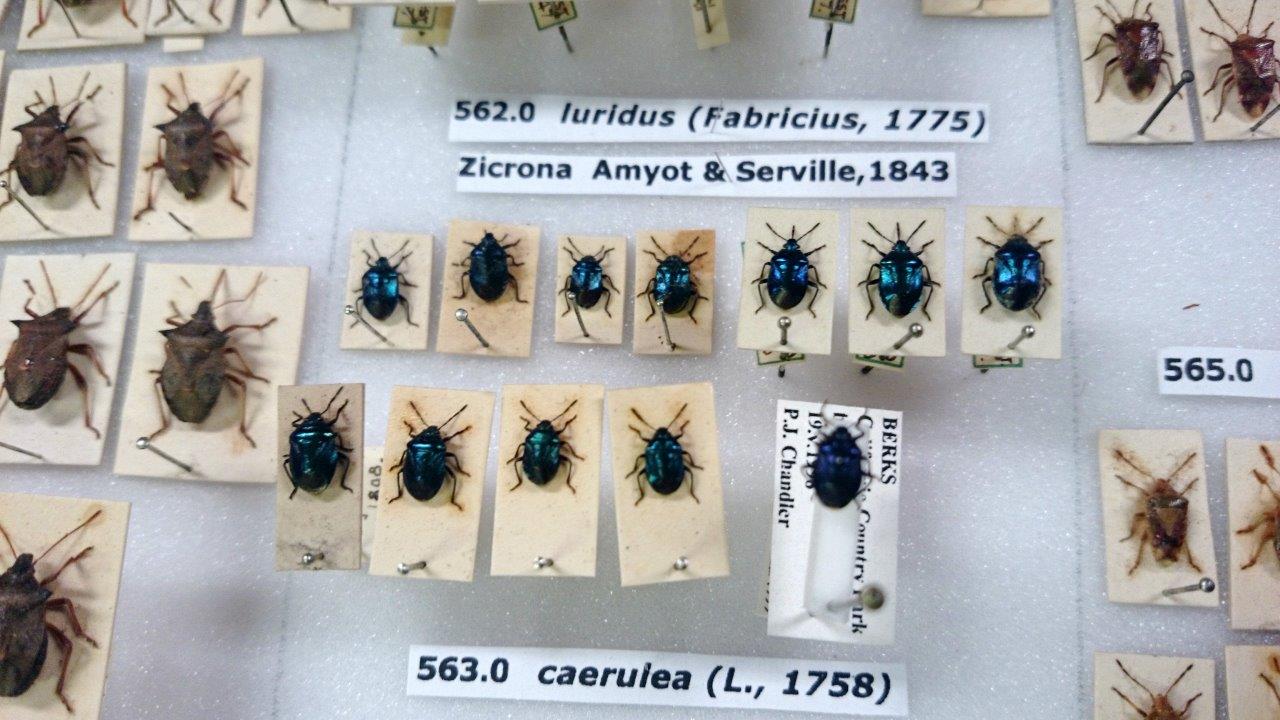
Shieldbugs in the Heteroptera collection at BENHS
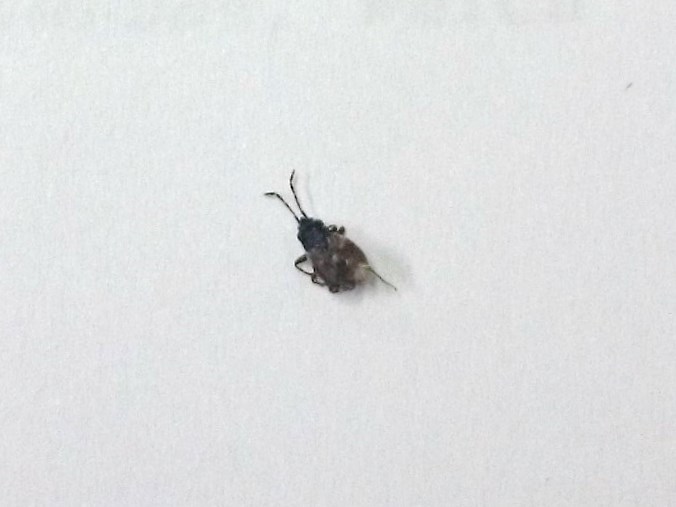
During the workshop I identified a few bugs which I found in leaf litter during my MSc Taxonomy and Biodiversity project, I didn’t have very many but it is particularly satisfying to work on your own specimens, and I can add to the species list for the site. The first bug I identified was a small brown specimen which I found in leaf litter from a rotting tree stump}, I got stuck keying this specimen as the couplet asked if the head was heavily punctured (lots of small round dents) or less heavily punctured. Mine seemed to have a lot of punctures but I soon came to a dead end following that route. After asking one of the tutors for advice it transpired this was one of the less punctured species, but of course without the contrasting one to check against how would I have known that!
Bug finally identified as Drymus brunneus
I finally successfully identified the bug as Drymus brunneus, a common bug in leaf litter. Next I identified some even smaller bugs which I sieved from moss during my MSc. These were only 2-3mm in length, but under high magnification were immediately identifiable as a species of lacebugs (Tingidae), which as the name suggests have lace-like wings. These keyed much more easily to Acalypta carinata, which was then confirmed by Jim. The rest of the afternoon was spent practising using the keys on specimens in the BENHS collection, I will have to find time to go through more of my insect collections to see if there are more to identify!