Throwback Thursday – Earthworms – the final chapter! (December 2013)

This week’s #throwbackthursday chronicles the final part of field work on the NERC BESS earthworm project in 2013 – hard to believe two years have past since we finished!
This week’s #throwbackthursday chronicles the final part of field work on the NERC BESS earthworm project in 2013 – hard to believe two years have past since we finished!
Two years ago I was volunteering on yet another week of earthworm sampling on the NERC BESS project, this time in Leicestershire and Dorset. This week features farty mustard solution and an exciting day in an active quarry!
Another county, another field… Last Monday and Tuesday I was again away with the Natural History Museum Soil Biodiversity Group, this time heading up to Leicestershire, for more earthworm sampling. Not as scenic as Somerset, we were sampling in a research farm near Loddington, in addition to myself, Sholto was again volunteering, I also met for the first time Salma and we were joined by Irfaan on Tuesday.
|
|
|
Another earthworm is sampled by Irfaan, with Salma and Sholto |
|
|
|
Salma is trained in the correct way to retract the tape measure |
In the previous week there was a problem with the mustard solution, which had developed a pungent smell of hydrogen sulphide (egg-fart gas). This was a concern because the smell was so strong it could be killing the worms in their burrows before they could emerge. Could the change be because of a faulty batch of mustard powder, or change to the ingredients? This week different batch numbers of mustard powder were purchased to test this.
 |
|
David checks the bouquet of the mustard solution |
Sniffing the mustard solution before pouring was now a necessary step, after the first mixing the smell was promising but by the morning some bottles had deteriorated. A new hypothesis was proposed that some sort of bacterial contamination was causing the smell and then it was realised the problem started after the mustard solution was made up using water from the soil laboratory back at the the Museum. The water in the labs comes from the museum’s own borehole and often has a slightly sulphurous smell, could some sulphur-reducing bacteria dwelling in the supply have caused the problem? It was decided to use fresh water bottles on the next trip.
Tuesday evening we travelled back to London and on Wednesday I spent the afternoon helping in the soil laboratory preparing the kit for Thursday and Friday and changing the alcohol in the earthworm samples. Earthworms have a high water content and this dilutes the alcohol, if the liquid is not replaced with fresh spirit the earthworms can start to decompose which makes identification difficult (and stinky). Then Wednesday evening we left for Dorset – the final county being sampled in.
 |
|
That’s a lot of earthworms! |
Living in just the next county I have had many family holidays in Dorset and it was a pleasure to be back in beautiful Purbeck. Our site was near a quarry were limestone (Purbeck ‘marble’) is extracted and on Friday we got to view a blasting, which was very exciting.
|
|
|
Quarry manager Simon discusses the site with David |
|
Quarry blasting (guess who made the excited squeal!) |
The shallow soil did not yield many big anecic worms but large numbers of smaller species, since earthworms have a preference for areas of high pH. As might be expected there were also large numbers of snail shells which I tried my best not to be distracted by, although I think I may sneak a few specimens when we return next week!
 |
|
Off for a well-earned meal after a hard day’s earthworm sampling |
Analysis of the NERC BESS Earthworm project is still on going, and a paper is in progress. The Dorset site had particularly high earthworm numbers, with over 200 found in one pit! I will discuss that in another #throwbackthursday. I also plan to use the NERC BESS data to compare with my PhD data so taking time out to volunteer on the project is paying off well!
It’s Christmas party season!
I actually am not keen on Christmas or parties, but do try to go along to a few to try and get in the spirit of things, chat with people I haven’t seen for a while and eat free/cheap food and drink. Between the Museum and and various Imperial College departments I have been overwhelmed with invitations and have only been able to attend a few, but I thought I would list some of the others so you can see all the different opportunities for partying at Imperial.
Parties at the Natural History Museum
The Museum has a reputation for boozy parties (although we have to be careful not to upset security and neighbours). This Monday I attended the Student Christmas party, which was organised by the Natural History Museum Student Committee, but not just for students but anyone who wanted to come along. Unfortunately I couldn’t stay long as I had to finish a presentation for the next day but enjoyed chatting to some of the other students who work in other parts of the building and that I don’t speak to very often.
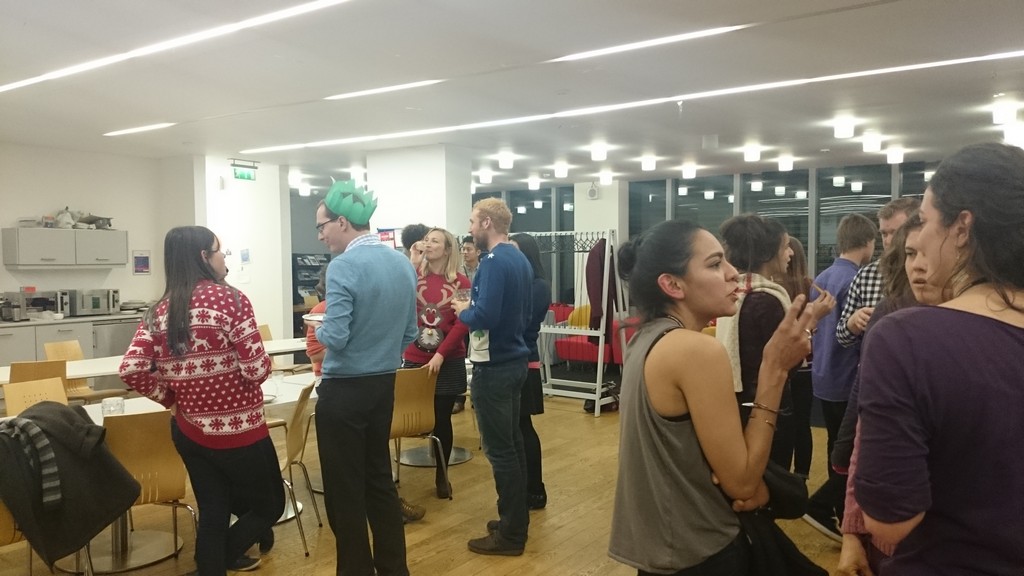
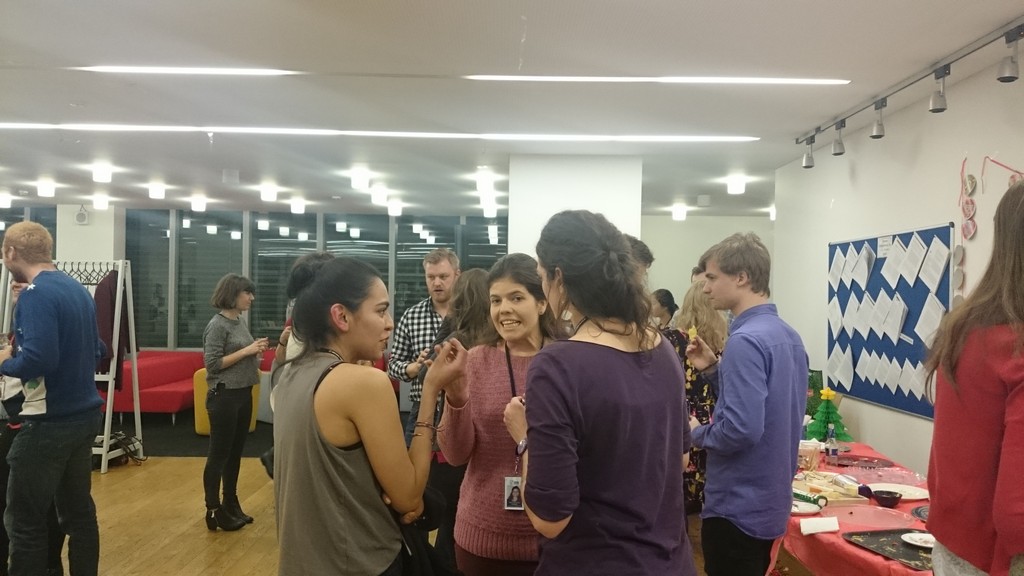
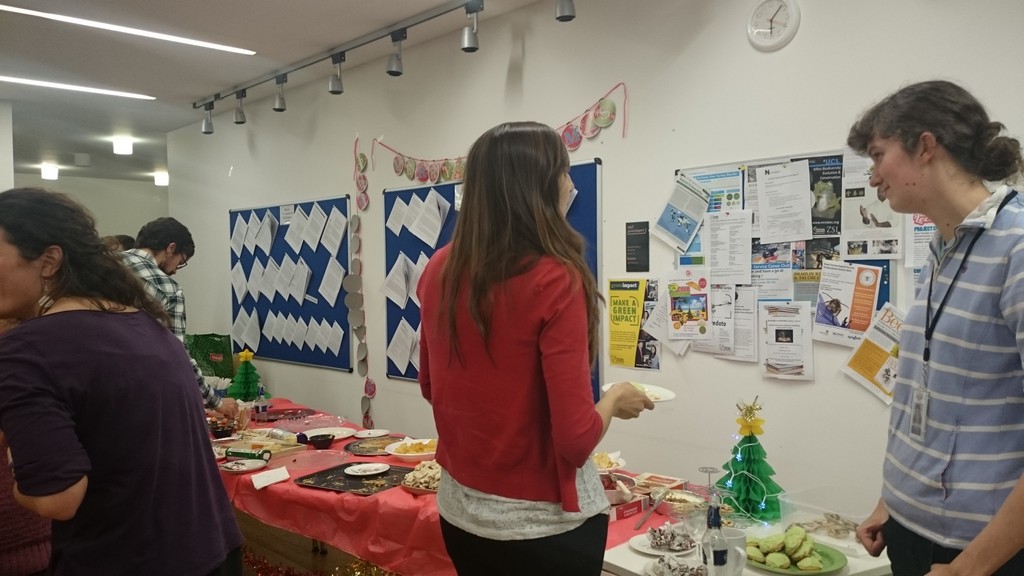
Today there is a Christmas get-together with the Natural History Museum Soil Biodiversity Group, which is traditionally held as a thank you for the hard work of our volunteers over the year. I enjoy the chance to chat over some food and drink without loud music playing, but those that want too often continue the party in the pub.
Tomorrow Purvis Lab are having a Christmas meal and then it will be time for the Life Science department Christmas Party which has a Stars in Their Eyes theme! Some people will be performing dressed as their favourite stars and there is a prize for the best. I am not dressing up but looking forward to seeing everyone else and hoping my supervisor will be there doing his famous karaoke! Other departments put on parties too, there are posters up for the Core Laboratories and Earth Sciences parties, but one is enough for me!
Parties at Imperial College London
I have had a number of party invites from Imperial College too, although am not able to attend, but to give you an idea of what’s going on here they are:
Department of Life Sciences (DoLS) Grown-ups party – with quizzes and live music
Department of Life Sciences (DoLS) family friendly party – with children’s activities etc. (what a great idea!)
Science and Solutions for a Changing Planet (SSCP) DTP party – which unfortunately clashes with the NHM Life Sciences party
Imperial College Silwood Park party – for those doing research at Imperial’s campus near Ascot
and probably lots of others I don’t know about!
Whatever gatherings you are attending this year, have a great time!
After two poster presentations last week, this week’s #throwbackthursday is a timely look back at the first event I presented at, back in November 2013.
I started species identification of earthworms after attending a course in 2013 which proved very useful when I went on to sample earthworms and other soil animals during my MSc project. (more…)
I’ve attended two conferences this week, with different audiences and it’s been tiring! On Tuesday I was the Wildlife Gardening Forum Conference held at the Natural History Museum where I presented a poster on my forthcoming Citizen Science project Earthworm Watch. This conference was a celebration of 10 years of the Wildlife Gardening Forum, a charity for people and organisations interested in wildlife gardening. The next day I was off to Reading University presenting the same poster at the Healthy Soils for a Healthy Life event held by the Soil Research Centre. This event consisted of talks, networking and workshops on the theme of healthy soils – including how we define healthy soils and what indicators we can use. I would have like to have gone on to the National Biodiversity Network (NBN) Conference in York which ran Thursday and Friday, but decided two conferences in a week was enough, I have a PhD to do after all…
Thankfully Twitter allowed me to view the NBN Conference as it happened using #nbnconf15
Check out my Storify of Tweets from the Wildlife Gardening Forum Conference:
[View the story “Wildlife Gardening Forum Conference” on Storify]
And from the Healthy Soils event:
[View the story “Healthy Soils for a Healthy Life” on Storify]
Over one year into my PhD now, and I had been hoping to blog a little reflection on this but things have been rather hectic! Instead here is a look back to some more earthworm fieldwork I volunteered on in November 2013, digging holes in Somerset and Berkshire.
For eight days in November I returned for more earthworm survey work with the Natural History Museum Soil Biodiversity Group, this time in Somerset and Berkshire. A small team of volunteers this time, just myself and long-time SBG volunteer Irfaan, travelled first to the Somerset site to continue work started the previous week. We had been informed the Somerset site was the most beautiful yet but when we arrived on Monday the fog was so thick we had to take David’s word for it! Thankfully, by Tuesday the sun had returned to reveal a superb landscape, the countryside you imagine from hundreds of years ago, with little patchwork fields fringed with ancient hedgerows.


What a difference a day makes in Somerset
Four fields are sampled per farm, covering a spectrum of management intensity, such as how often the field is grazed, how much fertiliser (animal or artificial) is added and whether it has been ploughed or used for crops in the past. The field we worked first was the lowest intensity field at the Somerset site, not surprisingly as it was some distance from the nearest track, was steep and had springs running through it. This field had never been ploughed, giving an odd feeling of being possibly the first people to disturb the soil. It also had the biggest Yellow Meadow Ant (Lasius flavus) mounds I have ever seen!

Horse battered Yellow Meadow Ant (Lasius flavus) mound, at least two foot tall
 |
 |
Digging and coring in Somerset, quite possibly the first time the soil has been broken by man!

Shire Horses in Somerset

Dipterological distraction: Noon Fly (Mesembrina meridiana) in Somerset (thanks to Georgie for this photograph from the previous week’s visit)

If he had fallen over I could have bagged £300 pounds!
Once the location is marked with a flag it’s time to start over again taking measurements, digging a pit, taking samples and hunting for worms!

Irfaan and I intently sorting soil for worms

There’s one!

Blue-grey worm (Octolasion cyaneum)
On Thursday we left Somerset for Berkshire, unfortunately still with a field left to finish. The site in Berkshire was the Organic Research Centre Elm Farm.

Excitingly the very first pit had a bumper crop of the UK’s largest earthworm – Lumbricus terrestris emerge when the mustard solution was added, some were bigger than by baby snakes at home! Could this be because of higher organic inputs in this field than Somerset? The statistics will tell us in time (hopefully!).

Lumbricus terrestris expelled by mustard solution

Must get on with planning my own fieldwork!
Just in time for UK Fungus Day this week’s #throwbackthursday looks back at a training course on the identification of fungi I attended in October 2013.
The day after the PREDICTS Symposium it was the Science and Solutions for a Changing Planet (SSCP) DTP Conference 2015, in the same venue at the Natural History Museum! I got up early to help set up at the Museum and welcome delegates. This Conference was for members of the DTP and showcased our work with talks, a three minute thesis competition and poster session. The three minute thesis competition was a challenge to explain our theses to the audience in just three minutes using one static slide with a prize for the audience and judges’ favourite.
Check the Grantham Institute’s Storify for more Tweets from the event: SSCP DTP Conference