Project: Student Driven Peer-learning in Biomedical Data Science
As a lab scientist, what would you do if you need to analyse the data you have collected but you have never done it before? The DS helper team, which is a student-led activity organised within the MRes in Biomedical Research, is here to help you. The project is characterised by different forms of peer-to-peer learning, whose aim is to create an open, friendly, instructive environment where students can reach out in case of issues with data science related topics and can learn some data science if interested. The basic assumption of this initiative is that students with a more technical background have already gained knowledge in different aspects of the field, and can, therefore, share their expertise with students with a more biological training.
Dr. Timothy Ebbels

The MRes in Biomedical Research is a large research based masters degree aiming at training the next generation of leaders in Biomedical Research. It brings together around 80 students from diverse disciplines across 8 streams, each of which is focussed on a specific research area. Students spend most of their time pursuing two long research projects, and this “on the job” training is complemented by a weekly core programme of lectures, seminars, practical demonstrations and journal clubs.
The research community is becoming increasingly aware of the importance of bioinformatics and data science skills these days. From gene sequencing to image analysis, the ability to understand how artificial intelligence and informatics algorithms can complement and accelerate traditional lab-based research, is becoming more and more important. The Data Science Stream of the course specifically recruits students from a physical sciences, engineering or mathematics backgrounds, who want to apply their skills in the biomedical environment. Coming into contact with their peers on other streams, who have a more biological training, provides the ideal opportunity for cross-disciplinary interaction.
Although the programme already provides some training for all students in bioinformatics and statistics, there is little formal teaching time available to cover all aspects. Some students find they need a little more help in this area and the Data Science Team was conceived to fill this gap. I should emphasise that this initiative has been developed by students for students, and academic faculty only provide support as needed. This approach has the advantage of encouraging student engagement, while clarifying that it is not a required element of the programme.
Valentina Giunchiglia
 The advent of COVID-19 put many students in the position of not being able to go to the lab on a daily basis. As a consequence, the data analysis part of every research project has become more prominent. At the beginning of the year, I realised how difficult it would be for students coming from a wet lab background, and probably doing a project in a predominantly wet-lab research group, to start working in data science.
I wanted to create a platform where students could feel free to ask any kind of question, without being worried about making a bad impression, and where they could receive indications on how to start programming, where to look for information, or even how to begin their analysis from students that had already been in the same position. This is why I started the Data Science Helper Team project, which was possible thanks to the interdisciplinarity of the course.
As part of this project, my aim was both to provide general knowledge necessary to work in the field, and to address the specific questions that each student might have as part of their projects. To do this, I organised introductory lectures, ranging from general Python/R coding tutorials to more specific data science techniques, clinic sessions, where each student could book a call with members of the data science helper team to discuss specific project-related issues, and a discussion forum, where students could post their questions and wait for a written reply from a member of the team.
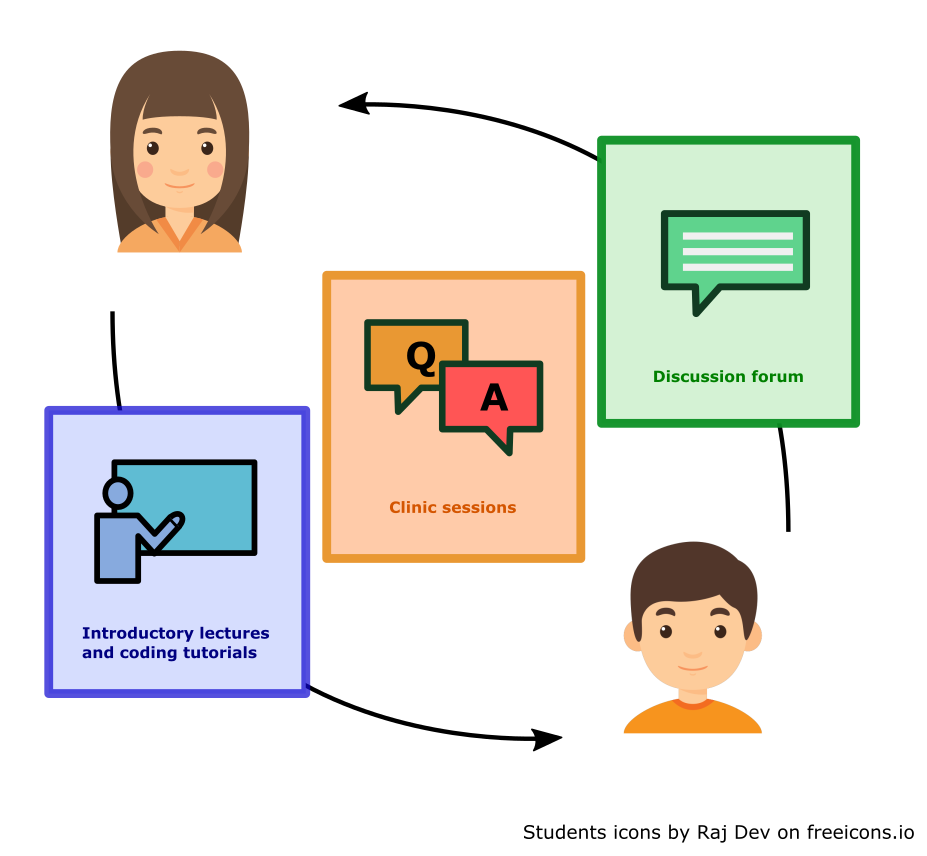
The Data Science helper team was possible thanks to a group of students in the data science stream that voluntarily offered to join the activity, either by giving the lectures or joining the clinic sessions. Each of them has knowledge in different areas of data science, and could, therefore, provide help on the topic they know best. To date, the project has been helpful not only for some of the biologically trained students, but also for some students in data science. They were able to use this opportunity to learn a new programming language, deepen their knowledge in data science methods, but also gain confidence in what they know and learn how to share this knowledge with other students. In addition, it created a friendly environment where students could meet other people from the masters programme that share the same interest in data science, which is not currently easy due to the COVID-19 pandemic. Based on a first evaluation survey shared within the cohort, the students that joined the activities of the DS helper team found it useful, engaging and helpful.
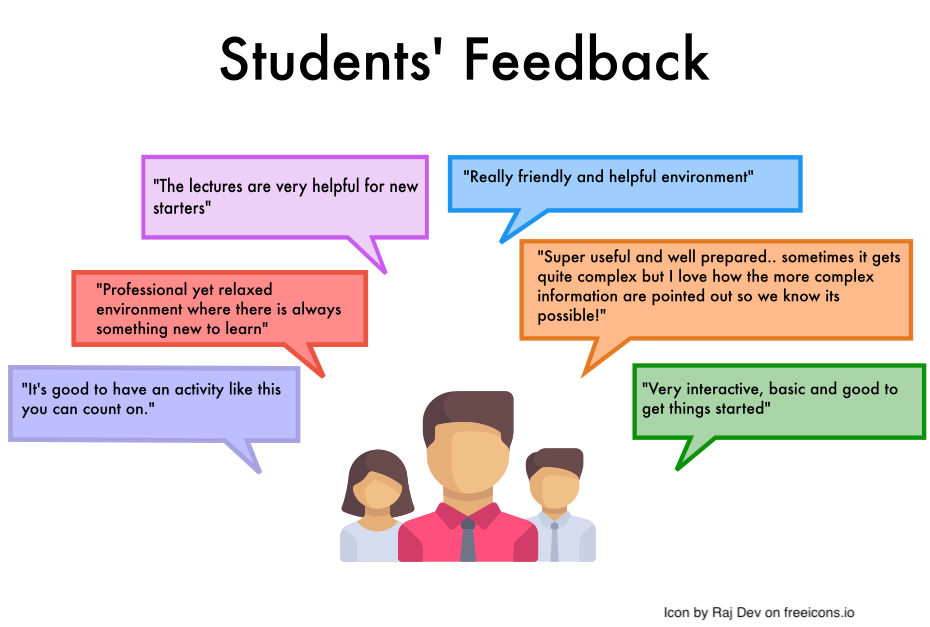
Overall, the Data Science Helper Team project shows that peer-to-peer learning can be beneficial to students as both learners and teachers. For this reason, we believe it would be advantageous to continue this project in the next year, and, potentially, expand it to other courses. Of course, there are some difficulties to overcome, mainly related to the fact that the availability of each student is highly dependent on their time-zone, stream timetable and lab hours. Also, at the beginning, it is harder to get students involved, mainly if the activity is still not well-known. However, the fundamental structure is now all set, and the material of the lectures is also publicly available here https://github.com/valegiunchiglia/DS_sessions/, which means that in the next year the management of the project would not only be easier, but could potentially improve and reach a wider audience. If this sounds interesting to you and would like to know more, further information will be provided during the “Talking Teaching” seminar on the 12th May.
 Dr. Latha Ramakrishnan, Module lead and Biomedical Education Transformation Fellow, Faculty of Medicine:
 Laura Mereweather, PhD Student, Department of Immunology and Inflammation
  partners with the module lead Dr Latha Ramakrishnan and the session leads in order to build the STEMM Module, Personalised Medicine: Hope or Hype. Aside from providing us with an insight into the behind the scene aspects of academic teaching, it also enabled us to develop a range of professional skills. This included practical skills such as proficiency in a number of digital platforms such as Microsoft Sway, Panopto, Mentimeter, Padlet and Powtoon, which are commonly used to produce educational materials. Perhaps more importantly, we were able to improve our information communication skills as well as critical thinking. Critical thinking was a key cornerstone of the module, and we wanted students to assess material and think from different viewpoints about the future of personalised medicine. In order to identify the correct pre-session materials, we had to first develop these skills ourselves, before conveying it to the students. We refined our own critical thinking skills through working together in an inclusive environment and being able to benefit equally from the different perspectives of each team member, whether staff or student. The fruitful collaboration with students and staff from different academic backgrounds and research interests led to the nurturing of ideas and translation of these into a successful module.
 Dhanya Mahadevan, Change Makers student:
 Dr Elizabeth Hauke, Change Makers Field Leader:
 I have been the Allergy Programme lead since 2015. It is an absolute pleasure to work with our faculty and module leads, who are amongst the world’s leading researchers in Allergy, as well as very experienced clinicians. We are a very dynamic team continuously working on improving and innovating to deliver a programme of the highest quality.. Every year we incorporate new elements to ensure it is fully up to date as Allergy is such a rapidly evolving field. We focus on active and student-centred learning. For this we use engaging teaching strategies to ensure students’ active participation and interaction, both with our faculty as well as their student peers. Students have plenty of opportunity for group work, peer support and feedback. As they have diverse backgrounds and share their strong interest in allergy, they find it a very rich and positive atmosphere. We promote a challenging yet open, enjoyable and friendly learning environment where students can ‘learn by doing’ and bring their own cases and challenges for discussion.
 Undertaking the MSc Allergy programme at Imperial has been a very enjoyable and beneficial experience which has proved very useful in my daily clinical work as a general paediatric trainee in Ireland.
 At the time of the inception of ImpVis, I had recently completed a Masters in Education that was focussed on how students learn difficult, abstract concepts in special relativity – the module that I taught at the time. One of the outcomes of my MEd project was that visualisation plays an important role in gaining a deeper understanding of abstract concepts and students would often go in search of visual resources for self-study. However, one of the major hurdles to finding existing resources is that they often do not align well with the course: they may use different terminology, symbols, or simply focus on different learning objectives. Creating your own visualisation that suits your needs as a lecturer is challenging as it requires a wide skill set (not to mention plenty of time): programming skills, in-depth subject knowledge, an eye for visual design as well as an intimate understanding of how students learn and which concepts they struggle with and why. If you do manage to create a useful visualisation, the next challenge is to ensure it is straightforward for students to engage with it in an effective manner.
 Taking part in the ImpVis project was one of the most enjoyable and rewarding aspects of my undergraduate degree. During my four years in this project I have had the opportunity to work both as a summer UROP student and as a term-time mentor and I have seen how this project has developed from a small set of ideas to a rich suite. One of the most amazing parts of being part of ImpVis is that I have not only witnessed this transformation, but I have had the chance to directly mould it by collaborating directly with a diverse team of staff and fellow students.
 The Faculty of Medicine (FoM) PG Education Team is launching a new approach to supporting postgraduate programmes as they address challenges, identify opportunities, and enhance the student learning experience. This new approach is called Education Transformation.


 One of the issues that we have encountered while building the IMPLEMnT site is the taxonomy we use and finding a balance between making it manageable while allowing the community to express the technologies used in its own terms. To highlight this we had the audience on their devices again to run a Poll Everywhere session where we asked them to tag two of the most well-known technologies we have on the site – YouTube and TurnitIn.
