Blog posts

Week 3 at the British Red Cross in Portsmouth

Ok, week 3 – What have we done?

I have finished writing up my report and have gone through and extended my points as Rachel had asked me to. I have checked all the spelling, grammar, punctuation and stats- so I think we are good to go! Phrasing of points is also key and parapharsing, though useful, can sometimes alter dramatically how well recieved the information is. It is funny how one word can totally change how people take things and since the report makes suggestions, this is important to consider.

I have a date set in my last week to allow me to feedback to the People and Learning team. I am going to have to make a PowerPoint to do that. I also had to write a memo for the area management team meeting, which Rachel has give out as a summary of my report before sending it out for real, so that it can be read and hopefully put into action by Senior staff ( Eek!!) and the volunteer council. So, hopefully, by making this report I will have helped the staff and volunteers of the British Red Cross in Hampshire Surrey and the Isle of Wight have their voices heard.

Some of the topics covered in my report have included Communication, People Management/ development and My Organisation. The aim is to find evidence for suggested improvements in the focus group, so that we can boost retention of volunteers. It has been a big project and a long one as it is sort of 3 projects in one . It started back in April and is due, well, next week! So it will be the end of a long process for Rachel and Chloe (the other intern), who have been working on it for 4 months collecting processing and writing up their work.

It has been lovely working here, and you do start to feel a part of the team, rather than just an intern who leaves in a few weeks. Members of staff do value your input if they ask for an opinion from past experience- it makes you feel like you are making an impact and genuinely helping the team on a project.

On a different note- how far do people commute to their place of work? For me it is about 40 mins on the train to Portsmouth from my family home ,which is great. I have been filling the time reading!
Final Tuesday

After having a long weekend with the bank holiday Monday it is weird that I am entering my final week. My internship will officially end next Monday accounting for the Bank Holiday.

My first ‘Closure’ project has come to an end after three weeks of working in the Admin team at Barnardo’s. I didn’t manage to get through the entire cabinet of documents, as I strongly overestimated the rate at which I was able to carry out the processes. So I have created an organised systematic process which will allow my colleagues to continue on with my project once my internship has come to an end. It has been different to what I initially expected the project would demand. It has been very dependant on using creativity to maximise efficiency. It has strongly developed my time management skills.

Now I have started my final project which is predominantly research based. In one sentence: I will be researching the demand for an LGBT clinic in Leeds. Barnardo’s have not established an LGBT clinic in Leeds to date. Hence I will be researching and contacting any current LGBT clinics not working through Barnardo’s in the Leeds district. Ultimately I will be providing my Sub-Supervisor with information gathered regarding current LGBT clinics and then he will determine whether it is feasible to create and request funding for a clinic or whether Barnardo’s will work in partertnship with a current clinic. The project will require a high level of communication based skills (and am sure they will build on them).

I am sorry for the lack of pictures in my Blogs. Most of the work that I do is CONFIDENTIAL. Hence if I take a picture in the office I run the risk of publicising confidential property.

Fifteenth Day

Time flies, and this week has honestly been the most busy week at Sense About Science to-date. Lots of things wrapping up and being reviewed, and lots of things to start.

Due to a lack of time I haven’t had the time to draw up a full blog post, or get some items reviewed for posting. In the meantime, though, do check out my first Ask For Evidence effort where I enquired for evidence behind Calamari Gold squid oil capsules: http://www.senseaboutscience.org/pages/a4e_examples_of_evidence_hunting.html#

First week at CABI!

Today completes my first week at CABI. I knew CABI was a bit outside London, but the walk from the train station in Egham this week has been a welcome surprise. The forested areas around CABI are fantastic and make for such a pleasant walk to work. I got lost in the forest on Thursday and ended up going further than the public path I was meant to take; I was a bit late for work, but the sights, sounds, and pleasantness of the woods reminded me why I have no love affair with living in London.

On to the work! I met with Peter Baker, the coffee expert of CABI, and we further defined the goals of my work for the next month. There are some MSc students I am getting data from this weekend and I hope to continue with some of the brilliant work they’ve started on. I’ll save a full summary of the background of the work for a later post, but in short we are working with HRNS to (1) analyse the coffee production data in Guatemala, Honduras, and El Salvador to see the impacts of Coffee Leaf Rust, and (2) develop a model/simulation/game based on the results to explore how farmers and extension agents respond to climate and other market risks. While I don’t have the “right” numbers to fill in, I decided to follow the fail quickly paradigm and started drafting a model in excel on the first day. Here is where it is at on Friday and we’ll see where we want to take it next. My knowledge of VBA and creating user input forms on excel has greatly improved this week.

Until next week, Lee

Week 4 at RECLAIM

It is my last day at RECLAIM! I have had a great four weeks here. As the charity is so small everyone is really close and have made me feel very welcome. I will be sad to leave!

During my last week I have conducted two interviews with two 14 year olds from the Moss Side and Gorton projects. They were very thoughtful and helpful and glad to be involved in my work. I have used this information as a case study for my evaluation for RECLAIM. I have finished writing up my report, hopefully this will highlight the good work RECLAIM is doing with young people and also identify ways in which the projects can be improved.

We also took a group of young people to Bradford as part of the summer program. We went to the media museum where you could produce your own version of BBC News and then went to sample some local cuisine and the oldest Indian restaurant in Bradford. I think the young people are creative and intelligent and RECLAIM is needed to encourage this and give them the opportunities that they may not otherwise have.

I hope I have contributed towards RECLAIM’s amazing work and hope to work here again in the future.

Internship Visits and Cupcakes

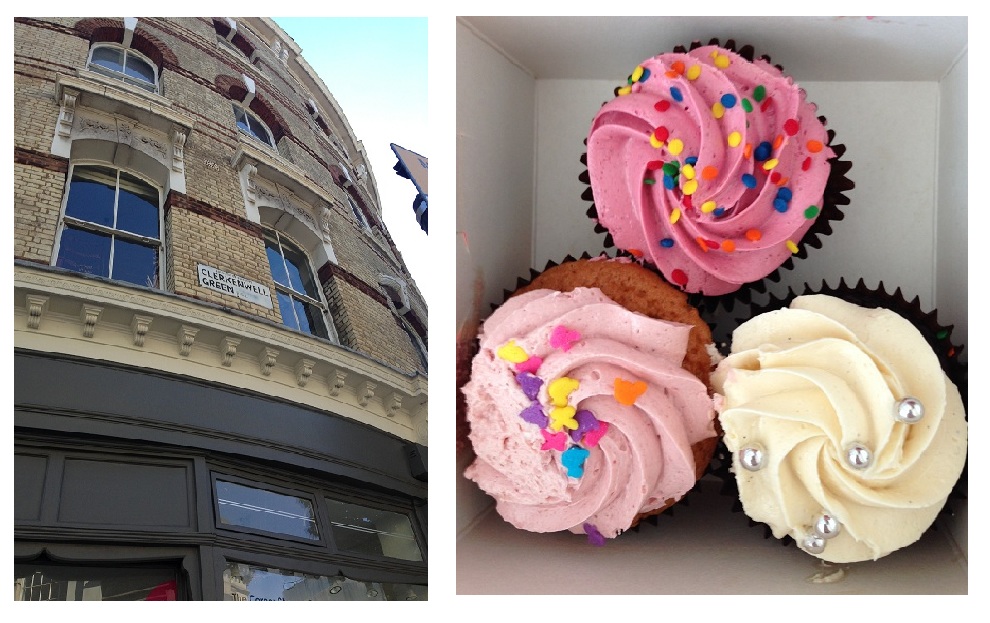
Amy and I have been out on the road again since our last tour of Hampstead Heath, Vauxhall and the West End. This time we took in the sights of Moorgate, Victoria and trendy Clerkenwell with one mission in mind; to see how three more Charity Insights internships were progressing! Okay, with one minor detour for cupcakes at Bea’s of Bloomsbury…


blog pics

We got to catch up with Jay, Rupert and Chun-Yin interning at the British Red Cross, The Passage and Sense about Science respectively. What stood out about these visits was the variety that working in the charity sector can offer. At our visit to the British Red Cross we saw a working environment of being in a large office with a large building dedicated to the charity and hundreds of employees working on different tasks and projects. The Passage and Sense about Science showed us a more intimate office environment with a small team all working together and getting stuck in wherever help was needed. The projects also varied massively from software and IT solutions, policy and report writing, through to graphic design and communication. From speaking to all three students, they really have learnt so much in their time with their charity and have been given the time and flexibility from their supervisors to grow their existing skillset, be it doing Code Academy training or deciphering legal legislation and copyright laws.

Whilst there were differences to these internships, there were also some commonalities. All took on early responsibility, with Jay being put straight into an urgent project with a deadline of two days after his start date. Rupert was also keen to take the lead on his project and set about defining his research and initiating and setting up meetings to speak to important figures in the field. Chun-Yin has already made leaps to complete various infographics and posters on topics including Radiation and Screening; and still has a week to go in his internship! The supervisors of the internships (Andrew, Miranda and Victoria) were also hugely encouraging, passionate about what they do and really cared about their intern’s future development; not only the progress of specific projects they had been tasked with.

This summer really has been amazing so far for Charity Insights and we’ve loved hearing about your internships through your blogs. And there is still more to come; good luck to Anna and Chandrika who are starting their internships in September!

Week four/five: the end

It’s hard to believe that my time at St. Anne’s is over – four weeks has flown by! Over the past week (alongside my usual screening programme) I’ve been involved in several events with St. Anne’s, such as helping to run their service user drop-in session yesterday. It was a chance for people to make suggestions or raise concerns about the services on offer at St. Anne’s, as well as to sample the Krispy Kreme doughnuts on offer! I really enjoyed getting involved with the service users and hearing their opinions on the services they use everyday, and it really highlighted to me how important St. Anne’s is to some of these people. During my project I’ve seen the same faces passing through, whether it’s to get help with benefits, take a class in computer skills or even just to take a shower. I’ve been amazed by the sheer range of services and help available to anyone, all under one roof – and I feel really honoured to have been a (albeit small) part of it.

Anyway, back to my project. I’ve been analysing the data I’ve collected and have prepared a report for the staff at St. Anne’s about ARBD. It consists of the data analysis itself, an information leaflet about ARBD and some advice on the next steps to tackle this little-known condition. I really hope that with the data I’ve collected, St. Anne’s can begin to raise awareness of ARBD amongst their staff and their service users, eventually spreading this knowledge to other relevant organisations. ARBD is a serious condition that makes everyday life extremely difficult for those affected, and these people need to be noticed by clinicians and charity workers, and given appropriate help. My project will hopefully be the first step along this path.

To conclude, I’ve learnt a huge amount during my time at St. Anne’s, from data analysis and report writing skills to dealing with difficult people on a daily basis. It’s been immensely rewarding, challenging and above all fun! Although this is officially the end of my internship with St. Anne’s, I’m hoping to volunteer with them again in the future. They are truly an amazing organisation, and deserve all the help they can get.

Week 2 at the British Red Cross in Portsmouth

Hi Everyone!

So it has been a busy and productive week here! Last Friday after I wote my Blog post I went over our huge, very detailed spreadsheet  with the other intern, also called Chloe! ( As you can imagine this is quite funny and creates a touch of confusion!) We came up with lists of errors in the data collection and searched the data again for evidence for my report.

I have been typing up drafts of my report  this week and have shown it to my Line Manager Rachel who has given me feedback after my first attempt, which has been really helpful. I was glad that I had a good structure to my report sorted and that the information and links currently down were not overlapping the work done by Rachel and Chloe.

Rachel and Chloe are both looking at the different sets of data individually and making very detailed points from our data in their reports. Mine differs as I have to link the 2 data sets together and look at the broad trends, which is very different as it is ingrained in us from GCSE Level upwards  ‘DETAIL MORE DETAIL!! BE ACCURATE, BE EXACT!!’.  So, when I had my initial table of: the areas of disscussion,  areas for improvement as suggested by volunteers, and detailed points from the retention study with percentages/ numbers ,and quick starting point  to expand for report; being told it was great, but too detailed for my report was mindblowing .  You can imagine my inner science geek threw their scientific calculator out of the lab and had a little tantrum.  As someone who is used to writing less on trends (though trends are none the less important!) ,then going into far more detail and refering to exact points on graphs to show outliers, refering to differences between  datapoints , and backing  all my statements up religiously …. This has been a bit of a shock to the system.

All this said, I very pleased that I am learning new ways of doing things and writing this report, I feel, has made me more confident in planning essays and how to put information and data from different sources together. Hopefully useful skills to take in to second year of Imperial and will help me improve my performance in assessment.

The hard work is paying off!!


Infrastructure and I: Part Two – Friendship Established

After a few week break I am back again, with your weekly insight into the future of the UK energy infrastructure! Many of the Green Alliance staff are on holiday, making desk space plentiful, which means I have been able to work my first 40-hour week at an office job ever! Takes a bit of getting used to, but overall sitting at a desk for 8 hours straight is more fun than expected.

1

Just another day at the office… (Sorry I just couldn’t resist!)

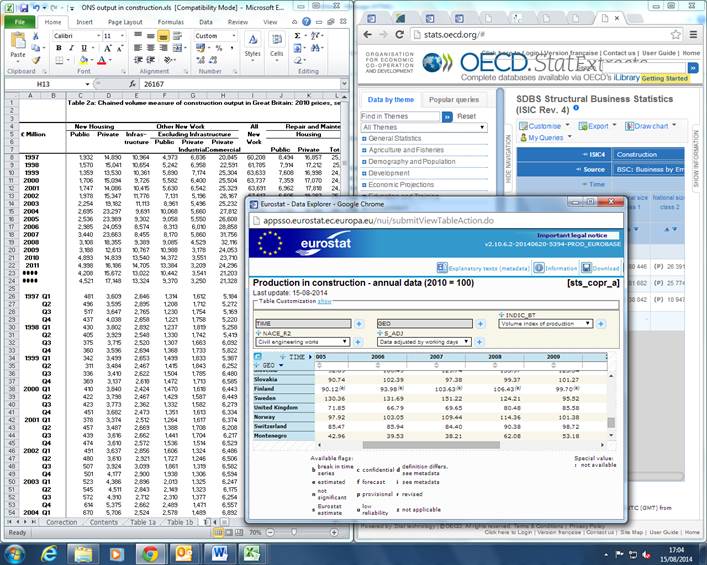
So what have I been doing in my first full-time week? Well, the focus in the past five days has momentarily shifted from dusty data archives to the forward looking analysis of future electricity generation projects. Indeed, I feel like prospective wind farm expenditure is all I know anymore! This is due to the summer revision of the National Infrastructure Pipeline shuffling the project titles around in a peculiar way. The number of projects listed decreased from 646 to some 400, even though the total planned expenditure, the “value” of the pipeline, actually increased. This meant that the missing third of the projects were probably not actually dropped but rather regrouped under headings such as “Various renewables” and “Post-2020 generation”. So I went, googling through 100 odd wind farm projects to figure out if the numbers actually did add up. You would reckon that it is easy to get a credible estimate of the capital expenditure of a multi-billion pound offshore project with its own web site and generous media coverage. Instead it was sometimes impossible to even get a good idea of whether a project was ongoing any more, when a press release or a news flash from 2012 was the latest piece of information available. A comforting fact is that I am not the only one having trouble keeping track of things. Take for example National Grid’s Transmission Entry Capacity register, which still allocated 52.5MW of future capacity to an onshore project a month after it has been shut down by the officials. (Edit: Just today they updated the register, stripping this shred of comfort from me.)

I do not know if I can become any more fluent at googling, but at least I have learned a lot about the renewable energy market. Reading through news archives, government reports, consent applications, financial statements and annual reports really gives you a better understanding of how government subsidies affect the energy market, and the unharnessed potential of new floating offshore wind turbines, to name a few examples. Also, who knew the government had an e-archive dedicated to conserving not only snapshots of official sites from more than ten years ago but also saving tens of thousands of tweets made by official bodies for future generations. This not only made me ponder the historic value of a single tweet but also realise that the informative value of a website drastically decreases if every hyperlink leads to a 404 error.

In addition to wind farm research, I compiled my findings on the different data sources into a yet to be finished Word file. The finishing touch is pending explanations to some discrepancies, which I have chased to the point of emailing the corresponding institutions asking for clarification. Fingers crossed they reply in time!

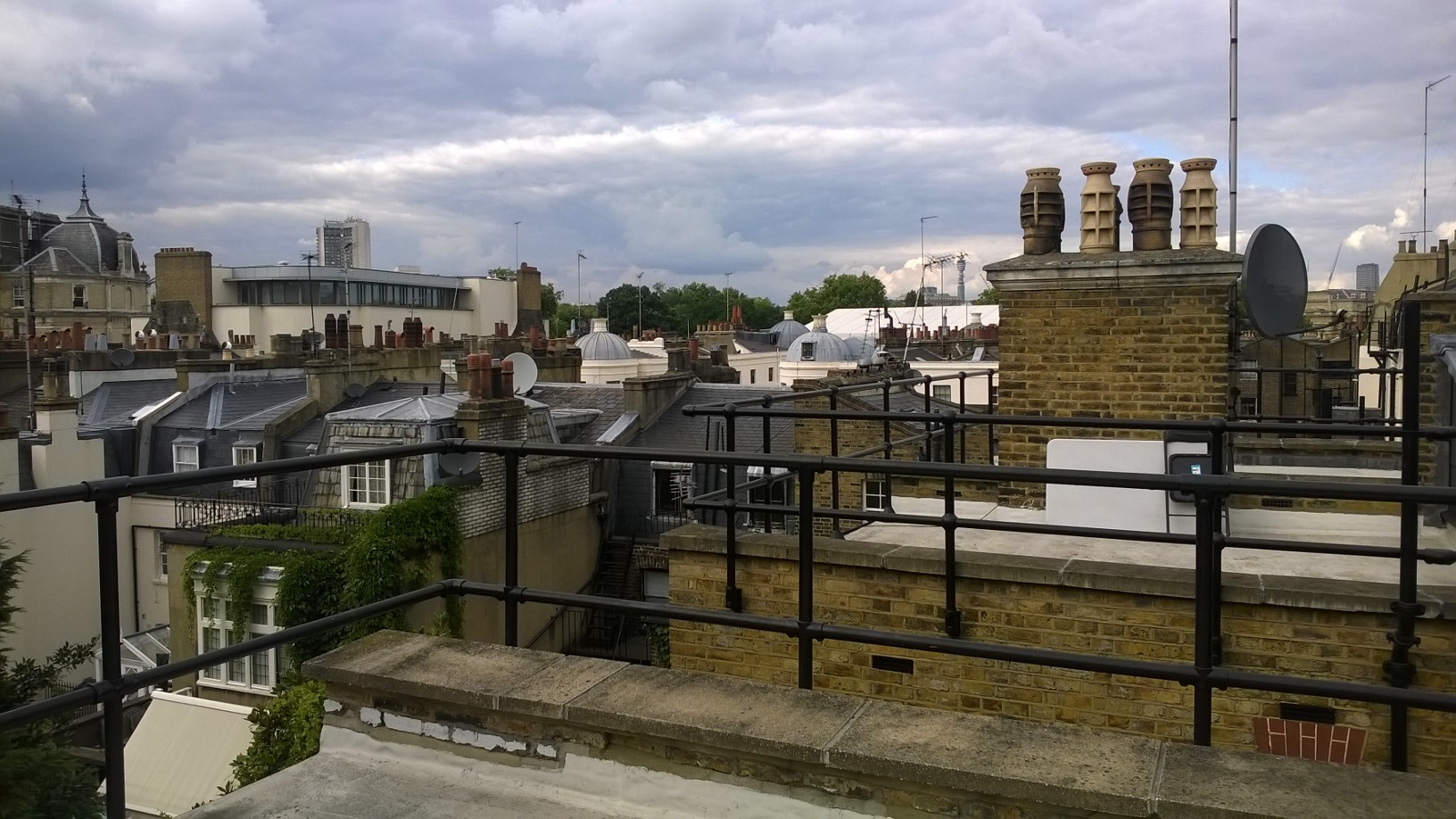
Lunch break with the other interns has provided a nice social aspect to the otherwise solitary nature of my work. And when it comes to lunch venues, nothing beats beanbags and a roof terrace on a sunny day! (Too bad there have not been too many this week…)

WP_20140815_001

Not quite sunny but good enough!

Tune in again next week when I share with you the story of how I got from first hearing about Charity Insights to present time, along with the usual update on my project!

Final Week at The Passage

My last week at The Passage was full of meetings with representatives of the various organisations that I had contacted over the preceding weeks. If nothing else this gave me an excellent opportunity to visit some parts of London that I hadn’t previously been aware of. Fortunately the majority of my meetings were extremely useful and provided a new perspective or some new information.

One issue that I discovered through these interviews was the problem of supported accommodation beds being occupied by EEA nationals who are in fact ready to move on. These residents are covered by the saving section of the new legislation which exempts those who were in receipt of housing benefit before the legislation came in to force. However this saving clause ceases to apply when a client makes a new claim. Moving to a different local authority necessarily involves making a new claim but it is possible to move within a single local authority. For residents in central boroughs such as Westminster private rents are unaffordable so they cannot move on within their local authority and if they moved they would no longer be eligible for housing benefit. Previously people recovering from homelessness would be expected to move from supported accommodation in central London to private accommodation in less central areas due to the lack of affordable accommodation in the centre; this pathway has now been disrupted.

I often found that the people I was interviewing would repeat opinions and stories that I had heard from other workers in the sector. This was encouraging as it indicated that these opinions were not baseless and the issues they reflected were not isolated.  For example the predicament explained above was alluded to both by a commissioner at Westminster City council, the submission of evidence to SSAC by St Mungo’s,  the manager of a housing program and a representatives of several day centres.

As well as providing information for my report the interviews enabled me to develop a number of useful skills, not least of which was budgeting my time carefully where the London Underground was involved. I learnt the necessity of having questions prepared; a practise that became easier as time wore on since I found that the certain questions were getting useful responses while others were simply too general and could lead to a long talk that was not eventually relevant to my report. Keeping a meeting on focus was therefore another ability that naturally became useful. Finally and perhaps trivially I got a great deal of practise at taking just the right amount of notes; that is, enough that I retain the relevant information but not so much that the interviewee thinks I am recording him verbatim, in which case he may become reticent.